
Ornamental Fencing in Southbury, CT: Style That Fits the House
By Tony Pellicone22 min readPublished
- ornamental fencing
- southbury ct
- aluminum fencing
- connecticut
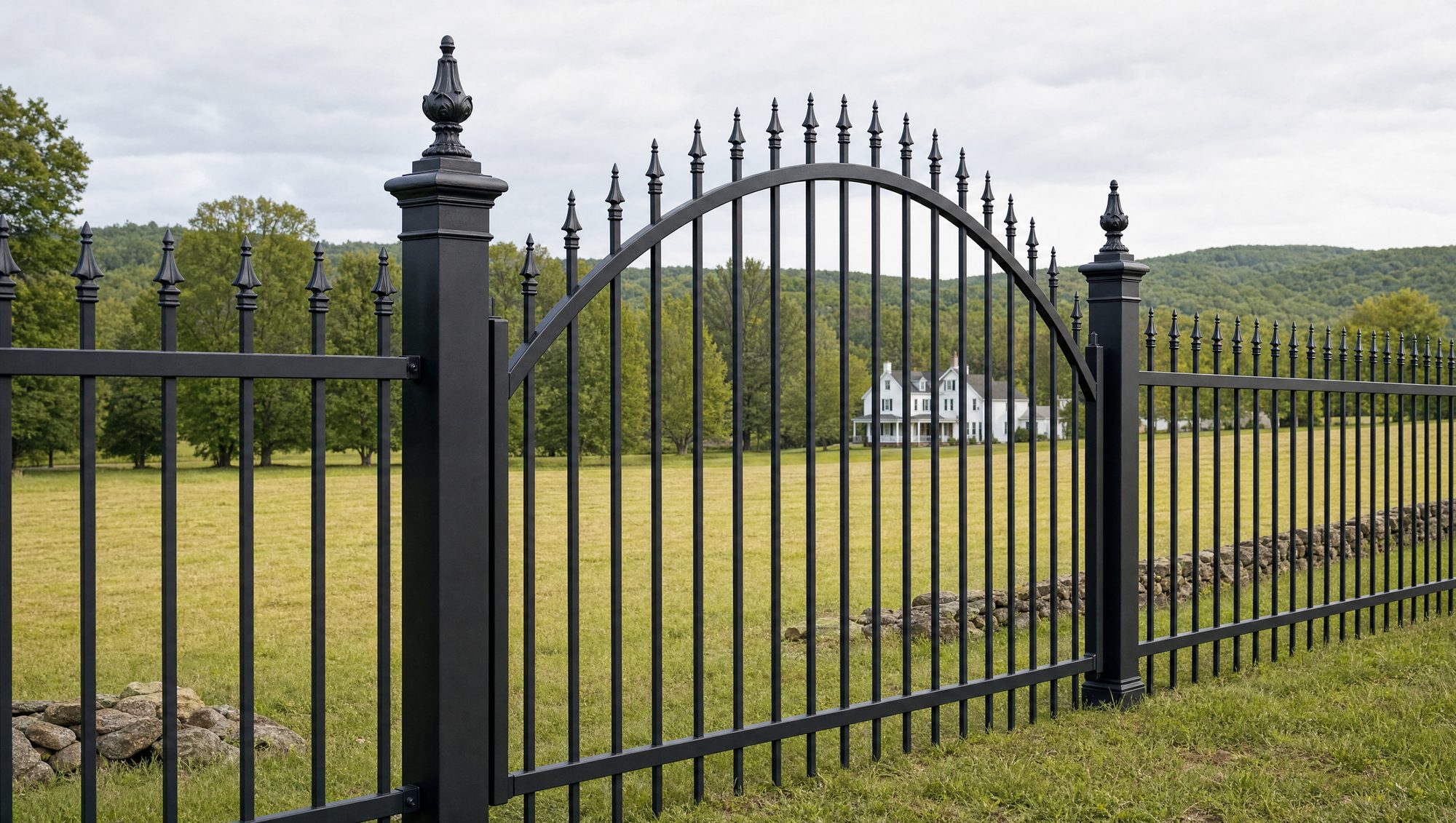
You have already settled the big question. The fence will be open metal, it will probably be black, and you will still be able to see your own yard through it. Then the sample photos come out, and every single one of them looks fine. A spear top with finials looks right. A flat top looks right. Scrollwork looks right, until you try to hold it up against your own house and cannot tell whether it reads as a period detail or as a catalog panel bolted onto a colonial. That is the part of ornamental fencing Southbury CT homeowners actually get stuck on, and it is not a materials problem. Nobody hands you the vocabulary for what you are choosing. Picket profile, spacing, rail count, the top treatment, finials, scrolls, post caps, and height are all design decisions, and each one quietly drags a practical consequence behind it. Learn to name them and the whole conversation with a contractor changes.
Key Takeaways
Ornamental is a style, not a product
The word describes an open, decorative fence of posts, rails, and pickets, and says nothing on its own about what it is made of or how it is built.
The top treatment is the loudest choice
Flat top, spear top, and alternating spears set the character of the whole run, and points are the detail most often ruled out by a pool, a road, or a climbing child.
Spacing is a look and a function at once
The gap between pickets sets the visual weight of the line and decides whether a small dog stays in the yard.
Details belong where the eye already stops
Arches, scallops, scrolls, and heavier post caps read as deliberate at an entrance and fussy across an entire perimeter.
Southbury reviews fences property by property
The town takes building and zoning applications online, and a pool barrier carries its own requirements regardless of height, so confirm current requirements before design becomes an order.
What Does "Ornamental" Actually Mean on a Fence Estimate?
Ornamental is one of those words that sounds like a specification and functions like a mood. On an estimate it means an open fence of vertical pickets held between horizontal rails on posts, with the decorative work concentrated at the tops, at the posts, and sometimes in the panel itself. That is the whole definition. It tells you nothing about the metal, the wall thickness, or the coating, which is why two bids using the same word can describe genuinely different fences. Those construction questions belong to the aluminum fencing conversation. What follows here is the other half: the look.
The Word Describes a Style, Not a Metal
"Wrought iron fence Southbury" is a phrase people use to mean a black metal fence with a traditional profile. True wrought iron is a specific low-carbon forged material, and it is uncommon in modern residential fence systems. Nearly everything sold in that visual style today is ornamental aluminum or ornamental steel, each with its own standard behind it, ASTM F2957 for coated tubular-picket aluminum systems and ASTM F2408 for ornamental steel. None of that changes the design brief. It just means that when you say wrought iron, a good contractor should hear "traditional black profile" and then ask you which one.
The Six Parts You Are Actually Choosing
Strip the marketing away and an ornamental fence is six decisions: the picket and its spacing, the rails, the top treatment, the applied details, the posts and their caps, and the height. Every sample photo you have been shown is one combination of those six. Once you can name them separately, you can mix them deliberately instead of picking a picture and hoping.
Which Picket Profile and Spacing Suit Your Property?
The pickets are the fence. They are most of what you see from the road, and they are the decision people skip straight past on their way to arguing about finials. Profile and spacing together set the visual weight of the line: how solid it reads, how much it disappears against trees, how much it announces itself against a house. Get this pair right and the rest of the details have something to sit on.
Profile Sets How Heavy the Line Reads
Ornamental pickets are typically square tubular sections, and the size of that section changes the character of the run. A slimmer picket reads light and formal and tends to vanish against a wooded edge, which is often the point on a boundary that should be defined rather than displayed. A heavier picket reads substantial and holds its own next to stone, brick, or a house with real mass. Neither is better. The mistake is choosing by price and finding that a delicate line looks underfed against a large facade, or that a heavy line looks industrial around a modest garden.
Spacing Is a Design Rhythm and a Gap at the Same Time
Wider spacing reads open and airy and lets the yard show through, while tighter spacing reads more formal and more contained. That is the design half. The functional half is that the same gap decides whether a small dog can put his head through and follow it with the rest of himself. If pet containment is any part of the reason for this fence, spacing is a product-level decision made at design time, not a problem to solve later. Puppy-picket panels, which tighten the spacing in the lower portion only, exist precisely because so many people made this call by eye and regretted it.
Rail Count Changes the Proportion
Two-rail and three-rail systems look different from thirty feet away. A third rail adds a horizontal line, which generally suits taller fences and reads more formal, while two rails leave more open field between the pickets. Rail count relates to height and to the structural design of the system, so it is not purely cosmetic. Ask to see the same style in both before you decide.
What Should Happen at the Top of the Fence?
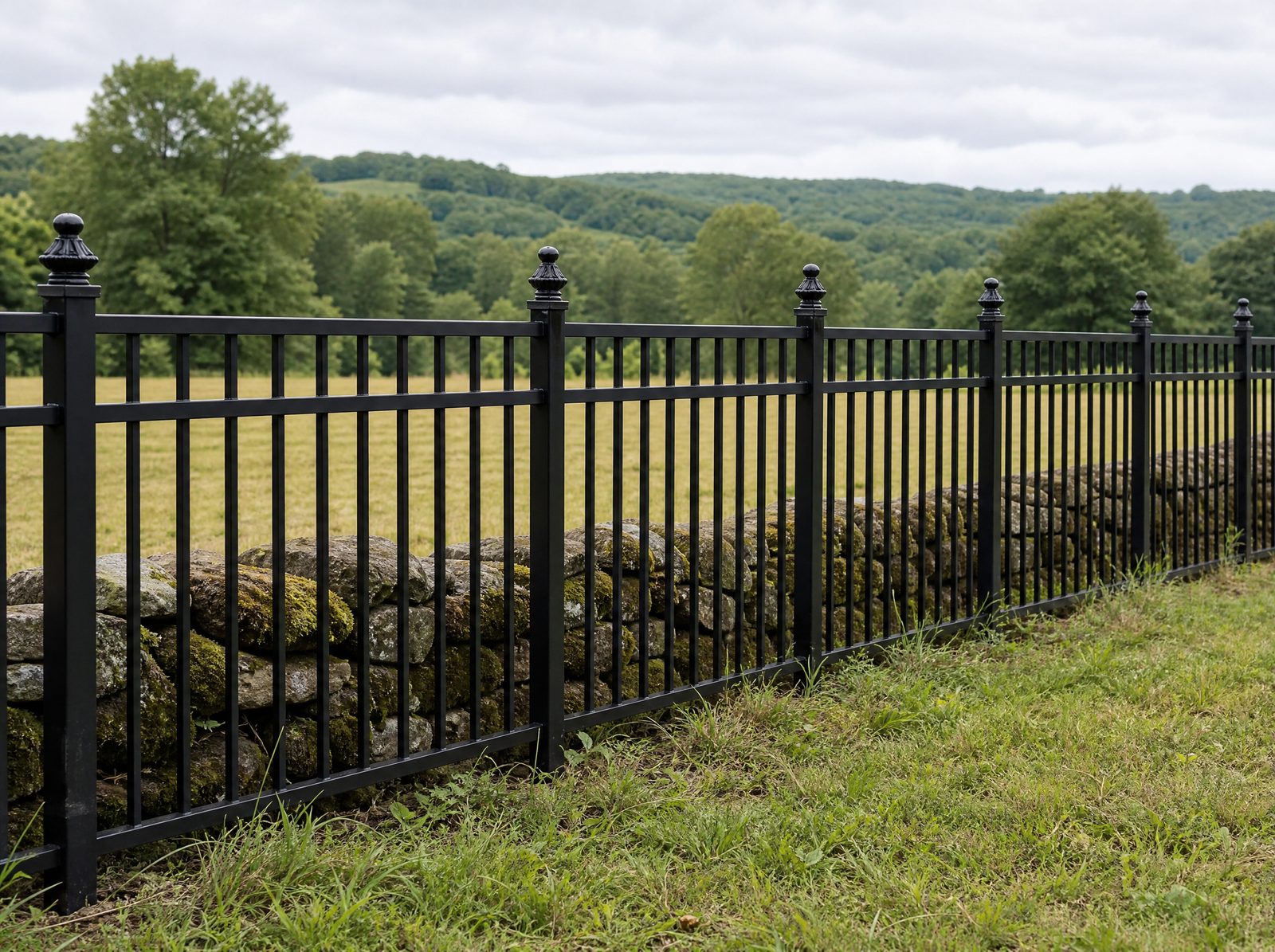
The top treatment is the loudest thing about an ornamental fence. It is the line your eye follows across the property, and it is what people mean when they say a fence looks traditional or looks modern. It is also the choice most likely to be overruled by something practical, which is worth knowing before you fall in love with a picture.
Flat Top Is the Quiet Choice
A flat top ends the pickets at or near the top rail and gives you a clean horizontal line across the run. It is understated, it suits contemporary homes and simple facades, and it tends to be the default around pools and pet yards for reasons that have nothing to do with taste. If your house already has plenty of visual detail, a flat top lets the house do the talking. It is rarely the choice people are excited about at the showroom and frequently the one they are happy with in year five.
Spear Top and Finials Are Traditional, With Conditions
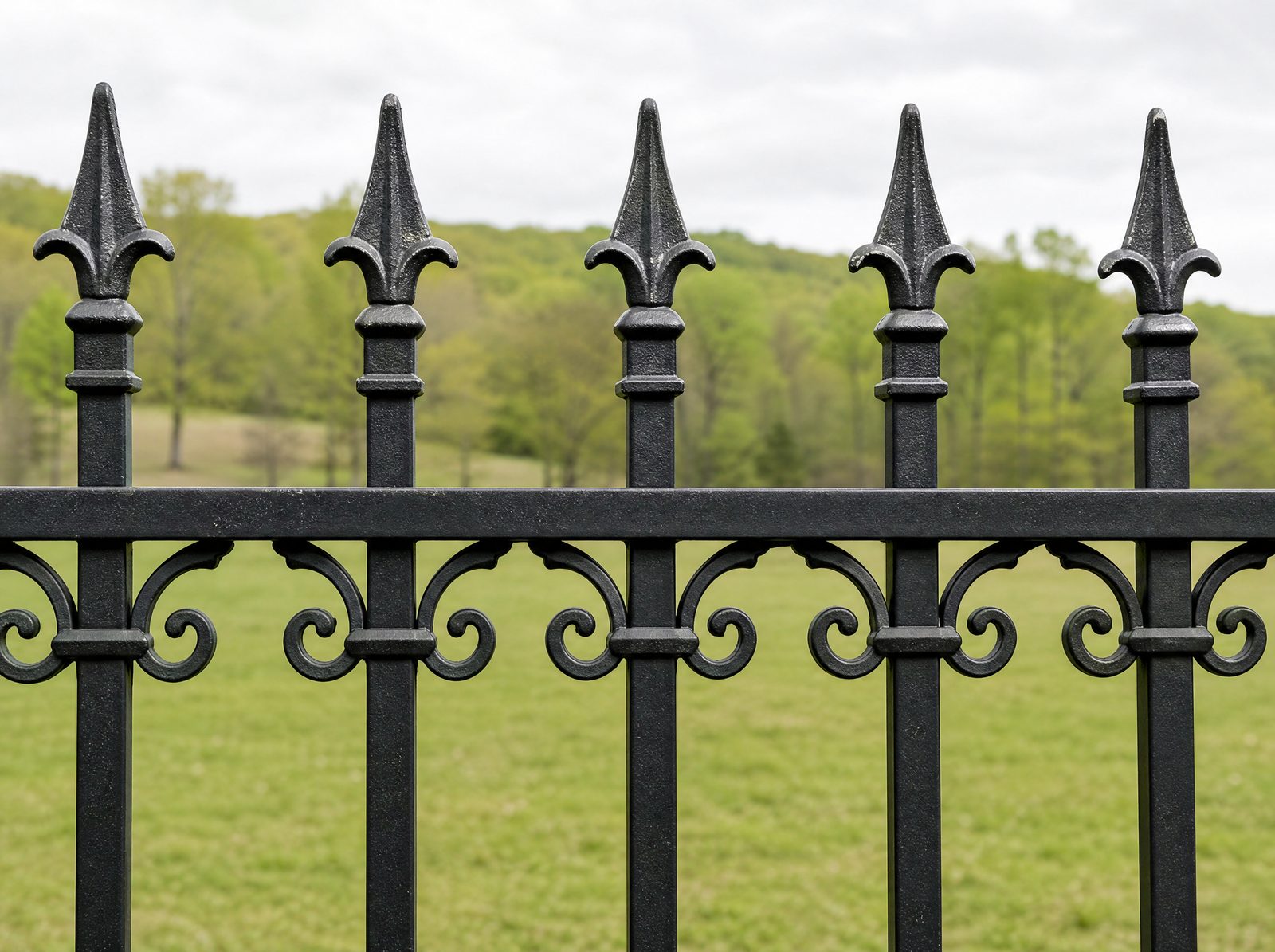
Spear-top pickets run above the top rail and end in a point or a decorative finial, and this is the look most people picture when they say wrought iron. It is genuinely handsome on the right house, but the conditions attach fast. Points near a pool enclosure, near a play area, or along a run children will treat as a climbing frame are a design question with a safety answer, and the applicable Connecticut residential code evaluates a pool barrier as a complete system including its non-climbable characteristics. Location decides whether points belong there at all, lot by lot rather than style by style. Plenty of properties end up with spears along the front and a flat top around the pool, which is not a compromise so much as a correct answer.
Alternating Spears Change the Rhythm
An alternating spear top runs every other picket above the rail rather than all of them. The result is less dense, a little less formal, and noticeably less repetitive across a long run. It is a good middle option that most homeowners never get shown, and it is worth asking for by name.
Do Scrolls, Rings, and Arches Belong on Your House?
Here is where a decorative fence Southbury owners are proud of separates from one they quietly stop noticing. Applied ornament, scrollwork, rings, finials, arched and scalloped sections, and heavier post caps, is the strongest flavor available to you, and it works best in small, deliberate doses. Ornament placed where the eye already stops reads as intentional. The same ornament repeated across two hundred feet of side yard reads as a pattern, and patterns get tuned out.
Scrollwork and Rings Read as Deliberate or Fussy
A band of rings or a scroll detail can be lovely, and it can also be the thing that dates the fence faster than anything else on it. The reliable test is whether the detail has a reason to be at that spot: an entrance, a gate, a short feature run facing the street, the panel that frames a garden. If it comes on every panel because the whole line was ordered that way, that is decoration by default rather than by design. Restraint is not the cheap option here, it is usually the better-looking one.
Arches and Scallops Belong at an Entrance
Arched panels rise between posts and scalloped panels dip, and both are built to mark something: an entrance, a gate, a transition from the drive to the garden. Used there, they tell a visitor where to go without a sign. Run around a perimeter, they turn into visual noise, and they add cost and lead time doing it. If you want one dramatic gesture on this project, an arched estate or driveway gate is usually the one that earns its keep.
Post Caps and Columns Set the Cadence
Posts are the fence's punctuation, and the caps on them are a design lever that costs relatively little. A flat cap keeps the line quiet, a ball or a finial cap adds formality, and heavier caps at corners and gates make the layout read as composed rather than continuous. Masonry columns at an entrance take this further and change the project meaningfully, since they involve their own construction and may attract their own review. If columns are anywhere in your imagination, raise them at the first walk, not after the panels are ordered.
How Do You Match a Fence to a Southbury House?
This is the question underneath all the others, and it does not have a chart. Southbury properties run from older colonials and Capes to farmhouses to contemporary and newer builds, and each of them is already making an argument that the fence either supports or fights. The useful move is to stop asking what looks nice and start asking what the house is already doing, then let the fence agree with it.
An older colonial or Cape tends to carry symmetry, modest scale, and simple detailing, so a slim to moderate picket, a traditional top, and restrained ornament at the entrance usually reads as though it has been there a while. Heavy scrollwork on a modest Cape is the classic over-decoration mistake, and the one that looks tired fastest. A farmhouse or a rural lot with open field and stone walls generally wants less fence, not more: a lower, simpler run that defines the yard without competing with the setting. A contemporary or newer home reads best with a flat top and clean spacing, where the fence acts as a horizontal line rather than a piece of period costume. And if your house sits behind mature trees, black ornamental fencing largely disappears against a wooded background, which is either exactly what you want or an argument for a heavier picket that still registers.
Whatever the fence does, it should have a conversation with the porch railing, the gate hardware, and any railings already on the property. A fence that matches nothing else on the house is the definition of a catalog panel, no matter how nice the panel is.
Where Does Ornamental Fit a Property, and Where Does It Not?
An open picket fence is the wrong answer to a surprising number of problems, and a contractor worth hiring will tell you so rather than sell you the whole perimeter. Ornamental earns its place where seeing through the fence is the point: a front boundary, a garden, a pool enclosure where visibility into the area matters, a pet yard, a driveway entrance, or a commercial frontage where appearance and a clear edge both count.
It is the wrong tool where privacy is the actual goal. You cannot make an open fence private by tightening the pickets, you can only make it look confused and cost more. Screening a road, blocking a sight line into a patio, or cutting wind calls for vinyl or wood instead, and containing livestock is its own discipline. Most properties do not need one fence type everywhere: ornamental across the front where it is seen, something solid where privacy is wanted, is a common and sensible plan, and it is a design decision you get to make on purpose.
How Do Style Choices Run Into Height and Town Rules?
Every design decision above eventually meets a rulebook, and height is where they collide hardest. Height is not only a number for containment. It changes the proportion of the run, whether the top treatment is even visible from the house, and how the fence sits against the facade. It is also the dimension most likely to be regulated, which is why it should be settled early rather than discovered late.
Southbury takes building and zoning applications through its online permitting system, and the Zoning Department administers land-use applications and regulation compliance. The town reviews fences against the specific property rather than applying one blanket answer, and its zoning regulations are going through a full update, so an older dimensional number found online is not something to design around. Confirm the current requirements with the town for your lot and design before anything is ordered. Height in a front yard, placement near a road, sight lines, easements, inland wetlands, aquifer protection areas, masonry columns, and private or association restrictions can all apply to a design that looks perfectly innocent on paper.
Two of those overrule style directly. Sight lines at a driveway or corner can limit height and openness exactly where a homeowner most wants a statement, and that is a safety judgment rather than a taste one. And a fence used as a pool barrier requires a permit regardless of height, with the finished system judged as a whole for height, openings, bottom clearance, gate swing, self-closing hinges, self-latching hardware, and climbability. Design the enclosure to the rules first, then make it attractive within them, because the reverse order is how a beautiful fence fails an inspection.
What Does a Decorative Fence Cost in Southbury?
There is no honest single figure for ornamental fence cost Southbury properties can rely on, and any number quoted before someone has seen your yard is a guess in a nice font. Published guides such as Angi's fence cost breakdown are general market context only, not a price for your lot. What is useful is knowing which of your design decisions are the expensive ones, because that is the part you control.
Footage and height set the baseline, and after that it is largely the details you have just been choosing. Picket profile and spacing change the parts count, rail count adds material across every panel, and applied ornament adds cost per panel and can add lead time. Arched and scalloped sections are custom work. Gates carry the most per unit, since walk, double, and driveway gates each need their own posts, footings, and hardware, with pool-compliant hardware adding another layer. Then the property adds its own line items: slopes, ledge, roots, wet ground, restricted access, brush clearing, removing an old fence, and any permits. The practical takeaway is that concentrating your ornament where it shows, and keeping the long side runs simple, is usually both the better design and the cheaper one.
Hover or tap a row to highlight it.
| Cost Driver | Why It Matters |
|---|---|
| Footage and height | The baseline for every run, and height is regulated as well as priced. |
| Picket profile and spacing | Section size and the number of pickets per panel change the parts count. |
| Rail count | A third rail adds material across every panel in the run. |
| Finials, rings, and scrollwork | Applied ornament adds cost per panel and can add lead time. |
| Arched and scalloped sections | Custom top lines are custom work, priced and scheduled that way. |
| Gates | Walk, double, and driveway gates each need their own posts, footings, and hardware, with pool-compliant hardware on top. |
| Custom colors and made-to-order panels | Anything off the standard run stretches the schedule as well as the number. |
| Masonry columns | Entrance columns are their own construction and may attract their own review. |
| Site conditions | Slopes, ledge, roots, wet ground, access, brush clearing, and old-fence removal are the property's own line items. |
How Does an Ornamental Fence Installation Come Together?
A good ornamental fence installation Southbury crews run starts with the design conversation and the property review, not with a product number. The order matters, because every step constrains the one after it, and a decision made out of sequence is the one that gets expensive. Knowing the sequence also helps you hear when a bid has skipped a step it should not have.
It starts by settling what the fence is for and what it should look like, since a pool enclosure, a pet yard, a garden edge, and a decorative front boundary are different projects that can share a style. From there it moves to the property itself, the boundary, the grade, the ledge, the trees, and what the town requires for that specific lot. A fence should never be placed off a mowing line, a hedge, or an old stone wall, because none of those is the legal boundary and only a licensed surveyor establishes that. Then the design is committed to writing, the utilities are marked, and only then does anyone dig. Connecticut's Call Before You Dig service is reached at 811 and comes before the first post hole, and privately owned lines such as septic, irrigation, and pet-fence wire are often not covered by public marking, so the contract should say who handles them.
The Southbury Ornamental Fence Design and Install Process
- 1
Step 1: Purpose and Design Walk
We walk the property and settle what the fence is for and what it should look like against your house, since a pool enclosure, a pet yard, a garden edge, and a front boundary are different projects.
- 2
Step 2: Property and Town Review
We check the boundary, grade, ledge, trees, easements, and wetlands, and confirm what Southbury requires for your specific lot and design.
- 3
Step 3: Style Selection on Paper
Picket profile and spacing, rail count, top treatment, ornament placement, post caps, gates, and height are all chosen and written down, not defaulted.
- 4
Step 4: Written Scope and Order
The estimate documents the product line, dimensions, gates and hardware, finish, removal, permits, timeline, and how hidden conditions get priced.
- 5
Step 5: Utility Marking and Layout
A Call Before You Dig request goes in at 811, private lines like septic, irrigation, and pet-fence wire are identified, and the run is laid out on the ground.
- 6
Step 6: Posts, Panels, Gates, and Walkthrough
Posts are set for the soil and the gate loads, panels rack or step to the grade, gates are hung and adjusted, and we walk the finished line with you.
What Should You Ask an Ornamental Fence Contractor?
Connecticut requires home improvement contractors to register with the Department of Consumer Protection, so registration and insurance are the floor rather than a selling point. The state's guidance for consumers is worth reading before you hire, and you can verify a license in about two minutes. My Fence Guy is a family-owned contractor with a local office right here in Southbury, licensed and insured, and we give free estimates. The ornamental fence contractor Southbury owners actually want, though, is the one who asks about the house before quoting the fence. The design questions are the ones bids leave out, so ask them directly:
- Which top treatment do you recommend for this house, and why: A real answer references your facade, your pool, your road, and your children, not a catalog.
- What picket profile and spacing are in this price: Both should be written down, and both should have been chosen rather than defaulted.
- Where would you put the ornament, and where would you leave it off: A contractor who wants finials on every panel is selling panels.
- Can I see this exact style at this exact height: A style that works at one height can look wrong at another, and custom sections carry lead times that belong in the plan.
- What did you assume about height and placement: Confirm it against the town's requirements for your lot before the order goes in.
- What is in writing: Product line, height, footage, picket and rail details, gates and hardware, finish, removal, permits, utility responsibility, cleanup, timeline, payments, warranty, and how hidden conditions get priced.
Frequently Asked Questions About ornamental fencing southbury ct
Q: Is ornamental fencing the same as wrought iron?
A: Not usually. True wrought iron is a specific forged material and is uncommon in modern residential fence systems, while most fences described casually as wrought iron are ornamental aluminum or steel built to create a similar traditional appearance. You are almost always describing a style rather than a metal.
Q: What is the difference between a flat-top and a spear-top ornamental fence?
A: A flat top ends the pickets at the top rail for a clean horizontal line, while a spear top runs pickets above the rail, often with finials, for a traditional look. Beyond appearance, points have to be evaluated for the location, including pool enclosures, play areas, and anywhere the fence could be climbed.
Q: Does ornamental fencing require a permit in Southbury?
A: It depends on the property and the design. Southbury takes building and zoning applications through its online permitting system and reviews fences against the specific site, and a fence used as a pool barrier requires a permit regardless of height. Since the zoning regulations are being updated, confirm the current requirements with the town before ordering anything.
Q: Do finials and scrollwork make a fence look dated?
A: They can, when they are applied everywhere by default. Ornament tends to read as deliberate at entrances, gates, and short feature runs where the eye already stops, and as fussy when it repeats across a whole perimeter. Match the amount of detail to what the house is already doing.
Q: Can ornamental fencing give me privacy?
A: No, and tightening the picket spacing will not get you there. Ornamental fencing is designed to be seen through, so privacy, road screening, and wind blocking call for a solid fence such as vinyl or wood. Many properties use ornamental across the front where it is seen and something solid where privacy is wanted.
Q: What ornamental style suits an older Connecticut colonial?
A: Colonials and Capes generally carry symmetry, modest scale, and simple detailing, so a slim to moderate picket, a traditional top treatment, and restrained ornament near the entrance tend to suit them. The common mistake is over-decorating a modest house with heavy scrollwork that competes with it.
Q: How does ornamental fencing in Southbury Connecticut handle a slope?
A: Rackable panels follow moderate grades by letting the rails angle while the pickets stay vertical, and stepped sections hold each panel level and drop it down steeper hills. The method affects bottom gaps, pet containment, and how the top line reads across the yard, so it belongs in the design conversation.
Test Your Ornamental Fence Design Knowledge
1. What does the word "ornamental" tell you about a fence on an estimate?
2. Which fence detail most often gets ruled out by a pool, a road, or a climbing child?
3. Besides how it looks, what does picket spacing decide?
4. Is every ornamental fence in Southbury exempt from town review?
5. Where does applied ornament like scrollwork read as deliberate rather than fussy?
Pick an answer to begin.
Final Thoughts
Ornamental fencing is a design category, and almost every choice inside it is a style decision with a practical string attached. Picket profile and spacing set the weight of the line and decide whether a small dog stays home. The top treatment sets the character and gets overruled by pools, roads, and climbing children. Scrolls, arches, and heavier caps earn their place at entrances and lose it across a perimeter. Height is both proportion and rulebook. And matching all of it to what your house is already doing is what separates a fence that looks like it belongs from one that looks ordered.
Settle those in the right order and the payoff is quiet and long. The fence stops being a thing you notice and becomes part of the property, framing the yard, holding the line at the road, and looking as deliberate in ten years as it did the week it went up.
If you are planning ornamental fencing in Southbury CT, we would be glad to walk the property with you and talk through what actually suits the house before anyone quotes a panel. My Fence Guy is a family-owned contractor with a local office right here in Southbury, CT, and we install residential, commercial, industrial, and agricultural fencing in wood, vinyl, aluminum, chain link, and ornamental styles, plus pool fencing, pet fencing, estate gates, and railings across Connecticut and New York. We handle the design conversation, the layout, the permit and utility questions, and the details that decide how the finished line reads from the road. Call us at (203) 746-1100 for a free estimate, or reach out through our contact page.
Ornamental Fence Design Terms
Tap a term to see what it means.
Ornamental Fencing. A design category rather than a material: an open fence of vertical pickets held between horizontal rails on posts, with the decoration concentrated at the tops, the posts, and sometimes the panel.
More about fences
Aluminum Fencing in Southbury, CT: Iron Look, No Rust
Aluminum fencing in Southbury, CT: residential, commercial, and industrial grade are not marketing words. Wall thickness, gates, and racking on a slope.
Read the guide to Aluminum Fencing in Southbury, CTRailings in Southbury, CT: Guards, Handrails, and Safety
Thirty inches off the ground is where a railing stops being optional in Southbury, CT. Guard height, baluster spacing, and how the attachment gets built.
Read the guide to Railings in Southbury, CTOrnamental Fencing in Sherman, CT: Choosing the Right Style
Ornamental fencing in Sherman, CT should look like it came with the house. How profile, finial, spacing, and height read against a colonial or a farmhouse.
Read the guide to Ornamental Fencing in Sherman, CT