
Railings in Southbury, CT: Guards, Handrails, and Safety
By Tony Pellicone21 min readPublished
- railings
- southbury ct
- aluminum fencing
- connecticut
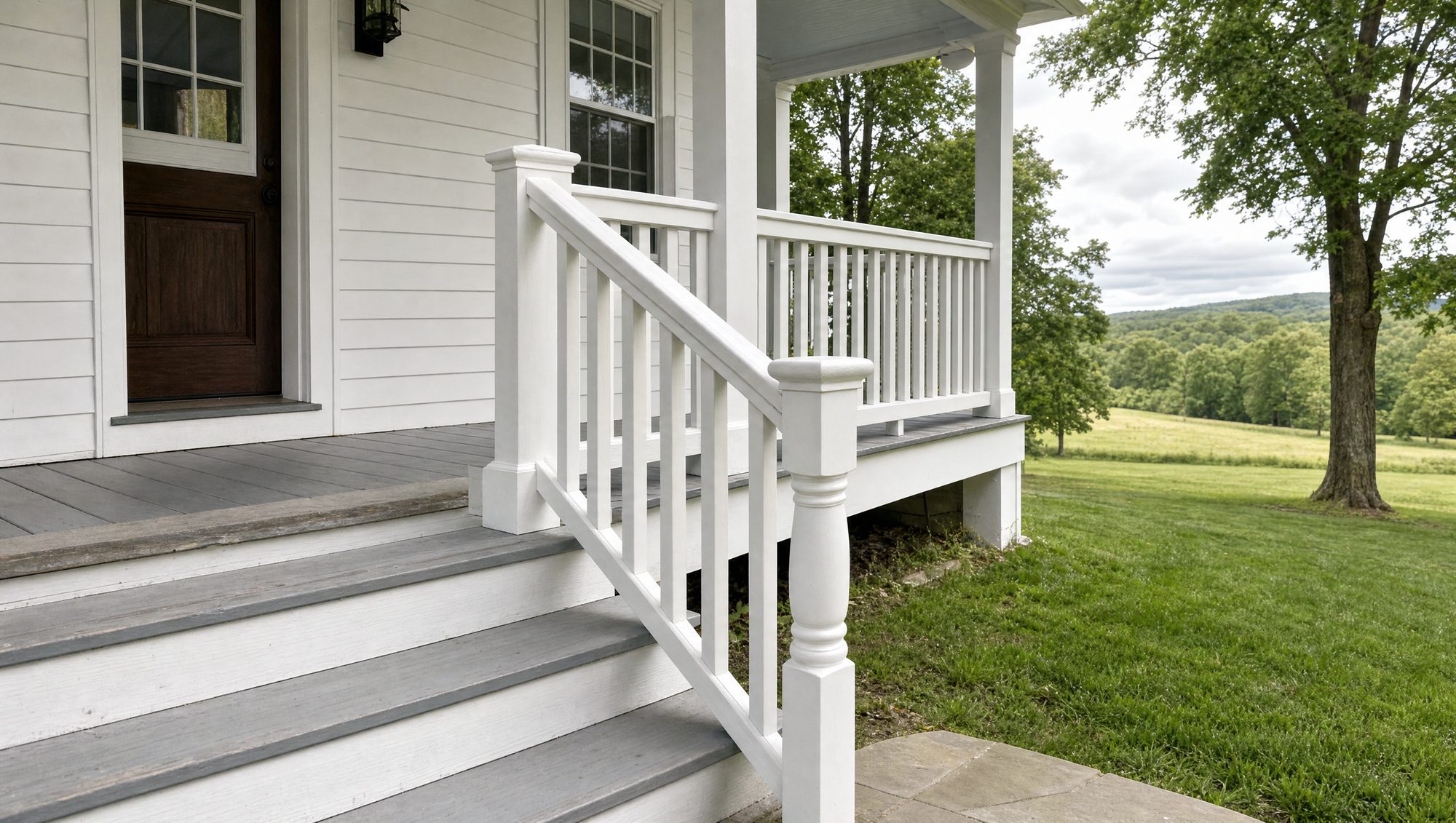
Something usually changes before anyone really looks at a railing. A parent is coming to stay and the stairs suddenly look steeper than they used to, or the post by the front steps turns in place, or the top rail on the deck rocks a little under a lean. However it starts, it lands the same way: the one thing in your yard whose entire job is to stop a fall is the thing that feels loose.
Here is what makes railings different from almost everything else we install. A fence that leans is an annoyance. A guard that lets go is an injury. That raises the stakes on every decision, from the height of the rail to the fastener behind the post, and it means the rules are not suggestions. Railings in Southbury CT are governed by the Connecticut State Building Code, and the town reviews work property by property. This is what you should understand before you pick a style, and definitely before someone bolts a new rail onto an old deck.
Key Takeaways
A guard and a handrail are not the same
A guard stops a fall from an elevated surface, while a handrail is the graspable rail you hold on stairs. One stair assembly often needs both.
The attachment fails, not the rail
Posts fastened only to deck boards, rot behind a post base, or a loose masonry anchor are what give way, so the structure gets checked before anything new goes on.
The code sets real numbers
Guard height, opening size, handrail height, graspability, continuity, and returns all carry requirements, and they are worth confirming with the town for your project.
Material decides upkeep, not safety
Aluminum, steel, wood, vinyl, composite, cable, and glass trade maintenance, appearance, and exposure risk differently, but all still depend on the framing behind them.
Permits here are project-specific
New or structurally altered deck, porch, stair, and balcony work may require a building permit and inspection, and Southbury takes applications online.
Is It a Guard or a Handrail?
Most people use one word, railing, for two different safety devices. The distinction is not pedantry. It changes what the code asks for and what the thing has to do when it matters.
A guard is a protective barrier along an elevated walking surface: a deck, a porch, a landing, a balcony, or the open side of a stair. Its job is to keep a person from going over the edge. A handrail is a graspable rail you hold for support while walking up or down stairs or a ramp. Its job is to be there when your foot slips, and to fit your hand well enough that you can actually close your fingers around it and stop yourself.
A single stair can need both at once. It needs a guard because the open side is elevated. It needs a handrail because the flight has enough risers to require one. Some coordinated systems perform both functions when the code and the product design allow it, but that is something to verify, not assume. The trap is a wide decorative top rail that looks like a railing and works fine as a guard cap, yet gives your hand nothing to grab. It fails the job you would need it for on an icy morning.
What Does the Connecticut Code Ask of a Railing?
Railing requirements in Southbury come from the Connecticut State Building Code in effect for your permit application. The 2022 Connecticut State Building Code is based on the 2021 International Codes with Connecticut amendments. Because the exact requirement depends on the project type, the code edition, the existing conditions, and local interpretation, treat everything below as the general picture and confirm the current requirements with the town before you order a system. Connecticut's state building code page is the state-level starting point, and the residential building planning chapter is where the residential railing rules live.
Where a Guard Is Required
Residential guards are generally required along open-sided walking surfaces more than 30 inches above the floor or grade below, measured under the applicable code rules. That single figure catches more Southbury properties than people expect. A deck that steps down a sloped lot can sit low at one end and well above that mark at the other, and the whole open edge is what gets evaluated.
How High a Guard Sits and How Big the Gaps Can Be
Residential guards at decks, porches, balconies, and landings are generally required to be at least 36 inches high. Stair-side guard requirements can differ. As for the infill, guard openings are generally limited so a 4-inch-diameter sphere cannot pass through, with specific exceptions for stairs and triangular openings. This is the rule that quietly disqualifies a lot of decorative ideas, and it is also the reason a design that reads beautifully in a catalog photo can be a problem in a house with small children.
When Stairs Need a Handrail
The Connecticut residential code states that handrails are required on at least one side of each stair flight with four or more risers. Count the risers, not the steps you think you see. A short set of front steps can cross that line easily.
Height, Grip, and Where the Handrail Ends
Residential stair handrails are generally installed 34 to 38 inches above the stair nosings. Beyond height, handrails must provide a graspable profile, and both circular and non-circular profiles have dimensional requirements. Handrails also generally need to be continuous through a flight and return to a wall, guard, or walking surface, or terminate in an approved manner. Returns are not decoration. An open-ended rail is what catches a sleeve or a bag strap and pulls someone down the stairs.
Commercial Work Is a Different Conversation
Commercial, multifamily, public, and certain residential alterations can trigger accessibility requirements well beyond typical one- and two-family rules: ramp handrails, extensions, gripping surfaces, clearances, continuity, edge protection, and landing details. The 2022 Connecticut State Building Code references the ICC A117.1 accessibility standard. Do not carry residential stair details onto a commercial or public project and assume they transfer.
What Is Your Deck Railing Actually Bolted To?
This is the question that matters most, and the one almost nobody asks. A deck guard has to resist real loads and transfer them into the deck framing. The posts and rails you can see are only part of the system. The part that decides whether it holds is the part you cannot see.
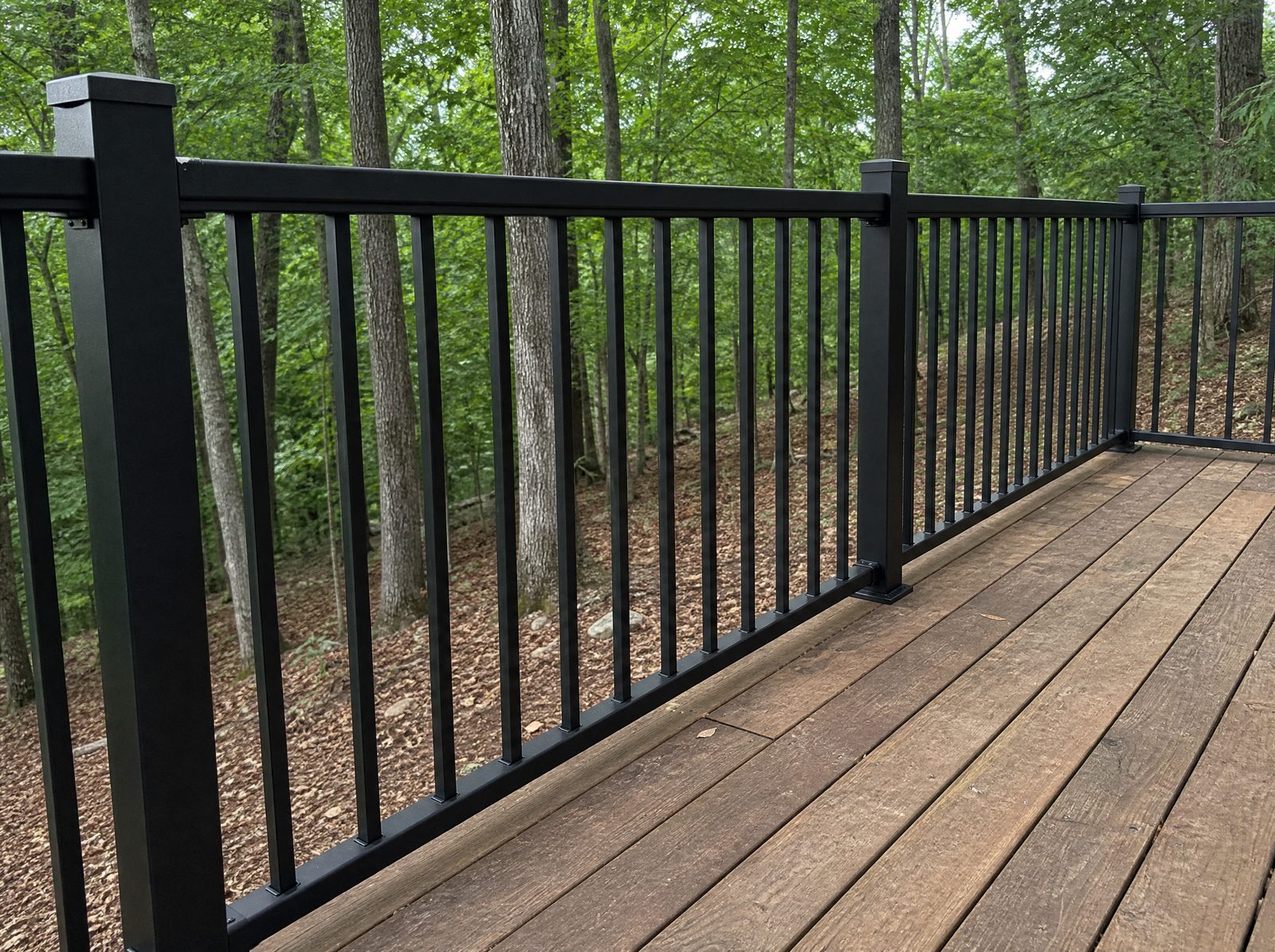
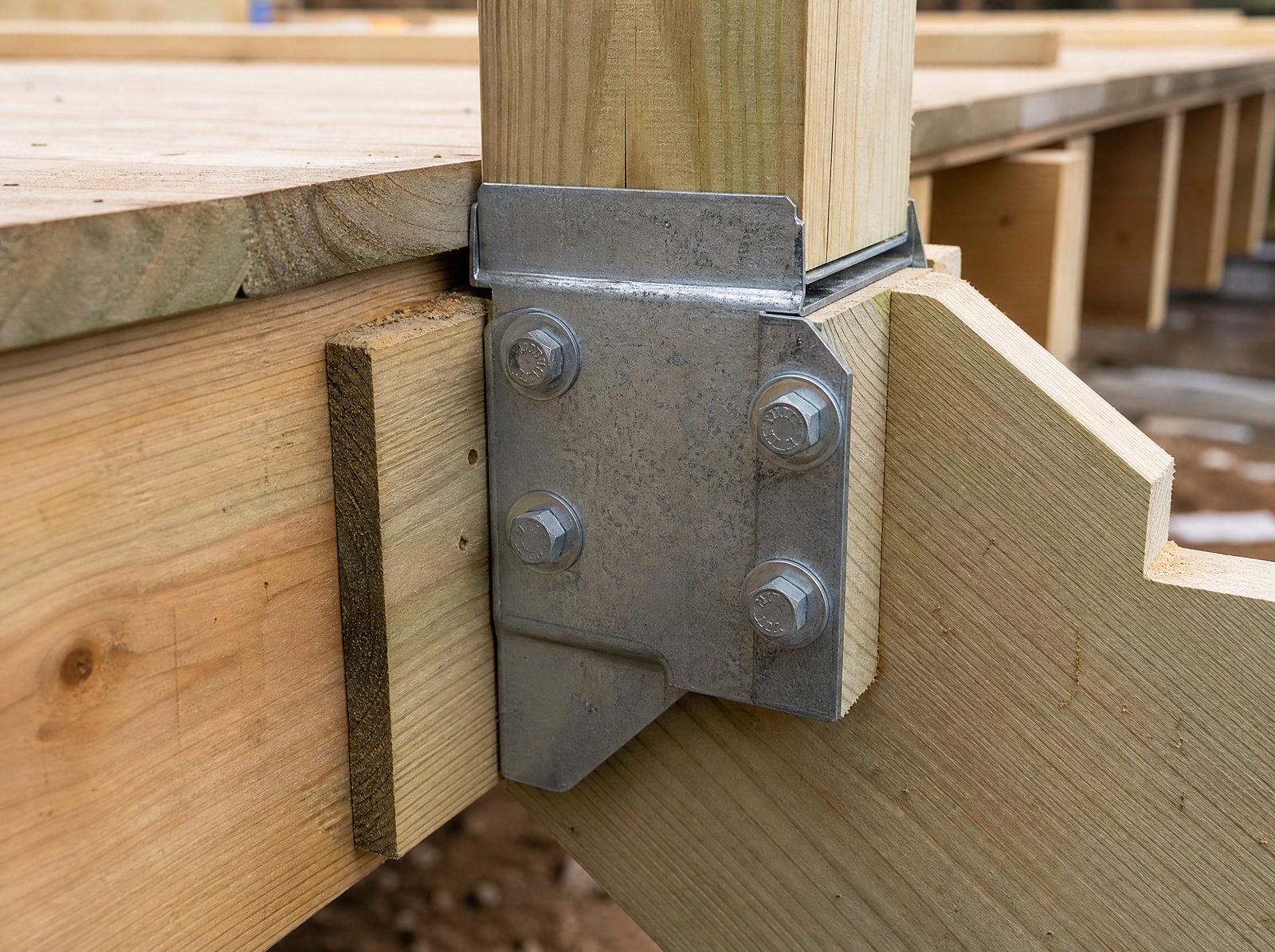
Deck railing Southbury projects live or die on the details behind the post: post spacing and dimensions, through-bolts or approved structural connectors, blocking, rim-joist reinforcement, corrosion-compatible fasteners, and the manufacturer's installation instructions. Here is the short version of all of it. Posts should not be attached only to deck boards or trim. Decking is a walking surface, not a structural anchor, and a post lag-screwed into it will feel solid on installation day and let go years later, usually with a person leaning on it.
A loose railing is frequently not a railing problem at all. It is the first visible symptom of something in the rim joist, the floor framing, the stair stringers, the blocking, the ledger connection, or the waterproofing detail. A post that moves under hand pressure, rot around a post base, split framing, corroded fasteners, a loose masonry anchor, cracked concrete, or a sagging deck edge all mean the structure gets evaluated before a new railing goes anywhere near it. A new guard over rotted framing is a new guard that is still unsafe, and it is worse than the old one because now it looks trustworthy. The floors chapter of the residential code is where the framing side of this is addressed.
What Makes a Porch Railing Different?
A porch railing Southbury project usually has to answer to the house as much as to the code. Front entries are what the street sees, and Southbury has plenty of homes where a wrong-looking rail would be a genuine loss.
Porch railings attach to a wider mix of things than deck railings do: wood framing, composite framing, masonry steps, concrete slabs, columns, newel posts, and stone landings. Each of those is a different attachment problem with different anchors and different failure modes. Masonry and concrete in particular are unforgiving, because an anchor set in a cracked or spalling substrate has nothing to hold.
The design pull is real here too. Porch projects balance code compliance against historical character, house style, column spacing, stair geometry, snow and ice, drainage, salt exposure, street visibility, and even mail and delivery access. Two cautions worth stating plainly. A decorative low rail may simply not be tall enough to serve as a required guard, and decorative elements should not create oversized openings or a climbable condition. Pretty and compliant are not opposites, but they do not arrive together by accident.
Why Do Stair Railings Fail First?
Stairs are where a railing gets used the hardest and where the two-devices problem shows up most often. A stair railing Southbury design has to address fall protection and graspability at the same time, which means the riser count, the open or closed sides, handrail height and clearance from the wall, continuity, returns, baluster spacing, triangular openings, and landings all have to agree with each other. Outside, add drainage and ice to the list.
This is where the top-rail trap gets expensive. A wide cap that passes as a guard but gives your hand nothing to close around means a separate handrail is necessary, and people who liked the clean look of a single rail rarely enjoy hearing it. Stairs are where falls actually happen, though, and that is not the place to lose the argument.
Which Railing Material Fits a Southbury Property?
Material choice changes maintenance, appearance, and how the system ages outdoors. It does not change the need for sound attachment. Every option below still depends on what is behind the post.
Before the materials, the local conditions that judge them. Exterior railings in Southbury face freeze-thaw cycles, snow loads, ice, road salt and deicing chemicals, standing moisture, shade and algae, falling branches, and snowplow contact. Those conditions drive coatings, fasteners, drainage, post bases, and concrete anchors. Two rules cut across all of it. Exterior post bases should not trap water, and dissimilar metals should be evaluated for compatibility before they are bolted together.
Aluminum
An aluminum railing Southbury system is the common pick for decks, porches, stairs, and entries, and for good reasons: corrosion resistance, lower weight than steel, powder-coated finishes, modular systems, low routine maintenance, and easy compatibility with gates. Aluminum does not rust the way carbon steel does, but it can bend, loosen, oxidize, or suffer coating damage, and it still lives or dies on post spacing, structural attachment, compatible fasteners, and gate reinforcement. Ask about product evaluation reports and replacement-part availability before you commit to a system. Our aluminum fencing line shares the same finish and hardware logic.
Ornamental Steel
Steel brings mass, a traditional appearance, custom fabrication, welded transitions, and strong newel posts, which makes it the choice when a heavy gate or real scrollwork is the point. In exchange it asks for galvanizing or coating, weld quality, drainage from hollow sections, and vigilance about rust at cut edges, plus lead time for custom work. One clarification worth having: many railings described casually as wrought iron are actually ornamental steel. True wrought iron is a distinct traditional material and is uncommon in modern residential systems.
Wood
Wood matches decks, porches, and traditional homes, takes paint or stain, coordinates easily with wood framing, and lets you repair one component instead of a whole run. It also brings rot, checking and splitting, fastener corrosion, moisture at post bases, paint failure, cap-rail deterioration, and pressure-treated lumber that moves as it dries. The structural warning applies with force here. A wood guard should not rely on decorative nails or surface screws that do not transfer loads into framing.
Vinyl and Composite
These give low routine maintenance, coordinated deck colors, concealed fasteners, and rot resistance, with thermal movement, UV exposure, impact damage, and gate limitations as the trade. The thing to know is structural. The visible sleeve may not be the post. The internal reinforcement and the approved mounting system are what carry the load, which is why the manufacturer's instructions are not optional reading on these systems.
Cable
Cable railing preserves views and reads contemporary. It also concentrates serious force. Cable systems impose substantial tension on end posts, and they should not be installed on weak or inadequately blocked framing. Beyond that, cable spacing and post stiffness drive the code interpretation, children climbing horizontal cable is a real design question, and the system needs retensioning over its life.
Glass
Glass offers open views and wind screening, and it asks for safety glazing, engineered supports, the right thickness, edge protection, and a post or shoe system that drains. Budget for cleaning and the occasional replacement. Glass railings should use a tested system installed according to engineering and manufacturer instructions, not improvised.
Does Southbury Require a Permit for Railing Work?
Sometimes, and the honest answer is that it depends on the project. Southbury's Building Department reviews permit applications for compliance with building and fire codes and town ordinances, and the town accepts building and zoning applications through its online permitting system. It also maintains separate resources for zoning, historic-district review, wetlands, and other site-specific approvals, which is another way of saying that Southbury looks at work property by property rather than by a blanket rule.
A railing project may require a permit when it is part of a new deck, a new porch, new stairs, a balcony, structural alterations, a replacement involving framing changes, new footings, masonry reconstruction, a change to required means of egress, or commercial and multifamily work. A simple repair replacing a component in kind may be treated differently from a new or structurally altered railing. What nobody should tell you is that every railing repair is automatically permit-free, because that is not a promise anyone can make about your specific project.
Additional review may apply for Historic District properties, exterior work visible from a public way, new decks or porch expansions, structural framing changes, masonry steps and landings, commercial or multifamily accessibility, wetlands or aquifer areas, and changes to required egress. Confirm the current requirements with the town through the Southbury permit page and the Building Department before you remove or install anything.
What Actually Moves the Cost of a Railing?
There is no reliable one-price-fits-all figure for railings in Southbury, and anyone who quotes one over the phone is guessing at your property. A short wall-mounted stair handrail and a full deck-guard replacement with framing reinforcement and custom gates are not the same project in any respect. Published consumer guides give broad market context, but they are not a quote for your deck.
What moves the number is length, the material and system grade, how much of the run is stairs, corners and transitions, gates and custom fabrication, what the railing has to anchor into, any structural repair, removal of the old system, and the permit, inspection, and engineering the project needs. Restricted access and custom colors show up too, the first as labor hours and the second as lead time.
Two of those deserve a flag, because they are the ones that surprise people. Structural repair is the big one. If the framing under your guard has failed, the railing quote was never the real project. And stairs cost more per foot than a straight run for a reason: more posts, more transitions, more geometry, and a separate graspable handrail on top of the guard.
Hover or tap a row to highlight it.
| Cost Driver | Why It Matters |
|---|---|
| Linear footage and location | A deck, porch, stair, balcony, or ramp each price differently, and longer runs need more posts and hardware. |
| Guard versus handrail | A guard and a graspable handrail are separate requirements, and a stair may need both in one assembly. |
| Material and system grade | Aluminum, steel, wood, vinyl, composite, cable, and glass differ in cost, testing, and custom fabrication. |
| Stairs, corners, and transitions | More geometry means more posts, more cuts, and more detailing than a straight run. |
| Structural repair | Rot, cracked concrete, or missing blocking must be fixed before the railing, and that is its own scope. |
| Attachment surface | Anchoring into masonry or concrete is different work from fastening into sound wood framing. |
| Removal, permits, and engineering | Taking out the old system, permit and inspection, and any engineering are each their own line items. |
How Does a Railing Installation Come Together?
A railing installation Southbury job follows a predictable order, and knowing it helps you spot a crew that skips the parts that matter. The sequence starts with what the railing is for and does not end until the town signs off, where a permit applies. Notice where the structural reinforcement sits: before the railing, not after. That ordering is the whole argument of this article in one step.
The Southbury Railing Installation Process
- 1
Step 1: Identify the Application
We name the device first, whether it is a guard, a handrail, a stair guard, a ramp rail, a decorative rail, or a combination, since that decides every rule that follows.
- 2
Step 2: Confirm the Code and Permit
We verify the applicable Connecticut code edition and check Southbury's building, zoning, and inspection requirements for your specific project.
- 3
Step 3: Inspect the Structure and Measure
We check framing, masonry, concrete, stairs, posts, rot, cracks, and prior attachments, then document heights, lengths, stair geometry, landings, corners, gates, and obstructions.
- 4
Step 4: Select the System and Write the Scope
Material, profile, infill, finish, post spacing, and handrail shape get chosen, then documented along with removal, repairs, permits, cleanup, schedule, and warranty.
- 5
Step 5: Remove Safely and Reinforce the Structure
The old system comes off with temporary fall protection at any exposed edge, then required blocking, connectors, and repairs go in before the new railing is attached.
- 6
Step 6: Install, Test, and Inspect
Posts, rails, infill, and handrails go in per code and manufacturer instructions, then movement, fasteners, openings, height, continuity, and gates are tested and any municipal inspection is completed.
How Do You Vet a Railing Contractor in Southbury?
Connecticut requires home improvement contractors to register with the Department of Consumer Protection, and the state's home improvement guidance for consumers explains why that registration and a written contract protect you. Verifying any contractor's registration takes a couple of minutes and is worth doing every time, on any project, with any company.
For a railing contractor Southbury homeowners should look past the registration to the specifics: current code knowledge, real guard and handrail experience, an ability to explain structural attachment details, material specifications and manufacturer documentation, framing-repair capability, masonry and concrete coordination, clear permit and inspection responsibility, removal and temporary protection, cleanup, warranty, and change-order procedures. The framing-repair question is the sharpest one you can ask. A crew that only installs railings has an incentive to not find rot.
My Fence Guy is a family-owned contractor with an office right here in Southbury, licensed and insured, serving Connecticut and New York since 2022. We install railings for decks, porches, stairs, and entries, along with residential and commercial fencing and estate gates, and we give free estimates.
What the Written Proposal Should Spell Out
- Railing or guard type: Which device is being installed where, named correctly.
- Material and product: Manufacturer, system, and grade, not just "aluminum."
- Height and infill: Finished height and the infill style with its spacing.
- Post spacing and attachment method: How the posts transfer load into the structure.
- Framing repairs: What structural work is included, and how surprises get priced.
- Stair handrail profile: The actual graspable shape, and whether it is separate from the guard.
- Gates, finish, and removal: Gate hardware, coating, and who takes the old system out.
- Temporary protection: How the open edge is protected while the railing is off.
- Permits and inspection: Who applies, and who meets the inspector.
- Cleanup, schedule, and payments: Timeline, lead times, and a payment schedule.
- Warranty and change orders: Workmanship and manufacturer terms in writing.
Frequently Asked Questions About railings southbury ct
Q: What is the difference between a guard and a handrail?
A: A guard is a protective barrier that keeps someone from falling off an elevated surface like a deck, porch, landing, or balcony. A handrail is a graspable rail that provides support along stairs or ramps. Many stair systems need both, because the open side is elevated and the flight also requires something to hold.
Q: When is a stair handrail required in Connecticut?
A: The Connecticut residential code states that handrails are required on at least one side of each stair flight with four or more risers. Confirm the current requirement with Southbury for your project, since the exact application depends on the code edition and the existing conditions.
Q: How high does a residential deck guard need to be?
A: Residential guards at decks, porches, balconies, and landings are generally required to be at least 36 inches high, and stair-side guard requirements can differ. Guards are generally required where the walking surface is more than 30 inches above the floor or grade below. Confirm the current requirements with the town.
Q: Can a wide deck top rail serve as the stair handrail?
A: Only if it meets the code's graspability, height, continuity, and termination requirements, and many decorative top rails do not. Handrails are generally installed 34 to 38 inches above the stair nosings and must offer a profile your hand can close around. When the top rail cannot do that, a separate handrail is necessary.
Q: Does railing installation require a permit in Southbury?
A: It depends on the project. New or structurally altered deck, porch, stair, balcony, and guard work may require a building permit and inspection, while a simple in-kind component repair may be treated differently. Southbury accepts building and zoning applications online and reviews work property by property, so confirm the current requirements with the town before starting.
Q: Can railing posts be mounted to deck boards?
A: No. The structural load has to transfer into approved framing or a tested mounting system, and decking boards alone are not an adequate structural attachment. This is one of the most common failures we find, and it is why a post that felt solid on day one can move a few years later.
Q: What happens if the deck framing under the railing is rotted?
A: The damaged framing gets repaired or replaced before the new railing is installed. A railing cannot be safer than what it is attached to, and putting a new guard over failed framing produces something that looks trustworthy and is not.
Q: Is aluminum railing a good choice outdoors in Southbury?
A: Yes. Aluminum resists corrosion, carries a powder-coated finish, and asks little in routine maintenance, which suits freeze-thaw cycles, snow, and road salt. It still depends on proper post spacing, structural attachment, compatible fasteners, and gate reinforcement, and it can bend, loosen, oxidize, or suffer coating damage.
Q: How much does railing installation cost in Southbury?
A: It depends on length, material, stairs, corners, gates, custom fabrication, structural repair, the attachment surface, removal, permits, and engineering. A short handrail and a full deck-guard replacement with framing reinforcement are different projects, which is why a site visit is the only honest way to price railings Southbury Connecticut homeowners actually need.
Test Your Southbury Railing Knowledge
1. What is the job of a guard, as opposed to a handrail?
2. When does the Connecticut residential code require a stair handrail?
3. How high are residential guards at decks, porches, and landings generally required to be?
4. Can railing posts be attached to deck boards alone?
5. What should happen first if the framing under a railing is rotted?
Pick an answer to begin.
Final Thoughts
Railings are not trim. They are structural safety systems, and they earn their keep in the one second when someone slips. That is why the order of operations matters so much here: name the device correctly, confirm what the code asks for your specific application, look hard at what the thing is bolted to, fix the structure first, then choose the material that fits the house and the weather.
If you take one habit away from this, make it the two questions. Is this the right device for this location, a guard or a handrail or both? And what is it actually attached to? Those two questions catch most of what goes wrong with railings in Southbury CT, and they are questions you can ask standing on your own deck this afternoon.
If your railing moves, or you are planning new ones, we would be glad to come look at it and give you a straight answer about the structure underneath. My Fence Guy has an office right here in Southbury, and we install deck, porch, stair, aluminum, ornamental, wood, residential, and commercial railing systems, handling the code questions, the permit and inspection coordination, and the framing repairs that a railing quote alone would miss. Call us at (203) 746-1100 for a free estimate, or reach out through our contact page.
Railing Key Terms
Tap a term to see what it means.
Guard. A protective barrier along an elevated walking surface such as a deck, porch, landing, balcony, or open stair side, meant to keep a person from falling off the edge.
More about fences
Railings in Sherman, CT: What the Code Actually Requires
Railings almost never break in the middle. They let go where they meet the deck. What that means for railings in Sherman, CT, from ledger to post base.
Read the guide to Railings in Sherman, CTRailings in New Fairfield, CT: Guards, Handrails, and Code
A guard and a handrail are not the same part, and the code treats them differently. Railings in New Fairfield, CT: heights, spacing, and the 4 inch rule.
Read the guide to Railings in New Fairfield, CTOrnamental Fencing in Southbury, CT: Style That Fits the House
Spear, flat top, or scroll? Ornamental fencing in Southbury, CT, and how picket profile, finials, and height decide whether a fence flatters the house.
Read the guide to Ornamental Fencing in Southbury, CT