
Vinyl Fencing in Sherman, CT: How to Spot the Good Stuff
By Tony Pellicone21 min readPublished
- vinyl fencing
- sherman ct
- privacy fencing
- connecticut
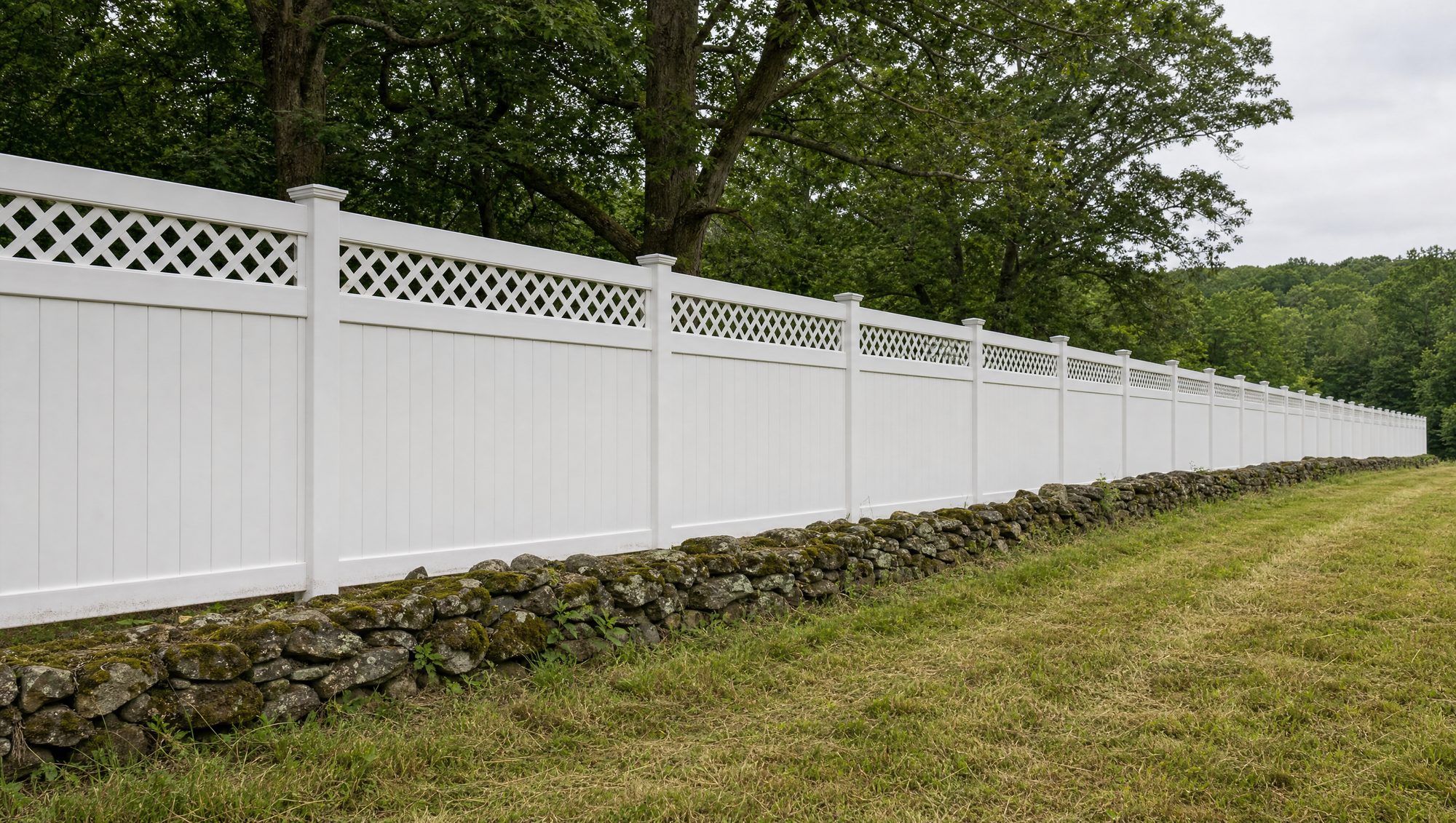
Almost everything separating a good vinyl fence from a bad one is invisible the day it goes up. The panels look alike. The posts look alike. So, the same white privacy fence, same height, same footage, can come back priced hundreds or even thousands of dollars apart with nothing in the paperwork to explain the spread, which leaves you working out whether the low number is a bargain or a mistake you will be staring at for the next fifteen years. The differences live in wall thickness, in what the PVC is actually made of, in whether the gate has anything inside it, and in how the posts went into the ground. Every contractor says low maintenance and lifetime warranty, so those words do not help you choose. What does help is knowing which questions turn two vinyl fencing quotes in Sherman, CT into a real comparison.
Key Takeaways
Vinyl is a spectrum, not one product
Wall thickness, profile dimensions, the UV package, and internal reinforcement vary widely between systems that look identical once they are installed.
Solid panels carry real wind load
A tall privacy run acts like a sail, so post spacing, rail reinforcement, and footings have to match the height and the exposure.
Gates fail before panels do
Gate leaves move and carry hardware, so internal aluminum framing and well supported hinge and latch posts are what keep them latching.
PVC moves with the temperature
A correct install leaves the manufacturer's clearances so seasonal expansion and contraction do not bind, buckle, or pull a rail loose.
Sherman reviews fences through Planning and Zoning
The town's fee schedule lists a zoning permit for fences, and a pool barrier carries its own requirements no matter its height.
Vinyl Fencing Is a Spectrum, Not a Single Product
Vinyl fencing is commonly made from rigid polyvinyl chloride, usually shortened to PVC, combined with pigments, impact modifiers, UV stabilizers, and other additives. That recipe is where the quality lives, and it is also the part no brochure photograph can show you. Two fences can share a color, a height, and a picture on a sales sheet while being built to very different specifications. ASTM F964 is the standard that covers rigid polyvinyl chloride exterior profiles used for assembled fencing and perimeter building products, and asking whether a product is made to it is a reasonable question, not a rude one.
Wall Thickness Is the Number Nobody Volunteers
Wall thickness is the amount of material in the post, rail, and board profiles, and it is the single detail most likely to be missing from a quote. A thinner profile uses less PVC, which is exactly why it costs less. It is also what flexes under a hand, oil cans in a gust, and gives up first when a mower deck or a snow shovel catches it. Ask each contractor for the profile dimensions and wall thickness of the posts, rails, and boards they are quoting. If two estimates are hundreds apart and one will not give you those numbers, you have probably found your explanation.
Ask What the Compound Is Made Of
Vinyl fence profiles are not all mixed from the same material. Some are manufactured from virgin PVC compound, while others include recycled regrind, and the manufacturer is the only honest source for which one you are getting. This is worth asking about directly, because the compound is what carries the impact modifiers and UV stabilizers that keep the fence performing. The answer to look for is a manufacturer who publishes a specification and stands behind it in writing. A contractor who names the manufacturer, the product line, and the spec is telling you something. A contractor who only says "vinyl" is telling you something too.
The UV Package Decides How the Color Holds
Sunlight is what ages PVC, and UV stabilizers are the additives that slow it down. Quality vinyl products use pigments and UV stabilizers to hold their appearance, but weathering, product quality, chemical exposure, and age can all still affect how a fence looks over time, so treat any claim of permanent color as marketing rather than fact. Heat matters here as well. A dark colored vinyl system can take on more heat gain than a white one, which is one reason product specific instructions exist for spacing, fastening, and clearances. When a fence line runs along a south facing stretch with no tree cover, the UV package stops being a technicality.
A Solid Vinyl Privacy Panel Is a Sail, Not a Screen
The most common mistake with a vinyl privacy fence in Sherman is treating it like a taller picket fence. It is not. Tongue and groove boards captured between horizontal rails give you full screening, and they also give the wind a solid surface with nowhere to go. An open picket line lets air through; a solid panel takes the whole push and hands it to the rails, the posts, and the concrete under them.
Exposure in Sherman Is Not Uniform
Wind exposure comes from the site, not the town. Fence height, uninterrupted run length, terrain, nearby buildings, open fields, lake exposure, hilltop conditions, post spacing, rail reinforcement, footing size, and gate width all change what a panel has to survive. A short run tucked between two houses and a long run across an open rise are different engineering problems wearing the same panels. FEMA's technical guidance on wind and building components explains why exposure, not just height, drives the load. The practical version is that posts, rails, concrete, gates, and the manufacturer's instructions all have to match the fence height and the exposure of that specific line.
Do Not Add Screening a System Was Never Designed to Carry
This is a quiet one that bites people years later. Adding solid panels, lattice, or screening to a fence system that was not designed for the extra wind demand changes the math after the posts are already in the ground. The same logic applies to a homeowner who decides to swap a semi privacy section for solid boards, or to add a lattice top for a bit more height. If the panel gets less transparent, the load goes up, and the posts and footings underneath do not get a vote.
Gates Are Where Vinyl Fences Fail First
If a vinyl fence is going to disappoint you, it will usually start at a gate. Panels sit still; gate leaves move, carry hardware, and take repeated loads every day for years. That is why gates almost always need more reinforcement than the fixed panels beside them, and why the gate is the first thing worth interrogating on a quote.
What Goes Inside a Gate That Does Not Sag
Gate sag can come from inadequate internal reinforcement, weak posts, wide gate leaves, poor hinges, settlement, or repeated impact. The details that prevent it are specific: an internal aluminum frame, real hinge post and latch post support, the right hinge and latch for the leaf, diagonal reinforcement, controlled bottom clearance, and double gate alignment where two leaves meet. Driveway slope and snow belong on that list too, because a gate that swings fine in August can drag in February. A wide gate without adequate reinforcement will sag, twist, or stop latching, and no amount of adjusting fixes a leaf that has nothing inside it. If you are looking at driveway and estate gates, the reinforcement conversation matters even more, because width multiplies every one of these loads.
Routed, Bracketed, and the Rest of the Assembly
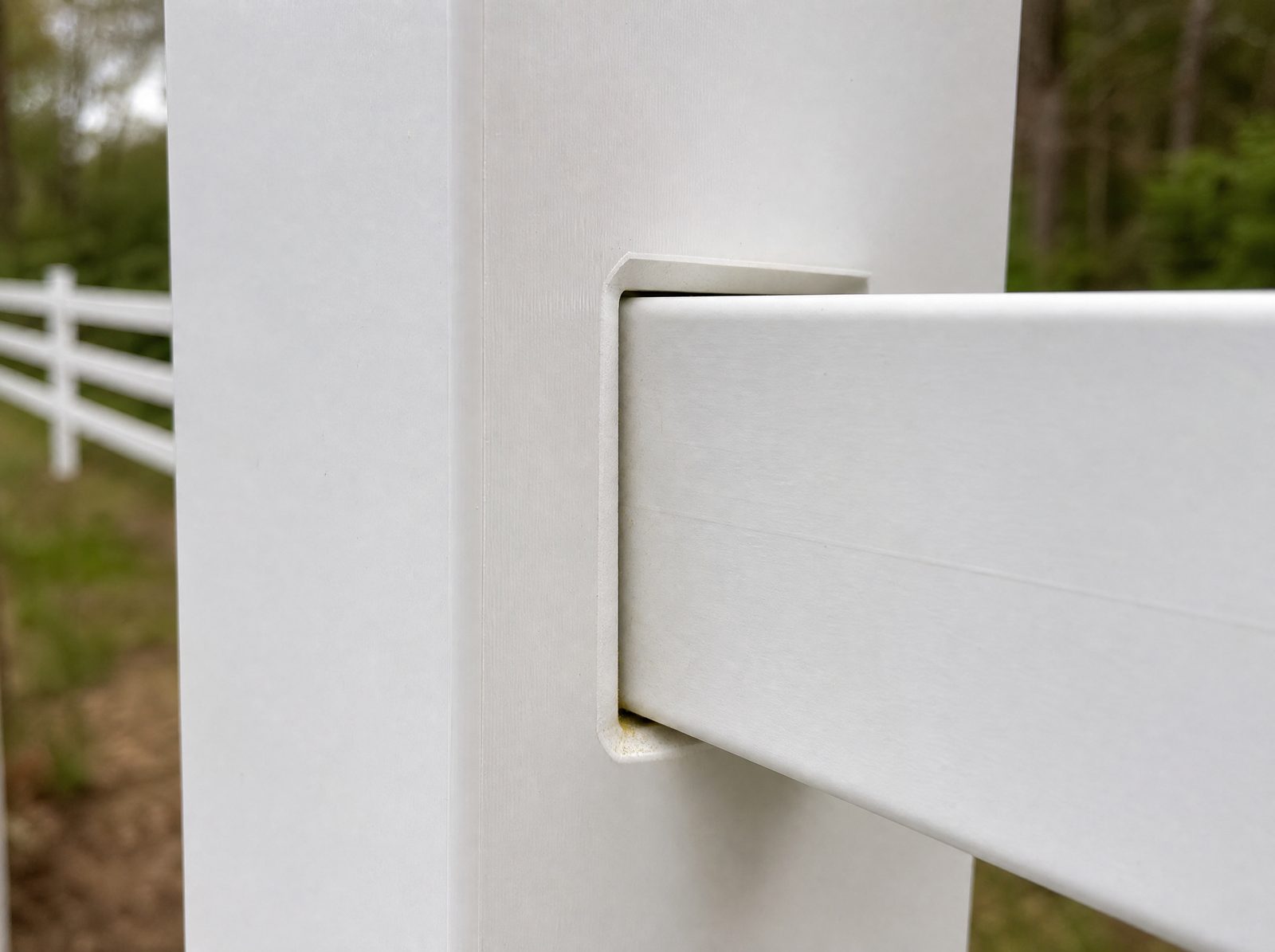
Beyond the gate itself, the way a system goes together tells you how it will age. Rail size, post size, internal reinforcement, gate frame construction, hardware, routed versus bracketed assembly, picket spacing, and how deeply the tongue and groove boards engage are all real product details, not sales language. So are the two that people only discover later: warranty exclusions and replacement part availability. A warranty that excludes wind, impact, or discoloration is a different promise than the one implied by the word lifetime, and a discontinued profile is a problem the day you need one panel.
PVC Moves All Year, and a Sherman Winter Tests the Posts
Two forces work on a vinyl fence here around the calendar. The PVC itself changes dimension as temperatures change, and the ground it stands in freezes and thaws repeatedly. A system that is designed and installed correctly handles both without complaint. One that is not shows you exactly where the shortcuts were.
Expansion and Contraction Are Planned For, Not Prevented
PVC expands and contracts, and no install method stops it. What a good install does is leave room for it. That means the manufacturer's specified clearances, correct rail insertion depth, attention to panel width, gate adjustment, seasonal movement, direct sun exposure, dark colors, post spacing, and fastening methods. Get those wrong and the fence binds, buckles, or pulls apart at the joints, usually at the first hard temperature swing. This is one of the clearest reasons that low maintenance never meant the installation does not matter.
What Sets Post Depth and Support
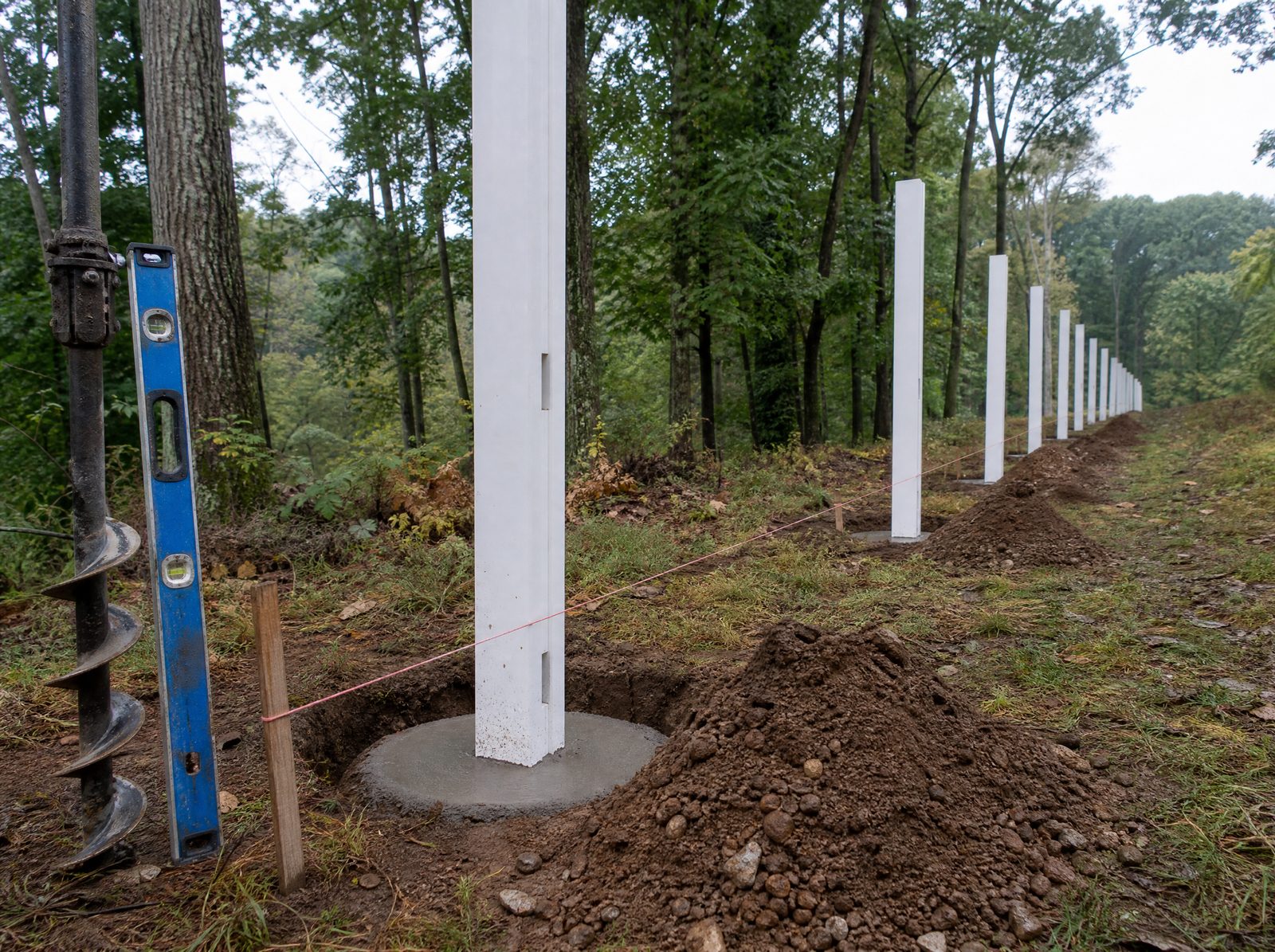
Sherman gets real winter, with repeated freeze thaw cycles that push on anything set shallow or draining poorly. Connecticut's residential code requires permanent supports of regulated structures to be protected from frost by extending below the local frost line or by another approved method, and while a typical fence is not always regulated like a building foundation, the frost protection principle in the code explains why shallow or wet posts heave. Be skeptical of any contractor who quotes one depth for every fence. Proper depth and support come from fence height, material and panel design, post size, gate load, soil and ledge conditions, drainage, wind exposure, manufacturer specifications, and local frost conditions together. Gate posts, terminal posts, corner posts, and any post carrying a solid privacy panel usually need more support than a light intermediate post.
What Actually Moves Vinyl Fence Cost in Sherman
There is no reliable one price fits all figure for a vinyl fence, and anyone who has collected a few estimates already knows it. Connecticut cost guides show broad installed ranges because material, layout, gates, terrain, removal, and labor vary so much from lot to lot, so treat any published average as general market context rather than a quote for your yard. Independent breakdowns like Angi's fence cost guide show how far the basics alone can spread a total. The useful exercise is knowing where the money actually goes.
Footage, Height, and Style Set the Baseline
Linear footage is the first lever, because longer runs need more posts, more panels, more hardware, and more labor. Height is the second, and style is the third: full privacy, semi privacy, picket, ranch rail, lattice top, and closed picket all use different amounts of material for the same run. Profile dimensions and product grade sit underneath all of it, which is why two quotes for "six foot white privacy" can be describing two different fences.
Gates, Reinforcement, and Color Stack On Top
Gate quantity and gate width both add cost, and gate frame reinforcement is a separate line from the gate itself. Color belongs here as well. White, tan, gray, and custom colors do not all price the same, and a custom color can affect both cost and how easily you replace a panel later. Post and rail size round out the list, since a heavier system costs more before anyone picks up a shovel.
Ledge, Slopes, Access, and the Old Fence
Sherman soil does not always cooperate. Rock and ledge can slow excavation and sometimes force a different tool or a shifted layout, and that belongs in your estimate as a named site condition rather than buried in a vague number. Slopes add work too. Depending on the product, vinyl panels may be racked where the system allows, stepped in level sections, custom trimmed, or transitioned with shorter panels, and stepping can leave triangular gaps under the panels that matter a great deal if you have a dog. Roots, restricted access, brush clearing, and removing and hauling an old fence with its posts and concrete are each real labor. So are permits, survey work, and pool or pet requirements. When you compare bids, make sure they all treat these the same way, or you are not comparing the same job.
Hover or tap a row to highlight it.
| Cost Driver | Why It Matters |
|---|---|
| Linear footage and height | More posts, panels, rails, hardware, and labor on longer and taller runs. |
| Style and product grade | Privacy, semi privacy, picket, ranch rail, and lattice top use different amounts of material, and profile dimensions differ by grade. |
| Gates and reinforcement | Gate quantity, gate width, and internal frame reinforcement each price separately from the fence line. |
| Color | White, tan, gray, and custom colors do not all cost the same, and a custom color affects later panel replacement. |
| Ledge, slopes, and access | Rock, grade transitions, roots, and a long carry from the truck all add labor and time. |
| Old fence removal | Pulling panels, posts, and concrete and hauling the debris is its own line item. |
Sherman Handles Fences Through Planning and Zoning
Sherman processes fences through its Planning and Zoning Department, and the town's fee schedule lists a zoning permit for fences under miscellaneous structures and equipment. Sherman also publishes current zoning regulations, and those are the ones to read, because dimensional and application requirements change. The short version for a vinyl project is that a permit question and a zoning question are not the same question, and a pool barrier is its own category entirely.
A Permit Exemption Is Not a Zoning Pass
Sherman routes fences through its Planning and Zoning Department, and the town fee schedule lists a zoning permit for fences, but that settles one question and not every question. Yard placement, road and driveway sight lines, property boundaries, easements, inland wetlands and watercourses, gates near the road, grade changes, and private association or deed restrictions can all still apply, and solid privacy panels and their wind exposure can be part of that review. Confirm the current height, placement, setback, visibility, and site specific requirements with the town before you order panels, not after.
Pool Barriers Follow Their Own Rules
A fence used as a swimming pool barrier is the clear exception, requiring a permit regardless of height, and the whole barrier system is what gets reviewed rather than just the panels. Gate direction, self closing operation, self latching hardware, opening sizes, clearances, and climbability all matter under the applicable pool barrier code. Vinyl can serve as a pool barrier when the complete installed system meets those requirements, but treat pool fencing as its own project with its own approval.
The Line and the Utilities Come First
Two things settle before the first hole. The property line is one, because mowing lines, tree rows, stone walls, and an informal understanding with a neighbor are not the legal boundary. A contractor can lay out the run, but a licensed surveyor is the professional who confirms the line, and that is worth the cost when corners are missing, the fence will sit close to the boundary, or a neighbor has questioned the location. The utilities are the other. Connecticut's Call Before You Dig service is free and required by law before excavation, and a request goes in by calling 811. Public marking does not reach private lines, though, so septic, irrigation, propane, well, low voltage yard lighting, invisible pet fence wire, and pool equipment lines may need a separate private locate.
How a Vinyl Fence Installation Comes Together in Sherman
A clean vinyl fence installation in Sherman runs in a predictable order, and knowing that order helps you spot a crew that skips steps. It starts with a walk of the property and ends with a walkthrough, with the compliance and utility checks built in where they belong rather than bolted on at the end. Nothing gets ordered until the layout and the rules are settled, because vinyl components are made to a plan.
The Sherman Vinyl Fence Installation Process
- 1
Step 1: Property Consultation
We walk the line to settle the purpose, layout, approximate footage, fence height, style, and where the gates make sense.
- 2
Step 2: Boundary and Compliance Review
Surveys, property lines, zoning, permits, wetlands, easements, and pool requirements get reviewed before anything is ordered.
- 3
Step 3: Written Scope and Product Selection
The estimate names the manufacturer, product line, profile, color, post and rail sizes, gate reinforcement, removal, cleanup, and who is responsible for what.
- 4
Step 4: Utility Marking and Site Prep
A Call Before You Dig request goes in, private lines are identified, and the fence path is cleared without tearing up what does not need to move.
- 5
Step 5: Posts, Rails, and Panels
Posts are set for the soil, grade, height, exposure, and gate loads, then rails and tongue and groove boards go up to the manufacturer's clearances.
- 6
Step 6: Gates, Adjustment, and Walkthrough
Hinges and latches are set, bottom gaps and grade transitions checked, the site cleaned, and the finished line walked with you.
White Vinyl Fence Upkeep Is Light, Not Zero
A white vinyl fence in Sherman is popular for a reason. It is bright, traditional, coordinates with most houses, and it never needs staining. What it does need is occasional attention, which is a different claim than maintenance free.
What Actually Marks a White Fence
The list of what dirties white vinyl is longer than most people expect: algae, mildew, pollen, soil splash, irrigation staining, leaf tannins, grass clippings, rust transfer from nearby metal, scuffs, and construction dust. Most of it washes off. The important part is how. Follow the manufacturer's cleaning instructions, because abrasive tools, harsh solvents, and incompatible chemicals can damage the surface. Routine upkeep is otherwise light: wash the dirt and algae, check the post caps, tighten hardware, adjust gates, look for impact damage, clear vegetation, correct erosion, check bottom gaps and rail engagement, and walk the line after a storm. Vinyl does not need painting, but damage from mowers, snowplows, falling branches, ladders, and vehicles still needs repairing.
Why Matching an Old Panel Is Hard
Here is the argument for buying a system you can still get parts for. Color matching gets difficult when an older panel has to be replaced, because weathering, manufacturing lots, and discontinued profiles can all differ. A panel that is technically the same white can read as a patch. This is where replacement part availability, which sounded like a footnote when you were choosing, turns into the whole conversation. Ask about it while you still have bargaining power.
What to Ask a Vinyl Fence Contractor in Sherman
Connecticut law requires home improvement contractors, including fence installers, to register with the Department of Consumer Protection, so registration and insurance are the floor rather than a selling point. The state explains why that registration protects you, and checking any contractor's status takes a few minutes. My Fence Guy is a family owned local contractor with an office right here in Sherman, licensed and insured, and we give free estimates. Past the paperwork, a vinyl fence contractor in Sherman should be able to answer plainly on material brand, grade, style, height, and color, on the post and footing approach, on gate dimensions and hardware, on who handles permits and the utility request, on removal and disposal terms, on schedule and material lead time, on payment schedule, on warranty, and on how a hidden condition like ledge gets priced when it turns up.
What a Written Vinyl Fence Contract Should Cover
Connecticut's contracting guidance is a good checklist to hold a bid against, and the state notes that a home improvement contract must include the contractor's name, address, and registration number, signatures, the signing date, and the date by which you may cancel. At a minimum, the scope should spell out:
- Contractor identity and registration: The registered name, address, and registration number, which you can verify yourself.
- Footage and height: The measured run and the finished height.
- Product specification: Manufacturer, product line, style, color, and the profile dimensions, not just the word vinyl.
- Post and gate details: Post sizes, footings, gate widths, gate reinforcement, and hardware.
- Removal and disposal: Who pulls the old fence, its posts and concrete, and who hauls the debris.
- Permit and utility responsibility: Who handles any zoning permit and who files the 811 request.
- Schedule and payments: Timeline, material lead times, and a payment schedule.
- Change orders and cleanup: How surprises like ledge get priced, plus final cleanup and restoration.
- Warranty: Workmanship and manufacturer warranty terms in writing, including the exclusions.
Frequently Asked Questions About vinyl fencing sherman ct
Q: Is vinyl fencing the same as PVC fencing?
A: Yes, in practice. A pvc fence in Sherman and a vinyl fence are the same thing, commonly made from rigid polyvinyl chloride combined with pigments, UV stabilizers, impact modifiers, and other additives. The names are used interchangeably in the trade.
Q: Does vinyl fencing require a permit in Sherman?
A: Sherman routes fences through its Planning and Zoning Department, and the town fee schedule lists a zoning permit for fences, but a pool barrier requires a permit regardless of height. The town processes fences through Planning and Zoning and its fee schedule lists a zoning permit for fences, so confirm the current placement, setback, wetlands, and site specific requirements with the town before installation.
Q: Is a vinyl privacy fence a good idea in a windy spot?
A: It can be, but the system has to be designed for it. Solid vinyl panels catch substantial wind, so post size, post spacing, rail reinforcement, footing design, height, exposure, and the manufacturer's instructions all have to match the site rather than a generic layout.
Q: Can vinyl fencing be installed on a slope?
A: Yes. Depending on the product, panels may rack to follow the grade, step down in level sections, or need custom transitions. Bottom gaps and gate placement have to be controlled, and gates are better kept off steep grade wherever the layout allows.
Q: Does white vinyl fencing turn yellow?
A: Quality vinyl products use pigments and UV stabilizers to hold their color, but weathering, product quality, chemical exposure, and age can all affect appearance over time. Follow the manufacturer's cleaning and warranty guidance, and treat any promise of permanently unchanged color with caution.
Q: Is vinyl fencing maintenance free?
A: No. It does not need painting or staining, which is most of the appeal, but it still needs cleaning, gate adjustment, hardware checks, vegetation control, and inspection after storms or impact from a mower, a plow, or a falling branch.
Q: Why do vinyl gates sag?
A: Gate sag usually traces back to inadequate internal reinforcement, weak hinge or latch posts, a leaf that is too wide for its support, poor hinges, settlement, or repeated impact. Internal aluminum framing and properly sized, well set gate posts are what prevent it.
Q: How much does vinyl fencing in Sherman Connecticut cost?
A: It depends on footage, height, style, product grade, gates, gate reinforcement, slopes, ledge, wind exposure, old fence removal, access, permits, and custom colors. Published averages are market context, not a quote, which is why a free on site visit is the honest way to price a specific yard.
Test Your Vinyl Fence Knowledge
1. Which detail most often gets left off a vinyl fence quote?
2. How does a solid vinyl privacy panel behave in wind?
3. What keeps a wide vinyl gate from sagging?
4. Why does a vinyl install leave the manufacturer's clearances?
5. Does a fence used as a pool barrier need a permit in Sherman?
Pick an answer to begin.
Final Thoughts
Vinyl earns its reputation when it is specified and installed properly, and it earns its bad reputation when it is not. The decisions that matter are made before anyone digs: what the profile actually is, how thick the walls are, what the UV package and the compound are, whether the gates carry internal reinforcement, whether the posts and footings suit the height and the exposure on your line, and whether the install leaves room for PVC to move through a Sherman winter. Settle those and the price differences between quotes finally start to make sense. Skip them and you are choosing on faith.
Done right, a vinyl fence is quietly excellent. It holds its line, it keeps the dog in, it screens the patio, and it asks for a wash and a hardware check instead of a weekend of staining every few years. That is the payoff for asking harder questions up front.
If you are weighing vinyl for a Sherman property, we would rather walk the line with you than hand you a number over the phone. My Fence Guy is a family owned contractor with an office right here in Sherman, licensed and insured, and we install residential, commercial, industrial, and agricultural fencing in vinyl, wood, aluminum, chain link, and ornamental styles, plus pool fencing, pet fencing, gates, and railings. We will tell you what product we are quoting, how the gates are reinforced, and how the posts are going in, so you can hold our estimate against anyone else's on the same terms. Call us at (203) 746-1100 for a free estimate, or reach out through our contact page.
Vinyl Fence Key Terms
Tap a term to see what it means.
PVC. Rigid polyvinyl chloride, the base material of vinyl fencing, combined with pigments, impact modifiers, UV stabilizers, and other additives.
More about fences
Wood Fencing in Sherman, CT: What Lasts and What Warps
Wood fencing in Sherman, CT: cedar, spruce, and pressure treated do not age the same. Grades, fasteners, and the drainage that decides how long it stands.
Read the guide to Wood Fencing in Sherman, CTVinyl Fencing in Southbury, CT: What Separates Good From Bad
Vinyl does not rot, but it does sag, yellow, and crack. What separates vinyl fencing in Southbury, CT that lasts: thickness, additives, and gate steel.
Read the guide to Vinyl Fencing in Southbury, CTVinyl Fencing in New Fairfield, CT: Not All Vinyl Is Equal
Vinyl fencing in New Fairfield, CT comes in real grades. Wall thickness, UV package, gate reinforcement, and post setting decide how long it lasts.
Read the guide to Vinyl Fencing in New Fairfield, CT