
Vinyl Fencing in Southbury, CT: What Separates Good From Bad
By Tony Pellicone20 min readPublished
- vinyl fencing
- southbury ct
- privacy fencing
- connecticut
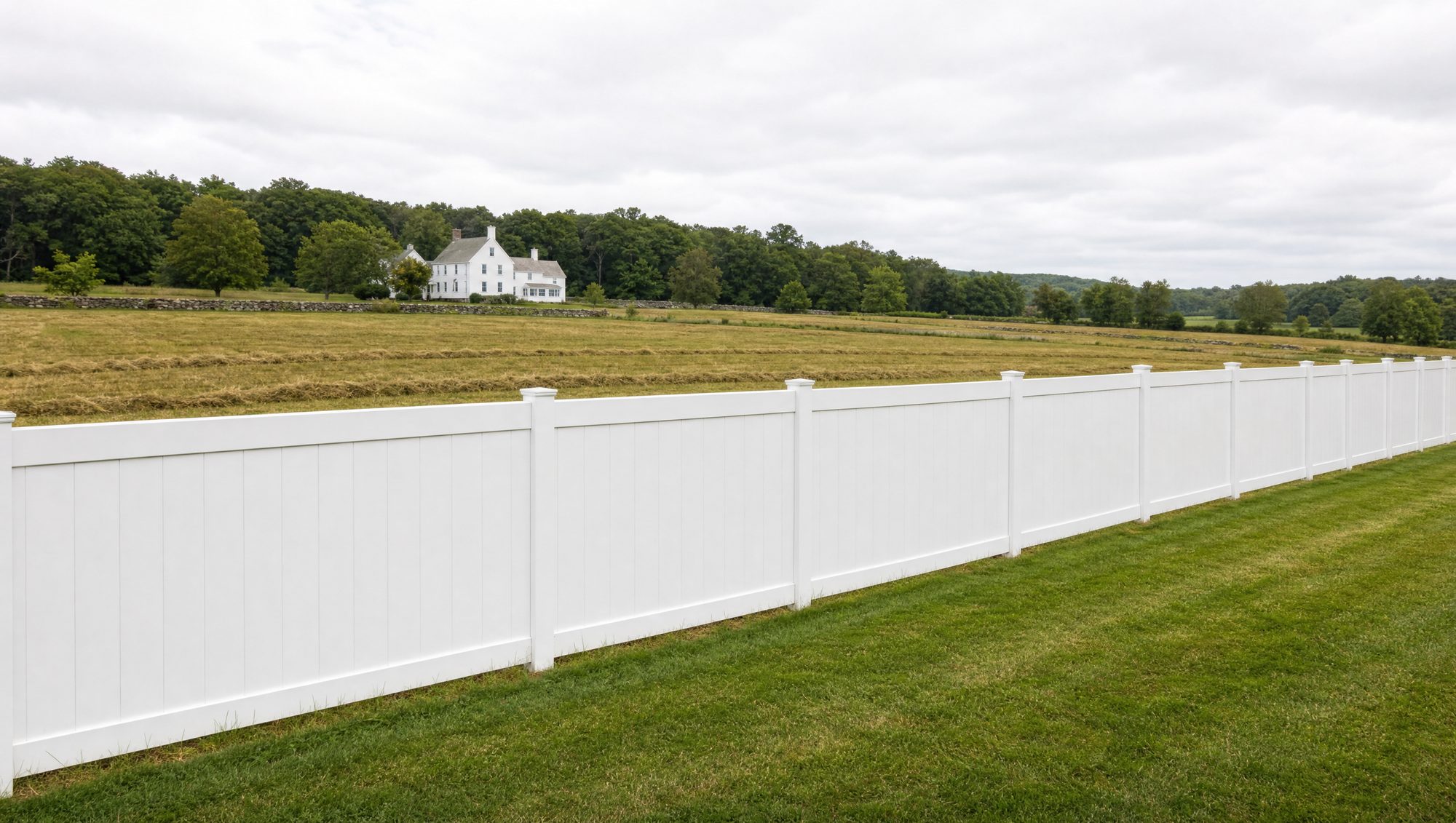
The difference does not show up on install day. It shows up in year five, when one fence still looks like the day it went in and the other has a bowed rail, a gate that no longer latches, and a chalky cast on the side that faces the afternoon sun. Until then, two bids for vinyl fencing in Southbury, CT can describe the same white privacy fence in nearly the same words and still land thousands of dollars apart, with nothing on the page to tell you why. The panels look alike in every brochure, the white is the same white, the heights match, so it is easy to assume the low bid is the same fence with a thinner markup. Sometimes it is. Often it is not. Vinyl is a manufactured product with real specifications, and those specifications are where the money went. Once you know the handful of things to look at, two estimates that read the same stop reading the same.
Key Takeaways
Vinyl is PVC plus an additive package
Rigid polyvinyl chloride carries pigments, UV stabilizers, and impact modifiers, and that recipe, not the color, decides how the fence ages.
Wall thickness and profile size separate products
Post and rail dimensions and the thickness of the material are where two look-alike fences quietly stop being the same fence.
A solid panel is a sail
Full privacy vinyl carries real wind load, so height, run length, exposure, post spacing, and footing have to match the site.
Gates fail before panels do
A wide vinyl gate without internal aluminum reinforcement and a properly supported hinge post is the most common thing to sag.
Low maintenance is not maintenance free
Vinyl skips the staining, but it still needs washing, gate adjustment, and posts set for real freeze-thaw.
Vinyl Is a Manufactured Product, Not a Color Choice
Most vinyl fence shopping starts and ends with two questions: what does it look like, and what does it cost. That is a reasonable place to start and a terrible place to stop, because the part of a vinyl fence that determines its life is invisible from the driveway. Vinyl fencing is commonly made from rigid polyvinyl chloride, usually called PVC, combined with pigments, impact modifiers, UV stabilizers, and other additives. Two fences can share a profile shape and a color and still be built from meaningfully different material.
The Additive Package Is Doing the Hard Work
Bare PVC does not do well outdoors on its own. Sunlight breaks it down, and cold makes it less forgiving. The additives are what answer both problems. UV stabilizers slow the degradation that leads to fading and chalking, and impact modifiers give the material enough toughness to take a hit instead of cracking, which matters in January when a plastic anything is at its most brittle. A product that skimps on the UV package may look identical the day it goes in and look tired several summers later, especially on a south-facing run. This is not something you can see or feel in a sample chip, which is exactly why it is a place to cut cost.
Ask What the Product Is Made Of, Not Just What It Looks Like
There is an industry specification for this material. ASTM F964 covers rigid polyvinyl chloride exterior profiles used for assembled fencing and perimeter products, and asking whether a product conforms to it is a fair question to put to any bidder. Some vinyl systems use reprocessed material in an inner layer with virgin material carrying the pigments and UV package on the outside, and that construction can be perfectly good. The honest way to find out what you are buying is to ask for the manufacturer, the product line, and the spec sheet, then read what the warranty covers and, more importantly, what it excludes. A pvc fence in Southbury is only as good as the profile it was extruded from, and a bidder who cannot name the manufacturer is telling you something.
Wall Thickness and Profile Size Are Where the Price Gap Hides
Here is the practical answer to why two vinyl estimates differ by thousands. Vinyl fencing should be judged by more than color and panel height. Wall thickness, profile dimensions, rail size, post size, internal reinforcement, gate frame construction, hardware, routed versus bracketed assembly, picket spacing, and tongue-and-groove engagement all vary from product to product, and every one of them costs money to add. A thinner wall uses less material, weighs less, ships cheaper, and installs the same way, so it is the easiest place to save without changing the photo on the brochure.
Posts and Rails Carry the Fence, the Boards Just Fill It In
People shop panels and they should be shopping posts. The boards in a privacy fence are infill. The posts and the rails are the structure, and their dimensions and wall thickness decide how much load the run can take before it starts to deflect. A bottom rail that spans a longer bay with nothing stiffening it is a rail that can bow over time, which is why some systems reinforce the bottom rail internally. Post size matters the same way, and it matters most at the corners, the ends, and anywhere a gate hangs.
Routed Assembly Versus Brackets
The way the fence goes together is a specification too. Routed systems pass the rails through openings cut in the post so the post carries the rail through its section. Bracketed systems fasten the rail to the face of the post instead. Both exist for real reasons, and the point is not that one is always right, but that they are not the same construction and should not be priced as if they were. When you compare bids, compare the assembly method along with the dimensions, or you are comparing a number to a different number.
A Solid Vinyl Privacy Fence in Southbury Is a Sail
A vinyl privacy fence in Southbury does something an open picket fence never does: it stops the wind instead of letting it pass. Solid tongue-and-groove panels act like sails, and the load has to go somewhere. It goes into the rails, then the posts, then the footings. Wind exposure is shaped by fence height, uninterrupted run length, terrain, nearby buildings, open fields, lake exposure, hilltop conditions, post spacing, rail reinforcement, footing size, and gate width, and Southbury has plenty of properties that check the exposed boxes. Wind is a real design load on buildings, and FEMA's guidance for builders treats it that way; a six or eight foot wall of solid panel deserves the same respect.
Height and Run Length Change the Math
Taller is not simply more expensive by the foot. A taller solid fence catches more wind, which pushes back on post spacing, post size, footing dimensions, and rail reinforcement all at once. A long uninterrupted run on an open lot is a different problem than the same fence broken up by a house, a garage, and mature trees. Posts, rails, concrete, gates, and the manufacturer's instructions should all match the fence height and the exposure, not a generic default the crew uses everywhere.
Do Not Add Panels to a System That Was Not Designed for Them
A common and expensive mistake is treating a fence as something you can upgrade later. Adding solid panels, lattice, or screening to a system that was specified as open fencing raises the wind demand on posts and footings that were never sized for it. The fence does not know you changed your mind. If full privacy might be the goal eventually, say so before anything is ordered, because it changes the post schedule and the footings, and those are the parts you cannot retrofit without pulling concrete.
PVC Moves, and Southbury Winters Make It Move More
Vinyl does not rot and it does not rust, so it is easy to assume it just sits there. It does not. PVC changes dimension as temperatures change, and a properly designed system is built to let that happen without binding, buckling, or pulling apart. Manufacturer-specified clearances, rail insertion depth, panel width, gate adjustment, post spacing, and fastening methods all exist to give the material somewhere to go. Southbury runs the full range, from July sun on a white panel to a January cold snap, which is a real annual cycle for a plastic profile.
Dark Colors Move More Than White
Tan and gray vinyl have gotten popular, and they are a legitimate choice, but they are not a free one. Dark-colored vinyl systems can absorb more heat than white products, which means more thermal movement and, on the coldest days, a material working at the other end of its range. That is not a reason to avoid them. It is a reason to follow the product-specific instructions rather than the installer's habit, since the clearances that keep a white fence from binding may not be the clearances a darker product needs.
Freeze-Thaw Finds Every Shallow Post
Whatever the panels do, the posts decide whether the line stays straight. Southbury sees repeated freeze-thaw cycles, and fence performance depends on post depth, hole diameter, drainage, soil, fence height, panel type, wind exposure, gate weight, and the installer's setting method. Connecticut's residential code for foundations requires permanent supports of regulated structures to be protected from frost, and while a typical fence is not always regulated like a building footing, the principle is the same one: water that sits, freezes, and expands under a post is what lifts and leans a fence. There is no single correct depth for every fence, and any bidder who quotes one number for every job is guessing. Depth and support come from fence height, panel design, post size, gate load, soil and ledge, drainage, wind exposure, and the manufacturer's specifications together.
Gates Are Where a Vinyl Fence Fails First
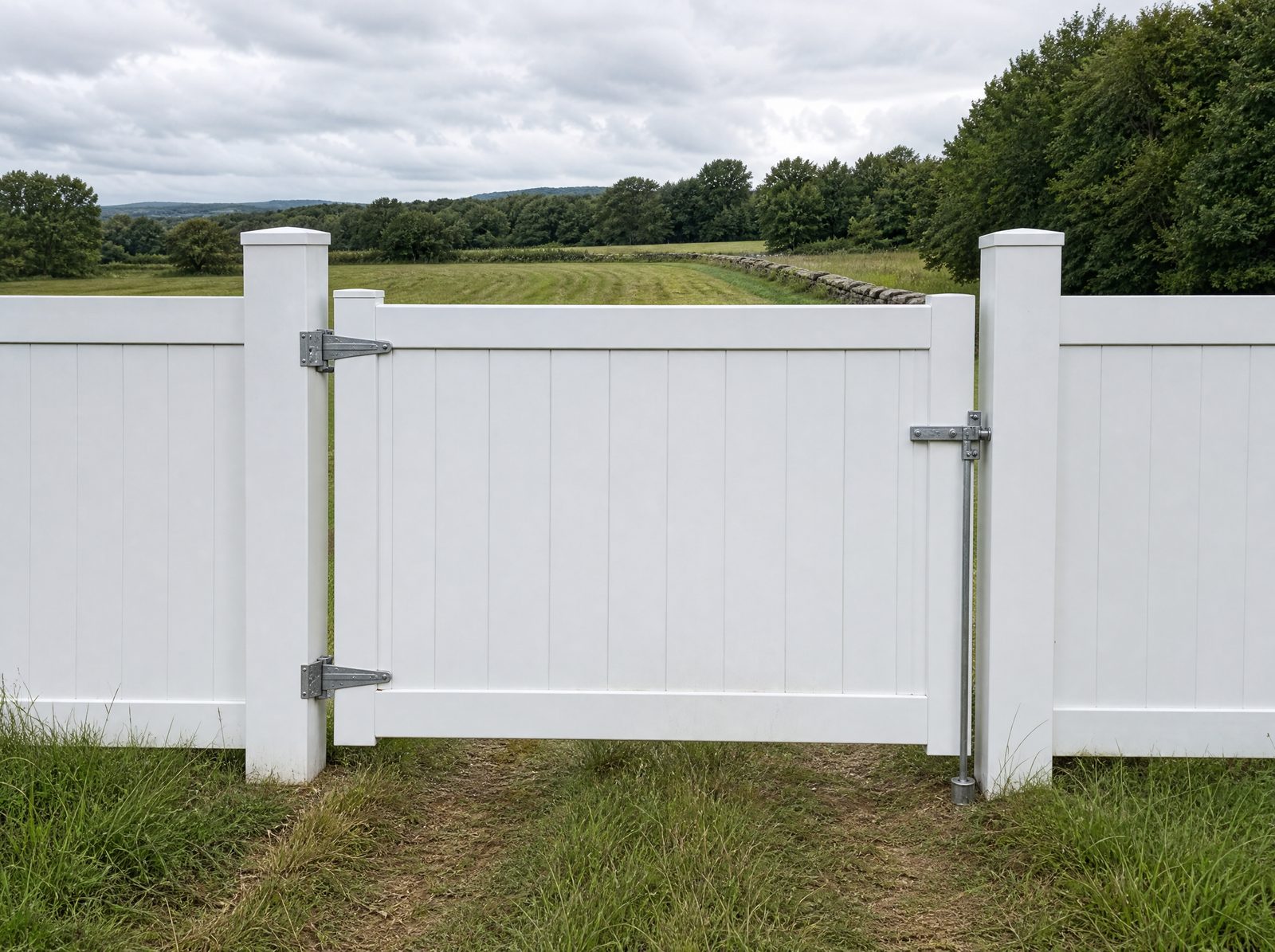
If a vinyl fence is going to disappoint someone, it is usually through a gate. Gate leaves move, carry hardware, and take repeated loads that a fixed panel never sees, so they need more than a fixed panel gets. A wide gate without adequate reinforcement can sag, twist, or stop latching, and by then the fix is rarely a quick adjustment. This is the single easiest thing to under-build and the single most visible thing when it goes wrong.
Internal Reinforcement Is Not Optional on a Wide Gate
The difference between a vinyl gate that holds its square and one that droops is usually what is inside it. An internal aluminum frame, diagonal reinforcement, hinge-post and latch-post support, the hinge type, the latch, and the gate width all work together. Skip the frame on a wide leaf and gravity does the rest over a couple of seasons. Bottom clearance, driveway slope, and where the snow ends up all belong in the conversation too, because a gate that clears in August and drags in February was planned for one season. Wider openings and driveway and estate gates raise the stakes further, since they need their own posts, footings, and hardware.
Pool Gates Answer to Code, Not Preference
When a vinyl fence is the barrier around a pool, the hardware stops being a preference and becomes a requirement. The complete barrier gets reviewed for height, openings, gates, latches, clearances, and climbability against the applicable pool code, and gate direction and self-closing, self-latching operation are part of that system. Vinyl can absolutely serve as pool fencing when the installed barrier meets those requirements. It just has to be planned as a barrier from the start rather than a yard fence that happens to be near water.
White Vinyl Stays White Only If Someone Washes It
White remains the most common vinyl color because it is bright, traditional, and it goes with most houses. It is also the color that shows everything. A white vinyl fence in Southbury collects algae, mildew, pollen, soil splash, irrigation staining, leaf tannins, grass clippings, rust transfer from nearby metal, scuffs, and construction dust, and none of that is the product failing. It is a light-colored surface outdoors in New England. The fence that looks bad at year six is often a fence nobody has washed since year one.
Cleaning It Wrong Is Worse Than Not Cleaning It
The instinct when something on the fence will not come off is to reach for something stronger. That is how surfaces get damaged. Cleaning should follow the manufacturer's instructions, because abrasive tools, harsh solvents, and incompatible chemicals can hurt the surface or the finish in ways weather never would. The vinyl industry's own guidance and the product's warranty language are better authorities than a bottle under the sink.
Color Matching Later Is Harder Than It Sounds
One more reason the product line matters: replacement. When a panel gets hit by a mower, a plow, or a falling branch, matching it can be difficult, because weathering, manufacturing lots, and discontinued profiles may all differ from what went in years ago. Buying a system whose parts are still going to exist, from a manufacturer you can name, is a quiet form of insurance. Ask about replacement-part availability before you sign, not after the branch comes down.
What Vinyl Fence Cost in Southbury Really Depends On
There is no reliable one-price-fits-all figure for vinyl, and anyone who has collected a few bids already knows it. Published Connecticut ranges from sources like Angi's vinyl fence cost breakdown spread widely because material grade, layout, gates, terrain, removal, and labor swing so much from lot to lot. Treat any published average as a general market reference, not a quote for your yard. The useful thing is knowing where the money actually goes, so you can tell a cheaper fence from a cheaper price.
Hover or tap a row to highlight it.
| Cost Driver | Why It Matters |
|---|---|
| Linear footage and height | More posts, panels, rails, and labor, and taller solid fences use more of everything and carry more wind. |
| Product grade | Wall thickness, profile dimensions, post and rail size, and the UV package are real cost, and they are invisible in a photo. |
| Style | Full privacy, semi-privacy, picket, ranch rail, closed picket, and lattice-top all price differently. |
| Gates and reinforcement | Quantity, width, internal aluminum framing, and hardware, with driveway gates in a category of their own. |
| Color | White, tan, gray, or a custom color are not all priced the same. |
| Terrain | Ledge, rock, roots, slopes and stepped transitions, wet ground, and restricted access all add hours. |
| Wind exposure | An open or hilltop lot can drive tighter post spacing and bigger footings. |
| Removal and restoration | Pulling an old fence, its posts and concrete, hauling debris, and restoring the ground is its own line item. |
Southbury Rules Still Apply, Even When a Permit Does Not
The town keeps fences simpler than most people expect, but simple is not the same as unregulated. Southbury takes building and zoning applications online and reviews fences property by property, with one clear carve-out: a fence used as a swimming pool barrier requires a permit regardless of height. That settles the building permit question and only that one. Southbury takes building and zoning applications through its online permitting system, and its zoning regulations are undergoing a full update, so confirm current requirements for your property rather than relying on what a neighbor did three years ago.
A Permit Exemption Is Not a Zoning Exemption
Plenty still applies to a fence that needs no building permit. Height, yard placement, road and driveway sight lines, property boundaries, easements, inland wetlands and watercourses, aquifer protection areas, retaining walls or grade changes, historic district visibility, and private association or deed restrictions are all separate questions. The safe read is that you may skip the building permit and still owe the town a zoning check.
Confirm the Line, Then Mark the Utilities
A vinyl fence set in the wrong place is expensive to move, and mowing lines, tree rows, and old posts are not the legal boundary. A contractor can lay out the run, but a licensed surveyor establishes the legal line, and recorded plans often live with the town clerk. Then comes the digging: Connecticut's Call Before You Dig service is free and required by law before excavation, and a request goes in by calling 811. Public marking does not cover private lines like septic, pet-fence wire, irrigation, propane, well, and pool equipment, which may need a separate locate.
How a Vinyl Fence Installation in Southbury Comes Together
A clean vinyl fence installation in Southbury runs in a predictable order, and knowing the order helps you spot a crew that skips steps. It starts with a walk of the property and ends with a walkthrough, with the compliance and utility checks built in where they belong rather than bolted on when someone remembers. Material selection sits in the middle, after the site is understood and before anything is ordered. Ordering panels before the layout and the gates are settled is how projects go sideways.
The Southbury Vinyl Fence Installation Process
- 1
Step 1: Property Consultation
We walk the property to define the goal, the route, approximate footage, height, style, and gate locations.
- 2
Step 2: Boundary and Compliance Review
Surveys, property lines, zoning, permits, wetlands, easements, and pool-barrier rules get reviewed before anything is ordered.
- 3
Step 3: Product Selection and Written Scope
Manufacturer, product line, profile dimensions, color, post and rail sizes, gate reinforcement, removal, cleanup, and responsibilities all go in writing.
- 4
Step 4: Utility Marking and Site Prep
A Call Before You Dig request goes in, private lines are identified, and the fence path is cleared.
- 5
Step 5: Post Setting
Posts are set for the soil, drainage, grade, wind exposure, and gate loads on this property, not to a one-size default.
- 6
Step 6: Panels, Gates, and Walkthrough
Rails and panels go up with the movement clearances the product calls for, gates are hung and adjusted, bottom gaps checked, and the job is walked with you.
How to Judge a Vinyl Fence Contractor in Southbury
Connecticut law requires home improvement contractors, including fence installers, to register with the Department of Consumer Protection, so registration and insurance are the floor, not a feature. The state explains why that registration protects you, and you can verify any contractor's license in a couple of minutes. Do that for every bidder, including us. My Fence Guy is a family-owned contractor with an office right here in Southbury, licensed and insured, and we give free estimates. Beyond the paperwork, the questions that actually separate bidders are about the product and the install.
The Questions That Make Two Estimates Comparable
Ask each bidder the same short list and the low bid either holds up or explains itself:
- Manufacturer and product line: Not "vinyl," but whose vinyl, which series, and does it conform to ASTM F964.
- Wall thickness and profile dimensions: Post size, rail size, and the actual thickness of the material.
- Reinforcement: What stiffens the bottom rail, and what is inside every gate leaf.
- Post setting: Depth, hole diameter, and drainage for this soil, this height, and this exposure.
- Grade handling: Whether the run steps or racks, what the product allows, and how big the bottom gaps end up.
- Gate details: Widths, hinge and latch hardware, and support at the hinge post.
- Warranty: What the manufacturer covers, what it excludes, and what workmanship warranty you get in writing.
- Removal and cleanup: Who pulls the old fence, its concrete, and the debris.
- Permit and utility responsibility: Who confirms zoning, who pulls any permit, and who files the 811 request.
What the Written Contract Has to Say
Connecticut's contracting guidance is a good checklist to hold a bid against. A home improvement contract must include the contractor's name, address, and registration number, signatures, the date of signing, and the date by which you may cancel. Beyond that, get the answers above written into the scope rather than left in a conversation, especially the product line and the gate reinforcement. And if a change order for ledge is not defined before work starts, it gets defined when the auger hits rock, which is the worst possible time.
Frequently Asked Questions About vinyl fencing southbury ct
Q: Is vinyl fencing the same as PVC fencing?
A: Yes. Vinyl fencing is commonly made from rigid polyvinyl chloride, or PVC, combined with pigments, UV stabilizers, impact modifiers, and other additives. ASTM F964 is the specification covering rigid PVC exterior profiles used for assembled fencing.
Q: Does vinyl fencing require a permit in Southbury?
A: Southbury takes building and zoning applications online and reviews fences property by property, but a pool barrier requires a permit regardless of height. Zoning, placement, easements, wetlands, and other site-specific rules may still apply, so confirm current requirements with the town before installation.
Q: Does white vinyl fencing turn yellow?
A: Quality vinyl products use pigments and UV stabilizers to resist it, but weathering, staining, product quality, chemical exposure, and age can all affect appearance over time. Following the manufacturer's cleaning and warranty guidance is the best protection, and the UV package is one reason two products priced differently are not the same product.
Q: Is vinyl privacy fencing a good idea in a windy spot?
A: It can be, as long as it is designed for the exposure. Solid panels catch substantial wind, so post size, post spacing, rail reinforcement, footing design, height, and the manufacturer's instructions all have to match the site rather than a default.
Q: Why do vinyl gates sag?
A: Sag usually traces to inadequate internal reinforcement, a weak or undersized hinge post, a gate leaf that is too wide for its framing, poor hinges, settlement, or repeated impact. A wide gate without an internal aluminum frame is the most common version of this.
Q: Is vinyl fencing maintenance-free?
A: No. It does not need painting or staining, but it still needs washing, post-cap checks, hardware tightening, gate adjustment, vegetation control, and inspection after storms or impact from mowers, plows, and branches.
Q: Can vinyl fencing be installed on a slope?
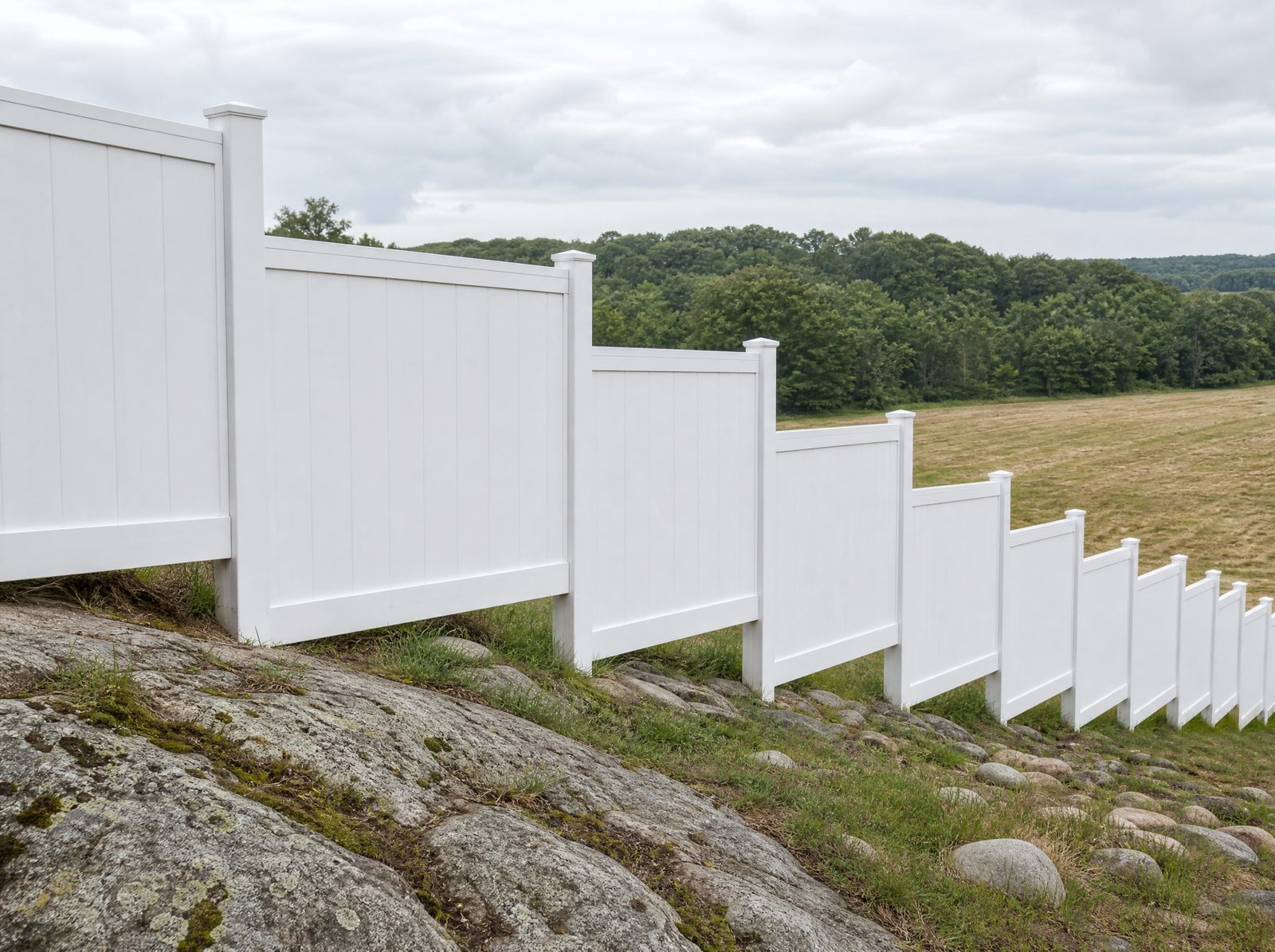
A: Yes. Depending on the product, panels may rack to follow the grade, step down in level sections, or need custom transitions. Stepping can leave triangular gaps under the panels, and racking is limited by what the product allows, so bottom gaps and gate placement should drive the choice.
Q: How deep should vinyl fence posts be set in Connecticut?
A: There is no single correct depth. Depth and support depend on fence height, panel design, post size, gate load, soil and ledge, drainage, wind exposure, and the manufacturer's specifications, which is why shallow or poorly drained posts are the ones that move during freeze-thaw cycles.
Test Your Vinyl Fence Knowledge
1. What are UV stabilizers and impact modifiers in vinyl fencing for?
2. Which spec most separates two vinyl fences that look identical?
3. What does a solid vinyl privacy panel do in a strong wind?
4. What most often keeps a wide vinyl gate from sagging?
5. Is vinyl fencing maintenance-free?
Pick an answer to begin.
Final Thoughts
Vinyl is not one thing. It is a material recipe, a set of profile dimensions, an assembly method, a reinforcement plan, and a post-setting decision, and every one of those is a place where cost can come out without the brochure changing. Judge the product by wall thickness, profile size, the UV and impact package, and what is inside the rails and the gates. Judge the install by how the posts get set for your soil and your exposure, and how the run handles your grade. Do that, and the estimates in front of you stop looking interchangeable.
The payoff for getting it right is a fence that quietly does its job for decades, holding its line and its color through every freeze-thaw cycle, asking for nothing more than a wash and an occasional gate adjustment. That is what people are actually buying when they buy vinyl, and it is worth a few specific questions up front.
If you are planning a vinyl fence in Southbury, we would be glad to walk your property and give you a straight answer about what your site needs. My Fence Guy is a family-owned contractor with a Southbury office, and we install residential, commercial, industrial, and agricultural fencing in wood, vinyl, aluminum, chain link, and ornamental styles, plus pool fencing, pet fencing, gates, and railings. We will tell you what product we are quoting, how the posts are going in, and what reinforces every gate. Call us at (203) 746-1100 for a free estimate, or reach out through our contact page.
Vinyl Fence Key Terms
Tap a term to see what it means.
PVC (Polyvinyl Chloride). The rigid plastic vinyl fencing is made from, combined with pigments, UV stabilizers, impact modifiers, and other additives before it is extruded into profiles.
More about fences
Wood Fencing in Southbury, CT: What the Estimate Leaves Out
A two word estimate hides most of the fence. Wood fencing in Southbury, CT: what cedar, grade, post treatment, and fasteners mean before you sign.
Read the guide to Wood Fencing in Southbury, CTVinyl Fencing in Sherman, CT: How to Spot the Good Stuff
Three quotes, one white privacy fence, three different products. How to read vinyl fencing specs in Sherman, CT: wall thickness, UV, and reinforcement.
Read the guide to Vinyl Fencing in Sherman, CTVinyl Fencing in New Fairfield, CT: Not All Vinyl Is Equal
Vinyl fencing in New Fairfield, CT comes in real grades. Wall thickness, UV package, gate reinforcement, and post setting decide how long it lasts.
Read the guide to Vinyl Fencing in New Fairfield, CT