
Vinyl Fencing in New Fairfield, CT: Not All Vinyl Is Equal
By Tony Pellicone20 min readPublished
- vinyl fencing
- new fairfield ct
- privacy fencing
- connecticut
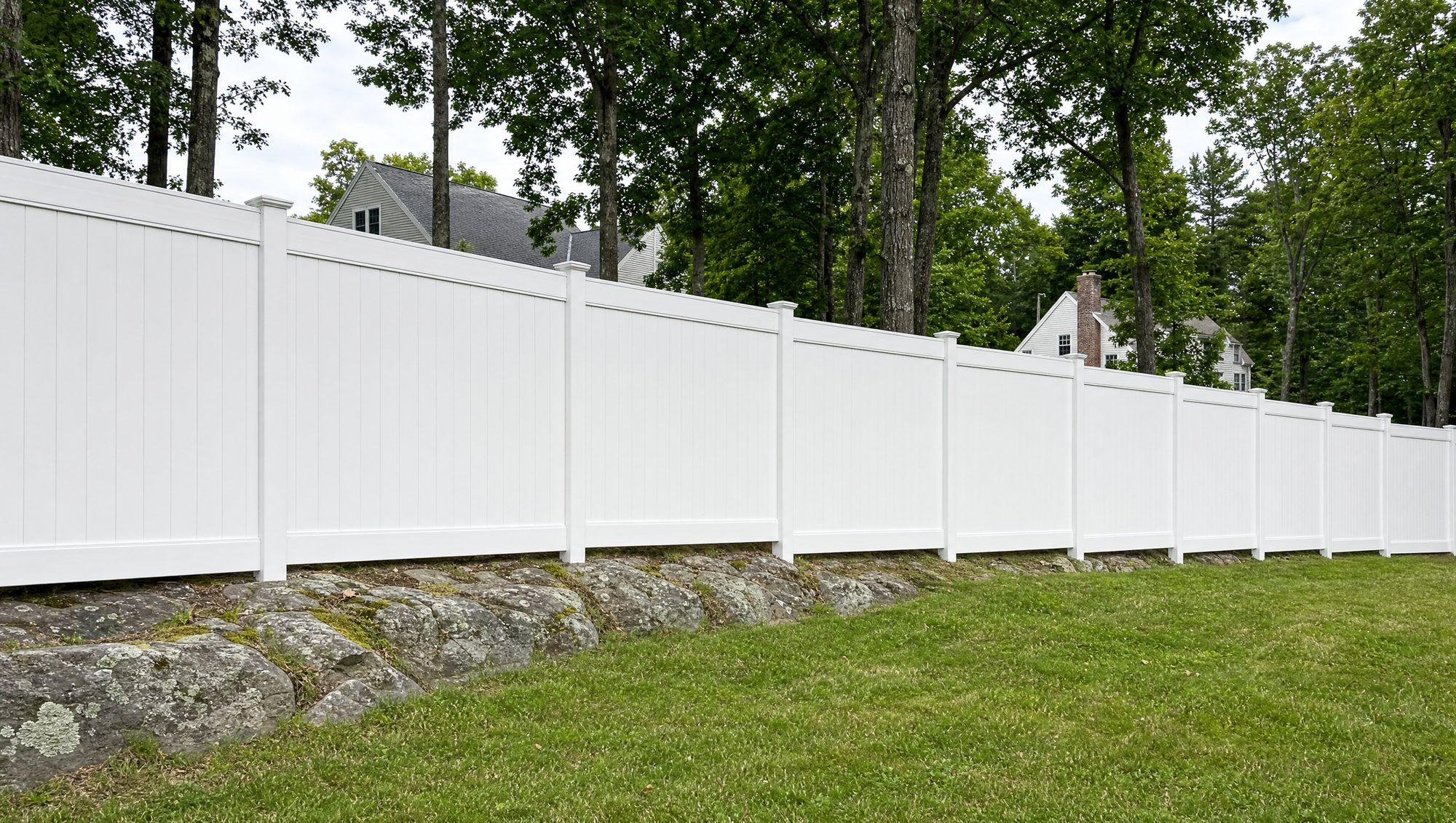
Three estimates are sitting on your kitchen table, and every one says the same thing: white vinyl privacy fence, six feet, roughly the same footage. The prices are thousands of dollars apart, and nobody has explained why. That is the honest starting problem with vinyl fencing in New Fairfield CT, because vinyl is not one product the way people assume. Two fences can look identical in a brochure and be built to very different specifications, and the differences hide where a homeowner is never told to look: how thick the walls are, what the compound is made of, whether the rails carry reinforcement, and how the gates are framed. The frustrating part is that you often will not know which fence you bought for three or four years, until a panel has gone chalky, a gate drags, or a windy run takes a lean. None of that is bad luck. It traces back to decisions made at the estimate stage. So, here is what actually separates good vinyl from bad, in terms you can bring straight back to those three bids.
Key Takeaways
Vinyl is a specification, not a color
Wall thickness, profile dimensions, the UV package, and impact modifiers vary widely between products that look identical from six feet away.
Solid privacy panels catch wind like a sail
Height, run length, and exposure drive the post spacing, rail reinforcement, and footing that a tall vinyl fence needs.
Gates fail before panels do
A gate leaf moves and carries hardware, so internal aluminum framing and hinge-post support matter more than the panel beside it.
PVC moves with temperature
A vinyl system is designed to expand and contract, and the clearances that allow that movement are an install detail, not an option.
Ask what the estimate does not say
Manufacturer, profile size, reinforcement, gate frame, and replacement-part availability separate a real specification from the word "vinyl."
What You Are Actually Buying When You Buy PVC Fence
Vinyl fencing is commonly made from rigid polyvinyl chloride, which is where the term pvc fence comes from, but the raw polymer is only part of the recipe. What arrives at your property is a compound: PVC plus pigments, impact modifiers, UV stabilizers, and other additives, extruded into profiles and assembled into posts, rails, and boards. ASTM F964 covers rigid polyvinyl chloride exterior profiles used for assembled fencing and perimeter building products, and it exists precisely because the compound and the profile are what determine performance. The pigment gives you color. The rest is doing the work you paid for.
The Additives Are Doing the Hard Work
A fence in an open New Fairfield yard takes ultraviolet light every day it exists, and unprotected PVC does not enjoy that. UV stabilizers and quality pigments are what keep the surface and the color where they started. Impact modifiers matter more than people expect, because cold PVC is less forgiving than warm PVC, and our winters are exactly when a branch comes down or a plow throws something. None of this is visible on a sample chip in a driveway consultation. It is not invisible in year eight.
Material Quality and Replacement Parts
Vinyl profiles are not all made from the same stock, and the finished system also includes hollow or reinforced posts, rails, tongue-and-groove boards, pickets, caps, gate frames, and hardware. Every one of those is a place a manufacturer can build to a price. The question almost nobody asks is whether the profile will still exist if a truck backs into a panel in six years, because weathering, manufacturing lots, and discontinued profiles all make an exact match harder later. Background from the Vinyl Institute is reasonable reading, but the practical move is simpler: get the manufacturer and the profile written on the estimate.
The Specs That Separate a Ten-Year Fence From a Thirty-Year One
Here is the part that explains your price spread. When two vinyl estimates differ by thousands of dollars for the same footage and height, the difference is usually sitting in a handful of numbers that neither bid bothered to print. Vinyl should be judged by more than color and panel height, and the details below are the ones that move both the cost and the outcome. None of this requires you to become an expert. It requires you to ask.
Wall Thickness and Profile Dimensions
Wall thickness is the spec that most reliably tells you which end of the market a product came from. A thicker wall on a post or rail is more material, which is why it costs more, and it is also what resists flexing, sagging, and cracking under load. Profile dimensions matter alongside it, since a five inch by five inch post is a different animal from a four by four, and a deeper rail carries a span better than a shallow one. Two fences can both be "six foot white privacy" and share almost nothing else. If an estimate leaves out post size, rail size, and the manufacturer, it has not told you what you are buying.
Rail and Panel Reinforcement
Long horizontal rails on a solid privacy panel carry real load, and better systems address that with internal reinforcement, often an aluminum insert in the bottom rail. Without it, a long span can bow over time, especially under snow load or when someone leans on it. Rail size, post size, internal reinforcement, and the tongue-and-groove engagement between boards all work together, and quietly removing one of them is an easy way to make a bid look cheaper without looking cheaper. Ask which rails are reinforced and where.
Routed Versus Bracketed Assembly
How the system goes together is its own quality signal. Routed assembly runs the rails through openings cut in the posts, so the post itself carries the connection. Bracketed assembly hangs the rails on brackets fastened to the face of the post. Both exist in real products, they behave differently under load, and the choice interacts with post size and reinforcement as well as with how a section gets repaired later. Routed or bracketed, and why for my fence, is a fair question for any installer.
Warranty Exclusions Are Where the Truth Lives
A long warranty sounds like a promise and reads like a document. The exclusions tell you what the manufacturer actually expects to go wrong, and impact damage, improper installation, and hardware are common carve-outs. Check what is excluded, whether the coverage transfers, and whether it covers labor or only material.
Why a Solid Vinyl Privacy Fence Is Really a Sail
A vinyl privacy fence in New Fairfield is a wall. That is the point of it, and that is also the engineering problem. An open picket line lets air through, while a solid tongue-and-groove panel catches everything the weather throws at it and hands that load down to the rails, the posts, and the footings. Federal guidance on wind loads for exposed structures is written for buildings, but the principle carries: a taller, more solid, more exposed surface takes more force. A tall solid fence is not an upgraded picket fence, it is a different structure, which is also why the retrofit is such a common way to get in trouble. Adding solid panels, lattice, or screening to a system specified as open fencing raises the wind demand on posts and footings that were never sized for it. Changing the surface changes the load, and the posts underneath do not know it was a late decision.
What Raises Wind Exposure on a New Fairfield Lot
Exposure is local, and it varies a lot inside one town. Fence height and uninterrupted run length matter first, since a long unbroken six or seven foot wall has nothing to break the load. Then the site adds to it: open fields, hilltop conditions, the fetch coming off the lake, and the way nearby buildings and trees either shelter a run or funnel wind into it. Post spacing, rail reinforcement, footing size, and gate width all get selected against that exposure, along with the manufacturer's instructions for the product. A yard tucked between two houses and a run along an open ridge should not get the same fence built the same way.
Keeping a White Vinyl Fence Looking White
A white vinyl fence in New Fairfield stays the popular pick for good reason, since it reads bright and traditional and coordinates with most homes here. What "low maintenance" hides is that white shows things. Algae, mildew, pollen, soil splash, irrigation staining, leaf tannins, grass clippings, rust transfer from nearby metal, and scuffs all land on a fence, and on white they land visibly. That is not a product failure. It is a surface that wants washing a couple of times a year, which is still far less work than staining wood.
Cleaning Without Damaging the Surface
The rule worth following is the manufacturer's cleaning instructions, and the reason is not legal boilerplate. Abrasive pads, harsh solvents, and incompatible chemicals can damage the surface or the finish, and once the surface is scarred it holds dirt more readily and looks worse faster than before you "cleaned" it. Pressure washing at the wrong distance belongs in the same category. Gentle and regular beats aggressive and occasional.
Color, Heat, and Darker Profiles
Tan, gray, and darker vinyl products have gotten popular, and they behave differently from white. Darker colors absorb more solar energy, so a dark system can run hotter in direct sun, which interacts with the expansion and contraction the product is designed around. That is not a reason to avoid a color you like. It is a reason to follow the product-specific instructions rather than assume every vinyl fence installs identically, and to expect that color is part of the engineering, not only the look.
Vinyl Gates Fail Before Vinyl Panels Do
Walk any neighborhood and the vinyl fences look fine while the vinyl gates tell on themselves. A gate that will not latch, hangs low on one corner, or drags after the first frost is the most common vinyl complaint there is, and it is rarely the panel's fault. A fixed panel just stands there. A gate leaf swings, carries hinges and a latch, gets pushed by a hand and a knee and a wheelbarrow, and has to return to the same place every time or the latch misses. That is a structural job, and vinyl alone is not stiff enough to do it at width.
What Is Inside a Gate That Does Not Sag
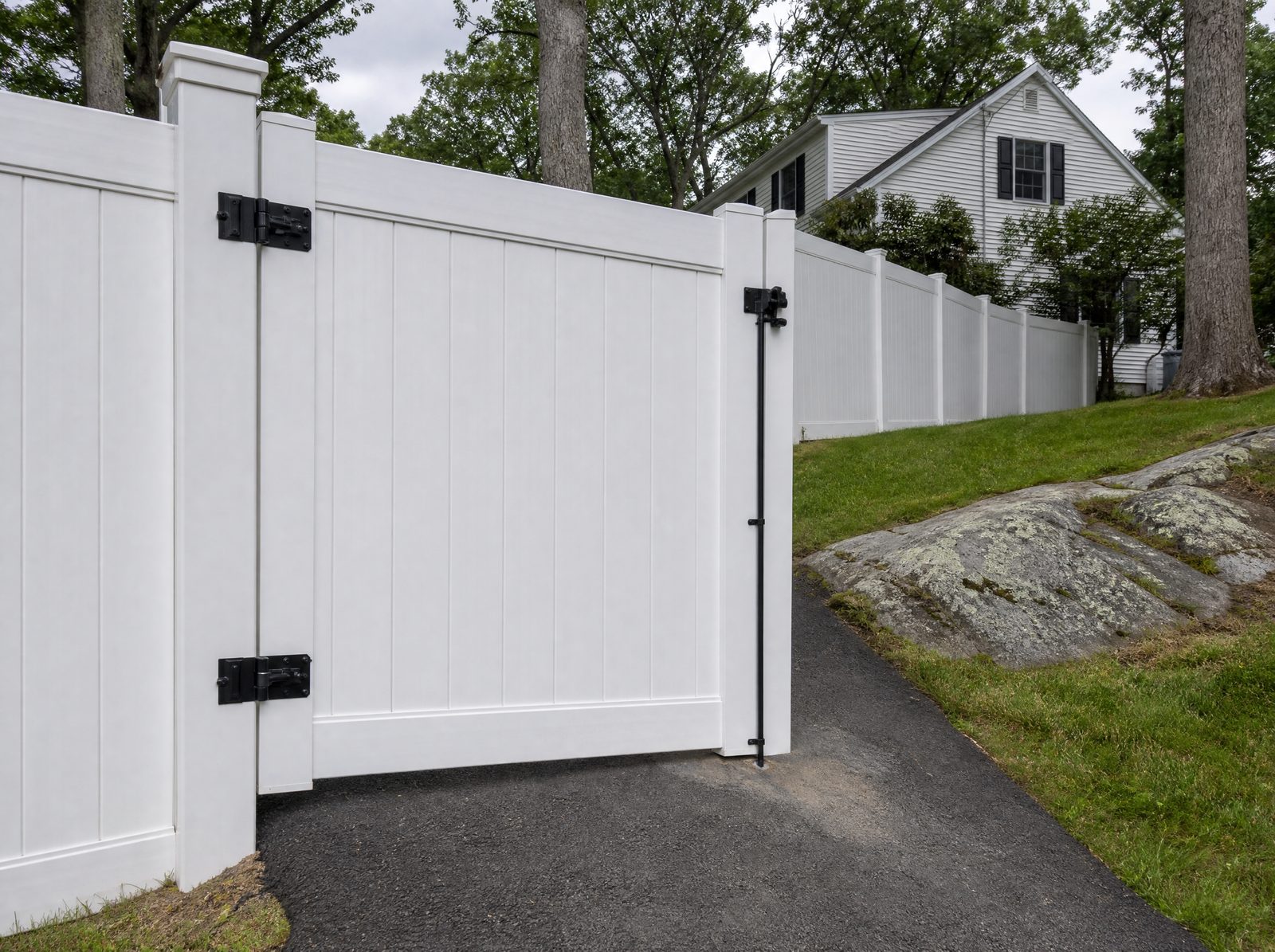
A vinyl gate that holds up is usually a metal gate wearing vinyl. An internal aluminum frame is what resists the racking force that pulls a gate out of square, and diagonal reinforcement addresses the same problem. Around it, the hinge post and latch post need support sized for the gate rather than for an in-line panel, since the hinge post carries the whole leaf on two or three points. Hinge type, latch choice, gate width, and bottom clearance get decided together. A wide gate without adequate reinforcement can sag, twist, or simply stop latching, and no amount of adjustment fixes a frame that was never there.
Driveway Gates, Slope, and Snow
Wider openings compound every one of those problems. A driveway or estate gate has more force working against it, and if the drive slopes, the swing has to clear rising ground through its whole arc. Then add a New Fairfield winter: snow piled where the gate opens, ice under the swing, and frost moving the ground the posts sit in. Double gates add alignment between two leaves that both have to land right. Where a pool is involved, self-closing and self-latching hardware is part of the pool fencing requirement rather than a preference, and the pool barrier code governs the whole system.
What a New Fairfield Winter Does to a Vinyl Fence
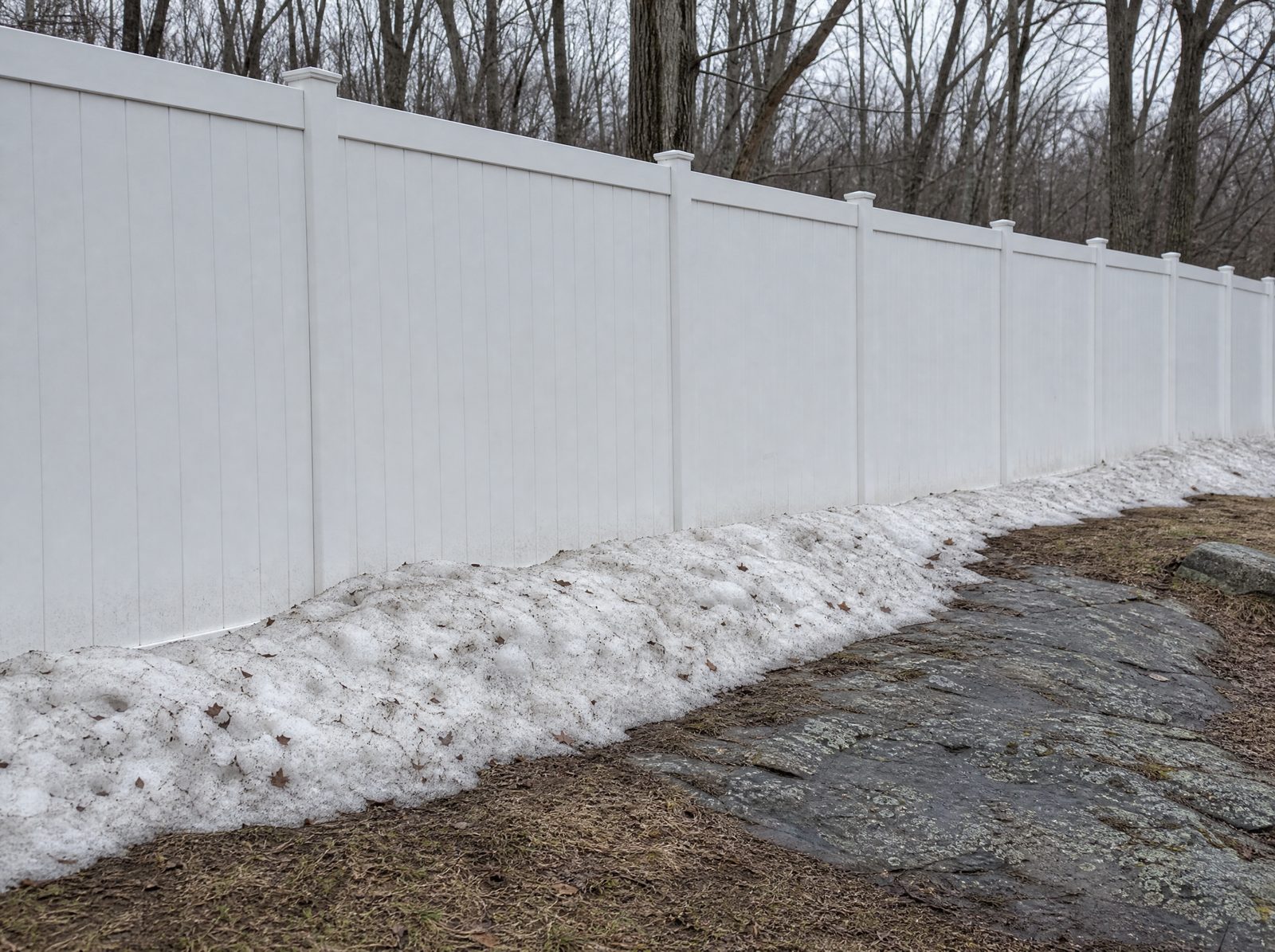
New Fairfield gives a fence real winter, with repeated freeze-thaw cycles that work on anything set shallow or poorly drained. Vinyl adds a second seasonal issue on top of that, because PVC changes dimension as temperatures change. A well designed and installed system allows for that movement, and a poor one binds, buckles, or pulls apart. Both problems, the ground and the material, are solved at install, which is why the crew matters as much as the product.
Expansion and Contraction Are Designed In, Not Ignored
A vinyl fence is meant to move a little. The manufacturer specifies clearances, rail insertion depth, panel width, and fastening methods that let it do that without stress, and an installer who fights those clearances to make something look tight in July is building a problem for January. Direct sun exposure, darker colors, and post spacing all feed into it. These details only exist in the product-specific instructions, which is one more reason a named manufacturer beats a generic bid.
Post Setting Is What Holds the Line
Everything above the ground depends on what is below it. Connecticut's residential code requires permanent supports of regulated structures to be protected from frost, and while a typical fence is not always regulated like a building foundation, the principle is exactly why shallow or poorly drained posts heave and lean. There is no single correct depth for every fence, and anyone quoting one number for everything is guessing. Depth and support come from fence height, solid or open design, post size, gate load, soil and ledge, drainage, wind exposure, and the manufacturer's specifications together. Gate, corner, and terminal posts, and any post carrying a solid privacy panel, need more than a light in-line post. Drainage under the post matters as much as depth, because water that sits and freezes does the damage. Setting posts means digging, so a valid Call Before You Dig request is required by law first, and private lines like septic, irrigation, and pet-fence wire may need a separate locate.
Following the Grade Without Leaving Gaps
New Fairfield yards slope, and vinyl has opinions about that. Depending on the product, panels may be racked to follow the grade continuously, stepped down in level sections, custom trimmed, or paired with a retaining wall. Racking changes the panel geometry and every product has a limit to how far it will go. Stepping keeps panels level but leaves triangular gaps underneath, which matters a great deal if the fence is there for pet containment and not much at all if it is there for looks. Gates should avoid steep grade wherever the layout allows.
What Vinyl Fence Cost in New Fairfield Actually Depends On
There is no honest one-price-fits-all number for a vinyl fence, and any homeowner who has collected a few bids already knows it. Connecticut cost guides show broad installed ranges because material grade, layout, gates, terrain, removal, and labor swing so much from lot to lot, so treat a published range like Angi's vinyl fence cost breakdown as general market context, not a quote for your yard. What is more useful is knowing where the money goes, because that is what lets you read three estimates side by side.
Footage, height, and style set the baseline, but product grade is the line that matters most here, because profile dimensions, post and rail size, and internal reinforcement are the most common reason two bids for the same fence diverge. Everything after that is your lot: gates, color, slopes, ledge, wind exposure, removal, and access. When you compare bids, make sure they all handle the old fence and the gates the same way, or you are not comparing the same job.
Hover or tap a row to highlight it.
| Cost Driver | Why It Matters |
|---|---|
| Linear footage and height | More posts, panels, and labor, and taller solid panels use more of everything. |
| Product grade | Wall thickness, profile dimensions, and post and rail size are real material cost, and the usual reason two bids differ. |
| Panel style | Full privacy, semi-privacy, picket, ranch rail, and lattice-top all price differently. |
| Gates and reinforcement | Quantity, width, internal aluminum framing, and hardware each add, and wide gates add most. |
| Color | White, tan, gray, and custom colors are not priced the same. |
| Slopes and grade transitions | Racking, stepping, and custom trimming add layout time and sometimes extra material. |
| Ledge, roots, and access | Rock slows excavation and a long carry from the truck adds hours. |
| Existing-fence removal | Pulling posts and concrete and hauling debris is its own line item. |
How a Vinyl Fence Installation in New Fairfield Comes Together
A clean vinyl fence installation runs in a predictable order, and knowing that order helps you spot a crew that plans to skip a step. The compliance checks belong near the front, not as an afterthought once material is on a truck. New Fairfield states that fences not over seven feet high are generally exempt from a building permit, with one clear carve-out: a fence used as a swimming pool barrier requires a permit regardless of height. A building-permit exemption is not a zoning exemption either, so placement, setbacks, corner sight lines, easements, and wetlands can still apply. Confirm the current requirements against the town's building permit page and its zoning department before anything is ordered, since local rules change.
The Vinyl Fence Installation Process in New Fairfield
- 1
Step 1: Property Walk and Purpose
We walk the line to settle what the fence is for, the approximate footage, the exposure, and where the gates need to be.
- 2
Step 2: Boundary and Compliance Review
Surveys, property lines, zoning, permits, wetlands, and pool-barrier rules get reviewed before material is ordered.
- 3
Step 3: Product Specification
The manufacturer, profile and post sizes, rail reinforcement, style, color, gate frames, and hardware get written down, not implied.
- 4
Step 4: Utility Marking and Site Prep
A Call Before You Dig request goes in, private lines are identified, and the fence path is cleared.
- 5
Step 5: Post Setting
Posts are set for the soil, drainage, grade, wind exposure, and gate loads on your lot, with heavier support at gates, corners, and terminals.
- 6
Step 6: Panels, Gates, and Walkthrough
Rails and boards go in with the manufacturer's clearances, gates are hung and adjusted, bottom gaps checked, and the job walked with you.
Questions That Separate a Real Vinyl Fence Estimate From a Vague One
Choosing a vinyl fence contractor in New Fairfield starts below the interesting part. Connecticut law requires home improvement contractors, including fence installers, to register with the Department of Consumer Protection, and the state explains why that registration protects you. Checking any contractor's registration through the state's license verification takes a couple of minutes and is worth doing on every bid you hold, ours included. My Fence Guy is a family-owned contractor headquartered right here in New Fairfield, licensed and insured, and we give free estimates. Registration and insurance are the floor, though, not the reason to hire anyone. Past that floor, these are the questions that make a vague vinyl bid tell the truth:
- Who makes it: The manufacturer and the specific profile line, written on the estimate.
- How thick: Wall thickness and the post and rail dimensions, not just "heavy duty."
- What is reinforced: Which rails carry internal reinforcement, and what is inside every gate frame.
- Routed or bracketed: How the rails meet the posts, and why that choice for this fence.
- How the posts get set: Depth and support at in-line, corner, terminal, and gate posts, and how drainage is handled.
- What happens at the slope: Racked, stepped, or trimmed, and what the bottom gaps will look like when it is done.
- Who calls 811: Which party files the Call Before You Dig request and handles private locates.
- What the warranty excludes: Coverage terms, exclusions, transferability, and whether labor is included.
- Removal and cleanup: Who pulls the old fence and concrete, hauls it, and restores the ground.
- Parts later: Whether the profile is current and how a damaged panel gets matched in five years.
Hold all three bids against that list and the price spread usually explains itself. Connecticut's contracting guidance is a good checklist for the contract, which should name the contractor and registration number, the footage and height, the materials, the schedule, the payments, and the warranty in writing.
Frequently Asked Questions About vinyl fencing new fairfield ct
Q: Is vinyl fencing the same thing as a PVC fence?
A: Effectively yes. Vinyl fencing is commonly made from rigid polyvinyl chloride, or PVC, combined with pigments, UV stabilizers, impact modifiers, and other additives. The additives are a large part of why two vinyl products with the same name perform differently.
Q: What makes one vinyl fence better than another?
A: Wall thickness, profile dimensions, post and rail size, the UV and impact-modifier package, internal reinforcement, how the rails meet the posts, and the gate frame construction. Height and color are what you see, but they are not what decides how the fence ages.
Q: Does white vinyl fencing turn yellow?
A: Quality vinyl products use pigments and UV stabilizers to resist it, but weathering, staining, product quality, chemical exposure, and age can all affect appearance over time. Following the manufacturer's cleaning and warranty guidance matters, and so does what went into the compound in the first place.
Q: Is vinyl privacy fencing a problem in windy spots?
A: Solid panels catch substantial wind, so exposure has to be designed for rather than discovered. Fence height, uninterrupted run length, terrain, open fields, and lake exposure all feed into post size, post spacing, rail reinforcement, and footing decisions.
Q: Why do vinyl gates sag?
A: Usually inadequate internal reinforcement, an undersized or under-supported hinge post, a gate leaf too wide for its framing, weak hinges, or ground movement. A vinyl gate that holds its line is generally an aluminum frame inside a vinyl skin.
Q: Is vinyl fencing maintenance-free?
A: No, though it is low maintenance. It does not need painting or staining, but it still wants washing, gate adjustment, hardware checks, vegetation control, and inspection after storms or impact from mowers, plows, or branches.
Q: Does vinyl fencing in New Fairfield Connecticut need a permit?
A: New Fairfield generally exempts fences not over seven feet from a building permit, but a fence used as a pool barrier requires a permit regardless of height. Zoning, placement, easements, and wetlands rules can still apply, so confirm the current requirements with the town before installation.
Test Your Vinyl Fence Knowledge
1. What most reliably signals the grade of a vinyl fence product?
2. Why does a solid vinyl privacy panel need more support than a picket line?
3. What is usually inside a vinyl gate that does not sag?
4. What does PVC do as temperatures change?
5. Is there one correct post depth for every vinyl fence?
Pick an answer to begin.
Final Thoughts
Vinyl earns its reputation when it is specified properly and installed for the site it stands on. The panel you see is only half the fence: wall thickness, the UV and impact package, rail reinforcement, and how the rails meet the posts decide how it looks in year ten, while post setting, drainage, wind exposure, and gate framing decide whether it is still straight and still latching. Those are all knowable things, and every one of them can be written on an estimate before you sign it.
Get it right and the fence quietly does its job. No staining weekends, no annual repairs, a white line that still reads white, and a gate that closes the same way in February as it did in July. That is what low maintenance is supposed to mean, and it is the payoff for slowing down at the specification stage instead of buying on the word "vinyl."
If you are weighing vinyl fencing in New Fairfield CT, we would be glad to walk your property and show you exactly what we would put in the ground and why. My Fence Guy is a family-owned contractor headquartered in New Fairfield, CT, and we install residential, commercial, industrial, and agricultural fencing in vinyl, wood, aluminum, chain link, and ornamental styles, plus pool fencing, pet fencing, gates, and railings. We will spell out the manufacturer, the profile, the reinforcement, and the gate framing, so you can compare our bid to any other line by line. Call us at (203) 746-1100 for a free estimate, or reach out through our contact page.
Vinyl Fencing Key Terms
Tap a term to see what it means.
Rigid PVC. Polyvinyl chloride, the base polymer in vinyl fencing, compounded with pigments, stabilizers, and modifiers before it is extruded into profiles.
More about fences
Wood Fencing in New Fairfield, CT: What Lasts and What Warps
Cedar or pressure treated? Wood fencing in New Fairfield, CT, plus the privacy styles, fasteners, and the staining cadence that keeps a fence straight.
Read the guide to Wood Fencing in New Fairfield, CTVinyl Fencing in Southbury, CT: What Separates Good From Bad
Vinyl does not rot, but it does sag, yellow, and crack. What separates vinyl fencing in Southbury, CT that lasts: thickness, additives, and gate steel.
Read the guide to Vinyl Fencing in Southbury, CTVinyl Fencing in Sherman, CT: How to Spot the Good Stuff
Three quotes, one white privacy fence, three different products. How to read vinyl fencing specs in Sherman, CT: wall thickness, UV, and reinforcement.
Read the guide to Vinyl Fencing in Sherman, CT