
Automatic Driveway Gate Problems: Power Outages, Cold Weather and Common Fixes
By Tony Pellicone13 min readPublished
- automatic gates
- estate gates
- fence repair
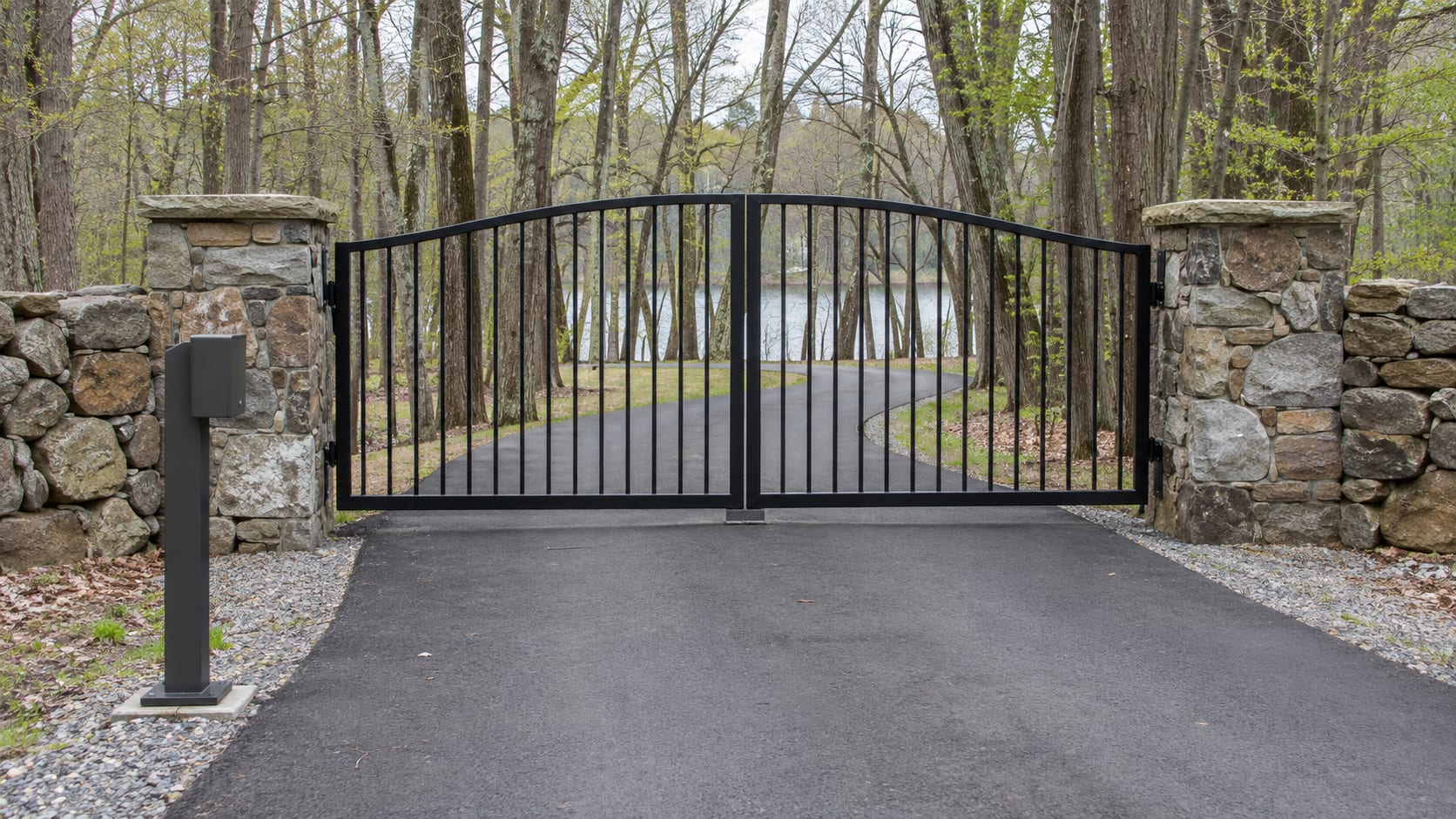
Most automatic driveway gate problems come from a blocked safety sensor, weak battery, power interruption, mechanical resistance, or a limit and control fault. Start by keeping people, pets, and vehicles clear, then check the path, photo eyes, power supply, and manual-release procedure for your operator.
If the gate is hard to move manually, repeatedly reverses, alarms, or fails a safety test, stop using automatic operation and arrange service.
Cold weather can make a sound system appear weak because batteries lose performance, while snow and ice can stop a slide gate or overload a swing gate. The repair cost depends on whether the issue is a simple remote, sensor, battery, or limit adjustment, or a larger problem involving the motor, control board, wiring, gate structure, track, or foundation.
Key Takeaways
Start safely
Keep people, pets, and vehicles away from the gate path and entrapment zones.
Check the basics
Look for snow, ice, debris, blocked photo eyes, power loss, and a low battery.
Use the manual release carefully
Follow the operator manual because releasing the motor does not make the gate safe to move.
Watch the gate type
Slide gates need clear tracks and wheels, while swing gates need a clear arc, hinges, and stops.
Know the town rule
Connecticut fence and gate requirements are set by each municipality and sometimes by zoning district.
The first checks when an automatic gate stops
A gate that will not open or close needs a simple first distinction. If the gate moves freely with the manufacturer’s manual-release procedure but will not move under power, the operator, battery, controls, safety circuit, or power supply may need diagnosis. If the gate is difficult to move manually, repair the gate, hinges, wheels, track, arms, posts, or foundation before replacing the operator.
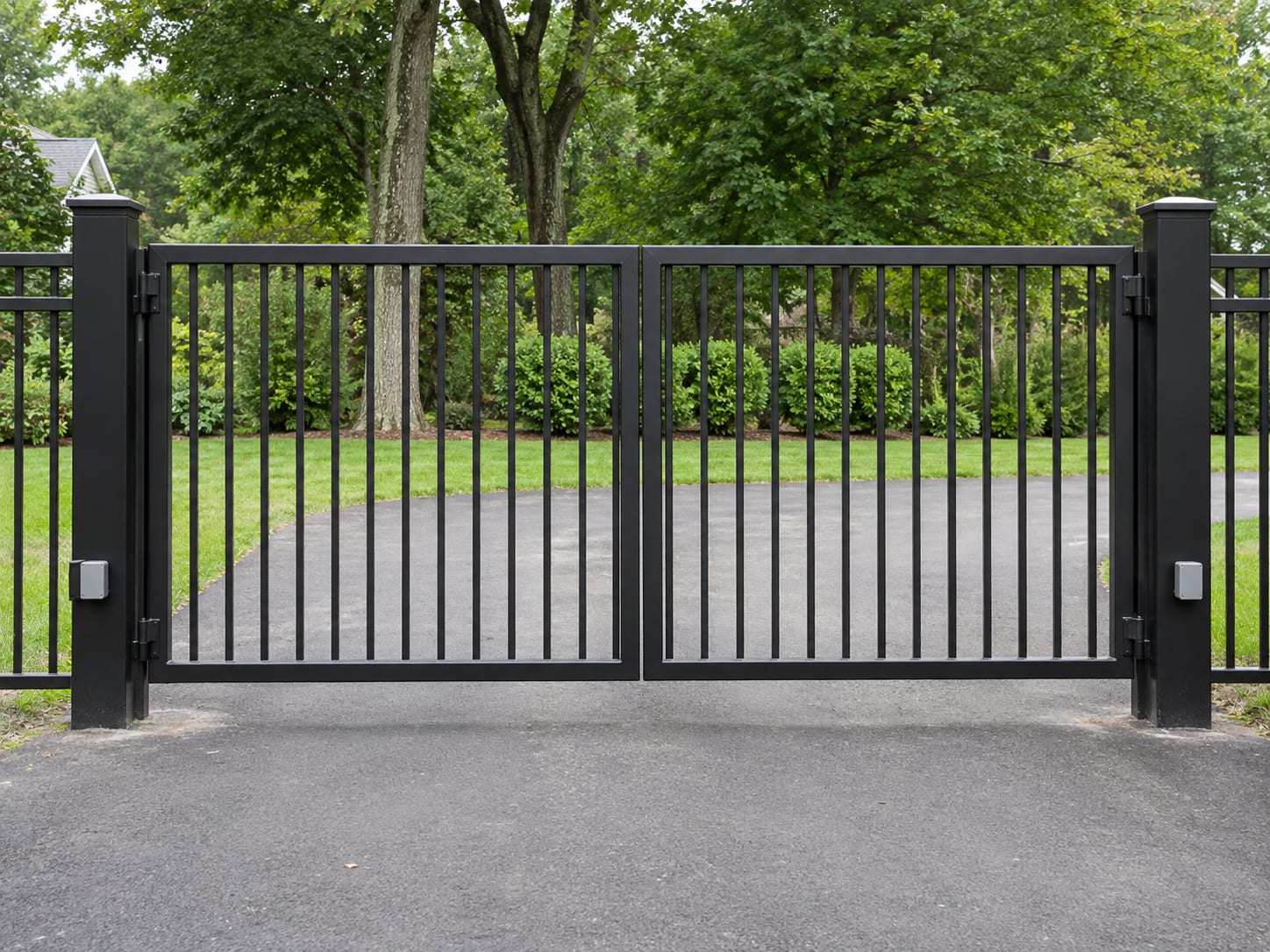
Keep the gate area clear while you look. Inspect the travel path for snow, ice, rocks, branches, vehicles, mud, and anything that may have shifted into the gate’s path. Look at the photo eyes for visible dirt, snow, impact, or obvious misalignment. A sensor beam that is blocked, aimed incorrectly, wired incorrectly, or damaged can prevent closing or make the gate reverse.
You can confirm that a power switch or breaker has not been turned off if checking the electrical panel can be done safely. You can replace a remote battery when the operator manual permits it, then test another authorized control if one is available. Record diagnostic lights, error codes, and the exact behavior, such as stopping partway, reversing at the same location, moving slowly, or responding to a keypad but not a remote.
The manufacturer’s manual controls the safe reset, release, limit, and reversal procedures. Keep every photo eye, reversing edge, loop, and other entrapment device active while you troubleshoot.
Why gates reverse, stop partway, or move weakly
A closing gate often reverses because its safety system detects a blockage or because the gate meets too much resistance. Common causes include a vehicle, branch, rock, snowbank, ice buildup, wall, damaged wheel, bent track, or gate stop. Dirty, wet, misaligned, shorted, or damaged photo eyes can create the same symptom.
A gate may stop partway when its travel limit is incorrect, lost, stuck, or poorly learned. Limit faults can make the gate stop short, run too far, open only partway, or exceed its expected run time. The operator may also be reacting to low voltage, a weak battery, excessive force, or a control-board error.
For a slide gate, inspect the track and wheels after freeze thaw cycles and plowing. Ice, packed snow, and small rocks can increase rolling resistance. A wheel that has moved off the rail, a broken axle, or a bent or cracked track can make the operator appear to fail even when the motor is working.
For a swing gate, snow can block the arc, while ice can bind hinges, arms, stops, locks, or the ground beneath the panel. Wind and snow load can increase the force needed to start or finish a cycle. Let the operator stop rather than forcing it through frozen resistance.
If the gate works manually but not automatically, the operator, battery, control board, safety circuit, travel limits, or access control may need service. If the gate is difficult to move manually, correcting the mechanical problem comes first. Gate Won't Latch or Close? Fixing Sagging, Dragging and Gapped Gates explains related problems that can affect closing and latching.
What a power outage does to the operator
The result of a power outage depends on the operator, battery, lock, and access-control design. A charged backup battery may provide a limited number of opening and closing cycles. LiftMaster identifies 11.5 VDC as the minimum battery voltage for operation in the cited residential DC operator. A disconnected, undercharged, or failed battery can leave the operator inactive when utility power is unavailable.
An operator without usable backup power usually requires a manual release. Depending on the equipment, that may be a keyed disconnect, release handle, detachable swing arm, or chain-release method. A manual release does not automatically make the gate safe to move. Keep people and vehicles away from the travel path and follow the specific manual.
A separate electric lock may be fail-safe or fail-secure. A fail-safe lock releases when power is lost. A fail-secure lock remains locked when power is lost, although an approved mechanical release may still allow authorized manual opening. Those terms describe the lock or access-control system, and the rest of the gate has its own release method.
Before the next outage, ask the installer where the release key is stored, how many backup cycles the battery is expected to provide, whether the lock releases without power, and how the gate should be secured after manual opening. The article Driveway Gate Openers: Swing Arm, Underground, Slide and Solar covers swing arm, underground, slide, and solar operator choices.
Cold weather, snow, and solar battery performance
Cold weather can reduce battery performance and make an otherwise functional operator appear slow or intermittent. Mighty Mule states that extreme cold may slow operation or cause malfunction and recommends an optional battery heater for extreme conditions. Its FM316 heater is recommended for extended periods below 32°F and is not compatible with solar-powered systems. Check the approved equipment for your operator before adding a heater.
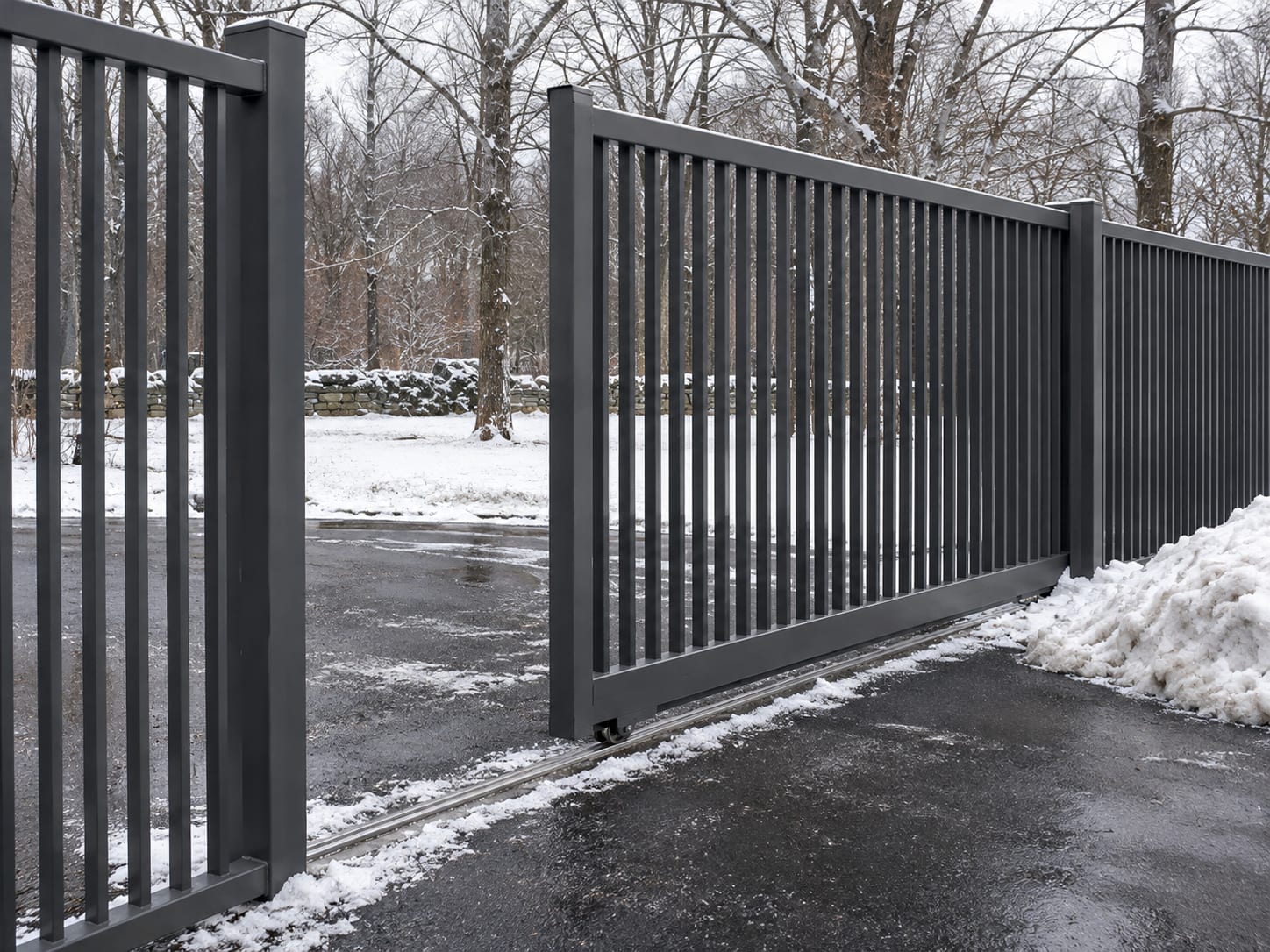
Snow should not build up in the travel path or against the gate. For a slide gate, clear the track, wheels, rollers, and area where the gate parks. For a swing gate, clear the arc, hinges, stops, latch, and ground beneath the panel. A snowbank left at the end of a driveway can create enough resistance to trigger obstruction sensing or prevent a cycle.
A solar operator uses a panel to charge a battery, and the battery supplies the operator during cycles and at night. Capacity depends on panel wattage, battery size, standby current, solar exposure, and cycles per day. Short winter days, clouds, shade, and snow on the panel reduce reserve.
LiftMaster states in its RSW12UL manual that solar installations are not supported in northern climates because of cold weather and fewer winter sunlight hours. The approved operator model matters more than a generic solar estimate.
A property with a shaded driveway may have less winter sun on the panel than the open part of the lot. That changes the battery reserve and should be part of the equipment decision.
Owner checks and technician work
You can handle low-risk checks without opening the operator cabinet or changing its settings. Clear accessible snow and debris, inspect the photo eyes, confirm power if safe, replace a permitted remote battery, observe diagnostic lights, and use the manual release exactly as described by the manufacturer.
Testing safety reversal should follow the manufacturer’s instructions, with no person in the gate path. A failed reversal test, unexpected movement, repeated alarm, or missing safety device calls for service.
A trained technician should handle internal fuses, control boards, high-voltage circuits, buried wiring, battery testing under load, chargers, solar wiring, heaters, limit programming, force settings, loops, reversing edges, and photo-eye replacement. Structural repairs also belong with a qualified gate or fence professional when they involve hinges, arms, rollers, wheels, tracks, posts, foundations, chains, or a heavy gate panel.
UL 325 addresses gate-operator safety and entrapment protection. UL Solutions states that automated gate systems require independent primary and secondary protection for entrapment zones, and monitored safety devices must be active. ASTM F2200-24 covers automated vehicular gate construction and states that automated vehicular gate systems are to comply with UL 325. A completed repair keeps every safety device working.
Ask My Fence Guy or any contractor for a written quote that separates the service call, diagnosis, parts, labor rate, permit responsibility, structural repairs, and final safety testing. A repair involving a motor, control board, track, wiring, trenching, or gate structure should not be priced as if it were only a sensor adjustment.
Hover or tap a row to highlight it.
| Repair or service | National figure | Unit and source |
|---|---|---|
| Automatic gate repair | $550 to $1,500, average about $900 | Per project, Angi national data |
| Emergency or after-hours fee | $150 to $200 | Per visit, Angi national data |
| Motor repair or replacement | $300 to $4,750 | Per project, Angi national data |
| Sensor repair | $100 to $1,250 | Per project, Angi national data |
| Track or roller repair | $150 to $600 | Per project, Angi national data |
| Wiring repair | $200 to $900 | Per project, Angi national data |
| Remote or keypad repair | $75 to $300 | Per project, Angi national data |
| Hinge or structural repair | $120 to $500 | Per project, Angi national data |
| Technician labor | $50 to $150 | Per hour, Angi national data |
These figures are national context, not Connecticut estimates. The final price depends on the fault, access to the wiring, replacement parts, trenching, gate weight, structural condition, and whether the operator or the gate itself needs work. Angi reports the figures in its national automatic gate repair cost data.
Power use and solar operation
An automatic gate usually uses little energy while idle, but the motor draws substantially more power during movement. Accessories such as radios, wireless dual-gate devices, expansion boards, loop detectors, lights, keypads, intercoms, and heaters change the total.
LiftMaster’s RSL12UL solar-use data lists typical standby battery current of 4.2 mA at 12 V for the main board with no programmed radios, about 0.05 watts. Programmed remote controls add 1.5 mA, a MyQ or wireless dual-gate device adds 3.9 mA, an expansion board adds 18.5 mA, and each loop detector adds 6.6 mA.
A separate Chamberlain GA420D manual lists maximum power consumption of 30 watts while charging the battery. Charging power is a separate figure from the motor’s operating draw and from the system’s monthly energy use.
For a useful estimate, gather the operator model, operating watts or current, motor minutes per day, open and close cycles, standby draw, battery-charging losses, accessory loads, heater loads, and local electricity rate. For solar, add panel wattage, battery size, winter exposure, expected cycles, and snow or shade on the panel.
A practical gate troubleshooting sequence
- 1
Make the area safe
Keep people, pets, and vehicles out of the travel and entrapment zones.
- 2
Check the path
Remove accessible snow, ice, rocks, branches, vehicles, and other obstructions.
- 3
Inspect the sensors
Look for dirt, snow, impact, moisture, or obvious photo-eye misalignment.
- 4
Identify the power condition
Check utility power, battery status indicators, and the operator switch if safe.
- 5
Compare manual and powered movement
Use the manufacturer’s release procedure and note whether the gate moves freely.
- 6
Record the behavior
Write down error lights, alarms, stopping points, reversal points, and which controls respond.
- 7
Arrange service when needed
Stop automatic operation for repeated reversal, unexpected movement, failed safety tests, or mechanical resistance.
Connecticut permits and town questions
Connecticut fence and gate requirements are set town by town. Zoning, setbacks, driveway rules, sight-line requirements, wetlands review, inspections, and permits can vary by municipality, zoning district, and site condition.
Before work starts, ask the town office which department reviews the proposal. Depending on the location, that may be the Building Department, Land Use Department, Planning and Zoning, Zoning Enforcement Officer, Inland Wetlands Commission, or Highway Department. Ask whether you need zoning approval, a building permit, driveway approval, an electrical permit, wetlands review, or a certificate of compliance.
Also ask whether the gate affects a public right-of-way, sidewalk, state or town road, sight line, wetland, watercourse, septic area, or drainage system. Confirm whether the gate will swing or slide entirely on your property, what survey or site information is required, who obtains each permit, and whether that responsibility is written into the contract.
Connecticut Department of Consumer Protection states that home-improvement contracts must be written, signed, and dated, with the work description, materials, dates, price, payment schedule, permit responsibility, and cancellation notice. Changes should also be in writing.
Connecticut requires notification to Call Before You Dig when power-operated equipment will be used for excavation. Homeowners using power equipment must call two full working days before digging. A contractor performing the excavation must make the notification. Review Do You Need a Permit for Fence Installation in CT? before speaking with the town, then confirm the current local requirement directly.
Brookfield illustrates why one town’s rule should not be applied across Connecticut. Brookfield zoning regulations state that fences under eight feet may be constructed in residential districts without zoning approval, while fences eight feet or higher require zoning approval before construction and a certificate of zoning compliance after construction. Brookfield’s FAQ states that fences under seven feet do not require permits and taller fences require a building permit. Ask Brookfield Land Use or Building officials to identify the current rule for your property before ordering materials.
Newtown’s zoning regulations require a zoning permit before a new or changing use of land, building, or other structure, and identify additional approvals that may include a driveway permit and Inland Wetlands Commission approval. Danbury maintains its own zoning regulations and directs applicants to its Permit Center and Building Department for permit coordination and building-code requirements. The answer depends on the town, the property, and the proposed gate.
Frequently Asked Questions
What are common electric gate problems and fixes?
Common problems include blocked photo eyes, weak batteries, power loss, mechanical resistance, incorrect limits, damaged tracks, and remote or keypad faults. Clear the path, inspect visible sensors, check safe power indicators, and use the manual release only as directed. A technician should handle internal wiring, control boards, force settings, safety devices, and structural repairs.
What happens when electric gates lose power?
An electric gate may keep working for limited cycles on a charged backup battery, stop until utility power returns, or require a keyed manual release. A separate fail-safe lock releases when power is lost, while a fail-secure lock remains locked. The operator and lock model determine the result, so learn the release procedure before an outage.
Why does an automatic gate open by itself?
An automatic gate may open because of a stuck keypad, remote, intercom, telephone-entry system, vehicle loop, timer, smart-device input, receiver, underground wire, or control board. Note when the gate opens and which controls are active, then stop automatic use if it continues moving unexpectedly. A technician should inspect the inputs, wiring, receiver, loops, access logs, and control board.
Why does a gate reverse when closing?
A gate reverses when closing because its safety system detects an obstruction or because the gate meets excessive resistance. Snow, ice, rocks, vehicles, dirty photo eyes, a bent track, a wheel off the rail, damaged hinges, incorrect force settings, low voltage, or a failed safety device can cause the response. Leave the reversal system active.
Does an automatic gate work in snow?
An automatic gate can work in snow when its track, wheels, hinges, sensors, battery, and travel path are maintained. Clear snow from slide tracks and swing arcs, and keep plow piles away from the gate. Repeated stopping, reversing, alarms, or slow operation after freezing weather calls for service rather than added force.
Automatic gate troubleshooting check
1. What should you check first when a gate reverses while closing?
2. What may allow a gate to operate during a power outage?
3. What does a fail-safe electric lock generally do when power is lost?
4. Which condition points toward a mechanical problem before an operator replacement?
Pick an answer to begin.
Final Thoughts
An automatic gate that stops after a storm or cold night may need only a cleared path, sensor cleaning, remote battery, or charged backup battery. It may also need a track, wheel, hinge, wiring, limit, safety device, or operator repair. Keep the gate safe, record what it does, and give the technician the operator model and error information.
For a new gate or replacement operator, settle the town approvals, property-line and drainage questions, manual release, battery plan, winter conditions, safety devices, and final testing before installation. My Fence Guy can explain what a quote covers and how the gate should be maintained after the work is complete. Call us at (203) 746-1100 for a free estimate, or reach out through our contact page.
Automatic driveway gate terms
Tap a term to see what it means.
Photo eye. A safety sensor that uses a beam to detect an obstruction across the gate opening.
More about fences
Driveway Gate Openers: Swing Arm, Underground, Slide and Solar
Swing arm, underground, slide or solar: matching a driveway gate opener to the gate's weight, width, daily use and power, with UL 325 safety and 2026 costs.
Read the guide to Driveway Gate OpenersDriveway and Estate Gates: Swing vs Slide, Automation and Safety
Driveway and estate gates: swing or slide for your driveway, UL 325 safety for automatic gates, power and snow needs, permits and national 2026 cost ranges.
Read the guide to Driveway and Estate GatesEstate Gates in Southbury, CT: Plan the System, Not the Panel
Estate gates in Southbury, CT: who opens it, how it fails safe, and what happens in a power cut. Operators, access control, and entrapment protection.
Read the guide to Estate Gates in Southbury, CT