
Estate Gates in Southbury, CT: Plan the System, Not the Panel
By Tony Pellicone20 min readPublished
- estate gates
- southbury ct
- automatic gates
- connecticut
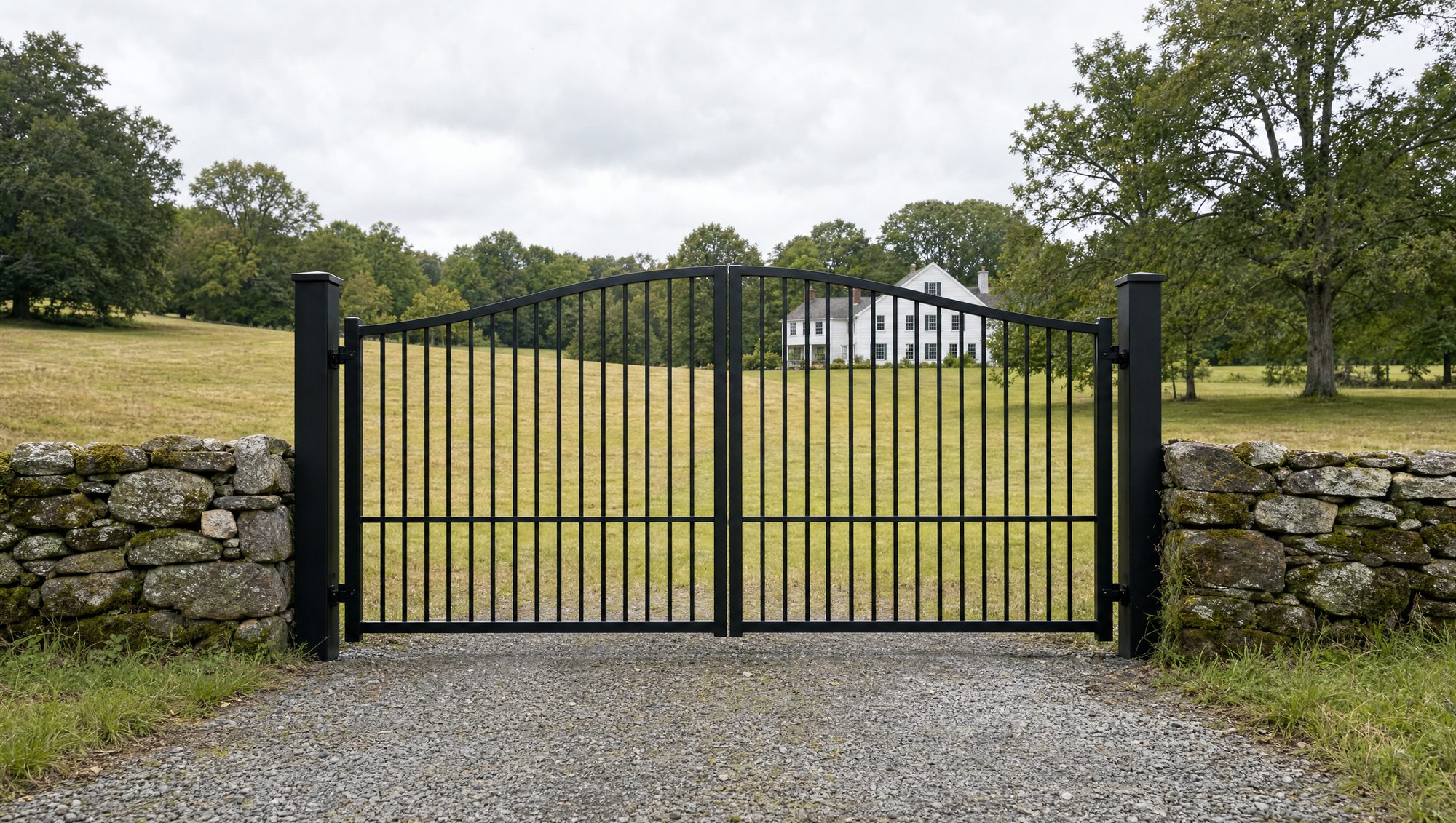
A driveway gate is not a fence panel with hinges bolted on. It is a machine that lives outside, moving a few hundred pounds of metal several times a day, in wind, in ice, and in the dark, across the one spot where your cars, your family, and the oil truck all cross paths. Learning to spot an arched top from fifty feet down the road is the fun part of the project, and it is also the part that decides the least. Gates rarely disappoint because someone picked the wrong finial. They disappoint because the driveway could not support the gate type, or the foundation got sized like a fence post, or the operator went in before anyone thought about safety devices, power, and what happens when the lights go out. Most of what decides whether estate gates in Southbury, CT still work in ten years gets settled long before anyone orders a leaf. Get the machine right and the good-looking gate takes care of itself.
Key Takeaways
The driveway picks the gate
Opening width, grade, side clearance, turning radius, and where the snow goes rule out gate types before taste ever enters the conversation.
Automation is a safety system
ASTM F2200 covers how an automated vehicular gate is built and UL 325 covers the operator, and they only work as one system.
Foundations carry a moving load
Leaf weight, wind, frost, ledge, and operator force decide posts, piers, and columns, which is why a gate support is not a fence post.
Plan for the day it fails
Power outages, manual release, a separate walk gate, and access for fire and ambulance crews belong in the design, not in the apology.
Bids differ because scopes differ
Foundations, operator class, safety devices, access control, trenching, and commissioning are where two gate quotes quietly stop matching.
Your Driveway Decides the Gate Before You Do
The most common mistake with a driveway gate in Southbury is falling for a style first and trying to make the entrance accept it. It works the other way around. The road, the pavement, the grade, and the vehicles that actually show up set the boundaries, and the gate type gets chosen from what is left.
The Opening Has to Fit More Than Your Car
A clear opening sized around a sedan will haunt you. The vehicles that need in include pickups, utility trailers, fuel and propane delivery, moving trucks, plows, and fire apparatus, which is the widest thing that will ever need your driveway and the one time it truly matters. Columns, walls, mature trees, and narrow pavement restrict the turning path too, so a wide gate can still be awkward if a vehicle cannot line up straight to enter it.
Give Cars Somewhere to Wait
A gate set close to the road forces you to stop in traffic while it opens. Where the property allows, it belongs far enough back that a vehicle can pull clear of the road and wait, and that a delivery truck is not hanging into a travel lane. That setback also leaves room for columns and lighting without pinching the opening.
Slope and Snow Are Not Details
Rising grade fights a swing gate, since the leaf has to clear ground that climbs as it opens. Slide gates answer that, but they need side room for the gate and, on a cantilever, for the counterbalance section that extends past the opening. Then there is winter. Plow routes, snow storage, a swing arc that has to stay clear, a track that has to stay clean, frozen drainage, and photo eyes that need to stay aligned all belong in the plan, not in a February phone call.
Swing, Slide, or Fold: Matching the Type to the Entrance
Every gate type trades something. Swing gates want clear arc space and cooperative grade. Slide gates want side clearance and rigid support. None of them is the best gate; one of them is the best gate for your entrance, and the survey of the driveway is what tells you which.
Single Swing Gates
One leaf pivots from one side, which suits moderate openings, level or gently sloped approaches, and designs where a single large panel looks right. Everything hangs on that one hinge post or column, so leaf weight, wind load, sag, swing path, positive stops, and the force the operator applies all have to be worked out for a single support.
Double Swing Gates
Two leaves meet near the center, cutting the length and weight of each leaf and reading as symmetrical on a wider entrance. The trade is two hinge supports instead of one, plus center alignment, drop rods or center stops, dual operators, synchronization, and keeping snow and debris out of where the leaves meet.
Cantilever Slide Gates
The gate slides parallel to the fence with no track crossing the driveway, which is why it does well on snow-prone or uneven approaches and on wider openings. It needs real side space, because the counterbalance extends beyond the opening, plus roller posts, sizeable foundations, a rigid frame, and defined safety zones.
Track Slide Gates
The gate rolls on a track at or beside the opening. That works on level, well-drained driveways where someone will keep the track clear, and it struggles where snow, ice, gravel, leaves, poor drainage, or track settlement get a vote.
Bi-Fold Gates
Panels fold as the gate opens, reducing swing depth and suiting constrained driveways with limited setback. More hinges and moving joints, specialized operators, synchronization, and a larger maintenance appetite come with it.
A Walk Gate Keeps People Out of the Car Gate
A vehicular gate should not be the normal way people walk onto the property, which is a core idea in the ASTM F2200 standard for automated vehicular gate construction. A separate pedestrian gate solves it. Plan its clear width, latch, self-closing function where needed, access control, and how it meets the walkway.
A Custom Entrance Gate That Still Works Every Day
Once the geometry is settled, the design opens up, and this is where a custom entrance gate in Southbury earns its keep. Proportion carries most of the result: gate height, column size, opening width, and fence height should balance, and oversized columns are a common way to eat useful opening width and create a turning conflict.
Aluminum, Steel, and Wood Infill
Aluminum fencing and aluminum gates run lighter than steel, resist corrosion, and reduce operator load for a comparable design, though thin or poorly reinforced frames can flex. Steel brings mass and the widest custom fabrication range for large or ornamental designs, at the price of serious corrosion protection, heavier foundations, and finish upkeep. Wood infill gives privacy and warmth, but moisture movement, weight, and wind load all grow. Hybrid gates, a metal frame with wood or decorative infill, are common for exactly that reason.
Open Versus Solid Is a Structural Choice
Open pickets let you see through the entrance and let wind pass. Solid infill buys privacy and hands the frame, hinges, operator, and foundations a much larger sail to fight on a windy ridge. It is a legitimate choice; it just has to be engineered and priced as one, not added at the end because the pickets felt too open.
Columns, Lighting, and the Fence It Meets
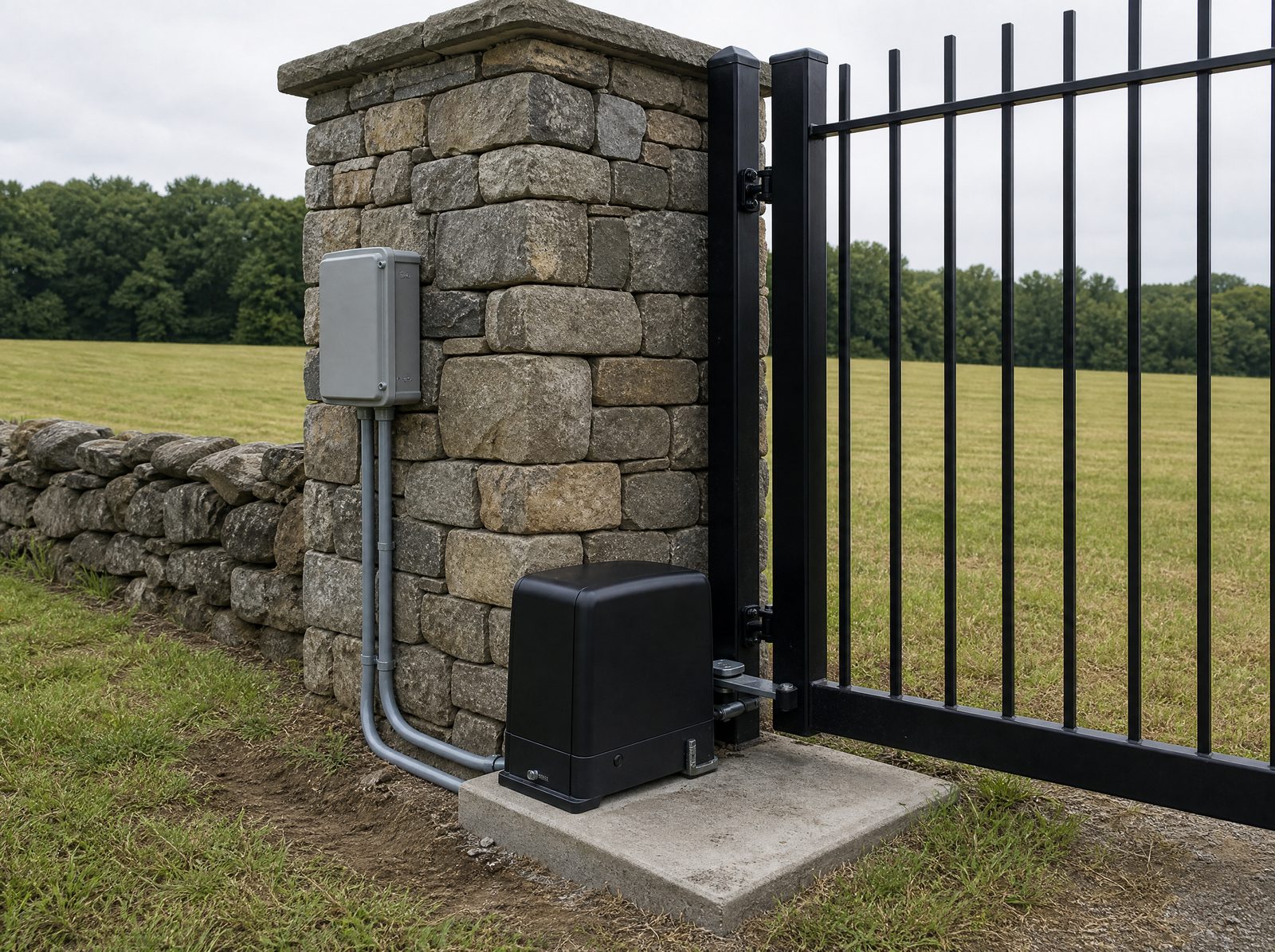
Stone or masonry columns, lighting, house numbers, an intercom pedestal, and matching fence panels are what make an entrance read as designed rather than assembled. Each adds a coordination item: columns need foundations, reinforcement, drainage, and conduit routed for gate hardware and controls before anyone lays a stone.
Automation Is a Safety System, Not an Upgrade
The moment a gate gets an operator it stops being a fence and becomes powered equipment near people and vehicles. That is why two standards exist, and why an automated gate in Southbury has to be designed as one system rather than a gate with a motor added later. A gate contractor should be able to talk about both documents without being asked twice.
What UL 325 and ASTM F2200 Each Cover
UL 325 is the safety standard for door and gate operators and systems, addressing hazards including entrapment, fire, electric shock, and casualty. ASTM F2200 is the standard specification for automated vehicular gate construction, covering horizontal slide, swing, vertical lift, vertical pivot, and overhead pivot gates under its applicable provisions. One governs the machine that moves the gate; the other governs how the gate itself is built so it can be moved safely. UL makes a related point worth repeating: access-control security and operator safety are separate things. A keypad controls who gets in. It does nothing about what happens if the gate closes on something.
The Devices That Do the Protecting
Entrapment is the hazard that drives the design. Guarding or screening of entrapment zones, protection against protrusions, positive stops, and external entrapment protection devices such as photo eyes and edge sensors are how the risk gets managed, along with monitored safety devices, the correct operator class for the application, sensible control placement, and warning signage. Photo eyes and edge sensors are safety devices, never access-control devices. And a bypassed safety device is not a repair, it is a decision to run the gate unprotected until someone gets hurt.
What Happens When the Power Dies
Southbury loses power in storms, so the honest question is not whether the gate will lose power but what it does when it does. The system needs an answer for outages, operator failure, snow blockage, and lost credentials. Manual release, battery backup, a key override, an emergency-access box, a separate pedestrian gate, and coordination with the fire department are the usual provisions. Release points should be secure but genuinely reachable by the people allowed to use them. Solar can work at some entrances, but it depends on gate usage, operator load, battery capacity, shade, panel orientation, winter sun, and what the accessories draw.
Access Control That Fits How You Actually Live
Access control is the part homeowners enjoy planning and the part that quietly decides whether the gate is a pleasure or a nuisance. Remotes suit residents and regular users, as long as someone plans for the remote that goes missing. Keypads give code-based entry, and systems supporting unique codes for residents, vendors, and temporary users are far easier to live with than one shared code that never changes. Intercoms let a visitor call the house over wired, cellular, or internet connections, and telephone entry can route those calls to your phone and let you release the gate from anywhere. Card or fob readers make sense for staff or multiple residences, and smartphone control can add remote operation and activity logs depending on the product and the signal at the entrance. Vehicle loops sit in or under the driveway to detect a car for free exit, safety, or opening logic, and their placement has to be coordinated with everything else buried there.
Foundations, Frost, Ledge, and Drainage Decide the Lifespan
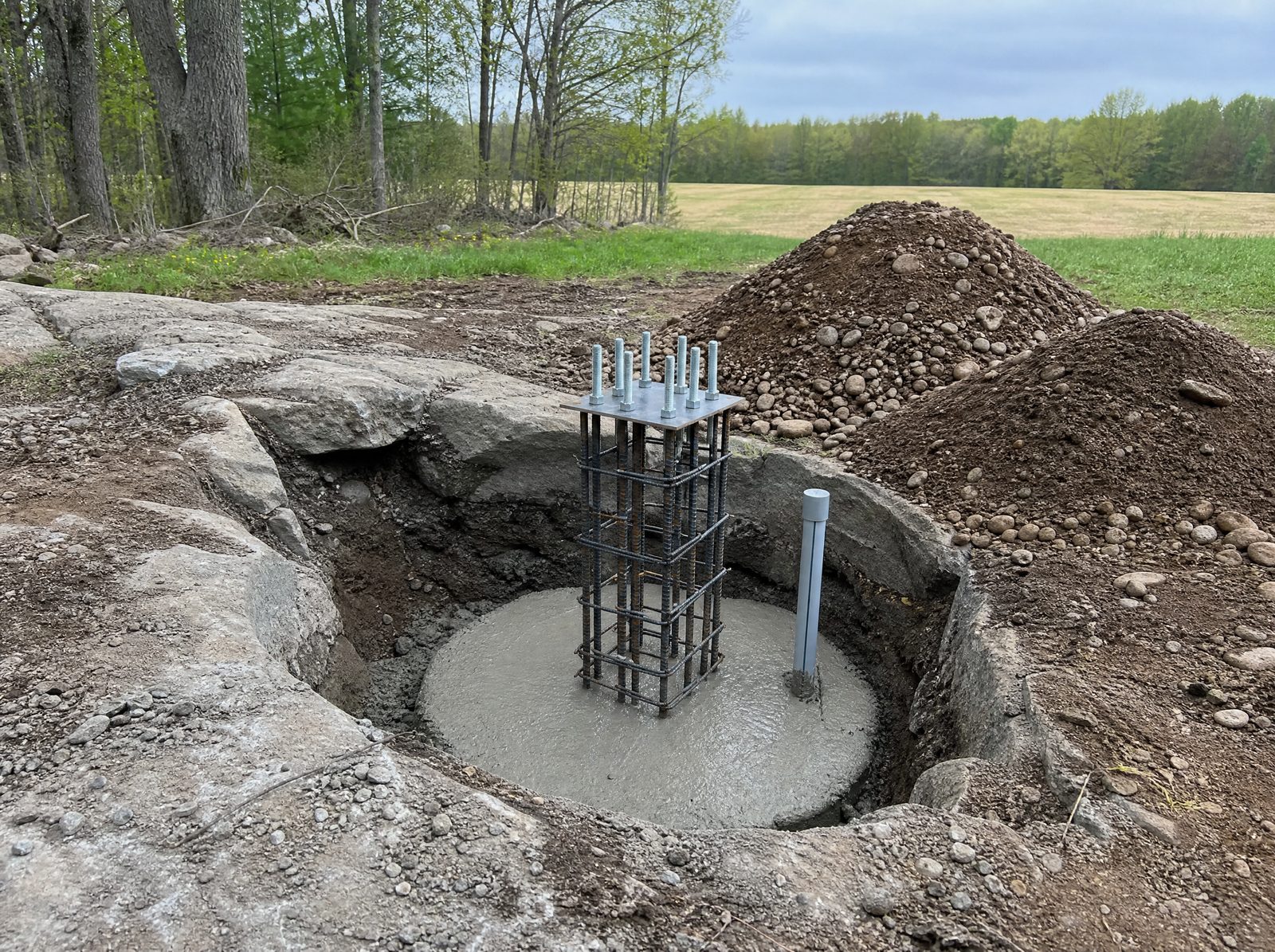
A gate support is not a fence post, because it is not holding a static panel. It resists a swinging or rolling load, wind on the leaf, and operator force, over and over, through frost, for years. This is the least glamorous part of the project and the one that decides whether the gate still closes cleanly in year eight.
Swing Supports, Slide Supports, and Columns
Hinge posts and columns have to resist vertical weight, sag, wind, and the force the operator applies every cycle. Cantilever roller posts and operator foundations have to stay aligned with each other, because settlement shows up as binding or unsafe movement rather than a cosmetic tilt. Frost matters here for the same reason it matters under any structure, which Connecticut's residential code chapter on foundations frames well even though a gate support is not always regulated like a building footing. There is no single correct depth for every gate, and anyone quoting one number for all of them is guessing.
Ledge and Water
Ledge near the surface can mean drilling, specialized anchoring, adjusted foundations, or engineering, and it should appear in the estimate as a real site condition rather than hiding inside a vague number. Water is the other one. It should not collect around operators, tracks, loops, foundations, or electrical enclosures, because whatever freezes there is what fails first.
What Southbury Will Want to Look At
Southbury takes building and zoning permit applications through its online permitting system, and the town reviews fences and gates property by property rather than by one blanket rule. That matters more here than for a plain fence run, because an estate gate is rarely just a gate. Columns, masonry foundations, electrical work, automated equipment, driveway changes, drainage, wetlands, aquifer protection areas, easements, and association restrictions can each pull in a different review. Southbury's zoning regulations are also in the middle of a full update, so the reliable move is to confirm current requirements with the town for your specific property rather than trusting older dimensional language or a rule someone heard applies in the next town over. One thing holds regardless: a gate near a road raises sight-line and setback questions, because columns, walls, plantings, and the gate itself must not create unsafe visibility where the driveway meets traffic. And if the gate forms part of a swimming pool barrier, that needs a permit no matter its height.
Survey, Easements, and the Lines You Cannot See
Estate gates tend to land exactly where the complications are: property lines, stone walls, driveway and utility easements, shared drives, road rights-of-way, and conservation restrictions. A current survey is often worth it before columns and foundations go in near a boundary, since those are not things you move casually. A contractor can lay out the project, but a licensed surveyor establishes the legal boundary, and recorded plans commonly live with the town clerk.
Call 811, Then Ask About the Lines It Misses
Posts, columns, foundations, operators, loops, and conduit all mean digging, so a Call Before You Dig request comes first; the service is free and Connecticut law requires it before excavation. Public marking is not the whole story at an estate entrance, because so much of what is buried there is privately owned: gate power, low-voltage control wiring, yard lighting, irrigation, well lines, septic, propane, drainage, security cable, and invisible pet-fence wire. Those may need a separate private locate, and the written scope should say who is responsible for each.
Who Does the Electrical Work
Connecticut requires the appropriate trade license for skilled work such as electrical. An automated entrance may need branch-circuit power, a disconnect, grounding, surge protection, conduit, low-voltage wiring, battery backup, intercom power, and connectivity. The proposal should say plainly which work is included and which licensed trade performs and permits the electrical connections. Trenching for that power and low-voltage run is not a footnote; it is often the difference between two very different-looking bids.
What Actually Moves the Cost of an Estate Gate
There is no one-price-fits-all figure for an estate gate, and the reason is easy to see once the parts are laid out. A manual aluminum swing gate and a custom automated steel entrance with masonry columns, an intercom, loops, lighting, and backup power are not the same product at two price points. They are different projects. Published consumer pricing, like Angi's driveway gate cost guide, is useful as broad market reference and nothing more; only a site visit prices your entrance. When two bids sit far apart, the gap is almost always hiding in the foundations, the operator class, the safety devices, the trenching, or the commissioning rather than in the gate you can see.
Hover or tap a row to highlight it.
| Cost Driver | Why It Matters |
|---|---|
| Clear opening and gate type | Width, and whether it swings, slides, cantilevers, or folds, drives the frame, the supports, and the operator. |
| Manual or automated | An operator brings safety devices, controls, power, and commissioning along with it. |
| Material and infill | Aluminum, steel, wood, or hybrid, open or solid, plus height and custom ornamentation. |
| Supports and foundations | Posts, piers, or masonry columns, foundation size, ledge, excavation, and drainage. |
| Electrical and controls | Trenching, conduit, licensed electrical work, loops, keypads, intercoms, readers, and battery or solar backup. |
| Site and finish work | Driveway grade, pavement restoration, removing an old gate, matching fence, lighting, permits, and commissioning. |
How an Estate Gate Installation Comes Together
A clean estate gate installation in Southbury runs in an order that protects you, and the order itself tells you a lot about the crew. Design decisions come before equipment decisions. Utilities come before excavation. Testing comes before turnover. A contractor who picks the operator before the gate design is settled has the sequence backwards, and you will find out where in about a year. Turnover is the step people forget to ask about: remotes, codes, keys, manuals, warranties, and someone actually showing you how the manual release works before they drive away.
The Southbury Estate Gate Installation Process
- 1
Step 1: Define Access and Security Goals
We settle who uses the entrance, which vehicles need to get in, and what has to happen in an emergency or an outage.
- 2
Step 2: Survey the Entrance and the Documents
We measure opening width, road setback, grade, turning radius, side clearance, and stacking, then review the survey, easements, and town requirements.
- 3
Step 3: Choose the Gate Type and Design
Swing, slide, cantilever, or bi-fold gets chosen from the geometry, then frame, infill, finish, columns, and matching fence.
- 4
Step 4: Specify the Automation and Power
Operator, photo eyes, edge sensors, positive stops, signage, emergency release, controls, trenching, and backup power go into the written scope.
- 5
Step 5: Mark Utilities and Build Foundations
A Call Before You Dig request goes in, private lines are located, then posts, piers, columns, conduit, loops, and drainage are installed.
- 6
Step 6: Hang, Commission, and Hand Over
The gate is set and aligned, licensed trades wire the operator, then travel, stops, entrapment devices, emergency release, and access control are all tested before turnover.
What Separates a Gate Contractor Worth Hiring
Connecticut requires home improvement contractors to register with the Department of Consumer Protection, and you can verify a registration in about a minute. Do it, and ask for proof of insurance while you are at it. That is the floor, not a selling point. My Fence Guy is a family-owned contractor with an office right here in Southbury, licensed and insured, and we give free estimates. What matters beyond the paperwork is whether a gate contractor in Southbury can speak to ASTM F2200 construction and UL 325 operator coordination without stalling, name the licensed electrical trade doing the wiring, and hand you a written scope instead of a number on a card.
What the Written Proposal Should Cover
Connecticut's guidance on what belongs in a home improvement contract is a good checklist to hold any bid against. For a gate specifically, the scope should spell out:
- Clear opening and gate type: The measured opening and whether it swings, slides, or folds.
- Frame, infill, and finish: Material, style, color, and finish system, not just "aluminum."
- Supports and foundations: Post or column sizes, foundation design, and how ledge gets handled.
- Operator and safety devices: Operator class and model, photo eyes, edge sensors, positive stops, and signage.
- Access control and power: Controls, loops, trenching, conduit, who performs the electrical work, and backup operation.
- Permits and utility locating: Who confirms town requirements and who files the 811 request.
- Commissioning and turnover: Testing, remotes and codes, manuals, warranties, and maintenance.
- Change orders: How surprises like ledge get priced before the work happens.
Frequently Asked Questions About estate gates southbury ct
Q: Should I choose a swing or slide gate?
A: Swing gates need clear arc space and suitable grade, while slide gates need side clearance and strong roller or track support. Driveway geometry usually decides it for you, which is why the entrance gets measured before the style gets picked.
Q: Does an estate gate require a permit in Southbury?
A: Southbury takes building and zoning applications through its online system and reviews fences and gates property by property, and the zoning regulations are mid-update. Columns, masonry, electrical work, automated equipment, driveway changes, wetlands, or a pool barrier can each trigger review, so confirm current requirements with the town for your specific property.
Q: What is UL 325?
A: UL 325 is the safety standard for door and gate operators and systems. It addresses hazards including entrapment, fire, electric shock, and casualty, and it governs the operator rather than who is allowed through the gate.
Q: What is ASTM F2200?
A: ASTM F2200 is the standard specification for automated vehicular gate construction. It covers several gate types and the safety-related construction requirements that let a gate be automated safely.
Q: Can an electric gate work during a power outage?
A: It can, when the system was designed for it. Battery backup, solar capacity, a manual release, or a key override are the usual provisions, and which ones you get depends on the operator and accessories chosen, so ask before the equipment is ordered.
Q: Do I need a pedestrian gate?
A: In most cases it is worth it. A vehicular gate should not be the normal route for people on foot, and a separate walk gate keeps visitors, kids, and deliveries out of the path of a moving leaf.
Q: Who performs the electrical work on an automated gate?
A: Connecticut requires appropriately licensed tradespeople for electrical work. The proposal should name who performs it and who pulls any electrical permit, rather than leaving it as an assumption.
Q: How often should an automated gate be serviced?
A: Follow the operator manufacturer's maintenance schedule, and inspect the system routinely and after storms, heavy snow, vehicle impact, or a power outage. Check alignment, hinges or rollers, stops, drainage, the safety devices, and the emergency release, and never leave a safety device bypassed as a permanent fix.
Test Your Southbury Estate Gate Knowledge
1. What should decide whether you use a swing gate or a slide gate?
2. What does UL 325 cover?
3. What does ASTM F2200 cover?
4. Are photo eyes and edge sensors access-control devices?
5. How does Southbury handle fence and gate permits?
Pick an answer to begin.
Final Thoughts
An estate gate comes down to a handful of decisions made in the right order. Measure the entrance and let the driveway pick the gate type. Design the gate and the operator as one system so ASTM F2200 construction and UL 325 operator safety line up. Size the foundations for a moving load and for frost, ledge, and water. Plan access control, trenching, and the outage before the equipment is ordered. Confirm with the town what your specific property needs. Do those and the finials are the easy part.
Built that way, an entrance gate becomes the thing you stop noticing. It opens when you get home, it closes behind the last car of the night, it holds its line through the freeze and the plow, and it still swings true years later. That is what the planning buys.
If you are thinking about estate gates in Southbury, CT, we would be glad to walk the entrance with you and give you a straight answer. My Fence Guy is a family-owned contractor with an office here in Southbury, and we install driveway and estate gates along with residential, commercial, industrial, and agricultural fencing in wood, vinyl, aluminum, chain link, and ornamental styles, plus pool fencing, pet fencing, and railings. We handle the layout, the foundations, the operator and safety devices, the permit and utility questions, and the details that keep a gate working through a Connecticut winter. Call us at (203) 746-1100 for a free estimate, or reach out through our contact page.
Estate Gate Key Terms
Tap a term to see what it means.
Estate Gate. A driveway entrance gate and everything that makes it work, including posts or columns, foundations, hardware, operator, safety devices, and controls.
More about fences
Estate Gates in Sherman, CT: Swing, Slide, Safety, and Cost
The gate is the easy part. Estate gates in Sherman, CT depend on the driveway grade, a foundation below frost, and getting power out to the road.
Read the guide to Estate Gates in Sherman, CTEstate Gates in New Fairfield, CT: A Machine, Not a Panel
A driveway gate is a machine that moves half a ton, every day, for years. Estate gates in New Fairfield, CT: swing or slide, foundations, and safety.
Read the guide to Estate Gates in New Fairfield, CTDriveway and Estate Gates: Swing vs Slide, Automation and Safety
Driveway and estate gates: swing or slide for your driveway, UL 325 safety for automatic gates, power and snow needs, permits and national 2026 cost ranges.
Read the guide to Driveway and Estate Gates