
Estate Gates in New Fairfield, CT: A Machine, Not a Panel
By Tony Pellicone22 min readPublished
- estate gates
- new fairfield ct
- automatic gates
- connecticut
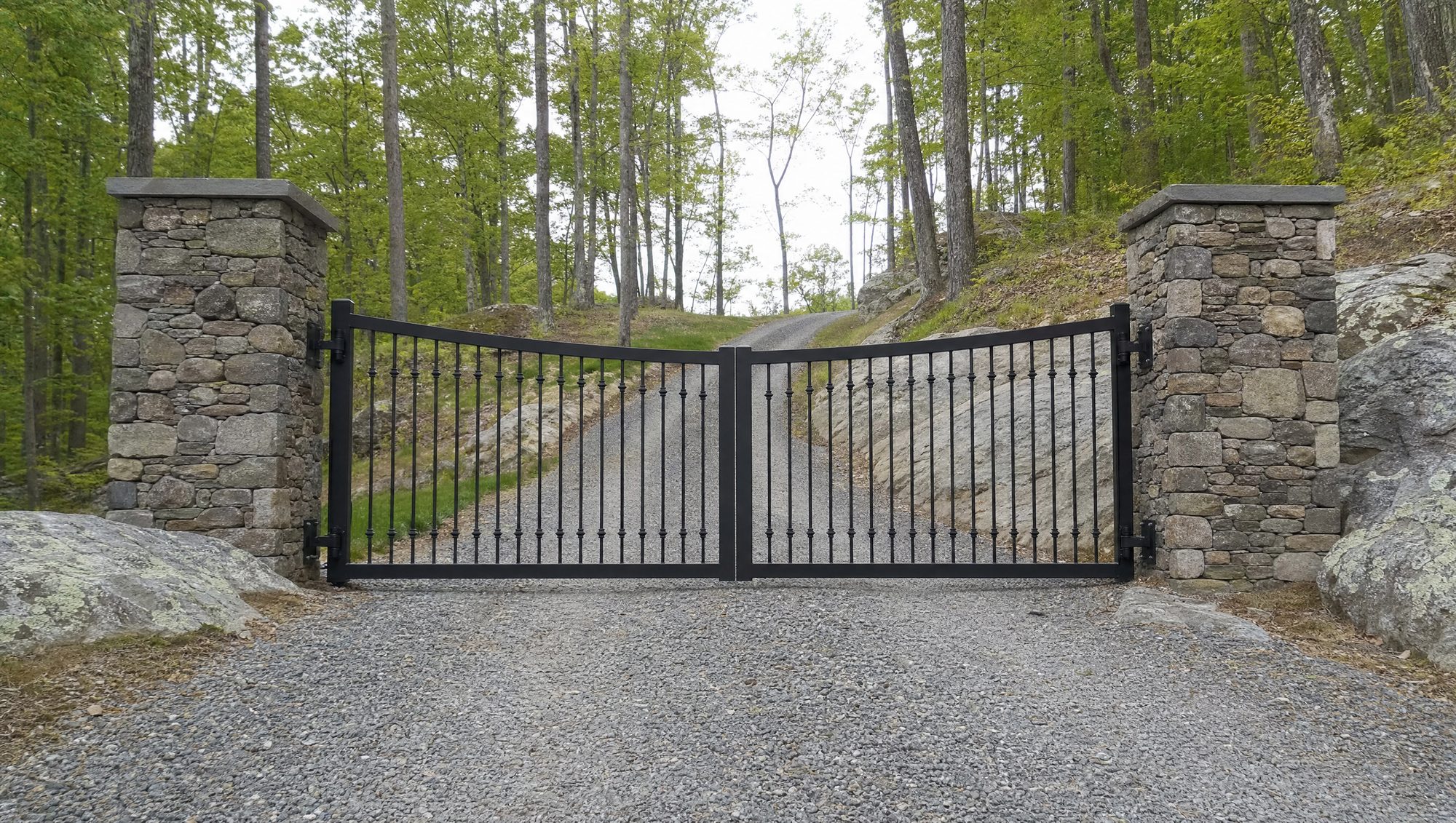
Most people start an estate gate project with a look in mind. Stone columns, an arched top, maybe a monogram, and that satisfying moment when the leaf swings open as you turn in off the road. Then the estimates come back and none of them match, because one contractor priced a panel and another priced an entire entrance system with foundations, an operator, and safety devices. That gap is where the trouble starts. A driveway gate is the only moving machine most homes will ever have, and it lives outside all year, carries hundreds of pounds, and opens next to people and vehicles. It has to work at six in the morning in February with a plow bank shoved against it, and it has to fail safely when the power goes out. Estate gates in New Fairfield, CT reward the owner who plans the machine first and the finish second. Here is what that actually means on a real driveway.
Key Takeaways
The driveway picks the gate type
Opening width, grade, side clearance, turning radius, and snow decide whether a swing, slide, or bi-fold gate is even workable.
Automation is a safety system
UL 325 covers the operator and ASTM F2200 covers automated vehicular gate construction, and the two only work as one system.
Foundations outlive the finish
Leaf weight, wind, operator force, frost, ledge, and drainage decide whether the gate still lines up in year three.
The fence exemption is not the whole approval
New Fairfield generally exempts fences not over seven feet from a building permit, but columns, electrical work, driveway changes, and zoning conditions can still require review.
Plan for the day it does not work
Manual release, backup power, a pedestrian gate, and emergency-services access belong in the design, not in a panicked phone call later.
An Estate Gate Is a Machine That Happens to Look Good
A fence panel is static. Once it is set plumb and straight, physics mostly leaves it alone. A gate is different. Every time it opens, hinges take load, a frame flexes, a foundation resists a twisting force, and an operator pushes several hundred pounds through an arc or along a rail. Do that thousands of times a year through mud, heat, and freeze-thaw, and small mistakes stop being small. The leaf, the posts or columns, the foundations, the hardware, the operator, the safety devices, the power, the drainage, and the driveway itself all have to agree with each other. ASTM notes that gates carry real and often hidden hazards when they are built or automated without that coordination.
So, before anyone talks about finials, settle the job description. Who uses the entrance, what comes up the driveway, do deliveries need in, and is this about privacy, security, keeping a dog off the road, or framing the property? Answer those and the gate type, size, material, and controls start narrowing themselves down. A gate that photographs beautifully can still bind, sag, or hurt someone if the geometry, foundation, or operator was an afterthought.
The Gate and the Operator Are One Purchase
Choosing an operator after the gate is built is a common and expensive order of operations. The operator has to match the gate's weight, size, cycle demand, and mounting reality, and the gate has to be built to accept the operator's force and the required safety hardware. UL, which publishes the safety standard for door and gate operators and systems, treats them as parts of one system for good reason. Decide both together, or you end up rebuilding one to suit the other.
Your Driveway Picks the Gate Type, Not the Catalog
Homeowners usually arrive with a style already chosen. The driveway often disagrees. Clear opening, approach grade, side clearance, turning path, and where the snow ends up will rule some options out before anyone discusses color. Here is how the common types behave on real New Fairfield entrances.
Single and Double Swing Gates Need Arc Space
A single swing gate pivots from one side, which is simple and looks right on a moderate opening. All the weight and wind load lands on one hinge post or column, so leaf weight, sag, operator force, and positive stops matter a lot. A double swing splits the opening into two shorter, lighter leaves, which eases the load on each side but adds a second hinge support, center alignment, drop rods or center stops, and, when automated, two operators that must move together. Both types need a clear swing path, and both fight rising grade: a leaf that clears the ground at the closed position can drag as it opens uphill.
Cantilever and Track Slide Gates Need Side Room
A cantilever slide gate rolls parallel to the fence with no track crossing the driveway, carried by roller posts and a counterbalance section that extends past the opening. That makes it a strong pick for snow country, uneven approaches, and wider entrances, but it demands real side space for the counterbalance and rigid, well-founded roller posts that stay aligned. A track slide gate rolls on a track and asks for less side room, but the track has to stay clear of snow, ice, gravel, and leaves, and settlement in the track shows up as binding.
Bi-Fold Gates Fit Short Setbacks
Bi-fold gates fold as they open, so they need far less swing depth and open quickly. That helps on a constrained driveway or an entrance sitting close to the road. The tradeoff is more hinges, more moving joints, a specialized operator, synchronization, and more to maintain over time.
A Pedestrian Gate Keeps People Out of the Vehicle Path
A vehicular gate is not meant to be the normal walking route. That is a core safety idea in gate standards, and it is also just practical: a separate walk gate gives visitors, kids, and the mail a way in that does not involve a moving vehicle barrier. Plan its clear width, latch, self-closing function where needed, access control, and its connection to the walkway at the same time as the driveway gate.
The Road, the Grade, and the Snow Decide the Layout
Once the type is narrowed, the entrance layout gets its own round of decisions. This is the part of a driveway gate New Fairfield owners tend to skip, and it is the part that determines whether the gate is a pleasure or a daily annoyance. Four questions carry most of the weight.
Opening Width and Turning Radius
The clear opening has to suit the widest thing that regularly comes up the drive, not the family sedan. Fuel delivery, moving trucks, trailers, and fire apparatus all deserve a thought now rather than later. Width alone does not solve it either, since columns, walls, trees, or narrow pavement can pinch the turning path. Oversized columns are a frequent offender: they look substantial and quietly steal usable opening.
Vehicle Stacking and Sight Lines
A gate set too close to the road forces you to stop in the travel lane while it opens. Where the site allows it, the gate should sit back far enough that a vehicle can pull off the road and wait. Sight lines matter just as much. Columns, gates, walls, and landscaping should not block a driver's view of approaching traffic, which is exactly the kind of condition the town looks at even when a building permit is not in play.
Snow, Ice, and Water
New Fairfield gets real winter, and the gate has to keep working through it. That means a plan for where plowed snow goes, whether a swing arc stays clear, whether a track can be cleaned, and whether photo eyes stay aligned and unblocked when snow piles up. A gate that needs a shovel before it will open is a gate you will stop using.
Foundations Decide Whether the Gate Still Lines Up in Year Three
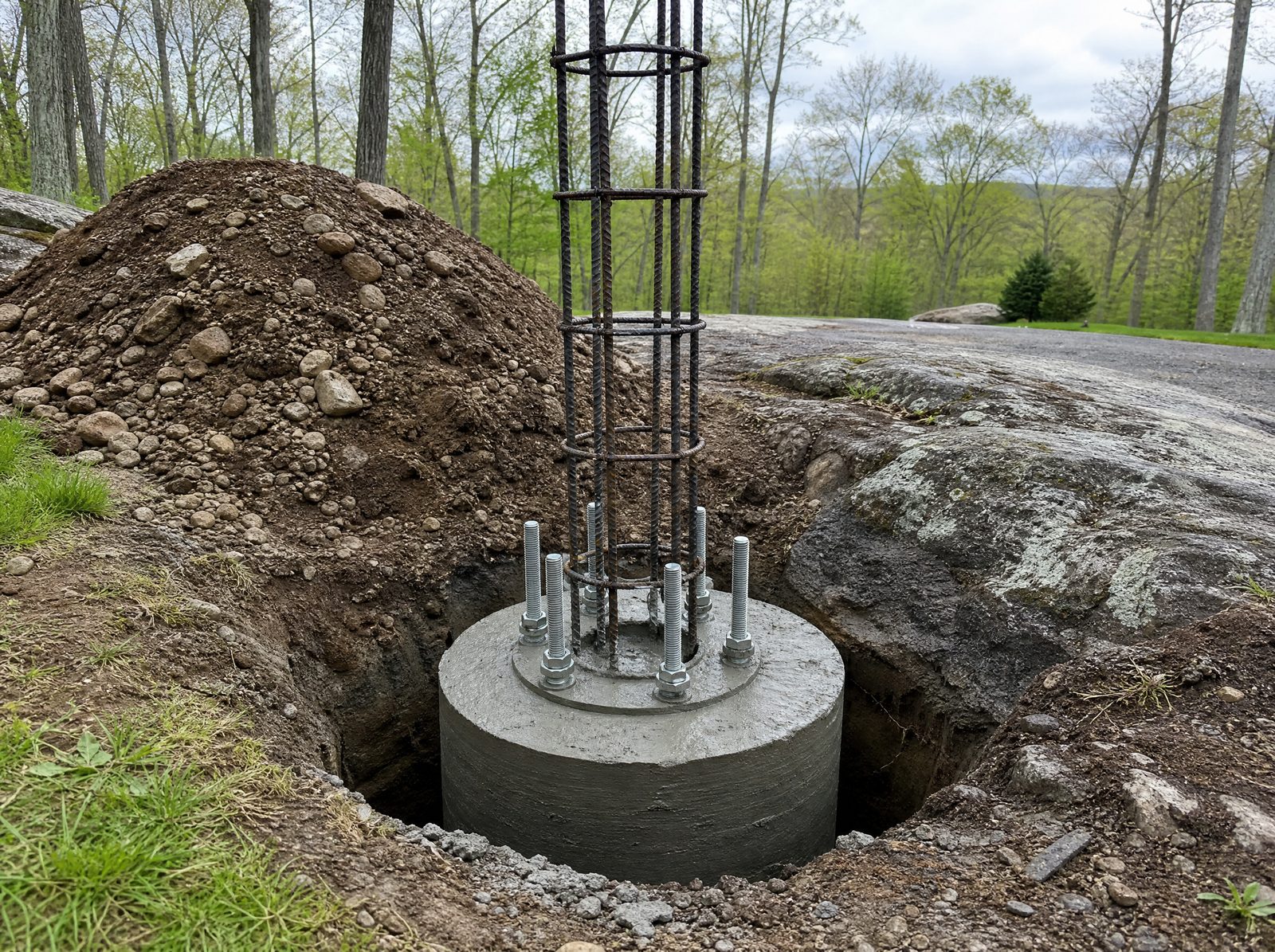
Nobody admires a footing, and no part of the job matters more. A gate that sags, binds, or scrapes almost always traces back to what is under it. Foundation design comes out of the whole picture: gate type, opening width, leaf weight, wind load, solid or open infill, operator force, hinge or roller geometry, soil, ledge, drainage, frost, column weight, and the manufacturer's requirements. There is no single correct depth or size for every gate, and anyone who quotes one number for everything is guessing.
Hinge Posts, Roller Posts, and Masonry Columns
A swing gate's hinge post or column resists vertical weight, sag, wind, and operator force all at once, which is why it is usually far heavier than an in-line fence post. A cantilever gate's roller posts and operator pad have to stay aligned with each other, since even small settlement turns into binding or unsafe movement. Masonry columns bring their own list: foundation, reinforcement, drainage, and conduit routed through them before anyone lays stone.
Frost, Ledge, and Drainage
Repeated freeze-thaw cycles push on anything set shallow or poorly drained, which is the principle behind Connecticut's residential code approach to foundations. Around here, ledge is the other variable. Rock near the surface can mean drilling, specialized anchoring, an adjusted foundation, or engineering, and it should show up in the estimate as a real site condition rather than hiding inside a vague number. Drainage ties the two together: water should never collect around operators, tracks, loops, foundations, or electrical enclosures, because what pools in November freezes in January.
A Custom Entrance Gate Balances Look and Load
Design is the fun part, and it is not separate from engineering. Every choice that makes a custom entrance gate New Fairfield owners want also changes what the frame, hinges, operator, and foundations have to handle. The goal is a gate that suits the house and the property at a scale the machine can actually carry.
Aluminum, Steel, Wood, and Hybrid Frames
Aluminum is lighter and corrosion resistant, coordinates with aluminum fencing, and reduces operator load for a comparable design, though frame strength varies by product and thin sections can flex. Steel brings mass and allows extensive custom fabrication for large or solid gates, at the cost of serious corrosion protection and, often, heavier foundations and operators. Wood infill gives warmth and matches wood fencing, but it moves with moisture, adds weight, and needs finish upkeep. Hybrids pair a metal frame with wood or decorative infill to get structure and appearance together.
Open Versus Solid Infill
This is a bigger decision than it looks. An open gate, in the spirit of ornamental styles, lets you see through the entrance and lets wind pass. A solid gate buys privacy and hands the frame, hinges, operator, and foundations a much harder job, because wind that used to pass through now pushes on the whole leaf.
Columns, Lighting, and Matching Fence
Proportion is what separates a designed entrance from an expensive one. Gate height, column size, opening width, and fence height should look balanced together, and the estate gate should read as part of the fence line rather than a bolt-on. Lighting, house numbers, and an intercom pedestal are easier to do well when they are planned into the columns instead of surface-mounted later.
Automation Is a Safety System Before It Is a Convenience
An automated gate New Fairfield homeowners enjoy in the rain is the same machine that swings unattended near children, pets, delivery drivers, and cars. That is why powered gates have their own standards, and why a bid that names an operator brand but never mentions safety devices is not a complete bid. Two documents anchor the subject, and they cover different halves of the same system.
UL 325 Covers the Operator, ASTM F2200 Covers the Gate
UL 325 is the safety standard for gate operators and systems, addressing hazards including entrapment, fire, electric shock, and casualty. UL has published on the key safety issues behind UL 325 and on external entrapment protection devices. ASTM F2200 is the standard specification for automated vehicular gate construction, covering gate types including horizontal slide, swing, vertical lift, and vertical pivot. Neither one works alone. The gate has to be constructed for automation, and the operator has to be the right class and application for that gate.
Entrapment Protection, Photo Eyes, and Edge Sensors
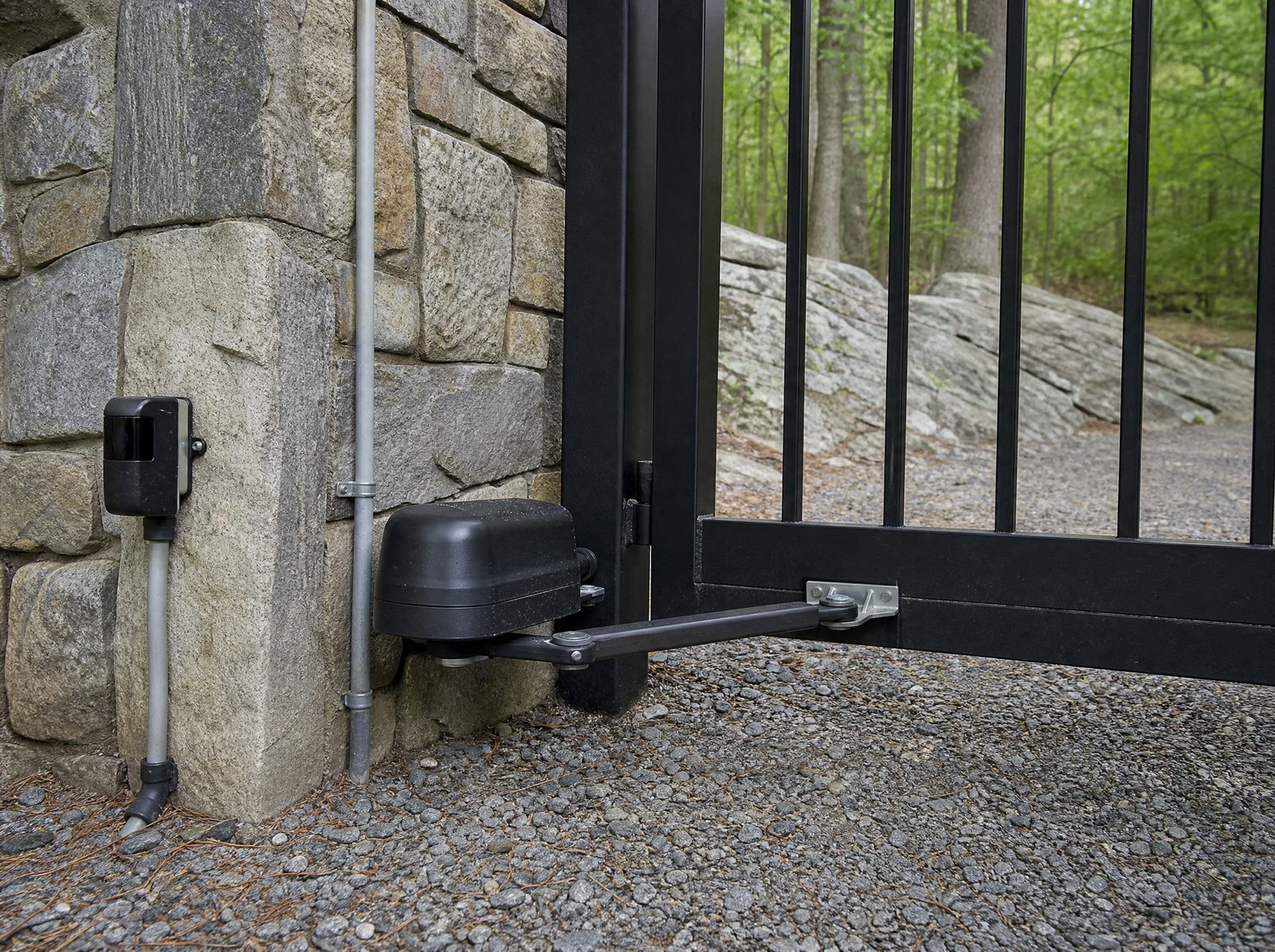
The recurring safety themes are worth knowing as a buyer: keep people out of the vehicular gate's path, guard or screen entrapment zones, avoid protrusions, use positive stops, add external entrapment protection devices such as photo eyes and edge sensors, monitor those devices, place controls where the operator can see the gate, post warning signs, and test the whole thing on a schedule. The gap under the leaf belongs on that list too. It has to clear the grade through the full travel without leaving an opening a dog slips under or a foot ends up in. One point causes real confusion, and UL makes it plainly: access control and operator safety are separate. A keypad decides who gets in. It does nothing to stop the gate from closing on a bumper. Safety devices are also not optional accessories to bypass when one acts up. A faulted photo eye is a repair, not a nuisance to disable.
Power, Trenching, and Licensed Electrical Work
Here is the unglamorous part that decides schedules and budgets. An automated entrance usually needs branch-circuit power, a disconnect, grounding, surge protection, conduit, low-voltage runs for controls and accessories, and often communications for an intercom. That means a trench from the house or panel to the entrance, which is real excavation across a lawn or under a driveway, plus restoration afterward. Connecticut's Department of Consumer Protection is clear that skilled work such as electrical requires the appropriate trade license, so the proposal should say exactly which work is included and which licensed trade performs the connections. Solar can be practical at some entrances, but it depends on gate usage, operator load, battery capacity, shade, panel orientation, winter sun, and accessory demand, so it is a calculation and not an assumption.
What Happens When the Power Goes Out
Ask this question early, because the honest answer shapes the design. An electric gate New Fairfield owners rely on can still open during an outage when the system includes battery backup, adequate solar capacity, a manual release, a key override, or another planned method. Backup capability depends on the operator and accessories chosen, not on hope. The plan should also cover operator failure, snow blockage, lost credentials, and gate damage, and it should account for fire, ambulance, and police access. Emergency release points need to be secure and still reachable by the people who need them, and somebody in the house should know where they are and how to use them before the night they matter.
Access Control Decides Who Gets In
Once the gate moves safely, the remaining question is who can make it move. Most estates end up with a mix rather than a single device, and the right mix depends on how many people come and go and how much you want to manage. Match the tool to the user.
Remotes are simple for residents and regular users, provided somebody manages lost ones. Keypads give code-based entry, and systems that allow unique codes for residents, vendors, and temporary visitors are far more useful than a single shared code. Intercoms let a visitor call the house over wired, cellular, or internet connections, while telephone entry can route calls to a phone and allow a remote release. Card or fob readers suit staff or multiple residences, and smartphone control can add remote operation, user management, and activity logs depending on the product. Vehicle loops sit underneath all of it, detecting a vehicle for free exit, safety, or opening logic, and their placement and function have to be coordinated carefully rather than dropped in. Deliveries deserve a decision too, since a temporary code or an intercom beats a driver leaving a package at the road.
New Fairfield Reviews an Estate Gate as More Than a Fence
Permits are where estate-gate projects surprise people, because the gate is only part of what is being built. New Fairfield states that fences not over seven feet high are generally exempt from a building permit, and that a pool barrier requires a permit regardless of height. That is a useful starting point and a bad stopping point. Local rules change, so confirm current requirements with the town before construction.
The Exemption Does Not Cover Columns, Power, or the Driveway
A gate that is part of a fence under seven feet may fall within that general exemption, while the rest of the project does not. Masonry columns and their foundations, electrical work, the automated equipment itself, driveway changes, drainage, wetlands or watercourse setbacks, road setback and sight-line conditions, easements, and private association rules can each pull the job into review. Because the gate sits at the road, sight lines and setbacks get attention that a backyard fence never draws. New Fairfield's building permit page, its permits and regulations information, and its zoning department are where you confirm what your specific entrance needs.
Property Lines, Easements, and Call Before You Dig
Estate gates tend to land exactly where the complications live: at the property line, along a stone wall, on a shared or easement driveway, inside a road right-of-way. A contractor can lay out the project, but a licensed surveyor establishes the legal boundary and easements, and recorded plans often live with the town clerk's land records. Then there is the digging. Posts, columns, foundations, conduit, and loops all mean excavation, so a Call Before You Dig request is required by law before any of it starts. Public marking does not cover private lines, and an estate entrance is full of them: gate power, low-voltage controls, yard lighting, irrigation, well lines, septic, propane, drainage, security cable, and invisible pet-fence wire. The written scope should say who handles public marking and who arranges private locating.
What Actually Moves the Cost of an Estate Gate
There is no one-price-fits-all figure here, and the spread is wider than it is for fencing. A manual aluminum swing gate and a custom automated steel entrance with masonry columns, an intercom, loops, lighting, and backup power are not the same purchase in any meaningful way. Published consumer averages are broad market context only, not a quote for your driveway.
The big levers are below. Underneath them sits a long tail that still adds up: custom ornamentation, lighting, matching fence, pavement restoration, removing an existing gate, permits and professional services, lead time on custom fabrication, and the commissioning and training at the end.
That list is also why two bids rarely match. If one includes monitored safety devices, a licensed electrician, a real foundation spec, and commissioning, and the other includes a leaf and a motor, the cheaper number is not a better deal. It is a different project.
Hover or tap a row to highlight it.
| Cost Driver | Why It Matters |
|---|---|
| Clear opening and gate type | Width and whether it swings, slides, cantilevers, or folds set the frame, the hardware, and the operator. |
| Manual or automated operation | An operator brings safety devices, controls, power, and commissioning that a manual gate never needs. |
| Material, infill, and ornamentation | Aluminum, steel, wood, and hybrid frames differ in weight and fabrication, and solid infill adds wind load. |
| Columns and foundations | Masonry columns, piers, and hinge or roller supports carry the loads, and ledge can force drilling or engineering. |
| Power and access control | Trenching, licensed electrical work, backup power, intercoms, keypads, and loops are a project inside the project. |
How an Estate Gate Installation Comes Together
A clean estate gate installation New Fairfield property owners can follow runs in a predictable order, and knowing the order helps you spot a crew that skips steps. It starts with goals and geometry, not with a gate order, and it ends with someone showing you how the machine works.
The New Fairfield Estate Gate Installation Process
- 1
Step 1: Define Access and Security Goals
We settle users, vehicles, deliveries, emergency access, privacy, and the controls you want before any gate is chosen.
- 2
Step 2: Survey the Entrance and the Documents
Driveway width, road setback, grade, turning radius, side clearance, and stacking, plus survey, easements, zoning, and wetlands review.
- 3
Step 3: Select the Gate Type, Materials, and Design
Swing, slide, cantilever, track, or bi-fold, then frame, infill, finish, columns, lighting, matching fence, and the pedestrian gate.
- 4
Step 4: Design the Automation and the Power
Operator, controls, photo eyes, edge sensors, loops, warning signs, emergency release, plus electrical, low-voltage, communications, and backup.
- 5
Step 5: Write the Specifications and Mark Utilities
Dimensions, materials, foundations, operator, safety devices, controls, permits, and warranties, then public marking and private locating.
- 6
Step 6: Build, Install, and Commission
Foundations, conduit, and drainage, then leaves and hardware, then the operator and controls with licensed trades on the electrical, then testing of travel, stops, entrapment devices, emergency release, and backup power.
Turnover is the step people forget to ask about, and it matters. Remotes, codes, keys, manuals, warranties, maintenance instructions, and safety training for the people who live there are what turn a finished install into a system the household can actually run.
What Separates a Gate Contractor Worth Hiring
Connecticut law requires home improvement contractors, including fence and gate installers, to register with the Department of Consumer Protection, and you can verify a registration in a couple of minutes. Do it for anyone who bids. Registration and insurance are the floor, not a selling point. My Fence Guy is a family-owned contractor with our office right here in New Fairfield, licensed and insured, and we give free estimates. Beyond the paperwork, a gate contractor New Fairfield owners should trust can talk fluently about ASTM F2200 construction, UL 325 operator coordination, licensed electrical trades, foundations, permits, and what happens after the install.
The written proposal is where all of that becomes real, and Connecticut's guidance on what belongs in a home improvement contract is a good checklist to hold a bid against. At a minimum it should spell out:
- Clear opening and gate type: The measured opening and whether it swings, slides, or folds.
- Frame, infill, and finish: Material, style, color, and how it coordinates with the fence.
- Posts, columns, and foundations: Sizes, footings, reinforcement, and how ledge gets handled.
- Operator and safety devices: Make, class, and the entrapment protection included.
- Access control and communications: Remotes, keypads, intercom, loops, and connectivity.
- Power and backup: Electrical scope, who performs it, trenching, restoration, and outage operation.
- Permits and utility locating: Who applies, who files the 811 request, and who arranges private locating.
- Commissioning and turnover: Testing, training, remotes and codes, manuals, and warranties.
- Maintenance and change orders: The service plan and how site surprises get priced.
Frequently Asked Questions About estate gates new fairfield ct
Q: Should I choose a swing or slide gate?
A: The driveway usually decides. Swing gates need clear arc space and a suitable grade, since a leaf can drag as it opens uphill. Cantilever and track slide gates need side clearance and strong roller or track support, and cantilever gates need room for the counterbalance beyond the opening.
Q: Does an estate gate require a permit in New Fairfield?
A: A gate that is part of a fence under seven feet may fall within New Fairfield's general fence permit exemption, but columns, masonry, electrical work, automated equipment, driveway changes, pool barriers, or site-specific zoning conditions may require review. Confirm the current requirements with the town before construction.
Q: What is UL 325?
A: UL 325 is the safety standard for door and gate operators and systems. It addresses hazards including entrapment, fire, electric shock, and casualty, and it is why a powered gate needs entrapment protection rather than just a motor.
Q: What is ASTM F2200?
A: ASTM F2200 is the standard specification for automated vehicular gate construction. It covers several gate types and includes safety-related construction requirements, which is why the gate itself has to be built for automation rather than motorized after the fact.
Q: Can an automated gate open during a power outage?
A: It can when the system includes battery backup, adequate solar capacity, a manual release, a key override, or another planned emergency method. Backup capability depends on the operator and accessories selected, so decide it during design rather than after the first storm.
Q: Who does the electrical work on an estate gate?
A: Connecticut requires appropriately licensed tradespeople for electrical work. The proposal should identify who performs it, what is included, and who handles any electrical permit.
Q: How much does an estate gate cost in New Fairfield?
A: It depends on opening width, gate type, material, customization, foundations, columns, operator, safety devices, controls, electrical work, drainage, ledge, matching fence, and permits. Published averages are broad market context, so a site visit is the only honest way to price estate gates New Fairfield Connecticut properties actually need.
Q: How often should an automated gate be serviced?
A: Follow the operator manufacturer's maintenance schedule, and inspect the system routinely and after storms, heavy snow, vehicle impact, outages, or any unusual noise. Check alignment, hinges or rollers, stops, drainage, safety devices, and the emergency release, and never bypass a safety device as a permanent fix.
Test Your Estate Gate Knowledge
1. What should decide whether you get a swing gate or a slide gate?
2. What does UL 325 cover?
3. What does ASTM F2200 cover?
4. Does a keypad make an automated gate safe?
5. Does New Fairfield's fence permit exemption cover the whole estate gate project?
Pick an answer to begin.
Final Thoughts
An estate gate rewards planning in a specific order: decide what the entrance has to do, let the driveway geometry pick the gate type, size the foundations for the real loads, treat the operator and its safety devices as one system with the gate, sort out power and permits before anything is ordered, and plan for the day the power is out and the snow is deep. Get that order right and the design choices, the material, and the price start making sense on their own. Get it backward, and you find out in year three.
Done well, a gate at the head of the driveway quietly does its job for decades. It frames the property, controls who comes up the drive, and opens on a February morning without complaint, which is exactly what you were imagining when you started.
If you are planning an entrance gate in New Fairfield, we would be glad to walk the driveway and give you a straight answer about what will actually work there. My Fence Guy is a family-owned contractor with our office in New Fairfield, CT, and we build custom driveway and estate gates, pedestrian gates, and matching fencing in wood, vinyl, aluminum, chain link, and ornamental styles, along with pool fencing, pet fencing, and railings. We handle the layout, the foundations, the operator and safety coordination, and the permit and utility questions that go with a moving machine at the road. Call us at (203) 746-1100 for a free estimate, or reach out through our contact page.
Estate Gate Key Terms
Tap a term to see what it means.
Estate Gate. A driveway entrance gate built as a complete system: leaf, posts or columns, foundations, hardware, operator, safety devices, access control, and power.
More about fences
Estate Gates in Southbury, CT: Plan the System, Not the Panel
Estate gates in Southbury, CT: who opens it, how it fails safe, and what happens in a power cut. Operators, access control, and entrapment protection.
Read the guide to Estate Gates in Southbury, CTEstate Gates in Sherman, CT: Swing, Slide, Safety, and Cost
The gate is the easy part. Estate gates in Sherman, CT depend on the driveway grade, a foundation below frost, and getting power out to the road.
Read the guide to Estate Gates in Sherman, CTDriveway and Estate Gates: Swing vs Slide, Automation and Safety
Driveway and estate gates: swing or slide for your driveway, UL 325 safety for automatic gates, power and snow needs, permits and national 2026 cost ranges.
Read the guide to Driveway and Estate Gates