
Driveway and Estate Gates: Swing vs Slide, Automation and Safety
By Tony Pellicone15 min readPublished
- estate gates
- automatic gates
- homeowner guide
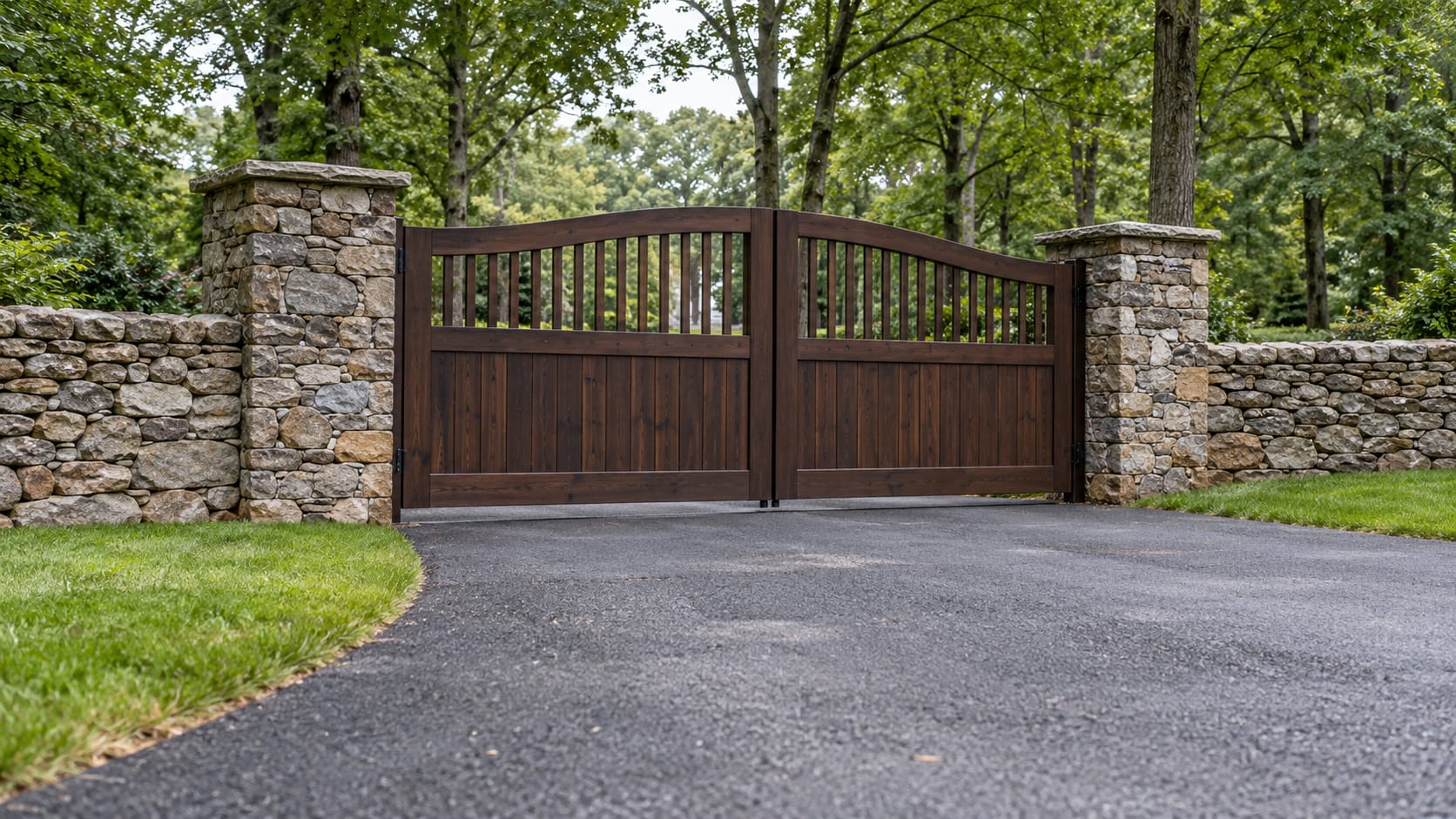
A swing gate fits when you have room for the gate leaf to open through an arc. A slide gate fits when the driveway has side room for the gate to park beside the opening. Automation adds electrical work, a concrete operator pad, safety devices, manual release hardware and local approval questions, so the right choice depends on the entire driveway, not just the gate style.
For a narrow entrance with open space in front of or behind the gate, a swing gate may be the better fit. For a steep approach, a driveway that cannot accept a swinging leaf, or a property where vehicles need a clear travel path, a slide gate may work better. Before ordering materials, measure the opening, side clearance, gate swing, grade, drainage, snow-storage area and vehicle turning path.
Key Takeaways
Gate type
Swing gates need arc clearance, while slide gates need side room equal to or greater than the opening.
Track choice
Track slide gates need a clear ground rail, while cantilever gates use a counterbalance and support posts.
Automation
Automatic gates need listed equipment, independent entrapment protection, power, wiring, foundations and manual release.
Winter use
Snow and ice can stop a working motor by blocking tracks, sensors, rollers, swing arcs or operator parts.
Permits
Connecticut requirements depend on the municipality, zoning district, driveway location, electrical work and property use.
Cost
National 2026 automatic driveway-gate estimates run about $1,900 to $6,000 per project, before site-specific additions.
Choosing the gate style for the driveway
A swing gate pivots from hinges and opens through an arc. It generally opens faster than a sliding gate, but the leaf or leaves occupy space inside or outside the driveway while moving. The gate bottom also needs enough clearance to pass over the pavement without striking the driveway on a slope.
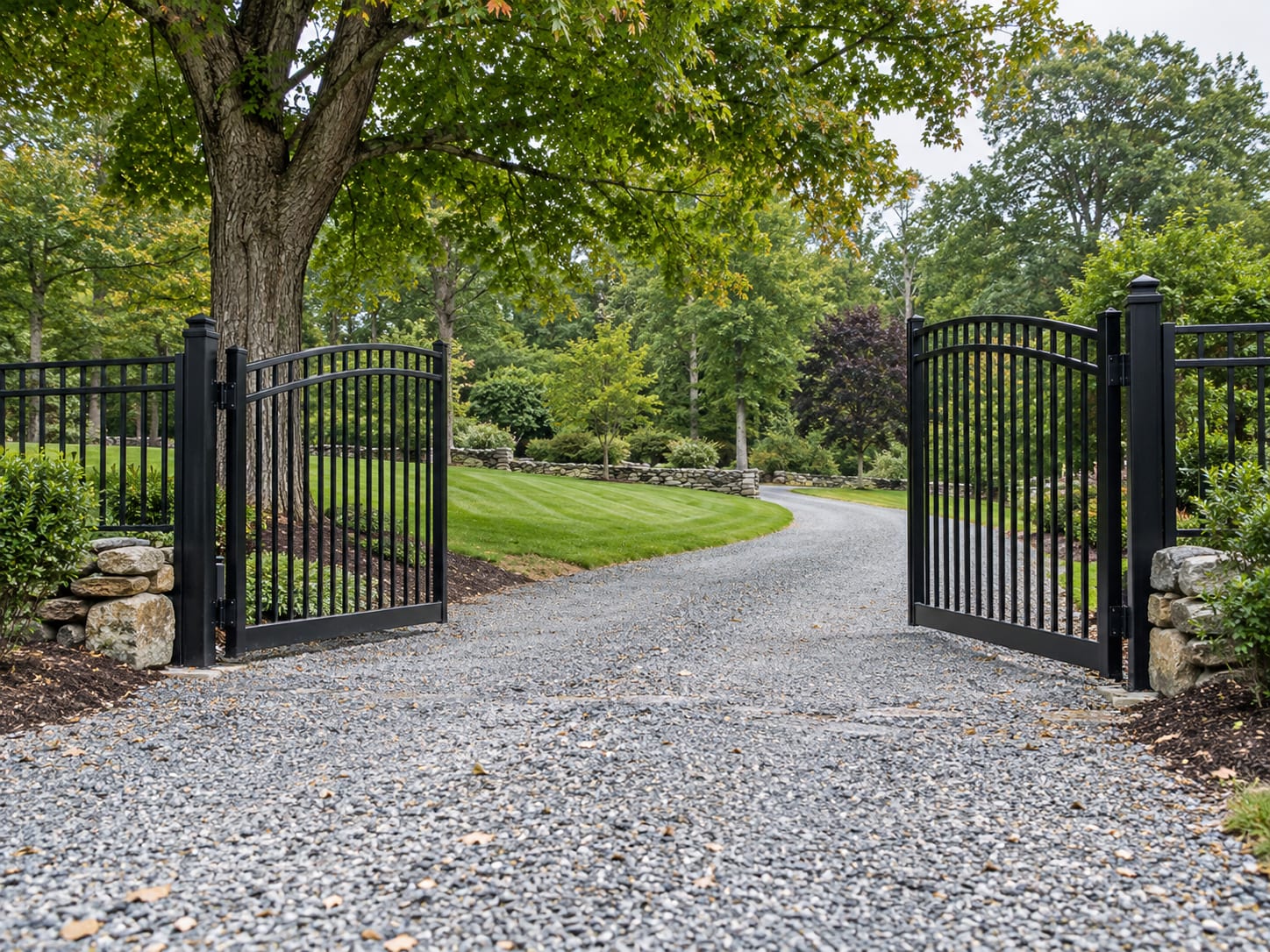
A slide gate moves horizontally beside the driveway. It needs side room equal to, or greater than, the clear opening so the gate can park in the open position. A long single-leaf gate may need more side room than a property has available.
A bi-parting, or split-slide, gate uses two leaves that move away from each other, usually one to each side. This can reduce the required pocket length on either side compared with one long leaf, but both sides need clear space and operating equipment.
Track slide and cantilever slide gates
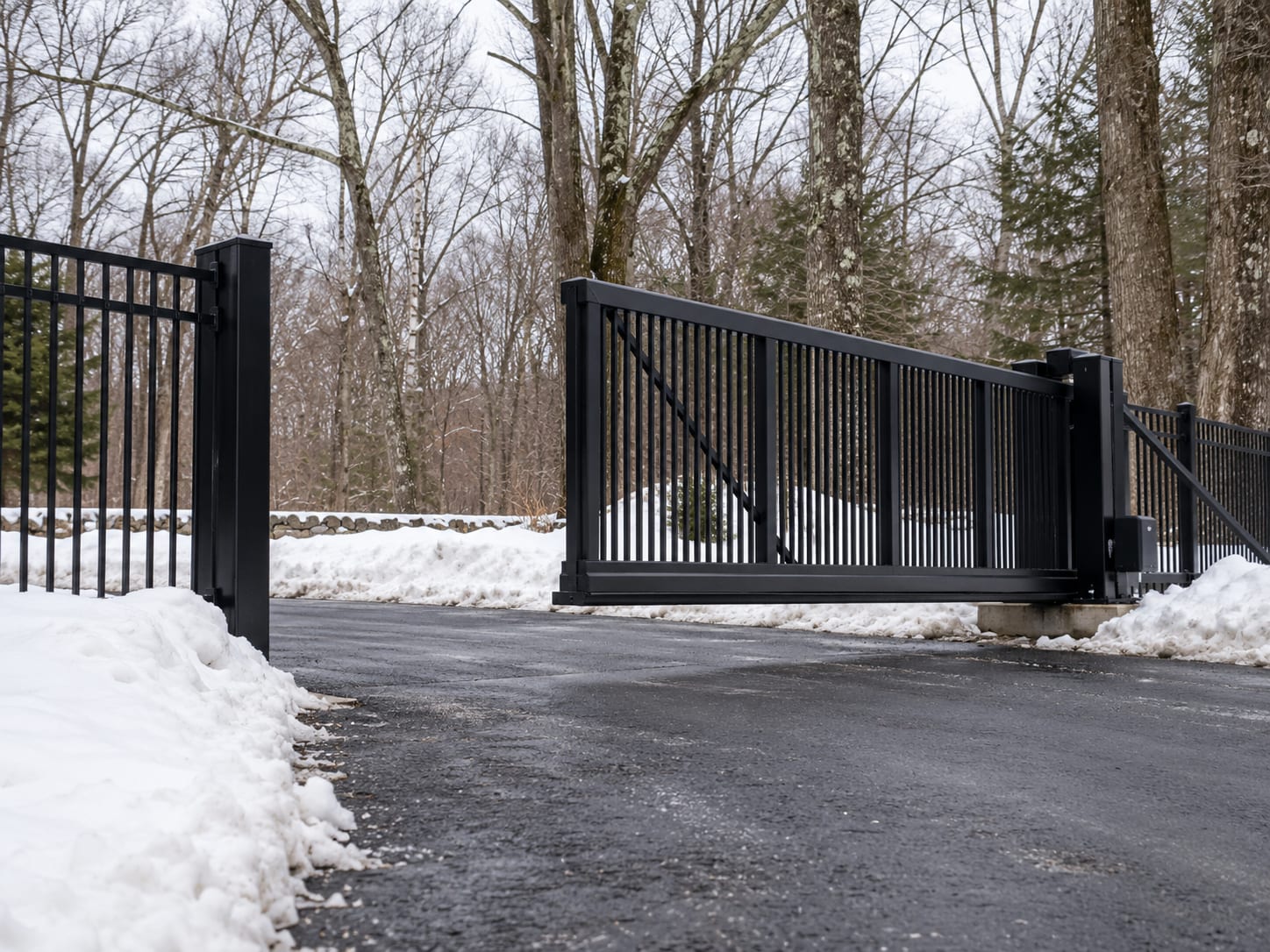
A track slide gate runs on a ground-mounted rail. Rollers or wheels carry the gate while the operator moves it along the track. The rail must stay aligned and clear of gravel, leaves, ice and snow.
A cantilever slide gate is suspended from rollers mounted on support posts. It has no ground track across the driveway. The gate includes a counterbalance section behind the opening, so the total side area needed is longer than the clear opening.
Cantilever construction can help where a ground rail would be obstructed by snow, gravel, drainage or uneven pavement. It still needs substantial posts, foundations and side clearance. Snow can affect the rollers, guide posts and operator even though vehicles do not drive over a track.
No single driveway grade decides the gate type. The installer should check the slope at the gate, swing arc, bottom clearance, drainage, side pocket, snow-storage area, vehicle turning path and emergency access. The selected operator must also match the gate weight, length, cycle frequency and intended use. LiftMaster describes swing gates as pivoting from hinges and slide gates as moving in a straight line with more side-room requirements. LiftMaster's residential gate operator buyer's guide provides the basic equipment distinctions.
Hover or tap a row to highlight it.
| Gate configuration | Main space requirement | Site condition to examine |
|---|---|---|
| Swing | Clear arc in front of or behind the gate | Driveway grade, pavement clearance and vehicle path |
| Single slide | Side pocket at least as long as the opening | Fence line, property limits and snow storage |
| Track slide | Side pocket plus a clear ground rail | Gravel, drainage, ice, leaves and snow |
| Cantilever slide | Longer side zone for counterbalance | Support posts, foundations and uneven ground |
| Bi-parting slide | Clear space on both sides | Two operator zones and balanced side clearance |
Hover or tap a row to highlight it.
| Gate style | Opens by | Main benefit | Main limitation |
|---|---|---|---|
| Swing | Pivoting from hinges | Often opens quickly and needs less side pocket | Needs a clear swing arc |
| Track slide | Rolling along a ground rail | Direct, compact movement along the fence | Rail needs regular clearing and alignment |
| Cantilever slide | Rolling on elevated support rollers | No ground track across the driveway | Needs counterbalance length and stronger support |
| Bi-parting slide | Two leaves moving apart | Shares the opening between both sides | Needs space and equipment on both sides |
For a gate that forms part of a longer fence, the material and post design matter as much as the operator. Ornamental metal, aluminum, vinyl and wood each carry different weights and wind loads. Review the matching estate gates product page when comparing decorative entrances with the rest of the fence system.
Automation, safety and emergency access
An automatic vehicular gate should comply with UL 325 and ASTM F2200. UL 325 is the product-safety standard used to certify automatic gate operators and systems. It addresses hazards including electric shock, fire, casualty and entrapment. UL identifies automatic vehicular gate operators as including swing, slide, pivot, vertical-lift, barrier-arm and bifold systems.
ASTM F2200 is the construction standard for automated vehicular gates. The current listed edition is ASTM F2200-24. It covers automated horizontal slide gates, horizontal swing gates, vertical lift gates, vertical pivot gates, overhead pivot gates and horizontal bifold gates. ASTM states that automated vehicular gate systems must comply with both ASTM F2200 and UL 325. See the ASTM F2200-24 standard listing and UL's gate-operator safety explanation.
UL 325 requires independent entrapment protection. A typical automatic gate uses a primary and secondary means of protection, such as photoelectric sensors and contact sensing edges. Photo eyes detect an obstruction across a protected zone. A sensing edge stops or reverses movement when it is compressed.
The correct number and placement of devices depends on the gate geometry, posts, nearby fence, walls, columns, rollers and operator. Each entrapment zone needs to be addressed. A listed operator does not make an incorrectly installed gate safe.
ASTM F2200 construction provisions address smooth gate edges, dangerous protrusions, pinch and entrapment areas, gravity-driven movement if the operator is disconnected, and a separate pedestrian gate positioned so people cannot contact the moving vehicle gate. A pedestrian route matters on a residential property with regular visitors, and it becomes more significant at a farm, business, multifamily property or facility.
Power, concrete and manual release
An automatic gate normally needs a suitable electrical supply or a listed solar and battery system. Underground conduit and wiring must be sized for the operator, controls, safety devices and accessories. The gate posts, hinges, rollers and operator equipment need stable foundations.
A slide operator generally needs a level, durable pad that holds the operator in place while it exerts force on the moving gate. LiftMaster states that the exact pad dimensions, reinforcement, anchor pattern and electrical requirements come from the selected operator's installation manual.
The system also needs a manual-release mechanism for a power failure or equipment malfunction. Depending on the project, access equipment may include vehicle detection loops, photo eyes, sensing edges, keypads, remotes, telephone entry and other controls.
Drainage and snow storage belong in the layout before concrete is poured. A gate should not block a drainage path or leave plowed snow with nowhere to go. If pedestrians use the property, plan a separate pedestrian route.
Commercial, multifamily, industrial, institutional and emergency-access properties may need a fire-department-approved opening method. The Connecticut State Fire Safety Code amendment provides for automatic gates to comply with ASTM F2200 and addresses secured access for authorized public officers. Ask the local fire marshal whether the property needs a Knox device, key switch, siren-operated receiver, manual release, delayed-close setting or another approved method.
Danbury's lockbox program identifies the Knox-Box as its approved product for certain alarm-system sites under City Ordinance section 3A-32(c). That program applies to those alarm sites, not to every private driveway gate. Newtown Planning and Zoning Commission minutes from 2025 discuss a proposed emergency gate and identify a Knox Box as one way to store keys and codes. Ridgefield project minutes from 2025 describe a proposed emergency access drive where the Fire Marshal requested an arm gate with keypad, delayed-close access and manual opening during a power outage.
Automatic Gate Planning Sequence
- 1
Measure
Record the opening, swing arc, side pocket, grade, drainage, turning path and snow-storage area.
- 2
Confirm utilities
Use Call Before You Dig before trenching or excavating for posts, foundations and conduit.
- 3
Confirm town approvals
Ask Planning and Zoning, the Building Department, the electrical official, the Fire Marshal, Inland Wetlands Agency and the road authority as applicable.
- 4
Select equipment
Match the gate, operator, foundations, power supply, access controls and safety devices to the site.
- 5
Build and wire
Install posts, hinges or rollers, operator pad, conduit, gate hardware and controls.
- 6
Test and hand off
Test entrapment protection, manual release, emergency access, remotes, codes and winter procedures.
What to settle with the town and contractor
Call the municipal offices before ordering the gate. Planning and Zoning can address the zoning district, front-yard rules, setbacks, height, visibility, access management and zoning permit. The Building Department can address foundations, structural work, the operator pad, building permits and inspections.
Ask the electrical official or a licensed electrician about the electrical permit, trenching, conduit, disconnects, grounding and power supply. Ask the Fire Marshal about emergency access, fire lanes, Knox equipment, key switches, manual release and gate-opening requirements.
If the work is near wetlands, watercourses, ponds, drainage areas or regulated upland review zones, contact the Inland Wetlands Agency. Public Works or the applicable road authority can address a road right-of-way, curb cut, driveway apron, culvert and sight distance. Use Call Before You Dig before excavating for a gate.
Bring the town a current survey or plot plan, property address, driveway and road information, gate opening, gate height, material, estimated weight, swing or slide direction, side-clearance dimensions, driveway grade, electrical plan and emergency-access method. Include easements, shared-driveway agreements, conservation restrictions or homeowners-association rules when they affect the gate.
A written contractor scope should identify the exact gate type, opening width, height, material, finish, operator, safety devices, manual release and backup power. It should also state whether the price includes electrical work, conduit, concrete, excavation, restoration, permits, inspections, testing, remotes, access controls and winter maintenance guidance.
My Fence Guy can coordinate the gate and its connection to the fence, and flag the electrical, concrete, permit and access-control items that belong in the written scope. The final quote should use clear units, such as per gate, per operator, per footing, per linear foot of trench or per project.
Connecticut Department of Consumer Protection states that a written, signed and dated contract is required for every home-improvement job. The contract must identify the contractor and Connecticut registration number, start and completion dates, cancellation notice and the complete agreement, including materials, permits and payment schedule. Changes should be in writing.
If the gate sits near a property line, shared driveway or easement, put the location, maintenance, access rights, lock or code responsibilities, snow clearing and cost sharing in writing with the affected neighbor or easement holder. For a boundary dispute, speak with a Connecticut real estate attorney. Connecticut's fence statutes are collected in Chapter 823 of the Connecticut General Statutes.
Gate permits, driveway grade and emergency-access approvals
Each town's zoning sets a driveway gate's height, setback, placement and permit needs. The municipality, zoning district, driveway location, construction, electrical work and property use affect the required approvals.
Ridgefield's zoning regulations require a zoning permit application before erection or alteration of a building or structure when the regulations require a zoning permit. Ridgefield states that fences, earthwork, grading and other exterior projects may require a zoning permit, building permit or another approval. Its 2026 regulations also address driveway grade and access management. A driveway generally may not exceed 12 percent, may be authorized up to 14 percent in certain circumstances, and requires a special permit above 14 percent.
Use Ridgefield as a local example, not as a rule for every Connecticut town. If your property is in Ridgefield, ask the Planning and Zoning Department how the proposed gate, driveway grade, sight distance and location are handled. The Ridgefield fence permit information and Ridgefield zoning regulations are useful starting points.
Danbury's lockbox program concerns alarm-system sites, and Newtown's planning minutes concern one proposed emergency gate. Emergency-opening methods vary by property, so ask the local Fire Marshal or authority having jurisdiction which one is approved for yours.
For Connecticut permit questions, the statewide overview Do You Need a Permit for Fence Installation in CT? can help you organize the questions for the town.
The Town of Kent in Putnam County requires plans for certain site-access driveways to show gates and provisions for police, fire or emergency vehicles. Contact the exact New York town, village or city zoning and building offices, plus the applicable county or state highway authority, before relying on a rule from another municipality.
National cost ranges and the items that change a quote
Angi reported a 2026 national average gate-installation cost of $2,322 per project, based on 541 reported projects. It reported a national installed cost of approximately $1,900 to $6,000 per project for an automatic driveway gate. Manual gate installation was reported at approximately $300 to $1,200 per project nationally, and automatic security-oriented installations can approach $12,000 per project. Additional national costs for hinges, locks, handles and posts were reported at approximately $150 to $1,500 per project.
These are national figures, not Connecticut bids. A local price may change with excavation, drainage, long conduit runs, electrical service upgrades, concrete foundations, custom ornamental work, access-control equipment, permits, survey work and emergency-access hardware.
Hover or tap a row to highlight it.
| Cost item | National unit or range | What to ask for locally |
|---|---|---|
| Average gate installation | $2,322 per project | Gate type, material and included labor |
| Automatic driveway gate | About $1,900 to $6,000 per project | Operator, safety devices, power and access controls |
| Manual gate installation | About $300 to $1,200 per project | Hinges, latch, posts, foundations and finish |
| Security-oriented automatic installation | Up to about $12,000 per project | Emergency access, monitoring and commercial duty cycle |
| Hinges, locks, handles and posts | About $150 to $1,500 per project | Hardware grade, post size and installation scope |
Hover or tap a row to highlight it.
| Project type | Reported national figure | Unit |
|---|---|---|
| Average gate installation | $2,322 | Per project |
| Automatic driveway gate | $1,900 to $6,000 | Per project |
| Manual gate installation | $300 to $1,200 | Per project |
| Automatic security-oriented installation | Up to $12,000 | Per project |
| Hinges, locks, handles and posts | $150 to $1,500 | Per project |
A Connecticut estimate should separate gate fabrication, posts, operator, foundations, concrete pad, electrical trench, conduit, access controls, safety devices, removal, permits and maintenance. Each item should carry its unit, such as per gate, per post, per operator, per linear foot or per project.
For post and foundation questions, review How Deep Should Fence Posts Be in Connecticut? Frost Line and Footings. A western Connecticut property with ledge or rocky soil may need different excavation equipment and foundation work than a level, easy-to-dig site. That changes the price and schedule because the gate posts and operator support must remain stable.
Snow, ice and cold-weather maintenance
Snow and ice can prevent a gate from moving even when the motor is working. Snow may pack against a swing leaf or block a slide track, roller, guide or latch. Ice on photo eyes can create a false obstruction signal. Reduced traction can occur between a slide operator wheel and its drive rail.
Cold weather can also affect lubricant, drainage, pavement alignment and battery capacity. Snowplow piles may block the swing arc, slide pocket or cantilever counterbalance area. Salt, sand and grit can enter the operator or drive mechanism.
A gate should not be used as a snowplow. Clear the gate path, track, operator, photo eyes and sensing edges before operation. Ghost Controls recommends clearing snow around the gate, brushing snow from photo-eye sensors and using lithium-based lubricants for cold-weather hinge maintenance.
HySecurity offers slide-gate snow brushes and rail scrapers designed to reduce snow and ice buildup. Certain operator models also have cold-weather heater strips and thermostats. These are model-specific options, so ask whether the selected equipment supports them.
A track slide generally needs more direct winter maintenance because the ground rail must remain clear. A cantilever slide removes the ground rail across the driveway, but its rollers, drive rail, guide posts and operator still need attention. A swing gate avoids a slide track but can be blocked by snow in its arc and may need more clearance below the leaves.
Ask the installer where plowed snow will be stored, whether battery backup is included, whether the operator is rated for winter conditions and what conditions require manual operation. If a track, roller or safety device freezes, stop and clear it rather than forcing the gate.
Frequently Asked Questions
Swing gate or sliding gate for a driveway?
Choose a swing gate when you have enough clear arc space and limited side room. Choose a slide gate when the driveway cannot accept a swinging leaf or when the gate should move parallel to the fence, then confirm the side pocket, grade, drainage, snow storage and emergency access.
What is UL 325?
UL 325 is the safety standard used to certify automatic gate operators and systems. It addresses hazards such as electric shock, fire, casualty and entrapment, and requires independent primary and secondary entrapment protection for automatic vehicular gates.
How much does an automatic driveway gate cost?
A 2026 national estimate places an automatic driveway gate at approximately $1,900 to $6,000 per project, with a reported national average gate-installation cost of $2,322 per project. Connecticut work may cost more when it includes long conduit runs, foundations, drainage, custom fabrication, access controls, permits or emergency-access equipment.
Do automatic gates work in snow?
Yes, automatic gates can work in snow when the equipment is suitable and the gate path, track, rollers, sensors and operator are cleared. Snow storage, battery capacity, drainage, cold-weather accessories and regular maintenance should be part of the installation plan.
Do I need a permit for a driveway gate?
Maybe. Ask the local Planning and Zoning Department and Building Department before ordering materials, then ask the electrical official, Fire Marshal, Inland Wetlands Agency and road authority when their areas apply.
Driveway Gate Planning Check
1. Which gate needs a side pocket at least as long as the opening?
2. Which standard addresses automated vehicular gate construction?
3. What should you clear before operating an automatic gate in winter?
4. Who should confirm whether a Knox device or emergency-opening method is required?
5. Which office should you contact about zoning district, setbacks and front-yard placement?
Pick an answer to begin.
Final Thoughts
The best driveway or estate gate is the one that fits the site movement, not only the property style. Measure the swing arc or side pocket, confirm the driveway grade and drainage, plan for snow, ask each municipal office about its part of the work and request a written scope that covers safety, power, foundations, access and maintenance.
My Fence Guy can help organize the gate and fence details so the finished entrance works with the driveway, property use and daily traffic. Call us at (203) 746-1100 for a free estimate, or reach out through our contact page.
Driveway Gate Terms
Tap a term to see what it means.
Swing gate. A gate that pivots from hinges and opens through an arc.
More about fences
Estate Gates in Southbury, CT: Plan the System, Not the Panel
Estate gates in Southbury, CT: who opens it, how it fails safe, and what happens in a power cut. Operators, access control, and entrapment protection.
Read the guide to Estate Gates in Southbury, CTEstate Gates in Sherman, CT: Swing, Slide, Safety, and Cost
The gate is the easy part. Estate gates in Sherman, CT depend on the driveway grade, a foundation below frost, and getting power out to the road.
Read the guide to Estate Gates in Sherman, CTEstate Gates in New Fairfield, CT: A Machine, Not a Panel
A driveway gate is a machine that moves half a ton, every day, for years. Estate gates in New Fairfield, CT: swing or slide, foundations, and safety.
Read the guide to Estate Gates in New Fairfield, CT