
How Deep Should Fence Posts Be in Connecticut? Frost Line and Footings
By Tony Pellicone12 min readPublished
- fence installation
- homeowner guide
- connecticut
For most Connecticut fence projects, start with the manufacturer’s depth, then compare it with your town’s requirements and the soil at the property. Common installation guidance puts a post about one-third of its length in the ground, or about one-third to one-half of the above-ground post height. That gives a starting point of about 24 inches for a 6-foot fence, 28 inches for a 7-foot fence and 32 inches for an 8-foot fence.
Connecticut’s State Building Code uses 42 inches below finished grade as a frost-protection benchmark for covered building foundations and other permanent supports. That 42-inch rule is not automatically a universal fence-post requirement. Your final depth depends on the fence material, height, gate locations, soil, drainage, exposure and the local building official.
Key Takeaways
State code
Connecticut’s State Building Code uses 42 inches below finished grade for covered foundations and other permanent supports unless an approved alternative applies.
Fence posts
Common fence guidance starts near one-third of the post length or one-third to one-half of the above-ground post height.
Six-foot fence
A 24-inch post depth is a starting point, not a final requirement for every Connecticut property.
Frost heave
Wet, fine-grained soil can freeze and lift posts, footings and concrete.
Stronger posts
Gate, corner and end posts usually need more depth or a larger footing than ordinary line posts.
Before digging
Ask the town about permits, zoning, wetlands, historic districts and the footing requirement for your fence.
What the 42-inch Connecticut rule means for a fence
The 2022 Connecticut State Building Code states:
> “Except where otherwise protected from frost, foundations and other permanent supports of buildings and structures shall be protected from frost by one or more of the following methods: 1. Extending a minimum of 42 inches below finished grade; 2. Constructing in accordance with ASCE 32; or 3. Erecting on solid rock.”
The same code addresses shallow foundations and frozen soil. A shallow foundation must not bear on frozen soil. You can read the applicable provision in Section 1809.5 of the 2022 Connecticut State Building Code, and the state publishes the Connecticut State Building Code regulations.
That language applies to the building-code work covered by the provision. A residential fence post is not automatically treated exactly like a house foundation, deck footing or structural building support. For that reason, you should not assume every fence post must be 42 inches deep, and you should not assume a shallower hole is acceptable without checking the product instructions and town requirements.
The right question for your property is: “Does this fence need to meet the 42-inch State Building Code frost-protection benchmark, or does the town and fence manufacturer allow another footing detail?” Ask the building official before you order posts or concrete.
Frost depth changes with the site
Frost penetration is affected by soil type, moisture, snow cover, exposure, elevation and winter weather. The USDA NRCS Connecticut soil information identifies differences in soil properties and frost action across the state.
A wet area with fine soil can behave differently from a well-drained gravelly area. A fence beside an old stone wall may also encounter shallow ledge, buried stone or compacted fill that changes how the holes can be built. In that situation, the contractor may need to adjust the footing design or ask the town building official how the site should be handled.
The local frost condition is therefore a design consideration, not a single number that answers every fence question in every town.
Starting depths for common fence heights
Retailer and manufacturer installation instructions commonly use one of two measurements. One approach puts about one-third of the post length in the ground. Another uses one-third to one-half of the above-ground post height for a wood fence. Home Depot also describes adding about 6 inches for a gravel bed in one installation method.
These figures create useful starting points:
Hover or tap a row to highlight it.
| Fence height | One-third baseline | With approximately 6 inches for a gravel bed |
|---|---|---|
| 6 feet | 24 inches | 30 inches |
| 7 feet | 28 inches | 34 inches |
| 8 feet | 32 inches | 38 inches |
These are installation baselines, not Connecticut-specific guarantees. A taller fence, solid privacy design, large gate, corner post, end post, high wind exposure, wet soil, disturbed fill, steep slope or local requirement can call for a deeper or wider footing.
Lowe’s wood-fence guidance says hole depth depends on fence height, local code and the frost line. Its installation guide places about one-third of the post length in the ground and calls for end, corner and gate posts to be at least 6 inches deeper. The Lowe’s wood fencing instructions also show approximately 6 inches of gravel at the bottom before concrete.
For a wood privacy fence, you can use these figures as a starting discussion with the installer. The final written proposal should state the depth, hole diameter, post size, concrete method and drainage detail.
If you are comparing materials, review the wood fencing options alongside the installation instructions for the exact product you plan to use.
Why frost heave moves fence posts
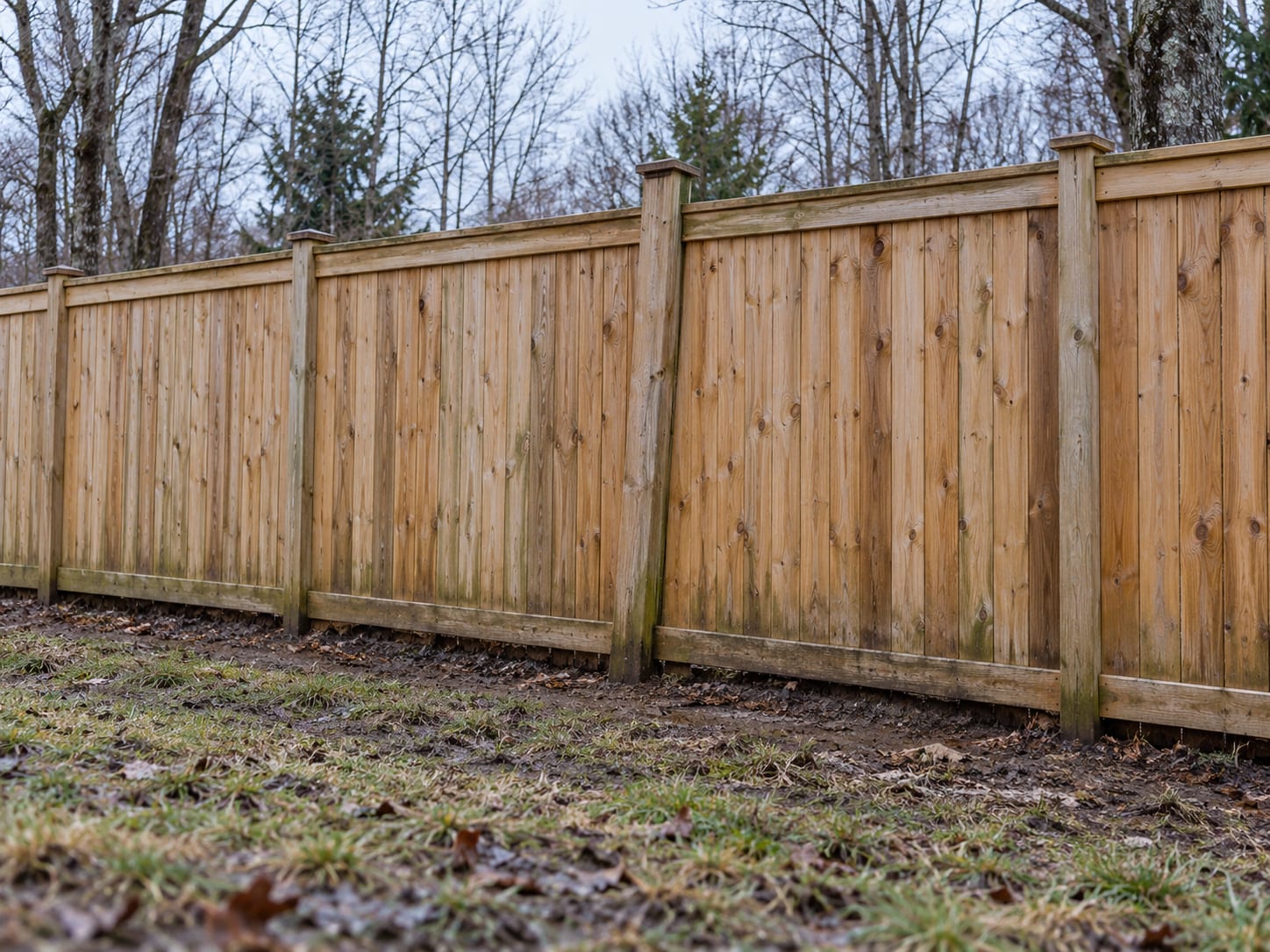
Frost heave happens when water in frost-susceptible soil freezes into expanding ice lenses. As the soil expands, it can push a post, footing or concrete mass upward. After repeated freezing and thawing, posts may sit higher than neighboring posts, lean out of plumb or settle unevenly.
The risk rises where soil holds water and fine particles allow moisture to move toward the freezing zone. Coarse, well-drained material has less available water and is generally less affected by frost action. The USDA NRCS Connecticut soil survey discusses frost action as a soil limitation and identifies coarse-grained subgrade as one way to reduce frost-related problems.
A drainage layer can help move water away from the bottom of a post when the surrounding soil and outlet conditions allow water to drain. It cannot correct a hole that is too shallow, a saturated site with nowhere for water to go or a footing that is too small for the fence.
Footing shape also matters. A concrete footing that widens toward the bottom provides more bearing area. A rough concrete surface that widens toward the top can give frozen soil more surface to grip, which may increase upward drag. Where the design depends on frost-depth protection, the footing bottom should extend below the active frost zone.
A post beside a wetland, drainage swale or spring can require more attention to water movement than a post in dry, compact soil. Confirm any wetlands or watercourse approval with the town before excavation.
Concrete, gravel and tamped soil by fence type
The installation method should match the fence material and the product instructions.
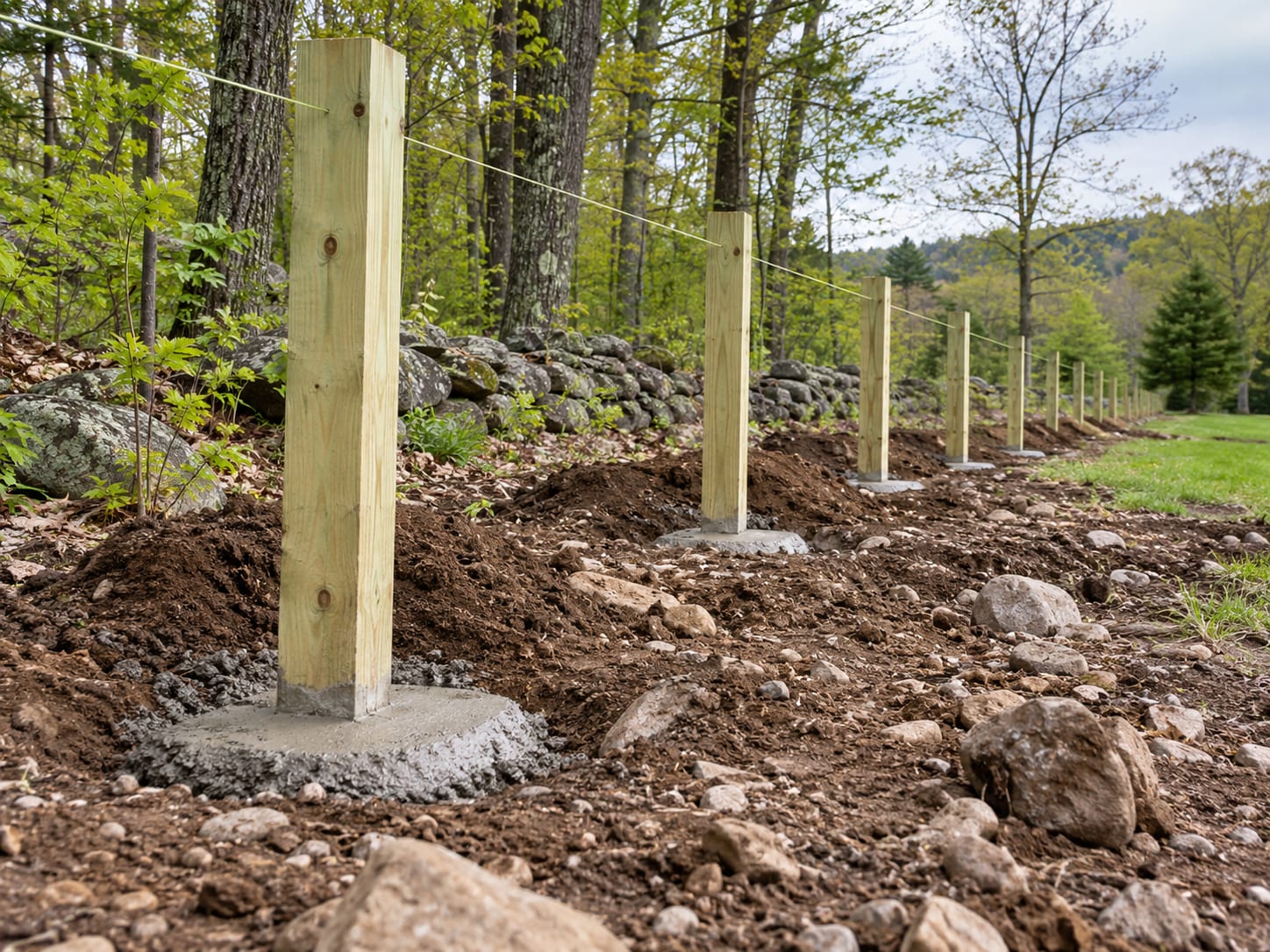
For ordinary residential wood, vinyl, aluminum and chain-link fences, the cited installation guides generally use concrete around the post. Gravel may be placed below the concrete when the guide specifies it and when the soil can drain.
Hover or tap a row to highlight it.
| Fence material | Common installation guidance |
|---|---|
| Wood | Concrete around the post, often with approximately 6 inches of gravel below it. End, corner and gate posts are set deeper. |
| Vinyl | Concrete around the post, with the product’s frost-line and post-installation instructions followed. |
| Aluminum | Concrete footings and, in some instructions, a 6-inch gravel drainage layer. Frost-area footings may extend below the frost line. |
| Chain link | Concrete commonly used for terminal, corner and gate posts, and often for line posts. Depth and diameter vary with height, post type and wind load. |
| Tamped soil | More common for agricultural or driven-post systems designed for that method than for ordinary residential fence installations. |
The Home Depot vinyl fence instructions call for concrete and product-specific frost-line instructions. Aluminum installation instructions commonly include concrete and gravel, and one manufacturer guide specifies a 6-inch gravel layer and below-frost-line installation in frost areas.
For chain link, terminal posts carry more force than ordinary line posts. The Home Depot chain-link instructions and Peak chain-link installation guide use concrete details that vary with the post and fence design.
Gravel alone can work for selected agricultural systems when the manufacturer permits dry-set installation and the soil drains well. It is not a universal replacement for concrete on a residential privacy, vinyl, aluminum or chain-link fence.
Line posts, gate posts and corner posts
Line posts support the ordinary runs between changes in direction. Gate posts carry the weight and movement of the gate, while corner and end posts resist tension from two fence runs or from the termination of a run.
That difference is why a proposal should separate ordinary line-post depth from gate, corner and end-post depth. Lowe’s installation instructions call for end, corner and gate posts to be at least 6 inches deeper than the standard post depth.
A driveway gate, estate gate or tall privacy gate may need larger posts, wider holes, more concrete or a separate footing design. The fence height and post depth should be considered together with the gate hardware and opening width.
What to settle before you dig
Contact the town’s zoning or planning office and building department before ordering materials. Ask whether the project needs a zoning permit, building permit, fence permit or other approval. Also ask about height, setbacks, wetlands, historic districts, surveys and inspections.
The statewide overview, Do You Need a Permit for Fence Installation in CT?, can help you organize the questions, but the office serving your property makes the local determination.
Connecticut towns handle these matters differently. Newtown’s zoning regulations include an exemption for a fence connected with a permitted use when the work does not involve removal or addition of more than 100 cubic yards of earth. That does not settle every other approval question. Newtown regulations also address how fences should follow terrain and avoid blocking or redirecting drainage. Read the Newtown zoning regulations for the town’s published requirements.
Greenwich states that fences and walls are governed by a specific section of its Building Zone Regulations. A historic district can add another review, as shown by the Newtown Borough historic-district record. Ask the office serving the property which review applies to your address.
Nearby New York towns use the New York State Uniform Code together with local zoning rules. New York’s building code uses below-frost-line protection for foundations and other permanent supports, but local zoning still controls the fence project. A rule from a Connecticut town should not be carried across the state line.
Before excavation, call Connecticut’s Call Before You Dig system when the excavation rules apply. Connecticut requires excavators using power-operated equipment to contact the central clearinghouse at least two full days, excluding weekends and holidays, and no more than 30 days before excavation. The state’s Call Before You Dig provisions provide the timing requirements.
A Practical Fence Footing Process
- 1
Confirm the town
Ask zoning, planning and building offices about permits, setbacks, wetlands, historic districts and footing requirements.
- 2
Mark the layout
Show the fence line, gates, corners, property boundaries, roads and nearby water features on a sketch or plot plan.
- 3
Call before digging
Contact Connecticut’s utility marking system within the required excavation window.
- 4
Check the product
Follow the exact manufacturer instructions for post depth, hole diameter, gravel and concrete.
- 5
Dig and inspect
Account for ledge, wet soil, disturbed fill, drainage and the different loads at gates and corners.
- 6
Set the posts
Place posts plumb, use the specified footing method and shape the finished surface so water drains away.
- 7
Complete the fence
Install rails, panels, mesh and gates, then arrange any required inspection or approval.
For residential work, the Connecticut Department of Consumer Protection says a contractor performing permanent changes to residential property, including fences, must register as a Home Improvement Contractor. Ask for proof of registration and insurance. A written quote from My Fence Guy should identify the fence material, post sizes, depths, hole diameters, footing material, drainage method, gates, utility marking, permit responsibilities and how unexpected ledge or unsuitable soil will be handled.
Who to call about frost depth and permits at your address
In Connecticut, the town can set or interpret local requirements involving fence height, setbacks, permits, wetlands, historic districts and site conditions. The State Building Code supplies a 42-inch frost-protection benchmark for covered foundations and permanent supports, while the fence installation itself may follow a product-specific detail.
If your property is in Connecticut, contact the Connecticut town office serving the parcel. A nearby town’s rule is not a substitute for the rule at your address.
In nearby New York, local municipalities apply the state code with their own zoning and permit procedures. If your property is in New York, contact that municipality directly.
Frequently Asked Questions
How deep should fence posts be in Connecticut?
Start with the manufacturer’s depth, commonly about one-third of the post length or one-third to one-half of the above-ground post height. That is about 24 inches for a 6-foot fence, 28 inches for a 7-foot fence and 32 inches for an 8-foot fence, before adjustments for frost, soil, gates, corners and local requirements.
What is the frost line depth in Connecticut?
The Connecticut State Building Code uses 42 inches below finished grade for frost protection of covered foundations and other permanent supports unless an approved alternative applies. Ask the local building official whether that benchmark applies to your fence footing, because ordinary fence posts are not automatically assigned a 42-inch depth.
Is 2 ft deep enough for a fence post?
Two feet can match a common starting point for a 6-foot fence, but it may not be enough for wet soil, a solid privacy fence, a gate, disturbed fill, high wind exposure or a deeper product or town requirement. Confirm the depth and hole diameter before digging.
What happens if you don't put posts below the frost line?
Freezing water in frost-susceptible soil can push the post or concrete upward. Posts may lean, fence sections may become uneven, gates may drag or stop latching, and repeated freeze-thaw cycles can cause continued movement.
Should fence posts be set in concrete or dirt?
Concrete is the common recommendation for residential wood, vinyl, aluminum and chain-link installations. Tamped soil or driven posts can suit agricultural systems designed for that method, but the product instructions and soil conditions must support the choice.
Is gravel necessary under a fence post?
Gravel is necessary only when the product instructions or footing design calls for it. A Lowe’s wood-fence guide specifies approximately 6 inches of gravel under the concrete, while an aluminum guide also shows a gravel drainage layer. Gravel helps only when water can drain away from the hole.
Fence Post Depth and Frost Check
1. What is the Connecticut State Building Code frost-protection benchmark for covered foundations and other permanent supports?
2. What is a common starting depth for a 6-foot fence under the one-third baseline?
3. Which posts usually need extra depth or a larger footing?
4. What should you check before choosing concrete or gravel?
Pick an answer to begin.
Final Thoughts
A stable fence starts with the right depth for the fence design and the property, not with one number applied to every yard. Use the manufacturer’s instructions, ask the town about the applicable frost and permit requirements, and put the proposed depth, hole diameter, footing material and drainage method in writing.
For a fence with a large gate or wet soil along the line, the footing deserves extra attention before installation begins. Call us at (203) 746-1100 for a free estimate, or reach out through our contact page.
Fence Footing Terms
Tap a term to see what it means.
Frost line. The depth below grade where soil may freeze during winter conditions.
More about fences
Installing a Fence on Rocky Soil and Ledge in Western Connecticut
Rocky soil and ledge are common in western Connecticut, and fences still go in. Core drilling, pinned posts, surface mounts, and how ledge affects cost.
Read the guide to Installing a Fence on Rocky Soil and Ledge in Western ConnecticutFencing a Sloped Yard: Stepped vs Racked Fences
Fencing a sloped yard: stepped or racked panels, which materials rack and how far, handling gaps under the fence for pets and pools, and the cost of a slope.
Read the guide to Fencing a Sloped YardHow Much Does a Fence Cost in Connecticut? What Drives the Price
What a fence costs in Connecticut: 2026 installed ranges by material, what raises the price on your property, what a written quote must include, and tax basics.
Read the guide to How Much Does a Fence Cost in Connecticut? What Drives the Price