
Installing a Fence on Rocky Soil and Ledge in Western Connecticut
By Tony Pellicone13 min readPublished
- fence installation
- homeowner guide
- connecticut
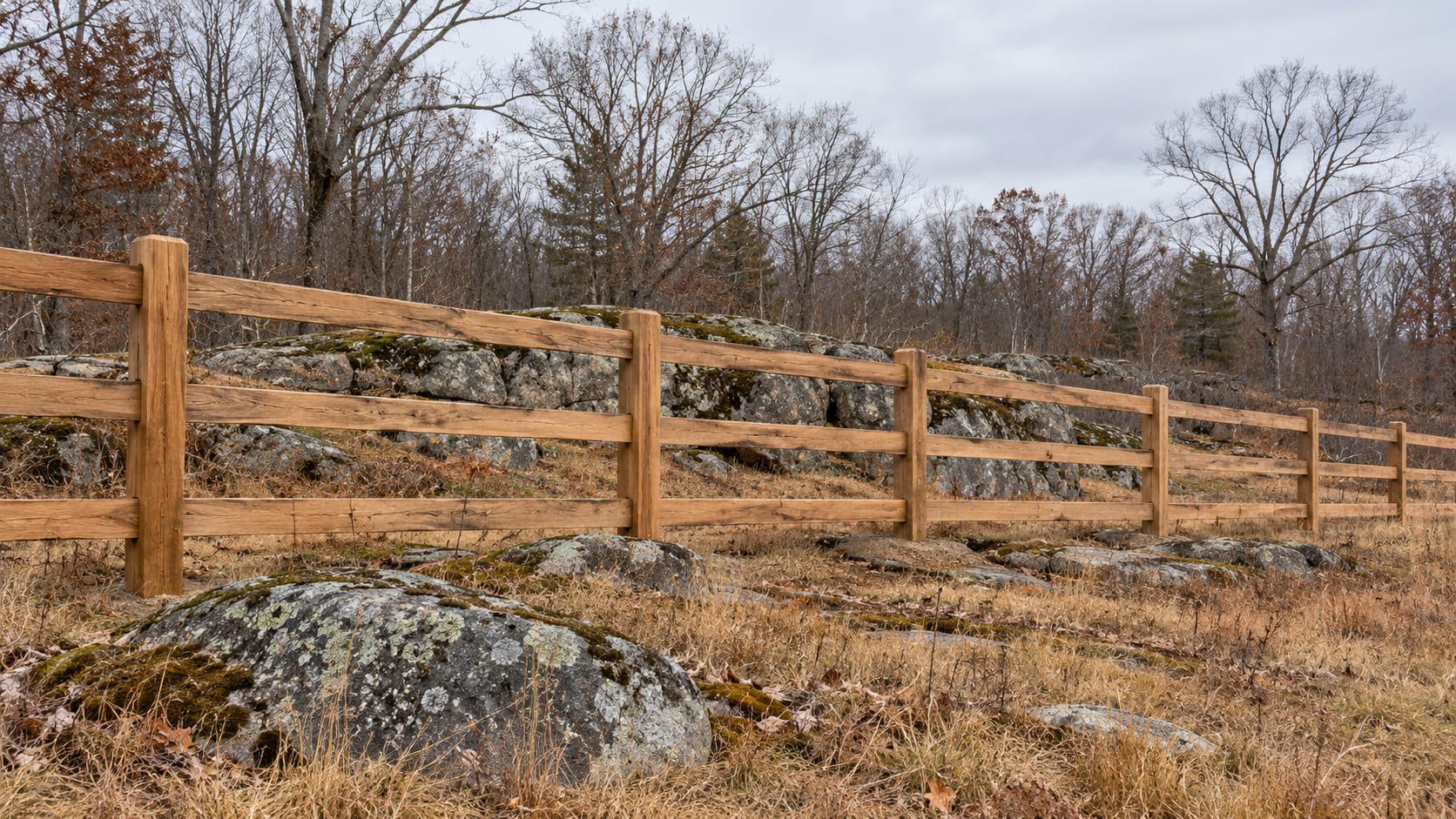
Yes, you can install a fence on rocky soil or exposed ledge in western Connecticut. The right method may involve removing loose boulders, drilling into bedrock, pinning a footing to ledge, using a surface-mounted base, or moving a post into a nearby soil pocket. Rock usually changes the labor, equipment, anchoring method and layout more than it changes whether the fence can be built.
Before you approve a route, confirm local requirements with the town and have the actual post locations probed or tested. A written estimate should separate ordinary digging from drilling, rock removal, grouting, anchors, equipment and any changes caused by conditions underground.
Key Takeaways
Rocky soil
Scattered rocks and shallow ledge do not automatically prevent fence installation.
Post method
The obstruction may call for hand removal, a rock auger, drilling, grouting, pinning or a surface mount.
Fence choice
Open aluminum, steel and chain link often create less wind load than solid privacy panels.
Cost driver
Rock adds labor, equipment, materials and possible post relocation, so the quote should show each charge.
Local approval
Zoning, building, wetlands, health and highway requirements depend on the town and the exact fence location.
Site preparation
Use soil maps for early planning, call 811 before excavation and test representative post locations.
Why Western Connecticut Has Rocky Fence Routes
Western Connecticut’s rocky ground comes from its glacial and bedrock setting. Upland properties commonly have thin glacial till over bedrock. The Connecticut Department of Energy and Environmental Protection describes till as a mixture of rocks, sand, silt and clay left by glacial activity. Most till is approximately 15 feet thick statewide, but depth changes widely from one property to the next. You may have several feet of soil at one post and exposed bedrock or a buried boulder at the next.
Ridge tops and uplands often have thinner soil. Valleys may contain deeper deposits of layered glacial material. That difference matters when you lay out a fence because a soil map can suggest general conditions, but it cannot tell you the exact depth at every post.
The USDA Natural Resources Conservation Service Web Soil Survey lets you enter a property address or draw an area of interest, review mapped soil series and use the Soil Data Explorer. Look for interpretations involving restrictive layers, depth to bedrock, lithic bedrock or depth to a selected restrictive layer. The NRCS Connecticut soil survey data can help with preliminary planning.
Use the map as a starting point, then have the proposed fence route probed or tested before the final price is set. A contractor should identify whether each difficult location contains loose rock, a removable boulder, fractured material or continuous ledge.
Hover or tap a row to highlight it.
| Ground condition | Typical installation question | Possible response |
|---|---|---|
| Loose stones | Can the material be removed by hand or with digging tools? | Remove the rock and continue the footing |
| Large boulder | Can the boulder be excavated, moved or avoided? | Adjust the post location or use a different anchor |
| Fractured rock | Can the material be broken enough for the required footing? | Use a rock auger, rotary hammer or jackhammer |
| Continuous ledge | Is the rock stable enough for drilled anchors or a surface base? | Drill, grout, pin or surface-mount the post |
| Exposed bedrock | Will the proposed fence and gate loads fit the anchor system? | Use a designed base and anchors suitable for the loads |
Ways to Install Posts When You Hit Rock
The installation method depends on the type of obstruction and the loads carried by that post. A line post supporting open mesh is different from a gate post carrying hinges, latch movement and wind pressure.
Small stones can often be removed with a digging bar, rock bar, pry bar or other hand tools. A larger boulder may need to be exposed on several sides before the installer can decide whether to remove it, work around it or shift the post.
A rock auger or hydraulic auger is made for dense, stony soil and some fractured rock. An ordinary soil auger is not the same tool. When the material is fractured shale or another breakable rock, a rotary hammer, jackhammer, pneumatic drill or hydraulic breaker may create enough space for the footing.
Solid ledge calls for a different detail. The installer may drill a cylindrical hole into the rock, set a steel post or post anchor, and use grout, concrete, epoxy or another specified anchoring system. Another option is to drill several smaller holes and pin a concrete footing to the ledge with rebar or threaded rod.
A surface-mounted post base can be anchored directly to exposed rock with mechanical or epoxy anchors. The base must fit the fence height, wind exposure, gate loads and rock condition. Surface mounting is not a substitute for design simply because excavation is difficult.
A Connecticut Department of Transportation specification gives one public construction example involving exposed ledge rock. It describes metal fence posts installed in drilled holes at least 6 inches in diameter and 12 inches deep, then grouted in position. That detail governs the state transportation work it was written for; a private fence follows your town's requirements and the post manufacturer's anchor details.
My Fence Guy can evaluate the route, identify difficult post locations and put the proposed drilling, pinning, relocation or surface-mount work in the written estimate. The exact anchor system should be identified before installation, especially for tall privacy panels, pool barriers, security fencing and large gates.
Typical Rocky-Ground Installation Sequence
- 1
Confirm the route
Review the survey or plot plan, fence line, property boundaries, gates and access.
- 2
Mark utilities
Contact [Call Before You Dig Connecticut](https://www.cbyd.com/) at 811 or 1-800-922-4455 before mechanized excavation.
- 3
Probe post locations
Identify soil, loose rocks, boulders, fractured rock or continuous ledge.
- 4
Select the footing
Choose ordinary excavation, rock drilling, pinning, grouting, a surface base or a nearby post location.
- 5
Install posts
Set posts and anchors according to the approved method, then allow required concrete, grout or epoxy curing time.
- 6
Install panels and gates
Fit the fence to the adjusted spacing and confirm that gate posts carry their loads safely.
- 7
Complete approvals
Arrange any required inspection or sign-off with the responsible municipal office.
How Rock Changes Time and Cost
Rock adds cost through labor, equipment, materials and layout changes. The price may be part of the linear-foot rate, assigned per post, billed hourly or handled through a separate allowance. Your estimate should state which method applies before work begins.
A national 2026 cost reference from Angi reports an installed-fence range of $6 to $50 per linear foot, with a national average of $23 per linear foot. Those are national figures, not western Connecticut prices; ledge drilling and rock anchoring show up as their own line items on a rocky lot. Angi also reports national figures of $20 to $60 for a fence permit, $3 to $5 per linear foot for old-fence removal and $1,000 to $3,200 for land leveling. Treat those figures as national context only.
For a rocky property, ask the contractor to identify:
- The number of posts expected to need drilling, pinning or surface mounting.
- Whether normal soil excavation is included in the base price.
- Hourly labor and equipment rates.
- Equipment rental or mobilization charges.
- Per-post charges for difficult locations.
- Concrete, grout, anchors, disposal and re-layout costs.
- The price and approval process if actual conditions differ from the early assessment.
Rock can also increase the number of posts if the route is adjusted around boulders. A gate may need a new location, a stronger post or a different footing. A short section can become more labor-intensive than a long section if access is tight or the ledge is continuous.
Do not approve a quote that says only “rock extra” without explaining how the extra work will be priced. Ask for the proposed post size, anchor type, drilling depth or surface-base detail, and the change-order process.
Choosing a Fence Material for Ledge
The best fence for rocky ground is the one whose posts can be anchored safely and whose wind and gate loads match that anchoring system. Material alone does not solve a ledge problem.
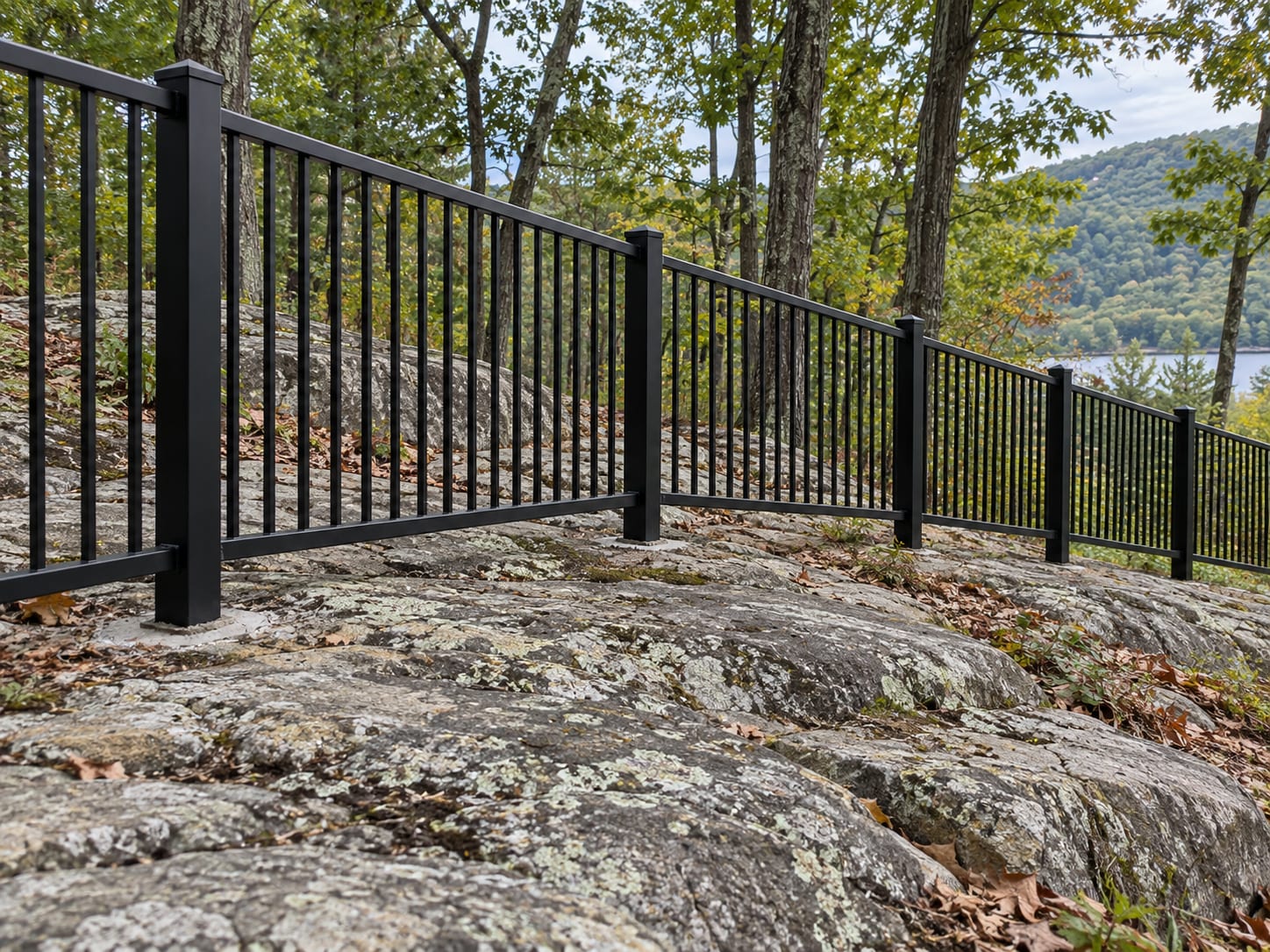
Open ornamental aluminum or steel often works well with drilled rock anchors or surface-mounted bases. An open picket design generally presents less wind exposure than a solid privacy panel. Heavy gate posts still need substantial anchoring. If that style fits your property, compare the installation method with the options described on the aluminum fencing product page.
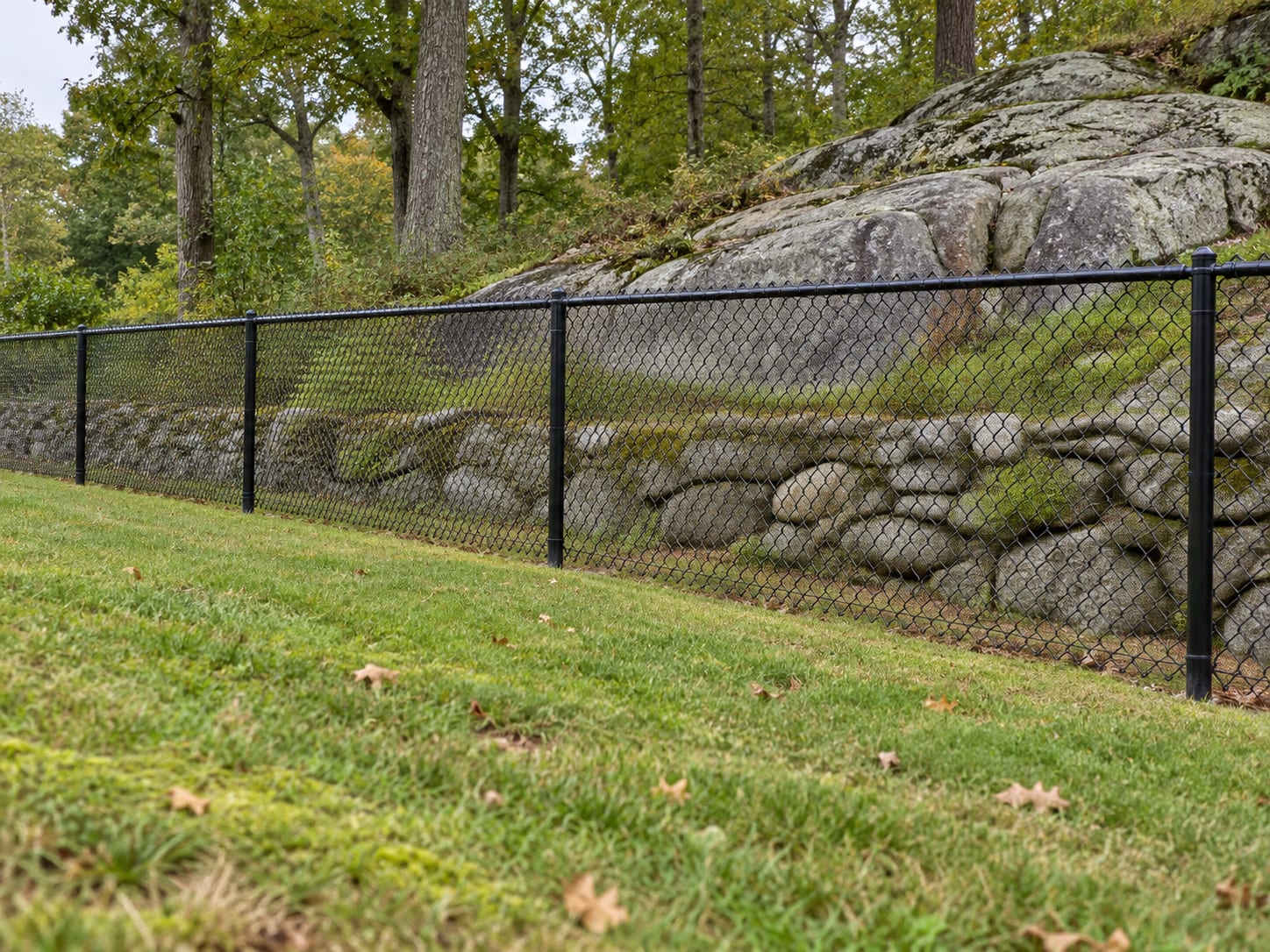
Chain link uses relatively narrow posts and generally has less wind exposure than a solid privacy fence. Drilled or grouted steel posts can work well for boundary, pet, agricultural and security applications. Privacy slats or fabric add wind load, so review the post and footing design if you want more screening.
Vinyl panels are lightweight, and some systems provide surface-mount solutions for vinyl posts. The panels can still catch wind across a broad surface. Use a post-base and anchor system designed for the height, panel style and site conditions. Do not choose surface mounting solely because digging is difficult. The vinyl fencing product page can help you compare styles before discussing the footing.
Wood gives the installer flexibility when the fence line must move around a boulder. Rails and pickets can be cut to fit irregular ground, and individual posts can be shifted when the layout allows it. Large privacy panels create more wind load than an open fence, so the anchoring detail matters. For material comparisons, see wood versus vinyl fence costs, upkeep and lifespan.
Agricultural wire and field fencing can use smaller steel posts or T-posts in some rocky conditions. Corner, end and gate posts carry more load than ordinary line posts and need a stronger detail. A split rail fence may also work where privacy is not required and the route can move around exposed rock.
For a pool barrier, the fence must meet Connecticut State Building Code requirements in addition to handling the ledge. Current state pool-barrier provisions include a barrier at least 48 inches high, limited openings, and self-closing, self-latching pedestrian gates. You can review related planning questions in Connecticut pool fence requirements for height, gates and permits.
Confirm Local Approval Before You Install
Fence requirements are set by the municipality. A rule in Brookfield is not automatically a rule in New Milford, Danbury, Newtown or a nearby New York town.
Start with the zoning or land-use office. Ask whether the building department, inland wetlands agency, conservation office, health department or highway department also needs to review the work. Provide the property address, parcel identification, survey or plot plan if available, proposed fence route, height, material, gate locations and distances from roads, property lines, wetlands, watercourses and structures.
Connecticut DEEP explains that activities in or affecting inland wetlands or watercourses may require review and a permit from the municipal inland wetlands agency. If the fence is near a wet area, ask that agency before placing posts or moving soil. The Connecticut fence permit overview gives additional statewide planning context.
Brookfield shows why you need to ask the town directly. Its zoning regulations tie zoning approval and a certificate of zoning compliance to fence height, and cap visibility-blocking fences at 8 feet and other fence types at 12 feet. Its public FAQ uses a separate height threshold for building permits. Confirm the current thresholds with Brookfield Land Use before ordering materials, and see fence permits in Brookfield, CT for the town’s height rules.
New Milford directs applicants to submit a zoning permit application with a survey or plot plan showing the fence, dimensions and distances from property lines. The town also advises applicants to contact Building, Inland Wetlands, Health and Sewer departments because separate permits or sign-off may apply. In Danbury, requirements follow your zoning district, so ask the city’s land-use or building office which district your lot is in and what applies to a fence there. In Newtown, ask the zoning office for the fence approval and district requirements that cover your address.
Nearby New York municipalities have their own processes. Putnam Valley lists a specific Fence/Wall Permit through its Building and Zoning Department. Hyde Park states that a fence permit is not required, while also setting property-line, height, visibility and right-of-way conditions. Bedford lists fences and walls among work requiring permits. Tarrytown requires a building-permit application for a fence and publishes a 6-foot maximum in its procedure, with additional review for some fences visible from a public street.
If you are working near a property line, put access, ownership, cost sharing, maintenance and gate access in writing with the neighbor. Connecticut General Statutes Chapter 823 addresses divisional fences. A specific boundary dispute calls for a current survey and advice from a Connecticut real estate attorney.
What to Put in the Written Quote
The quote should describe the fence route and the ground work with enough detail that you can compare proposals. Include the assumed property line, fence height, material, post size, spacing, panel style and gate locations.
Ask for separate line items for ordinary digging, rock removal, drilling, pinning, grouting, surface mounting, post relocation, concrete, anchors, disposal, equipment and labor. The proposal should also state who handles permits, utility marking, inspections and any required engineering detail.
Give the contractor photos of exposed rock, ledge, slopes and limited access areas. Mention pools, pets, livestock, horses, privacy needs, security concerns and large gates. A fence intended for a dog run may need different spacing and gate details from a boundary fence. A horse or livestock fence may need a different corner-post system from a residential privacy fence.
The route should be reviewed in the actual order of installation. First confirm the survey and town requirements. Then mark utilities, set post locations, resolve difficult ground, install posts, attach rails or panels, hang gates and complete any inspection. If you are planning work in another season, learn when fence installation usually works best in Connecticut.
Frequently Asked Questions
How do you put a fence post in rock?
You put a fence post in rock by removing the obstruction, drilling into stable bedrock, pinning a footing to the ledge, using a suitable surface-mounted base or moving the post to a nearby soil pocket. The method must match the fence height, wind exposure, gate loads and condition of the rock.
Can you install a fence on ledge?
Yes, you can install a fence on ledge with drilled and grouted posts, pinned footings or surface-mounted post bases. Ask the town whether the altered footing method needs building approval or an engineered detail before installation.
How do you dig a post hole in rocky soil?
You dig a post hole in rocky soil by probing the location, removing smaller stones with hand tools, using a rock-capable auger for dense mixed soil, and drilling or breaking fractured rock when needed. Call 811 or CBYD before mechanized excavation and document any alternate footing method.
What fence is best for rocky ground?
Open aluminum, steel and chain link often fit rocky ground because they can use drilled or surface-mounted anchors and may create less wind load than solid panels. Wood can work well when the fence line needs to move around boulders, while vinyl requires a post and anchor system suited to its panel wind exposure.
Does a rocky yard change the fence height you can build?
Your town, not the soil, sets how tall the fence can be. The permitted height depends on the municipality, zoning district, fence location, style, road visibility and other site conditions, so confirm the rule with the local zoning or building office.
Rocky Ground Fence Planning
1. What should you do before mechanized excavation?
2. Which fence style usually creates less wind exposure than a solid privacy fence?
3. What may be used to attach a post system to exposed bedrock?
4. Who sets local fence approval requirements?
5. What should a rocky-ground quote identify?
Pick an answer to begin.
Final Thoughts
Rocky soil and shallow ledge are construction conditions to plan for, not automatic reasons to abandon a fence route. Confirm the town’s requirements, mark utilities, test representative post locations and choose an anchor detail that fits the fence, gates and ground.
A clear written quote gives you a better basis for deciding whether to move the line, drill into ledge, use a surface base or select a different fence style. Call us at (203) 746-1100 for a free estimate, or reach out through our contact page.
Rocky Ground Fence Terms
Tap a term to see what it means.
Glacial till. A mixture of rocks, sand, silt and clay left by glacial activity.
More about fences
How Deep Should Fence Posts Be in Connecticut? Frost Line and Footings
How deep to set fence posts in Connecticut: frost depth, manufacturer depth rules by fence height, concrete or gravel, and how frost heave lifts posts.
Read the guide to How Deep Should Fence Posts Be in Connecticut? Frost Line and FootingsFencing a Sloped Yard: Stepped vs Racked Fences
Fencing a sloped yard: stepped or racked panels, which materials rack and how far, handling gaps under the fence for pets and pools, and the cost of a slope.
Read the guide to Fencing a Sloped YardHow Much Does a Fence Cost in Connecticut? What Drives the Price
What a fence costs in Connecticut: 2026 installed ranges by material, what raises the price on your property, what a written quote must include, and tax basics.
Read the guide to How Much Does a Fence Cost in Connecticut? What Drives the Price