
Chain Link Fencing in New Fairfield, CT: Specs That Matter
By Tony Pellicone20 min readPublished
- chain link fencing
- new fairfield ct
- pet fencing
- connecticut
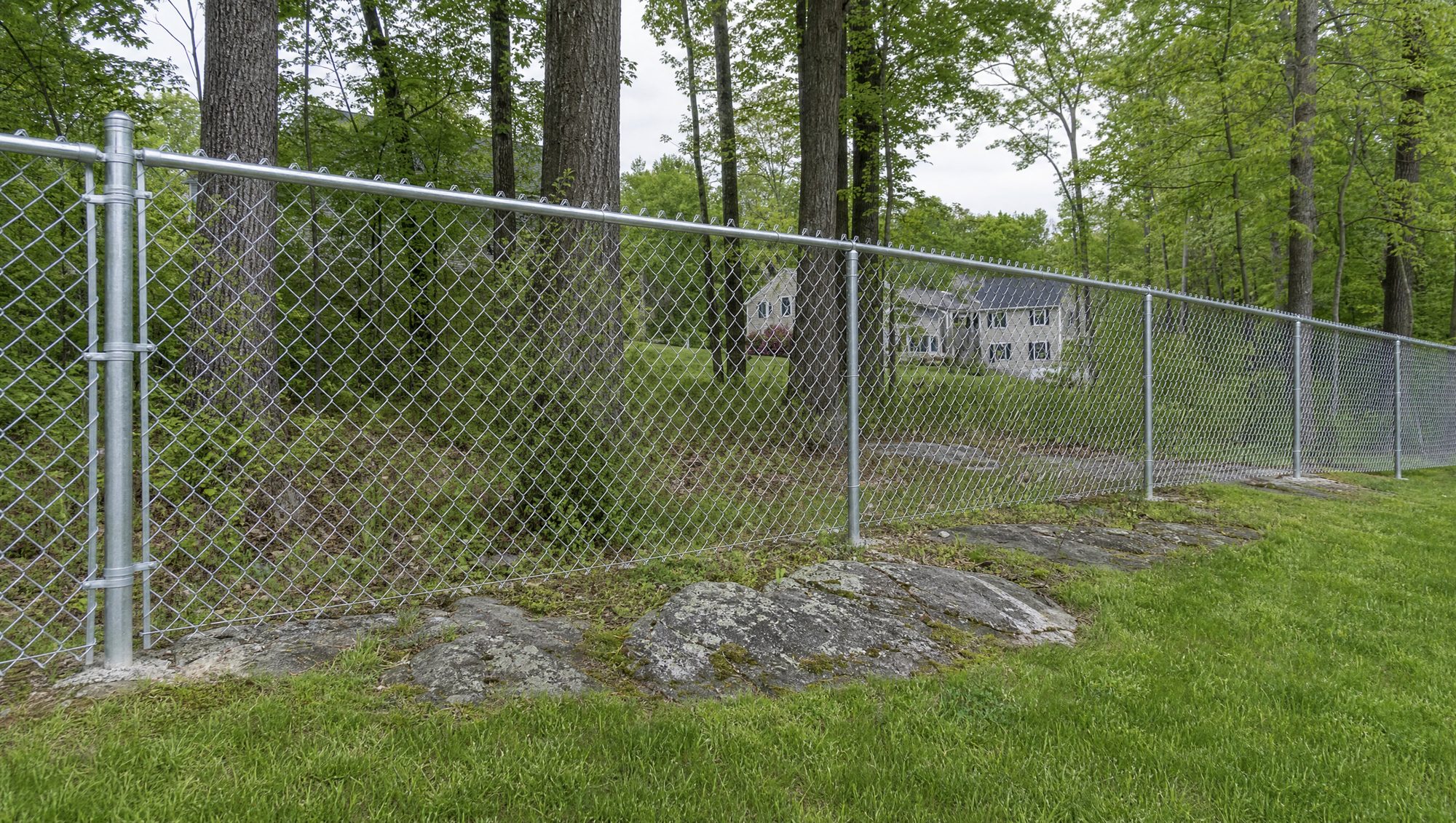
Chain link is a system, not a roll of mesh. That is the whole reason two bids for chain link fencing in New Fairfield, CT can describe the same fence and be nothing alike. Both say six feet. Both say black. Both give a price. One is built with heavier wire, thicker posts, a real top rail, and a gate frame sized for the load it carries. The other starts leaning by the second winter, and the dog finds the gap under the fabric long before that. The trouble is that the bid does not tell you which one you are buying, because the parts that decide it are the parts nobody writes down. Once you know what to look for in the paperwork you can tell the two apart in about a minute.
Key Takeaways
Specifications decide the fence
Wire gauge, mesh opening, coating, post and rail sizing, and gate hardware belong in the written estimate, not in the installer's head.
Galvanized and black are different systems
Zinc-coated and polymer-coated fabric protect steel differently, and the posts, rails, and fittings should match the fabric.
Privacy slats change the engineering
Slats add screening and wind load together, so posts and footings must be sized for the slatted fence, not the open one.
New Fairfield rules by use, not material
Fences up to seven feet are generally exempt from a building permit, but a pool barrier needs one regardless of height.
Your site writes part of the price
Ledge, slopes, roots, wet ground, access, and old-fence removal move the labor more than the fabric does.
Chain Link Earns Its Keep When Function Beats Screening
Chain link stays popular around New Fairfield for reasons that have nothing to do with looks. It contains without blocking, so you keep the sight line to the yard and the airflow through it. It scales to long runs cheaper than solid fencing, follows uneven ground better than rigid panels, and takes a beating without complaint. Where it fits depends entirely on what the enclosure has to do.
Residential Yards and Pet Runs
Around a house, chain link defines the boundary, keeps a dog in, and protects a garden without turning the yard into a box. Open mesh means you still see the trees behind the line, and black coating pushes the fence further into the background. The height, mesh, and bottom detail get decided by what is on the inside of the fence, not by the catalog.
Commercial, Industrial, and Agricultural Sites
Business and farm properties ask more of the same product. Commercial work often calls for heavier posts and rails, taller fabric, smaller mesh, and gate frames built for daily traffic, and commercial fencing gets specified accordingly. Industrial sites may add controlled access, anti-climb detail, and engineering matched to the real security risk, which is where industrial fencing separates from a residential product wearing the same name. On acreage, kennels, equipment yards, and small livestock enclosures fall under agricultural fencing, planned around the animals and the pressure they put on the line.
Galvanized or Black: Two Ways to Keep Steel From Rusting
The finish question is really a corrosion question. Both galvanized and black chain link start as steel wire, and both rely on a coating to keep New England weather from eating it. What differs is the coating, how the rest of the parts are treated, and what happens when something scratches it. Getting this right matters more than picking a color you like.
Zinc-Coated Galvanized Fabric
A galvanized fence in New Fairfield uses zinc to shield the steel underneath. ASTM A392 is the standard covering zinc-coated steel chain-link fabric, including how the fabric is woven and how the mesh and edges are finished. Not all galvanized fabric is equal, though. Zinc-coating weight, wire gauge, mesh opening, post diameter, pipe wall thickness, and fitting thickness all vary between a light residential product and a commercial one that looks identical from ten feet away.
Polymer-Coated Black Fabric
A black chain link fence in New Fairfield is typically polymer-coated fabric, often over galvanized wire, and ASTM F934 addresses the standard colors used for polymer-coated chain-link materials. Black is chosen because it visually recedes against trees, lawns, gardens, and darker siding, so the fence reads as a boundary rather than a barrier. It is a finish and a protection layer at once, which is why the underlying wire gauge still needs to be on the estimate.
Matching the Posts, Rails, and Fittings
This is where cut corners hide. Coated fabric hung on bare galvanized posts, with mismatched fittings and an uncoated gate frame, looks wrong within a season and protects unevenly. Ask whether the posts, rails, tension bars, bands, gate frames, and hardware are coated to match the fabric.
Coating Damage and What It Costs You Later
A black finish does not retire the inspection. Mower impact, plow contact, branches, chemicals, abrasion, and cut ends can all break the coating, and a break is where corrosion starts. Worth asking before you sign: what coating system is used, what happens when it gets scratched, and whether the warranty treats fading, peeling, corrosion, and impact damage as the same thing. They usually are not.
Reading a Chain-Link Bid the Way an Installer Reads It
Height and color are the two things every estimate lists and the two things that tell you the least. The specifications that decide how the fence performs are the ones you have to ask for. When you have them in writing, comparing two bids stops being a guess about price and starts being a comparison of the same job. Chain-link fencing is built from parts that each carry a number.
Gauge, Mesh, and Why Both Move
Wire gauge is the thickness of the wire; mesh opening is the size of the diamond. Heavier wire and smaller openings generally add strength, climb resistance, weight, and cost, and the right combination depends on whether the fence is holding a terrier, a pool line, or a loading yard. A small dog slips through an opening that a shepherd never notices. An athletic dog climbs fabric that stops a beagle cold.
Residential Versus Commercial Specifications
The words residential and commercial on a bid are shorthand, not a specification. What sits behind them is post diameter, pipe wall thickness, rail size, fitting thickness, and gate reinforcement, and ASTM F1043 covers strength and protective coatings for industrial chain-link framing while ASTM F1083 covers the galvanized steel pipe used in fence structures. Ask for the dimensions instead of the label.
Core Wire, Coated Diameter, and Selvage
Two details trip people up on coated fabric. The core wire diameter and the finished coated diameter are not the same number, so a bid quoting the coated measurement can read heavier than the steel actually is. The other is selvage, the treatment of the fabric's top and bottom edge: knuckled ends are smooth, twisted ends are sharp and are usually chosen for security, not for a yard where kids play.
Privacy Slats Buy Screening and Bill You in Wind
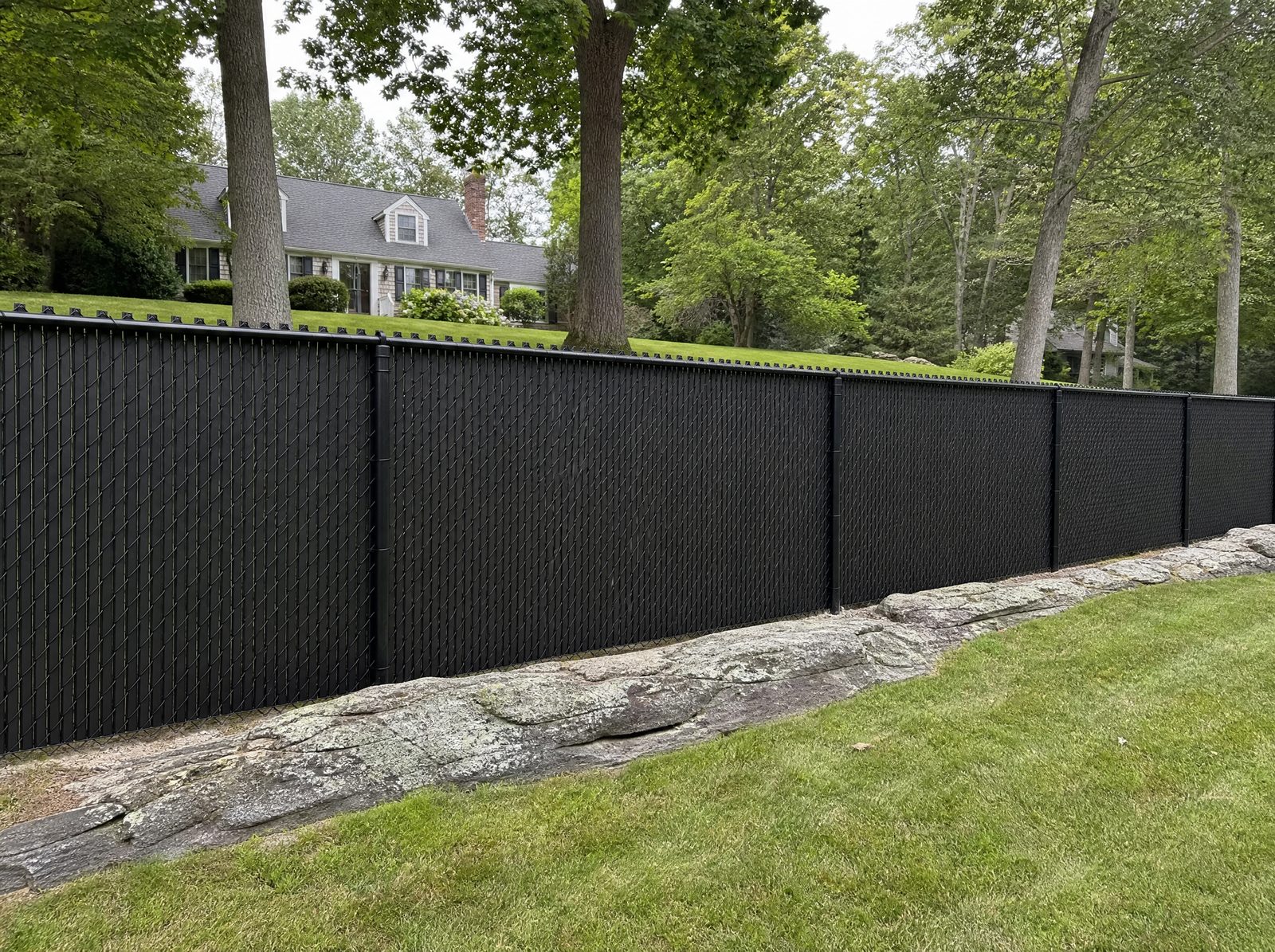
Slats are the most common late addition to a chain-link plan, and the one that most often gets added without a second thought about the posts. Woven into the mesh, they cut visibility and change the character of the fence. They also turn an open, wind-transparent line into something closer to a solid panel. That is a structural change, not an accessory.
Adding surface area means catching wind, and that load travels straight into the fabric tension, the rails, the posts, and the footings under them. Slats also affect gate loads, airflow, snow and debris collection, cost, maintenance, and how easily a damaged one gets replaced years later. If slats are in your plan, they belong in it from the start, so the posts and footings get sized for the slatted fence. Retrofitting them onto an undersized system without a review is how a straight line starts leaning.
Be skeptical of the screening claim too. Slats reduce visibility, but how much depends on the slat profile, the mesh size, the viewing angle, and how far away you are standing. Anyone promising total privacy from a slatted chain-link fence is selling past the product.
Pets, Pools, and Security Each Rewrite the Spec
The same fabric serves very different jobs, and each one pulls the specification in its own direction. A pet fence is designed around an animal's habits. A pool barrier answers to code. A security fence answers to what it is keeping out. Deciding the purpose first is what makes the rest of the choices obvious.
Chain Link for Dogs
Design around your dog, not the average dog. Height covers jumping, mesh size covers squeezing through, and bottom clearance plus a bottom tension wire covers pushing under. Digging is its own problem, and a buried apron or another dig deterrent may be appropriate where the animal works at it. Gate gaps and latch placement deserve the same attention, since gates are where most escapes actually happen, and good pet fencing treats them as part of the containment. Watch for climbable objects parked near the line too, because a woodpile is a staircase.
Pool Barriers Follow Their Own Rules
Chain link can serve as a pool barrier, but only when the complete installed system meets the applicable height, mesh opening, bottom clearance, climbability, gate direction, self-closing, and self-latching requirements. Standard fabric is not automatically compliant, and mesh dimensions and gate details are where it usually fails. New Fairfield requires a permit for a pool barrier no matter its height, so pool fencing is its own project with its own approval.
Commercial and Industrial Security
Security work adds taller fabric, smaller mesh, heavier posts and rails, access-control gates, and toppings where they are lawful. Gates carry the highest loads on any security line, and ASTM F900 covers industrial and commercial swing gates. Wide double gates, cantilever slide gates, and anything automated need engineered support rather than standard hardware, which is also true of estate gates on a residential drive.
New Fairfield Sets the Permit by the Use, Not the Fabric
The town keeps this simpler than most people expect. New Fairfield states that fences not over seven feet high are generally exempt from a building permit, with one clear carve-out: a fence used as a swimming pool barrier requires a permit regardless of height. Rules change, so confirm the current requirements before you order anything.
A building-permit exemption is not a zoning exemption, and that distinction is where projects get expensive. Placement near roads and intersections, driveway sight lines, setbacks, easements, wetlands and watercourses, security extensions, and private association or deed restrictions can all still apply to a fence that needs no building permit at all. The building permit page and the zoning department are where your specific lot gets confirmed.
Survey and Easement Questions
An old fence, hedge, tree line, stone wall, or mowing edge is not the legal boundary, and a fence set on the wrong side of one is an expensive thing to move. A survey earns its cost when markers are missing, the fence will sit close to the line, the lot has irregular boundaries, a shared driveway or an easement may be involved, a neighbor has questioned the route, or a wetland, lake, or watercourse is nearby. A fence contractor can lay out the project; a licensed surveyor establishes the line. Recorded plans often live with the town clerk's land records.
Call 811 Before Any Post Hole
Chain-link posts mean excavation, so buried lines get handled first. Connecticut's Call Before You Dig service should be contacted before any digging, and the public marking does not cover everything. Septic, well lines, irrigation, yard lighting, pool equipment, propane, generator feeds, private electrical service, drainage pipes, and invisible pet-fence wire are often privately owned and may need a separate locate. The contract should name who submits the request and who handles private lines.
Slopes, Ledge, and Frost Decide Whether the Line Stays True
New Fairfield ground does not cooperate on schedule. Rocky glacial soils, ledge, wooded edges, big roots, wet low spots, drainage swales, and old stone walls all show up on the fence line, and freeze-thaw movement tests whatever you put in the ground. Chain-link fabric can follow grade more continuously than rigid panels, which is a real advantage on a slope, but steep transitions still need careful post placement, even stretching, and bottom-gap control so the low points do not become a dog door.
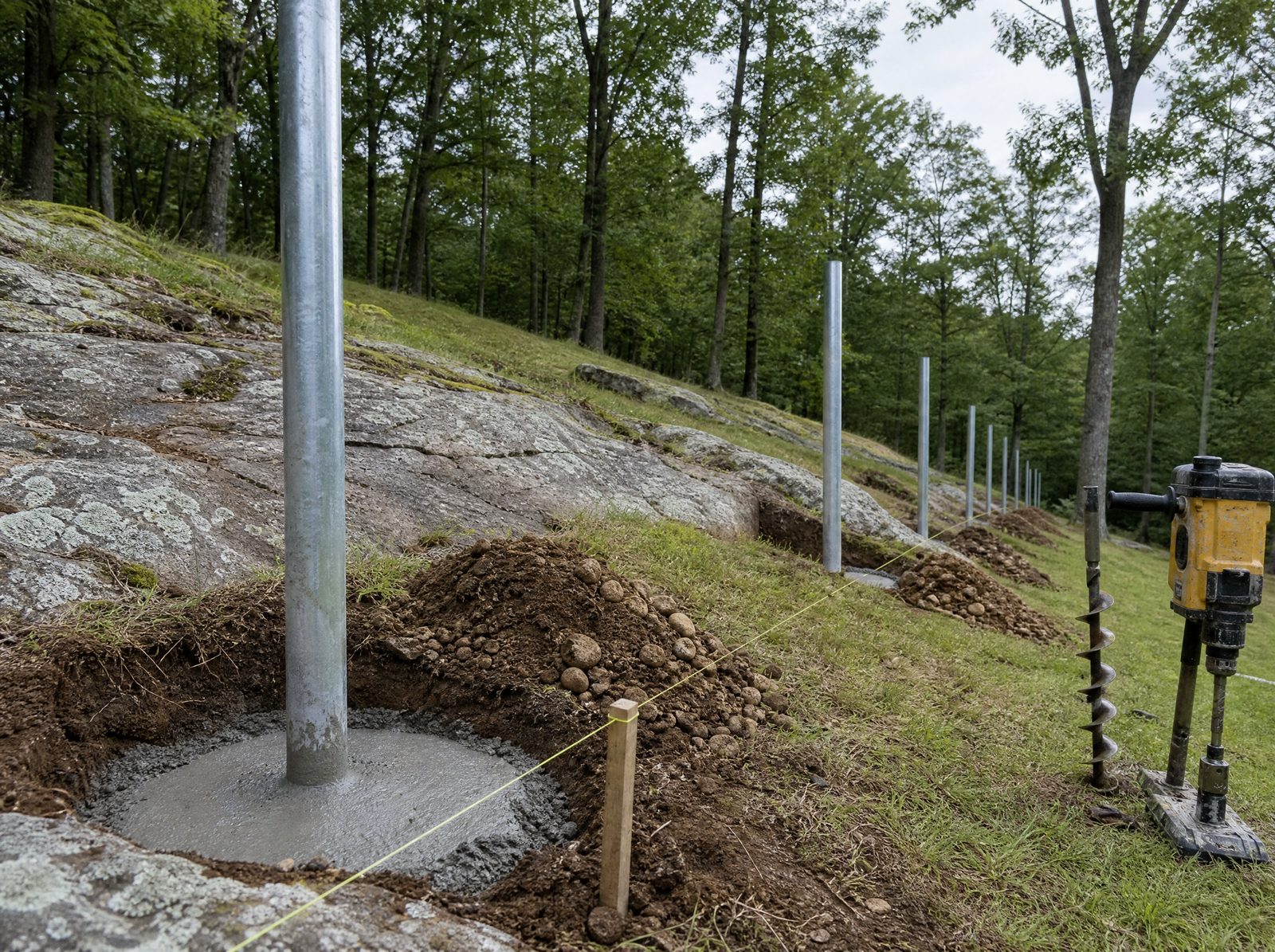
There is no universal post depth for every chain-link fence. Depth, hole diameter, the setting method, and post and rail sizing depend on fence height, fabric gauge, mesh, whether slats are involved, soil and ledge, drainage, wind exposure, gate width and weight, and the project specifications, and Connecticut's residential code for foundations frames why frost protection matters at all. Ledge may call for drilling, different equipment, a shifted post, or another anchoring approach, and that condition belongs in the contract's change-order procedure rather than in a surprise conversation on day two. Two smaller details save trouble later: posts and bottom tension wire should not block a swale, and living trees should never be pressed into service as posts, because they move and grow and the fabric loses.
What Actually Moves Chain-Link Fence Cost in New Fairfield
There is no reliable one-price-fits-all number for chain-link fence cost in New Fairfield. Published guides like Angi's chain-link cost breakdown give broad market context, and that is all they give, because the real number comes from your specifications and your dirt. Two identical footages price differently when one runs across ledge and the other across a lawn.
On the material side, the levers are linear footage, height, wire gauge, mesh size, coating, post and rail dimensions, top rail and bottom tension wire, gates, and slats. On the site side they are slopes, ledge, roots, wet soil, restricted access, brush clearing, old-fence removal, and permits, with pool and security requirements sitting on top of both. Gates earn their own mention, since each one needs its own posts, footings, and hardware, and a wide double or cantilever gate is a small structural project by itself. A site visit is the honest way to price the work, and we give free estimates.
Hover or tap a row to highlight it.
| Cost Driver | Why It Matters |
|---|---|
| Linear footage and height | Longer runs and taller fabric take more posts, more mesh, more hardware, and more labor. |
| Wire gauge and mesh size | Heavier wire and smaller openings add strength and climb resistance, and they add weight and cost with it. |
| Coating and framing | Galvanized versus polymer-coated fabric, plus post diameter and pipe wall thickness, separate a light residential system from a commercial one. |
| Gates | Each gate needs its own posts, footings, and hardware, and a wide double or cantilever gate is a small structural project by itself. |
| Privacy slats | Slats add material and wind load together, so the posts and footings have to be sized for the slatted fence. |
| Terrain and access | Ledge, slopes, roots, wet soil, brush, and a long carry from the truck all add hours to the labor. |
| Removal and permits | Pulling old fabric, posts, and concrete, hauling debris, and any pool or security approval are their own line items. |
How a Chain-Link Fence Installation Comes Together
A clean chain link fence installation in New Fairfield runs in a fixed order, and knowing the order helps you spot the crew that skips a step. It starts with what the fence is for and ends with a walkthrough, with the compliance and utility checks landing where they belong rather than after the holes are dug.
The New Fairfield Chain-Link Installation Process
- 1
Step 1: Purpose and Property Walk
We walk the line to settle what the fence has to do, then measure footage, grade, and gate locations against it.
- 2
Step 2: Boundary and Compliance Review
Property lines, zoning, setbacks, easements, wetlands, and any pool-barrier permit get sorted before anything is ordered.
- 3
Step 3: Written Specification and Estimate
Gauge, mesh, coating, post and rail dimensions, gates, hardware, removal, and cleanup go on paper as numbers, not labels.
- 4
Step 4: Utility Marking and Layout
A Call Before You Dig request goes in, private lines are identified, and the run gets staked and cleared.
- 5
Step 5: Terminal, Gate, and Line Posts
Terminal and gate posts are set first because they carry the tension and the gate loads, then the line posts follow.
- 6
Step 6: Fabric, Gates, and Walkthrough
Fabric is stretched evenly and tied off with tension bars, bands, and the specified bottom restraint, then gates are hung and the job is walked with you.
Two steps in that order carry most of the weight. Terminal and gate posts go in before line posts, because they absorb the tension and the gate loads the rest of the fence hangs on. And fabric gets stretched evenly, then tied off with tension bars, bands, and the specified bottom restraint, since over-tensioning, under-tensioning, missing ties, or a weak terminal all show up later as sag that no adjustment fixes.
What Separates a Chain-Link Fence Contractor Worth Hiring
Connecticut requires home improvement contractors, fence installers included, to register with the Department of Consumer Protection, and the state's license verification portal makes checking it a two-minute job. Registration and insurance are the floor, not a selling point. We are a family-owned contractor based right here in New Fairfield, licensed and insured. Beyond the paperwork, the difference shows in whether a chain link fence contractor in New Fairfield will put the fabric gauge, mesh, coating, post and rail dimensions, gate frame, and hardware in writing, or wants to talk only about the total.
What the Written Estimate Should Include
Connecticut's home improvement contract guidance is a good checklist to hold any bid against. At a minimum:
- Height and footage: The measured run and the finished height.
- Wire gauge and mesh size: The actual numbers, and the core wire diameter on coated fabric.
- Coating: Galvanized, aluminized, or polymer, and whether posts, rails, and fittings match.
- Post and rail dimensions: Diameter and wall thickness, with terminal and gate posts called out separately.
- Top rail and tension wire: Which the system uses, top and bottom.
- Gates and hardware: Widths, frames, hinges, latches, and any self-closing requirement.
- Slats or screens: The product, and confirmation the posts are sized for the added wind load.
- Removal and cleanup: Who pulls the old fence, the concrete, and the debris.
- Permits and utility responsibility: Who files with the town and who submits the 811 request.
- Ledge and change orders: How hidden conditions get priced before the work happens.
- Timeline, payments, and warranties: Schedule, payment terms, and material versus workmanship coverage.
The Mistakes That Cost People Twice
Most chain-link regret traces back to a short list. Comparing fences only by height and color. Not specifying gauge, or measuring a core wire number against a coated one. Undersized posts and weak gate support. Poor fabric tension and missing ties. Pet gaps nobody measured. Slats added without a wind review. Assuming standard fabric is pool-compliant, or that the seven-foot exemption settles zoning. Skipping the survey or the utility marking. Ignoring ledge and drainage until the crew hits them. Comparing only the initial price, with removal and cleanup left undefined. Every one of those is cheap to prevent on paper and expensive to fix in the ground.
Frequently Asked Questions About chain link fencing new fairfield ct
Q: What is the difference between galvanized and black chain link?
A: Galvanized chain link uses a zinc coating over steel for corrosion protection. Black chain link typically uses a polymer coating, often over galvanized wire, and is usually paired with matching coated posts, rails, gates, and fittings for a coordinated appearance.
Q: Do I need a permit for chain-link fencing in New Fairfield?
A: Fences not over seven feet are generally exempt from a building permit, but pool barriers require a permit regardless of height. Zoning, setbacks, sight lines, easements, and wetlands requirements may still apply, so confirm the current rules with the town before installation.
Q: Are privacy slats completely private?
A: No. Slats reduce visibility, but the actual screening depends on the slat profile, mesh size, viewing angle, and distance. They also add wind load, so the posts and footings need to be sized for the slatted system.
Q: Is chain link good for dogs?
A: It can be, when the system is designed around the animal. Height, mesh size, bottom clearance, bottom tension wire, gate gaps, latch placement, and digging behavior all matter more than the fabric alone.
Q: Can chain link be used around a pool?
A: Yes, when the complete installed barrier meets the applicable mesh, height, bottom clearance, climbability, gate, and latch requirements and receives the required permit and approval. Standard chain link is not automatically pool-compliant.
Q: What gauge chain link should I choose?
A: It depends on whether the use is residential, pet, pool, commercial, security, or industrial. Compare the written wire and post specifications rather than relying on a generic grade label, since core wire and finished coated diameter are different numbers.
Q: How much does chain-link fencing cost in New Fairfield?
A: Cost depends on footage, height, gauge, mesh, coating, post and rail sizing, gates, slats, terrain, removal, access, permits, and any pool or security requirements. A site-specific estimate is far more reliable than a published average.
Q: How do I verify a chain-link fence contractor in Connecticut?
A: Check the contractor's registration through Connecticut DCP's license-verification portal, request proof of insurance, and review a detailed written contract before any work begins.
Test Your Chain-Link Fence Knowledge
1. Which fence needs a permit in New Fairfield regardless of height?
2. What do privacy slats add besides screening?
3. On coated chain-link fabric, which measurement tells you how much steel you are buying?
4. Which posts get set first on a chain-link installation?
5. What is knuckled selvage?
Pick an answer to begin.
Final Thoughts
Chain link fencing in New Fairfield Connecticut works when the whole system is specified on purpose: the right gauge and mesh for what the fence contains, a coating matched across fabric, posts, rails, and fittings, posts sized for the height, the wind, the slats, and the gates they carry, and a layout that respects the boundary, the ledge, the slope, and the town's rules. Get those on paper and the price stops being a mystery. Skip them and the cheapest bid quietly becomes the most expensive one.
Done right, a chain-link fence is close to a set-and-forget piece of the property. It holds the dog, marks the line, encloses the pool, or protects the yard for decades with little more than an occasional look at the ties, the gate latch, and the bottom gaps.
If you are weighing chain link fencing in New Fairfield, CT, we would be glad to walk your property and tell you exactly what your site needs. My Fence Guy is a family-owned contractor based in New Fairfield, CT, and we install galvanized, black-coated, and privacy-slat chain link along with residential, commercial, industrial, and agricultural fencing, pool fencing, pet fencing, gates, and railings. We put the gauge, mesh, coating, post sizing, and gate hardware in writing, and we handle the permit and utility questions before the first hole gets dug. Call us at (203) 746-1100 for a free estimate, or reach out through our contact page.
Chain-Link Fence Key Terms
Tap a term to see what it means.
Chain-Link Fabric. The woven steel mesh that forms the body of the fence, specified by wire gauge, mesh opening, coating, and selvage.
More about fences
Pet Fencing in New Fairfield, CT: What Your Dog Will Test
Pet fencing in New Fairfield, CT only works if it matches your dog. How dogs jump, dig, and slip past fences, and what actually holds them in.
Read the guide to Pet Fencing in New Fairfield, CTPet Fencing in Southbury, CT: What Actually Holds a Dog
A pet fence keeps your dog in and other animals out. Pet fencing in Southbury, CT: height, dig defense, picket spacing, and a gate a dog cannot nose open.
Read the guide to Pet Fencing in Southbury, CTPet Fencing in Sherman, CT: What Actually Holds a Dog
Your dog already knows how it would get out. Pet fencing in Sherman, CT: height for the jumpers, buried edges for the diggers, spacing for the slippers.
Read the guide to Pet Fencing in Sherman, CT