
Pet Fencing in New Fairfield, CT: What Your Dog Will Test
By Tony Pellicone21 min readPublished
- pet fencing
- new fairfield ct
- chain link fencing
- connecticut
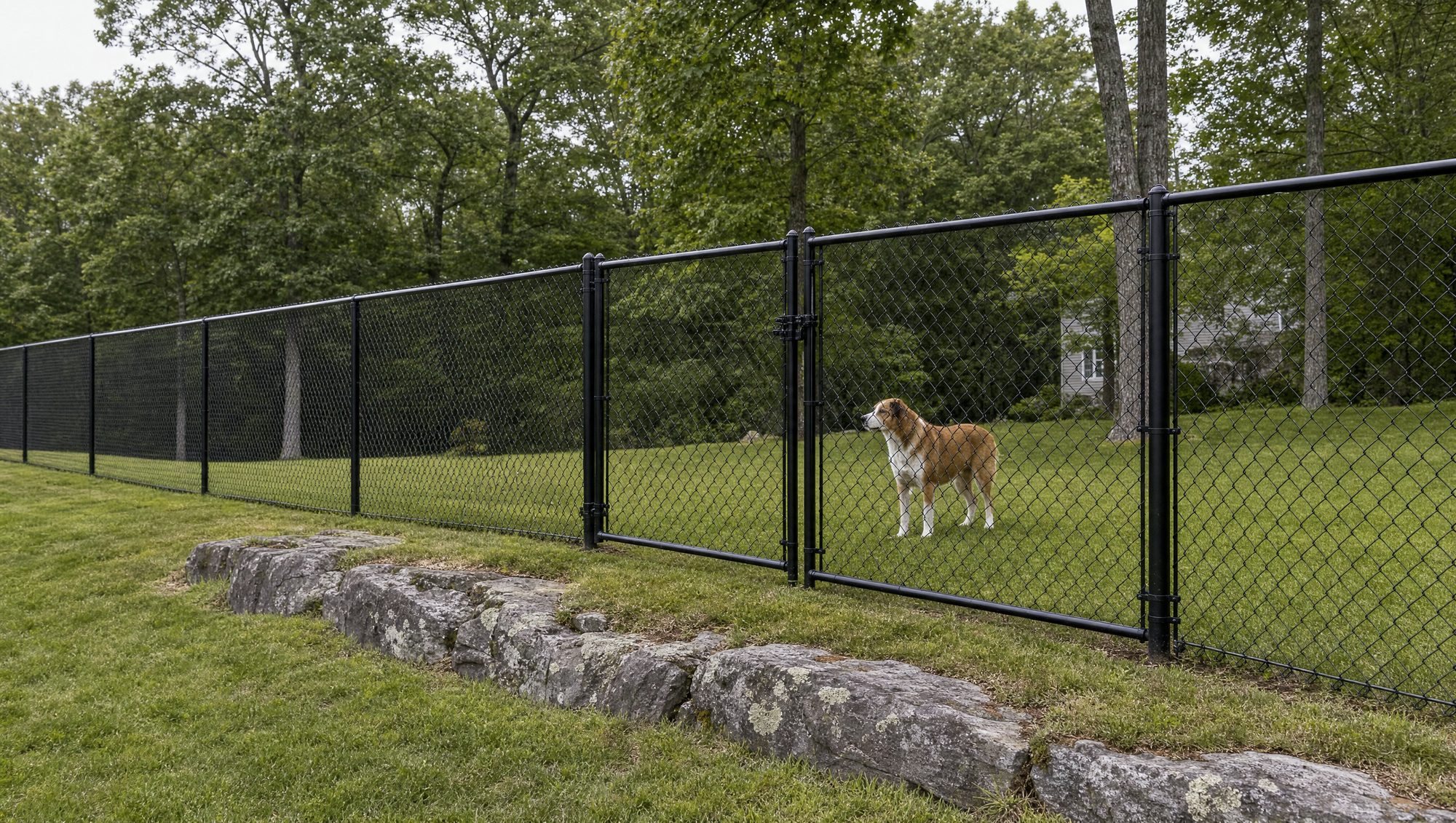
Most people shopping for pet fencing in New Fairfield, CT start with a picture. They find a style they like, they price it out, and they assume the dog is handled. Then the dog goes over it from a standing start, or comes back inside with dirt on its nose and a fresh hole under the back corner, or leans on a gate that never quite caught. The fence in the photo looked perfectly secure, because there was no dog in the photo. Every dog that gets out has a method, and it is usually one specific method, repeated until it works. The honest version of this decision is not which fence is best for dogs. It is which fence is built for your dog, on your lot, with your gate habits. That is a different conversation, and it is the one worth having before you order anything.
Key Takeaways
The animal picks the fence
Size, athleticism, digging, climbing, and escape history matter more than the style you like.
The bottom edge fails first
Gaps from slope, erosion, roots, and digging are more common than a dog clearing the top.
Gates are the weak point
Latch quality, hinge and bottom gaps, sag, and a second gate decide whether a good fence stays closed.
Invisible fencing is not a fence
It can shape a dog's behavior, but it keeps nothing out and depends on training and working equipment.
New Fairfield ground drives the build
Ledge, roots, slope, and freeze-thaw decide post depth, gap control, and what the crew can actually dig.
Your Dog Decides the Fence, Not the Catalog
A fence that holds one dog can fail on the next dog in the same yard. The variables are size, shoulder height, athletic ability, prey drive, reactivity, anxiety, how much time the dog spends outside alone, and how many dogs are out there at once. A beagle with its nose down solves a fence completely differently than a shepherd watching the road. The safest way to design is around the most determined behavior your dog has shown, not the average day.
Escape Is a Method, Not an Accident
Watch what your dog actually does at the fence line and you will usually see one pattern. Some dogs go over, using a run-up or a foothold. Some dogs go under, and they tend to pick the same corner every time. Some dogs go through, working a gap at a picket, a hinge, or the low point where the ground dips away. Some dogs work the gate, because the gate is the one part of the fence that is designed to open. Naming the method first is what turns a generic fence into a fence for dogs that actually holds. The American Kennel Club's guidance on dog-proofing a fence is a useful checklist for spotting which one you have.
Puppies Rewrite the Plan in Two Years
A puppy is a moving target. The eight-month-old that cannot clear two feet may clear four at eighteen months, and a body that fits through a five-inch picket gap in spring will not fit by fall. That cuts both ways: a puppy needs tighter lower spacing than the adult ever will, and the adult may need more height than the puppy ever hinted at. If you are fencing for a young dog, it is worth building for the adult you expect and adding a temporary lower barrier for the small version, rather than building twice.
Height Answers the Jumper, and Only the Jumper
Height is the first thing everybody asks about and it solves exactly one failure mode. There is no universal correct number, and any contractor who quotes one height for every dog is guessing. What sets it is the dog's size and athletic ability, whether it climbs as well as jumps, what sits near the fence line, and how much snow the yard holds in February. Gates need to match the containment height too, since a lower gate is just a shorter fence with a handle.
What Sits Near the Fence Line Sets the Real Height
A six-foot fence with a woodpile against it is a four-foot fence. So is one with a retaining wall, a raised bed, a deck rail, a shed, a stacked pallet of firewood, a low branch, or a plowed snowbank against the run. New Fairfield winters build those snowbanks against fences every year and quietly shorten them for two months at a stretch. Keeping an interior setback from anything climbable is often cheaper than adding a foot of fence.
Climbers Read a Fence as a Ladder
A climbing dog does not care much about height, it cares about footholds. Chain-link mesh, horizontal rails, decorative rings, and wide-mesh wire all give a determined climber something to push off. The design responses are a smooth surface the dog cannot grip, smaller mesh, fewer horizontal rails on the dog's side, and more clearance from trees and structures. For a genuine escape artist, a covered run can be more honest than an ever-taller fence line.
The Bottom Edge Is Where Pet Fences Actually Fail
Almost nobody shops the bottom of a fence, and it is the part that lets dogs out. Bottom gaps come from slope, erosion, uneven soil, roots, rock, settlement, stepped panels, drainage swales, gate clearance, and the dog's own digging. A gap does not have to be big. It has to be big enough for a head, because the rest of the dog follows the head. This is the section where a pet fence stops being a fence and starts being a design.
Dig-Resistant Details That Actually Hold
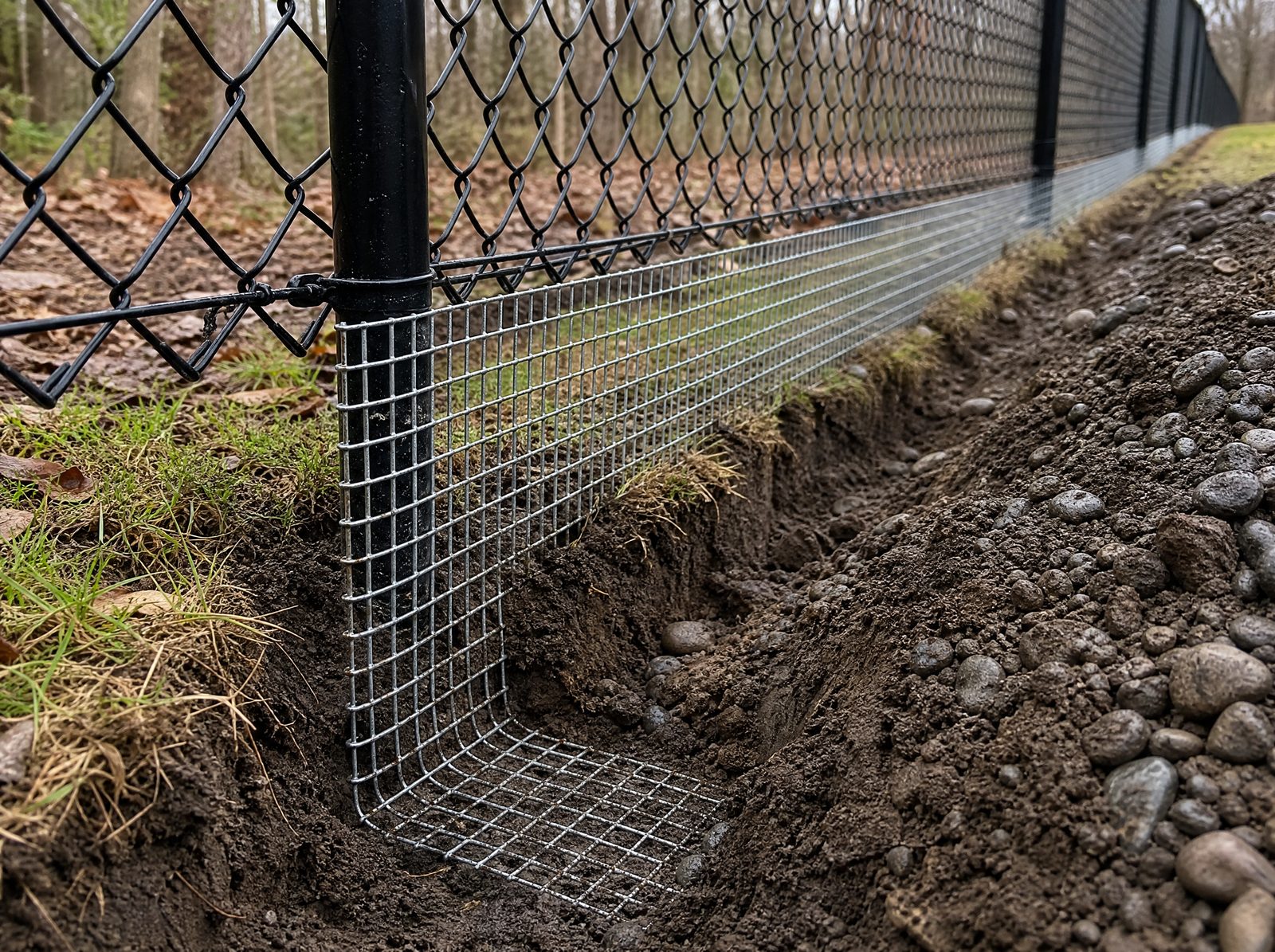
There is more than one way to build a dig-resistant fence in New Fairfield, and the right one depends on the soil, the drainage, and what is buried nearby. Wire mesh buried vertically along the line works where the ground can actually be excavated, which is not every lot here. A horizontal apron runs mesh inward from the fence at or just below grade, so the dog hits the barrier where it starts digging rather than where it ends. Bottom tension wire helps with chain link by reducing lift, though on its own it will not stop a committed digger. A compacted stone border can discourage some dogs and makes the line easier to maintain, and a concrete curb can make sense in a kennel or a commercial run where drainage, frost, and cost have all been thought through. Dense plantings, rocks, or an interior barrier can keep the dog off the fence line entirely, as long as anything you plant is pet-safe. Whatever goes in has to preserve drainage and leave no sharp cut ends.
Small Dogs Slip Through What Big Dogs Lean On
A large dog tests a fence with force. A small dog tests it with geometry. Standard picket spacing on an aluminum or ornamental fence is sized for looks and code, not for a twelve-pound terrier, and the same is true of larger chain-link mesh openings. Puppy pickets, a narrow-spaced lower section, or smaller mesh close the gaps that a big dog would never notice. The same math applies at the hinge side and latch side of every gate, where a two-inch gap is easy to overlook and easy for a small dog to find.
Gates Are the Weakest Point in Almost Every Enclosure
A fence is a barrier with one deliberate hole in it, and that hole is the gate. Most escapes traced back to the gate are not dramatic. The latch did not fully seat, a delivery driver pushed through and let it swing, the grounds crew left it open, or the gate sagged over three seasons until the latch no longer lined up. What matters is the gap under the gate, at the hinge, and at the latch, plus the latch height, the swing direction, sag resistance, and whether the hardware does its job when nobody is thinking about it.
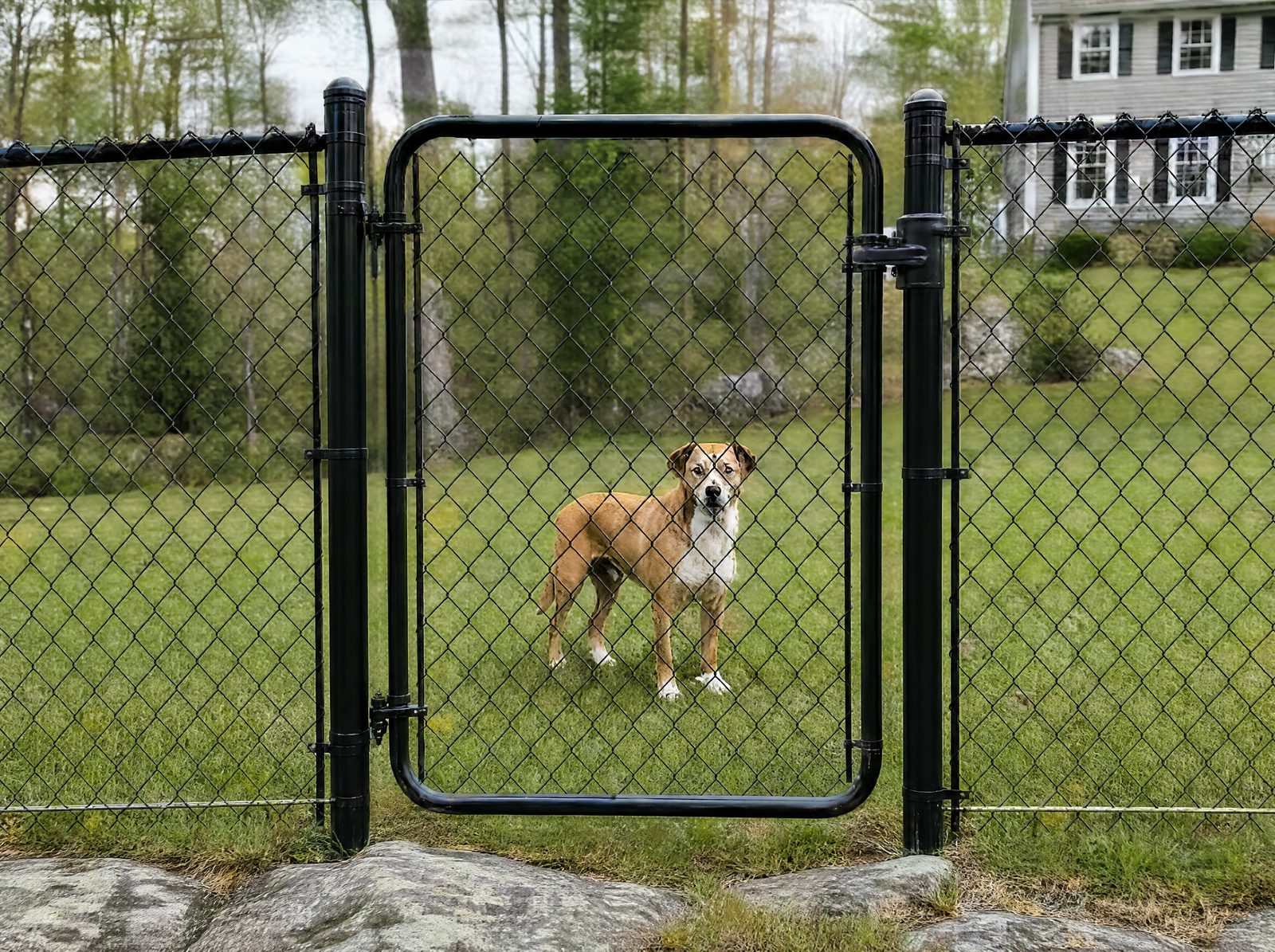
Self-closing hinges and self-latching hardware take the human out of the loop, which is the entire point, and a secondary clip adds a second failure that has to happen before the dog is on the road. Gate posts carry hinge load and frost movement that line posts never see, so they need more post and more footing. For an escape-prone dog, a busy household, or a run near a road, a double gate or vestibule creates a second containment zone: the dog reaches an enclosed space rather than the street, and both gates would have to fail at once.
Reactive Dogs Fight a Fence They Can See Through
Some dogs are not trying to leave. They are trying to get at something: a walker, a bike, a truck, a deer, or the dog next door. An open aluminum, ornamental, or chain-link line hands them every trigger in full view, and a dog that charges the same spot ten times a day will eventually find the weak point in it. Solid vinyl or wood, chain link with privacy slats, screening rated for the fence system, or partial screening at the known trigger areas can all cut the sight lines down. The AKC's material on managing a reactive dog is worth reading alongside the fence decision, since the fence manages the symptom and not the cause. One trade-off is structural: screening turns a fence into a sail, and wind load means stronger posts, rails, and footings.
Material Follows Behavior on a New Fairfield Dog Fence
Once you know the method your dog uses, the material list gets short fast. Each system trades privacy, climbability, spacing, chewing resistance, and upkeep differently, and none of them is the pet answer on its own. What follows is how the common choices tend to land on a New Fairfield property.
Chain Link
Chain-link fencing is durable, adapts well to slopes, comes galvanized or black-coated, and takes bottom tension wire and anti-dig details without a fight. It is the workhorse for full yards and dog runs. The catch is that the mesh is climbable for some dogs, larger openings do not suit very small dogs, privacy slats add wind load, and the top and bottom selvage should be specified pet-safe rather than left to chance.
Vinyl and Wood Privacy
Vinyl fencing gives you a smooth face that is harder to climb and blocks the visual triggers, with little routine upkeep. Solid panels carry serious wind load, impact can crack components, and gate alignment and latch quality carry more weight than the panels do. Wood fencing lets you control board spacing and height and follows irregular terrain, but chewers find exposed edges, and warping, rot, and grade movement all open gaps over time.
Aluminum and Ornamental
Aluminum fencing and ornamental styles look open and resist corrosion, and they rack to follow grade. For pets, the details are picket spacing, the gap at the bottom, whether the horizontal rails give a climber a foothold, spear-top details, and whether a small dog needs a puppy-picket section. They are the wrong pick for a strongly reactive dog, since they show the dog everything.
Welded Wire and Farm Style
On larger or wooded parcels, welded wire or agricultural fencing paired with wood posts can enclose ground that panel systems would price out of reach. Mesh opening, wire gauge, top and bottom support, and gate quality do the work here, and cut ends have to be finished so nothing is left sharp at dog height.
Invisible Fencing Does a Different Job Than a Fence
Electronic containment gets pitched as the cheap version of a fence, and it is not the same product. It is a training system with a boundary, not a barrier. That distinction matters most in the direction people forget: an electronic system does nothing to keep anything OUT. Loose dogs, coyotes, wildlife, and people walk straight across the line, and your dog has no way to leave the encounter. It also depends on things that can quit: the collar battery, the wire circuit, the transmitter, and above all the training. The American Veterinary Medical Association's overview of electronic fences is a fair place to read the limits.
There is a second failure mode owners rarely hear about. A highly motivated dog will take the correction and cross anyway when the deer is worth it, and then will not cross back, because coming home means a second correction. So, the dog is out, and staying out. None of this makes electronic containment useless. On the right property, with the right dog and real training behind it, it can work as a management tool. It just should not be sold to you as the same thing as a fence for dogs, because it solves a different problem.
A Dog Run Fits Some New Fairfield Lots Better Than a Full Yard
Not every property here can be fenced end to end at a sane price. Wooded boundaries, long rural runs, wetland edges, and ledge can make a full perimeter impractical, and some dogs do better with a defined space anyway. A dog run fence in New Fairfield is a smaller controlled area, sized to the number and size of the dogs, and it lives or dies on drainage. Grass, compacted stone, pea gravel, pet-rated artificial turf, or concrete in a kennel setting all behave differently in mud season, and standing water is the fastest way to make a run unusable.
The rest is the daily routine. Shade, water, and shelter are not extras, and where the run connects to the house decides whether it gets used in January. A double gate at the entry helps if the dog bolts, screening matters if the run faces a road or a neighbor's dog, and snow needs somewhere to go. The ASPCA's guidance on building a dog run is clear that a run is not a substitute for exercise, company, or supervision.
New Fairfield Sets the Permit by the Fence
The town keeps this more straightforward than most people expect. New Fairfield states that fences not over seven feet high are generally exempt from a building permit. That covers the height question and nothing else, and it has one clear carve-out. Confirm the current requirements with the town, since local rules change.
The Exemption Is Not a Zoning Pass
Skipping the building permit does not settle where the fence can go. Placement near a street or intersection, driveway sight lines, an unclear boundary, a recorded easement, wetlands or watercourse setbacks, and private association rules can all still apply. A fence used as a pool barrier is the exception to the seven-foot rule entirely: it needs a permit regardless of height, and the gate hardware, opening sizes, and clearances get reviewed against the applicable code. New Fairfield's building permit page and its zoning department are where you confirm what your lot needs.
The Property Line and the Utility Marks Come First
An old hedge, a stone wall, or the line you have always mowed is not the legal boundary, and a pet fence set in the wrong place is expensive to move. A contractor can lay out the run, but a licensed surveyor establishes the line. Posts, gate posts, and buried anti-dig mesh all mean digging, so Connecticut's Call Before You Dig service comes first, free and required. One catch matters here specifically: public marking does not cover private lines, and any existing invisible pet-fence wire is exactly that, along with septic, irrigation, propane, and drainage. If you are replacing an electronic system with a real fence, that old wire is in the ground where you are about to dig.
Ledge, Roots, and Slope Decide How the Posts Go In
New Fairfield ground does not cooperate on command. Rocky glacial soil, exposed ledge, tree roots, wet pockets, and wooded edges are all normal here, and ledge can stop a post hole short of the depth you wanted and force a different tool or a shifted layout. That belongs on the estimate as a real site condition rather than hidden inside a vague number. Depth and footing follow fence height, material, wind load, gate width, soil, drainage, frost, and the manufacturer's requirements, and Connecticut's residential code for foundations frames why frost protection matters at all. For a pet fence, slope is the part that bites: panels either rack to follow the grade or step down in level sections, and stepping is what opens a triangular gap at the bottom of every step. That is a containment decision, not a cosmetic one.
What Moves the Cost of Pet Fencing in New Fairfield
There is no one-price-fits-all figure for a pet fence. Published cost guides like Angi's fence cost breakdown are useful as general market context and are not a quote for your yard, because the pet-specific work is exactly what a generic average leaves out. Footage, height, and material set the baseline, then the dog adds to it: tighter spacing, puppy pickets, anti-dig aprons or buried mesh, bottom-gap corrections, upgraded gate hardware, and a double-gate vestibule are all real line items. Site conditions do the rest, with ledge, slopes, clearing, access, old-fence removal, and dog-run drainage moving the number more than the panel style does.
Hover or tap a row to highlight it.
| Cost Driver | Why It Matters |
|---|---|
| Footage, height, and material | The baseline every fence starts from, before the dog is factored in at all. |
| Picket or mesh spacing | Tighter spacing, puppy pickets, and small-mesh sections use more material for the same run. |
| Dig-resistant details | Buried mesh, a horizontal apron, tension wire, or a stone border is added labor and material. |
| Gate hardware and double gates | Self-closing hinges, self-latching hardware, and a vestibule each add posts, footings, and cost. |
| Ledge, slope, and access | Rock, grade, roots, and a long carry all add hours that a panel-style average never shows. |
| Dog-run surface and drainage | Grading, stone, or pet-rated turf makes a run usable in mud season instead of unusable. |
How Pet Fence Installation Comes Together in New Fairfield
A pet fence installation in New Fairfield runs in a predictable order, and the order is the point. The dog gets evaluated before the material gets picked, the property and the town rules get sorted before anything is ordered, and the enclosure gets walked from the dog's point of view before the dog is ever left in it. Knowing the sequence helps you spot a crew that skips the steps that matter.
The New Fairfield Pet Fence Installation Process
- 1
Step 1: Evaluate the Dog
We ask about size, age, escape history, and whether the dog jumps, climbs, digs, chews, or reacts to what it sees.
- 2
Step 2: Define the Enclosure
We settle on a full yard, a partial yard, a dog run, or a layered enclosure, and walk the property for slope, ledge, roots, and drainage.
- 3
Step 3: Confirm the Rules and the Line
Permit, zoning, wetlands, easement, and pool-barrier questions get answered, and the property line gets sorted before anything is ordered.
- 4
Step 4: Design the Pet-Specific Details
Height, spacing, bottom-gap plan, anti-dig work, gate hardware, and any screening go into the written scope.
- 5
Step 5: Mark Utilities and Set Posts
A Call Before You Dig request goes in, private lines get identified, then posts are set for the soil, grade, and gate loads.
- 6
Step 6: Gates, Gap Control, and the Dog's-Eye Walk
Panels or fabric go up, gates get adjusted, and the whole perimeter is walked for the gap your dog would find.
Once the posts are set and the panels or fabric are up, the gates get hung and adjusted: latch operation, bottom clearance, hinge gaps, and the self-closing function if it is specified. Then comes the walk. You go the whole perimeter looking for the gap your dog would find, not the gap you would find, and you fix it before the dog tries it.
What to Ask a Pet Fence Contractor in New Fairfield
Connecticut law requires home improvement contractors, including fence installers, to register with the Department of Consumer Protection, and you can verify any contractor's registration in about a minute. Registration and insurance are the floor, not a selling point. The real test for a pet fence contractor in New Fairfield is whether they ask about the animal before they quote the material. My Fence Guy is a family-owned local contractor working out of our New Fairfield office, licensed and insured, and we give free estimates.
What the Written Estimate Should Cover
Connecticut's guidance on home improvement contracts is a good checklist to hold a bid against, and for pet fencing the scope should go further than a standard fence quote:
- Picket or mesh spacing: The actual spacing, including any puppy-picket or small-mesh sections.
- Bottom-gap plan: How gaps at slopes, steps, and grade changes get closed.
- Anti-dig details: Buried mesh, apron, tension wire, or border, with the depth or width stated.
- Gates and hardware: Widths, swing, post sizes, footings, latch type, self-closing hinges, and any double-gate entry.
- Site conditions: How ledge, roots, and drainage get handled and priced if they show up.
- Permits and utilities: Who pulls any permit, who files the 811 request, and who handles private-line locating.
Frequently Asked Questions About pet fencing new fairfield ct
Q: What type of fence is best for dogs?
A: There is no single best fence for dogs. Chain link, vinyl, wood, aluminum, ornamental, and welded wire can all work when the design is built around the specific dog's size, jumping, climbing, digging, chewing, and reactivity, and around the property's terrain.
Q: How tall should a dog fence be?
A: There is no universal height. Athletic dogs and jumpers may need taller fencing, small dogs often need tighter lower spacing more than height, and nearby objects and snowbanks can reduce the effective height of any fence.
Q: How do I stop my dog from digging under the fence?
A: Options include buried mesh, a horizontal apron, bottom tension wire, a gravel border, an added lower rail, grading corrections, or a curb in specialized settings. The right one depends on soil, drainage, buried utilities, and how your dog digs.
Q: Can electronic fencing replace a physical fence?
A: No. Electronic containment does not prevent other animals or people from entering the yard, and it depends on training, a working collar, and a working circuit. It can be a useful management tool on some properties, but it is not equivalent to a physical barrier.
Q: Is chain link a good fence for dogs in New Fairfield?
A: It often is. Mesh size, height, bottom-gap control, tension wire, gate hardware, and anti-dig details all need to be evaluated, and some dogs can climb standard mesh, which is worth checking before you choose it.
Q: Does pet fencing require a permit in New Fairfield?
A: New Fairfield generally exempts fences not over seven feet from a building permit, but a pool barrier requires a permit regardless of height. Zoning, placement, easements, and wetlands rules may still apply, so confirm the current requirements with the town.
Q: Should I build a dog run or fence the whole yard?
A: A dog run gives a smaller controlled area and can suit lots where a full perimeter is impractical because of woods, ledge, or wetlands. Full-yard fencing gives more space. Property layout, supervision, drainage, and daily routine usually decide it.
Q: Do I need a survey before installing pet fencing?
A: A survey is worth it when boundary markers are missing, the fence will sit close to the line, the lot is irregular, an easement may exist, or a neighbor has questioned the route. A contractor can lay the fence out, but only a licensed surveyor establishes the legal boundary.
Test Your Pet Fencing Knowledge
1. Which part of a pet fence most commonly fails?
2. What does an invisible fence NOT do?
3. A six-foot fence with a woodpile stacked against it is effectively what?
4. Do fences up to seven feet generally need a building permit in New Fairfield?
5. What is the main risk for a very small dog on a standard ornamental fence?
Pick an answer to begin.
Final Thoughts
Pet fencing in New Fairfield comes down to a short list, taken in order: name the method your dog actually uses, control the bottom edge, treat the gates as the weak point they are, pick a material that answers the behavior rather than the photo, sort the town's rules and the property line before anything is ordered, and set the posts for the ground you actually have. Height is one answer to one question. The bottom, the spacing, and the latch are where most fences quietly fail.
Get it right and the fence stops being something you think about. The dog goes out, the dog comes back, the gate closes itself, and the line holds through mud season and snow load and the deer that walks the tree line every evening. That is the whole return on planning it properly the first time.
If you are planning pet fencing in New Fairfield, Connecticut, we would be glad to walk the property, meet the dog, and give you a straight answer about what it will take to hold. My Fence Guy is a family-owned contractor with an office right here in New Fairfield, CT, and we install pet fencing, dig-resistant enclosures, dog runs, and gates in chain link, vinyl, wood, aluminum, and ornamental styles, along with residential, commercial, industrial, and agricultural fencing, pool fencing, and railings. We handle the layout, the permit and utility questions, and the details that decide whether a fence contains a determined animal. Call us at (203) 746-1100 for a free estimate, or reach out through our contact page.
Pet Fencing Key Terms
Tap a term to see what it means.
Containment. Keeping a specific animal inside a defined area, which depends on the dog's behavior and the fence's details rather than on the fence style alone.
More about fences
Chain Link Fencing in New Fairfield, CT: Specs That Matter
Galvanized or black, 9 gauge or 11, slats or open. The choices behind chain link fencing in New Fairfield, CT, and which ones really change the price.
Read the guide to Chain Link Fencing in New Fairfield, CTPet Fencing in Southbury, CT: What Actually Holds a Dog
A pet fence keeps your dog in and other animals out. Pet fencing in Southbury, CT: height, dig defense, picket spacing, and a gate a dog cannot nose open.
Read the guide to Pet Fencing in Southbury, CTPet Fencing in Sherman, CT: What Actually Holds a Dog
Your dog already knows how it would get out. Pet fencing in Sherman, CT: height for the jumpers, buried edges for the diggers, spacing for the slippers.
Read the guide to Pet Fencing in Sherman, CT