
Pet Fencing in Sherman, CT: What Actually Holds a Dog
By Tony Pellicone21 min readPublished
- pet fencing
- sherman ct
- chain link fencing
- connecticut
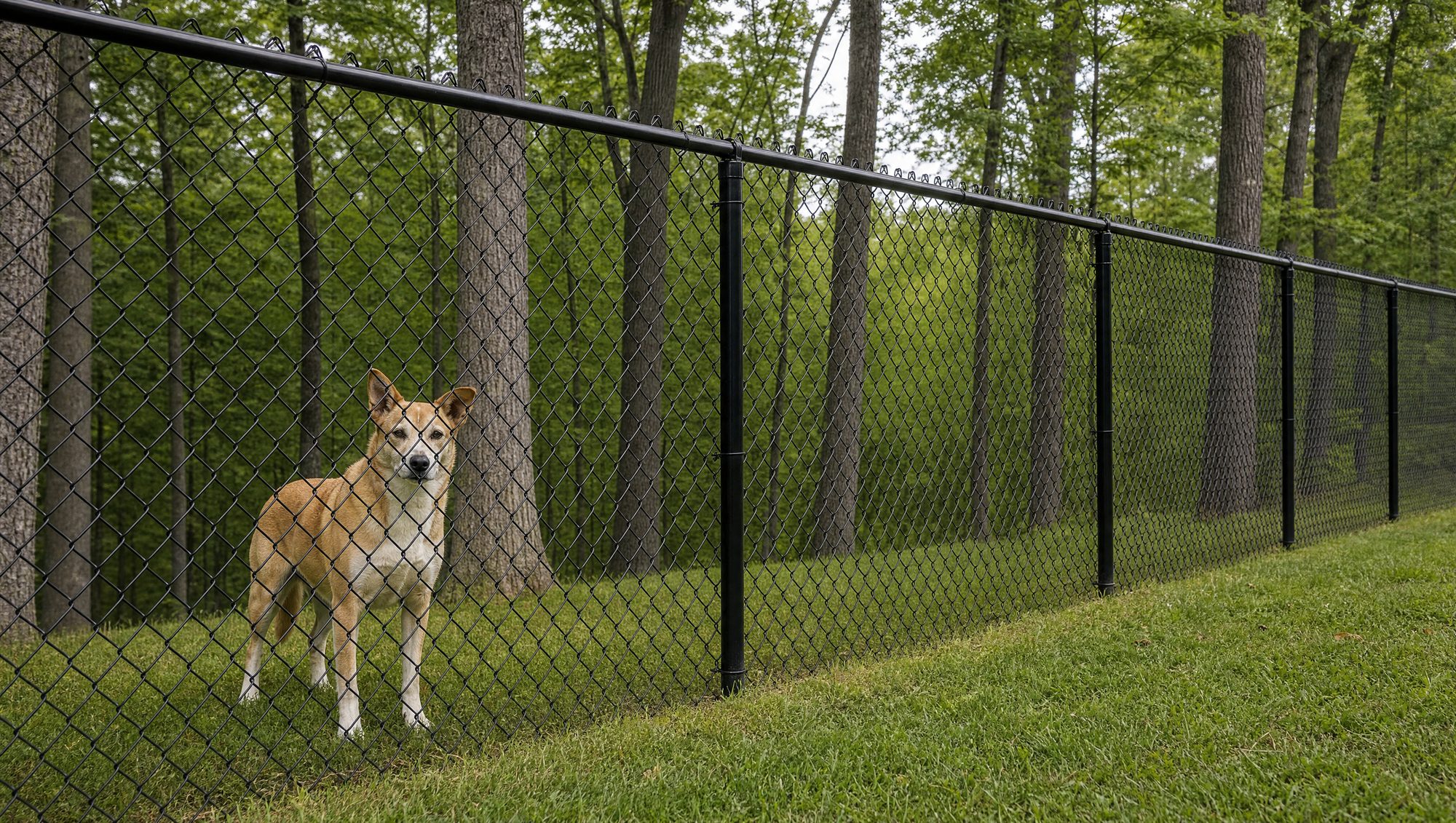
You open the back door, and the yard is empty. Maybe there is a fresh hole under the back corner and a muddy nose to match, or prints leading over a snowbank that turned your four-foot fence into a two-foot fence overnight. Maybe your fifteen-pound dog turned sideways and walked through pickets that looked tight when you measured them. Anyone shopping for pet fencing in Sherman CT has usually already had that moment, or has watched their dog study the line for a week and knows it is coming. What makes it maddening is that most quotes price a fence by the linear foot without once asking what your dog actually does. A fence is not a product you buy off a page, it is a barrier that has to beat one specific animal with one specific set of habits. Here is how dogs actually defeat fences, and what that means for your yard.
Key Takeaways
The animal decides, not the catalog
Size, jumping, climbing, digging, chewing, and reactivity matter far more than which material looks best in a brochure.
The bottom edge is the forgotten failure point
Most escapes start at the ground, where gaps, erosion, slopes, and digging get almost no attention in a typical quote.
Gates fail before fences do
A latch a nose can flip is not a latch, and hinge gaps, sag, and bottom clearance turn the gate into the easiest way out.
An invisible fence solves a different problem
It depends on training and a working circuit, and it never keeps a loose dog, wildlife, or a stranger out of your yard.
Sherman reviews fences through Planning and Zoning
The town's fee schedule lists a zoning permit for fences, and a pool barrier needs a permit regardless of height, so confirm current requirements with the town.
Your Dog Decides the Fence, Not the Catalog
A fence that holds one dog can fail completely for the dog next door. A senior beagle looking for a sunny spot and a two-year-old husky with a prey drive are not the same containment problem, even on identical lots. The honest starting point is not wood or vinyl, it is a clear-eyed description of your animal: how tall at the shoulder, how athletic, what it has already tried, and how much time it spends outside alone. The American Kennel Club's guidance on dog-proofing a fence makes the same point from the training side, which is that you design around the most determined behavior your dog has shown, not the average day.
The Four Ways a Dog Beats a Fence
There are really only four, and every design decision traces back to one of them. A dog goes over by jumping or climbing, which is a height and foothold question. A dog goes under by digging or by using a gap the ground already made, which is a bottom-edge question. A dog goes through by squeezing between pickets or mesh, or by chewing at a weak panel, which is a spacing and material question. And a dog goes out the gate, which is a hardware and habit question, and it is more common than the other three combined. Ask which of the four your dog is, and the fence starts specifying itself.
Puppies Grow Into a Different Dog
The fence you measure for a four-month-old puppy is not the fence that will hold the adult. A puppy is a squeezer, small enough to slip a gap an adult could never use, so lower spacing and gate gaps matter most early. That same dog at eighteen months may be a jumper with the shoulder height to test the top rail. Plan the height for the adult it will become, and add tight lower spacing or a puppy-picket section for now. That is cheaper than doing the job twice.
What Height Actually Solves, and What It Does Not
Height is the first thing everyone asks about and the most oversold answer in fencing. There is no universal correct number, and anyone who calls one height escape-proof for every dog is guessing. What matters is the relationship between your dog's shoulder height and athletic ability, the fence, and everything standing near it.
Launch Points Shorten Every Fence
A fence is only as tall as the highest thing a dog can stand on next to it. Sherman yards are full of launch points nobody counts: retaining walls, wood piles, raised beds, deck stairs, patio furniture, a stump, and in this climate the snowbank a plow builds against your back line every January. Snow is the one that catches people, because the fence that worked all summer loses a foot or two of effective height for the exact months your dog is bored and looking for a project. Setting the line back from climbable objects, and planning where snow gets pushed, is part of the design.
Climbers Need Fewer Footholds, Not More Height
A climber is a different animal from a jumper, and adding height to a climbable fence just gives it a longer ladder. Standard chain-link mesh is a ladder. So are horizontal rails on the dog's side, decorative rings, and wide-mesh wire. The answer is to take the footholds away: a smooth privacy surface, smaller mesh a paw cannot grip, or rails kept on the outside face where the product allows. If your dog goes up rather than over, height alone will not fix it.
The Bottom Edge Is Where Most Escapes Start
Here is the part almost no quote addresses. The top of a fence gets the attention because it is what you look at, but the ground is where determined dogs work, and it is where the yard itself works against you. A line that sat tight on install day can open a four-inch gap in one wet spring, and once a dog gets its head through, the rest follows.
Where Bottom Gaps Come From
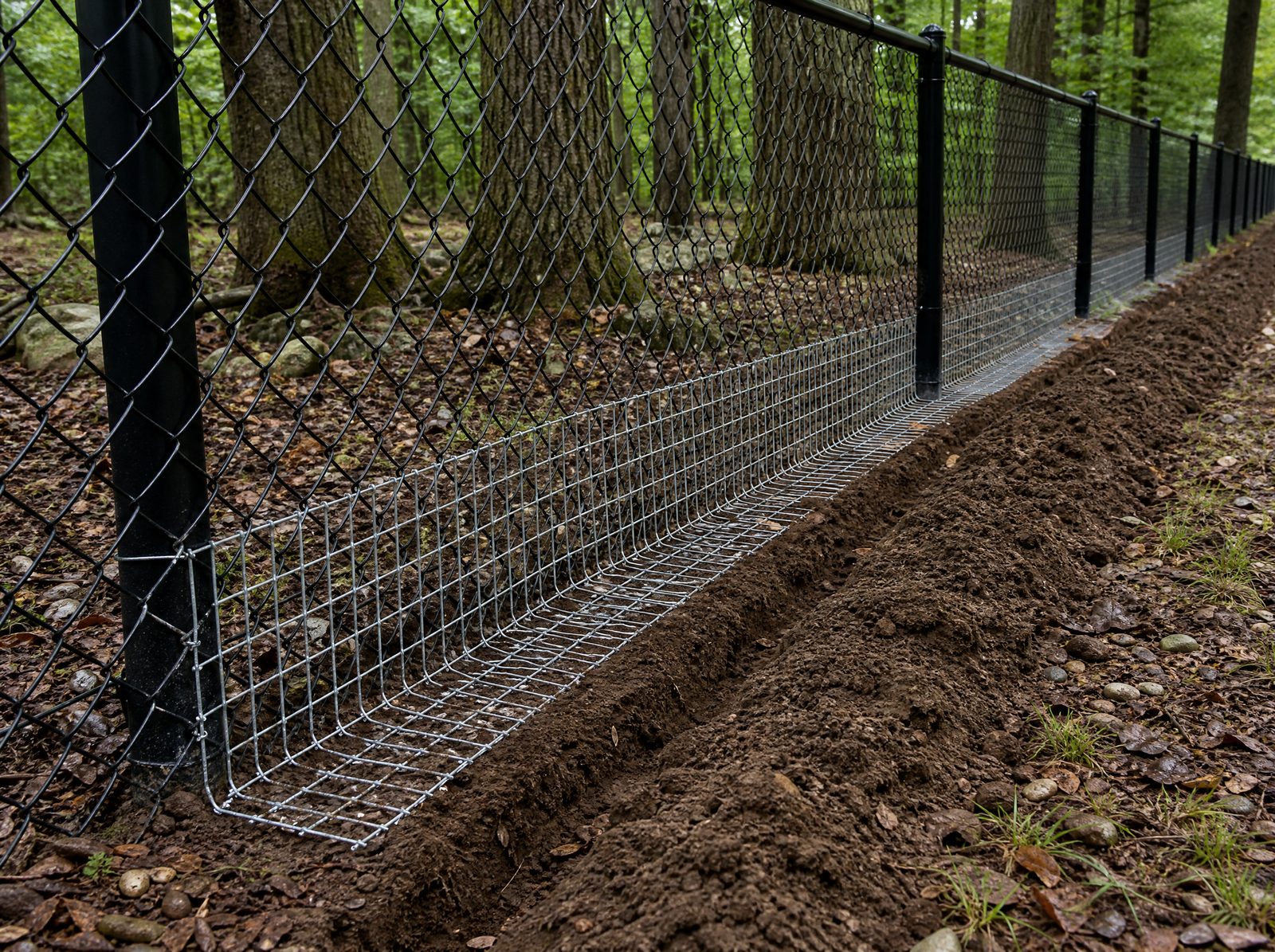
Gaps are rarely a single mistake. They come from slopes and grade changes, from stepped panels that leave a triangle of daylight at each step, from erosion in a drainage swale, from roots and rocks that stopped a panel from sitting down, from soil settling around a post, and from wildlife that dug first and left your dog a starter hole. Gate clearance is its own version of the same problem. Any fix has to preserve drainage, because a bottom detail that dams water in a Sherman yard just starts new erosion somewhere else.
Building a Dig-Resistant Fence in Sherman
A dig-resistant fence in Sherman is a decision made at the ground, and the right detail depends on your soil, your drainage, and how your dog digs. Buried mesh extends wire below grade and works where the soil allows excavation, which on a rocky lot is not a given. A horizontal apron lays mesh inward from the fence at or just below grade, so the dog meets the barrier where it starts digging rather than where the fence stands, which makes it the better answer where ledge stops you going down. Bottom tension wire pairs with chain link to stop the fabric being lifted, though it will not stop a committed digger by itself. A compacted gravel border discourages some diggers and keeps the line easy to maintain. A concrete curb belongs in kennels and controlled runs, where drainage, frost, and cost are worked out first. Planted deterrents like dense pet-safe planting keep the dog from reaching the fence line at all. Whatever gets used, the edges have to be finished so there is nothing sharp where a dog puts its face.
Small Dogs Escape Through, Not Over
Small-dog containment is a spacing problem wearing a height problem's clothing. Standard picket spacing on an ornamental or wood fence, and standard mesh openings on chain link or farm wire, are sized for a fence, not for a dog that can compress itself. If your dog is under about twenty pounds, the numbers that matter are the picket gap, the mesh opening, the gap under the bottom rail, and the gaps at the hinge and latch sides of every gate. Puppy-picket sections, tighter mesh, or a lower-rail detail solve it. Nobody notices those dimensions until a dog walks through them.
Gates Fail More Often Than Fences Do
If a dog gets out of a well-built yard, the gate is usually how. It is the one part of the enclosure with moving hardware, the one part that people and landscapers and delivery drivers touch, and the one part a dog can learn. A latch a nose can lift is not a latch. A gate that sags after one winter drops its latch out of alignment and stops catching, and a gate whose bottom clearance was set for a level lawn opens up when the ground settles. Worth specifying in writing: self-closing hinges, self-latching hardware set where a dog cannot reach it, a secondary clip for escape artists, the gaps at the hinge and latch sides, sag resistance sized to the gate width, and swing direction. For a dog that bolts at an open gate, a double gate or small vestibule gives you a second barrier and a place to catch the dog before it reaches the road. The ASPCA's guidance on building a dog run treats that airlock as a basic safety feature, not a luxury.
Matching a Dog Fence in Sherman to the Animal You Have
Once you know which escape route your dog uses, the material conversation gets short. Every system here can be a good dog fence Sherman homeowners are happy with, and every one can fail, depending on the animal it is asked to hold. What follows is how the common choices behave with dogs, not which is best in the abstract, because there is no such thing.
Chain Link
The workhorse for pet containment: durable, good on slopes, available in black-coated finishes that disappear against a wooded line, and readily fitted with tension wire and anti-dig details. Standard mesh is climbable for a climber, though, larger openings do not suit very small dogs, and privacy slats add wind load the posts must carry. Selvage should be finished so there are no sharp ends at nose height.
Vinyl Privacy
A solid vinyl panel suits a reactive dog, because it removes the sight lines that start the barking, and its smooth face gives a climber nothing to grab. The trade is wind load, which makes post setting and gate reinforcement more important rather than less. Gate alignment and latch quality are where vinyl pet fences usually go wrong.
Wood and Welded Wire
Wood lets you control height and board spacing and adapt to irregular Sherman terrain, but it is the material a chewer can work on, and it moves: boards warp, rot at the bottom, and open gaps as they age. On larger rural lots, welded wire on wood posts covers ground economically, where gauge, mesh opening, and finished cut ends are the whole story. Either way, fasteners stay buried and edges get finished so a dog is not meeting a nail head.
Aluminum and Ornamental
These rack neatly to follow grade and look right on a front boundary or around a pool. For dogs, the questions are picket spacing, the bottom gap, whether horizontal rails create footholds, and whether an open fence winds up a reactive dog by giving it a view of every passing walker. Puppy pickets close the spacing where it matters.
What an Invisible Fence Does and Does Not Do
An underground electronic system deserves straight talk, because it is often sold as an equivalent to a fence and it is not. It creates no physical barrier. It depends on a collar with a live battery, an intact wire circuit, and a dog trained to the boundary that stays respectful of it. A highly motivated dog can run through the correction after a deer, and the harder problem is that the same dog is then reluctant to cross back into its own yard to come home. The American Veterinary Medical Association's overview of electronic fences lays out those limits plainly.
The part that matters most in a town like Sherman is what an invisible system cannot do at all: it does not keep anything out. A loose dog, a coyote, wildlife, a delivery driver, or a child can walk straight into a yard your dog cannot leave, and your dog is standing there with no barrier and nowhere to retreat. It also gives no visible boundary, so no one else can see where your yard ends. An electronic system can make sense on some properties, usually paired with supervision, but it solves a different problem than a barrier does.
A Dog Run Fence for Yards That Cannot Be Fully Fenced
Sometimes fencing the whole yard is not practical, whether because of acreage, wetlands, ledge, a shared drive, or cost. A dog run fence in Sherman gives you a smaller enclosure that can be built to a higher standard precisely because it is smaller. Get the boring parts right: drainage first, then a surface that suits the dog and the cleaning routine, whether grass, compacted stone, pea gravel, or pet-rated turf. Shade, shelter, and water are not optional. A run with a direct connection to the house gets used far more than one parked at the back of the lot, and a double-gate entry keeps a bolting dog from getting past you. Place it away from the road and from a neighbor's dog if barking is a concern, and think about where snow will be pushed. A run is a containment tool, not a substitute for exercise and time with people.
Wooded, Rocky Sherman Lots Change What Is Possible
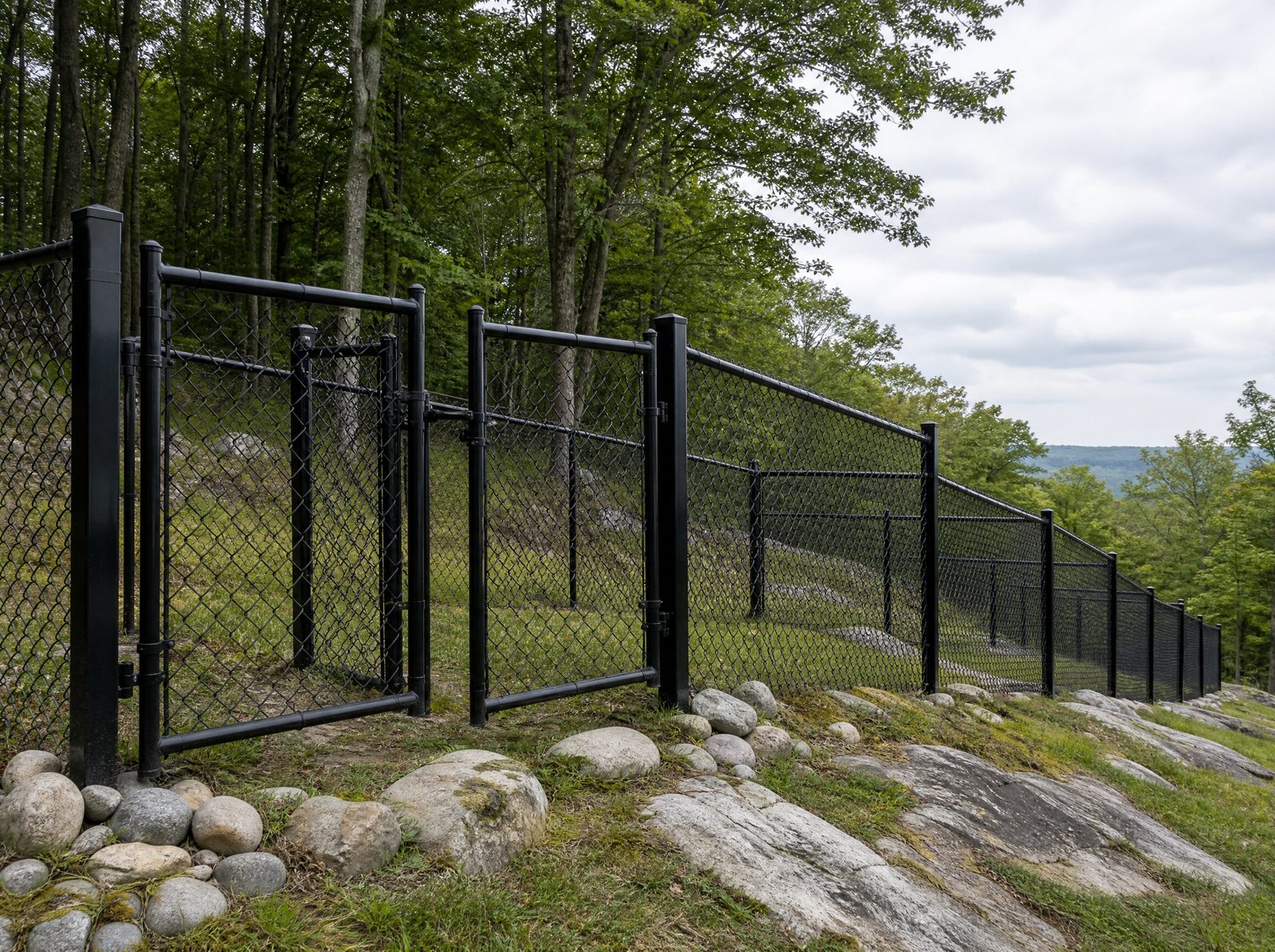
Sherman properties bring glacial soil, ledge near the surface, slopes, roots, stone walls, wet ground, and narrow access, and all of it decides what a pet fence can be. Ledge is the big one, because the anti-dig detail that assumes you can trench eighteen inches down is off the table when you hit rock at six, which is exactly when a horizontal apron beats buried mesh. Slopes force a choice between racking panels to follow grade and stepping level sections down the hill, and stepping is what creates those triangular bottom gaps a dog will find. Post depth and footing size are not one number either; they depend on fence height, material, wind load from any privacy surface, gate width, soil, drainage, and the manufacturer's requirements, with gate posts and corners needing more support than line posts. Connecticut's residential code for foundations frames why frost protection matters here, and freeze-thaw is what turns a shallow or poorly drained post into next year's leaning gate.
What Sherman Wants to Know Before You Build
Do not treat a pet fence as automatically permit-free. Sherman routes fence projects through its Planning and Zoning Department, and the town's Planning and Zoning fee schedule lists a zoning permit for fences under miscellaneous structures and equipment. Separately, a fence serving as a swimming pool barrier requires a permit regardless of height, and the whole barrier system gets reviewed, including gate swing, self-closing and self-latching hardware, and opening sizes. Other things can trigger review on a specific lot: height, yard placement, road and driveway sight lines, easements, inland wetlands and watercourses, grade changes, and any dog-run structure or roof. Confirm the current requirements with the town before you order material, since local rules change.
An Old Stone Wall Is Not a Property Line
Sherman has beautiful old stone walls, tree lines, and mowing edges, and none of them is a legal boundary. A fence set in the wrong place is expensive to move and worse if a neighbor makes it an issue. A survey earns its cost when corner markers are missing, the fence will sit close to the line, the lot is irregular, an easement may run through the yard, or a neighbor has questioned the route. A contractor can lay out the run, but a licensed surveyor establishes the line, and recorded plans often start with the town clerk.
Call 811 Before Any Digging
Posts, gate posts, buried mesh, and anti-dig aprons all mean excavation, so utilities come first. Connecticut's Call Before You Dig service is free and required by law, and the state's overview of the program explains what it covers. Public marking does not find everything. Septic and well lines, irrigation, propane, drainage, and existing invisible pet-fence wire are typically privately owned and may need a separate locate. Your contract should say who files the request and who handles private lines.
What Moves the Cost of Pet Fencing in Sherman
There is no honest one-price-fits-all number for a pet fence, and pet-specific work is exactly where generic per-foot figures fall apart. Published guides like Angi's fence cost overview are useful as general market context and nothing more, because they are not pricing your dog, your ledge, or your slope. Footage, height, material, and spacing set the baseline. Then the dog adds to it: dig-resistant details, bottom-gap corrections, tighter spacing or puppy pickets, privacy for a reactive dog, upgraded gate hardware, and a double-gate vestibule are real line items a fence built for looks does not carry. The site adds the rest through slopes, ledge, roots and clearing, restricted access, old-fence removal, and any dog-run surface work. Compare bids only when they all include the same pet details, or you are not comparing the same fence.
Hover or tap a row to highlight it.
| Cost Driver | Why It Matters |
|---|---|
| Linear footage and height | More posts, panels, and labor on longer runs, and a taller line uses more of everything. |
| Material and spacing | Chain link, vinyl, wood, aluminum, and welded wire price differently, and tighter picket or mesh spacing costs more. |
| Dig-resistant details | Buried mesh, a horizontal apron, tension wire, or a gravel border is real added work at the bottom of the line. |
| Gates and hardware | Walk gates, double-gate vestibules, self-closing hinges, and self-latching hardware each add posts, footings, and cost. |
| Terrain and access | Slopes, ledge, roots, wet ground, and a long carry from the truck all add hours. |
| Old-fence removal | Pulling posts and concrete and hauling debris is its own line item. |
How Pet Fence Installation in Sherman Comes Together
A pet fence installation Sherman homeowners can trust runs in a predictable order, and the order is the quality control. It starts with the dog, not the tape measure, and it ends with someone walking the finished line looking for the weak point before the dog does. Knowing the sequence makes it obvious when a crew skips a step.
How a Sherman Pet Fence Gets Built
- 1
Step 1: Evaluate the Dog
We start with size, shoulder height, jumping, climbing, digging, chewing, and any escape history, because that decides the rest.
- 2
Step 2: Walk the Property
We look at slopes, ledge, roots, drainage, launch points, snow storage, and where your property legally ends.
- 3
Step 3: Confirm Requirements and Write the Scope
We check Sherman's zoning and pool-barrier requirements, then document height, materials, spacing, gates, and the anti-dig detail.
- 4
Step 4: Mark the Utilities
A Call Before You Dig request goes in, and private lines like septic, irrigation, propane, and old pet-fence wire get identified.
- 5
Step 5: Set Posts and Control the Bottom
Posts go in for the soil, frost, and gate loads, then panels or fabric go up with gaps closed at slopes, steps, and transitions.
- 6
Step 6: Hang Gates and Walk It as the Dog
Latches, hinge gaps, and bottom clearance get set, then the full perimeter is walked at your dog's eye level before the dog ever uses it.
What to Ask a Pet Fence Contractor in Sherman
Connecticut law requires home improvement contractors, fence installers included, to register with the Department of Consumer Protection and to work under a written contract. The state's license verification tool takes a minute to use, and its guidance on home improvement contracts is a good checklist to hold any bid against. Check any contractor's registration and insurance before you sign, whoever it is. My Fence Guy is a family-owned contractor with an office right here in Sherman, licensed and insured, working across Connecticut and New York since 2022, and we give free estimates.
Registration is the floor, not the qualification. For a pet fence contractor Sherman dog owners should be asking about the pet-specific work, because that is what separates a fence from containment. Ask whether they ask about your dog at all, how they handle bottom gaps on a slope, what anti-dig detail they would use on your soil and why, what gate hardware they specify, and whether they have worked on ledge.
What the Written Estimate Should Include
- Fence route and height: The measured run and finished height, tied to your dog, not a standard.
- Material and spacing: Manufacturer, style, color, and the picket or mesh spacing in numbers.
- Bottom-gap and anti-dig plan: How gaps at slopes and steps get closed, which dig detail, where, and how deep.
- Gates and hardware: Widths, post sizes, hinges, latch type and height, and any double gate.
- Permits and utilities: Who confirms town requirements and who files the 811 request.
- Change orders and warranty: How ledge and surprises get priced, plus workmanship and manufacturer terms.
Frequently Asked Questions About pet fencing sherman ct
Q: What type of fence for dogs Sherman homeowners choose depends on what?
A: The dog. Size, jumping, climbing, digging, chewing, and reactivity decide it, along with the terrain. Chain link, vinyl, wood, aluminum, ornamental, and welded wire can all work when the design is built around the specific animal, and any of them can fail when it is not.
Q: How tall should a dog fence be?
A: There is no universal height, and be skeptical of anyone who gives you one. Athletic dogs may need a taller line, small dogs often need tighter lower spacing more than height, and climbers need fewer footholds rather than more feet. Snowbanks and anything a dog can stand on reduce the effective height of whatever you build.
Q: How do I stop my dog from digging under the fence?
A: Options include buried mesh, a horizontal apron laid inward at or below grade, bottom tension wire with chain link, a compacted gravel border, or grading corrections. The right one depends on your soil, whether ledge stops excavation, drainage, buried utilities, and how your dog digs.
Q: Can an invisible fence replace a physical fence?
A: It is not equivalent. An electronic system depends on training, a working circuit, and a charged collar, a determined dog may run through the correction, and it does nothing to keep loose dogs, wildlife, or people out of your yard. It may suit some properties, but it solves a different problem than a barrier does.
Q: Does pet fencing require a permit in Sherman?
A: Do not assume a fence is automatically permit-free. Sherman handles fences through its Planning and Zoning Department, and the town's fee schedule lists a zoning permit for fences. A pool barrier requires a permit regardless of height. Confirm the current requirements with the town before installation, since rules change.
Q: Should I build a dog run or fence the whole yard?
A: A run gives you a smaller area you can build to a higher standard, which suits properties with wetlands, ledge, acreage, or budget limits. Full-yard fencing gives the dog more room. Layout, supervision, drainage, and behavior decide it, and some homes end up with both.
Q: Who contacts 811 before pet fence installation?
A: Whoever is digging must make sure a valid Connecticut Call Before You Dig request is completed first, and the contract should name who files it. Private lines like septic, irrigation, propane, and existing pet-fence wire are usually not covered by public marking and may need a separate locate.
Test Your Pet Fencing Knowledge
1. Which part of a pet fence is most often overlooked?
2. Will a taller fence stop a dog that climbs?
3. Does an invisible fence keep other animals out of your yard?
4. Is every fence in Sherman automatically permit-free?
5. What commonly reduces a fence's effective height in a Connecticut winter?
Pick an answer to begin.
Final Thoughts
Pet fencing in Sherman Connecticut comes down to a short list handled in the right order. Describe the dog honestly, decide which of the four escape routes it uses, then let that drive height, spacing, the bottom detail, and the gate hardware. Confirm what the town needs and where your line legally sits, mark the utilities, and set the posts for real Sherman ground and real Sherman winters. The material choice, the one everyone starts with, turns out to be nearly the last decision and the easiest one.
Done right, the fence stops being something you think about. The dog goes out, the dog comes back, the gate latches behind you, and the yard quietly does its job for years without another muddy escape or a call to the neighbors.
If you are planning pet fencing in Sherman, we would be glad to walk your property, meet your dog, and give you a straight answer. My Fence Guy is a family-owned contractor with an office right here in Sherman, CT, licensed and insured, and we install pet fencing, dig-resistant enclosures, dog runs, and gates in wood, vinyl, aluminum, chain link, and ornamental styles, along with pool fencing and railings. We handle the bottom-edge details, the gate hardware, and the permit and utility questions that decide whether a fence actually contains your dog. Call us at (203) 746-1100 for a free estimate, or reach out through our contact page.
Pet Fencing Key Terms
Tap a term to see what it means.
Bottom Gap. The space between the bottom of a fence and the ground, created by slopes, steps, erosion, roots, or settling, and the most common way a dog gets under a fence.
More about fences
Chain Link Fencing in Sherman, CT: Beyond Height and Color
Chain link fencing in Sherman, CT is mostly framing you never see. Gauge, mesh, coating, and terminal posts decide whether the fence stays tight.
Read the guide to Chain Link Fencing in Sherman, CTPet Fencing in Southbury, CT: What Actually Holds a Dog
A pet fence keeps your dog in and other animals out. Pet fencing in Southbury, CT: height, dig defense, picket spacing, and a gate a dog cannot nose open.
Read the guide to Pet Fencing in Southbury, CTPet Fencing in New Fairfield, CT: What Your Dog Will Test
Pet fencing in New Fairfield, CT only works if it matches your dog. How dogs jump, dig, and slip past fences, and what actually holds them in.
Read the guide to Pet Fencing in New Fairfield, CT