Chain Link Fencing in Sherman, CT: Beyond Height and Color
By Tony Pellicone21 min readPublished
- chain link fencing
- sherman ct
- pet fencing
- connecticut
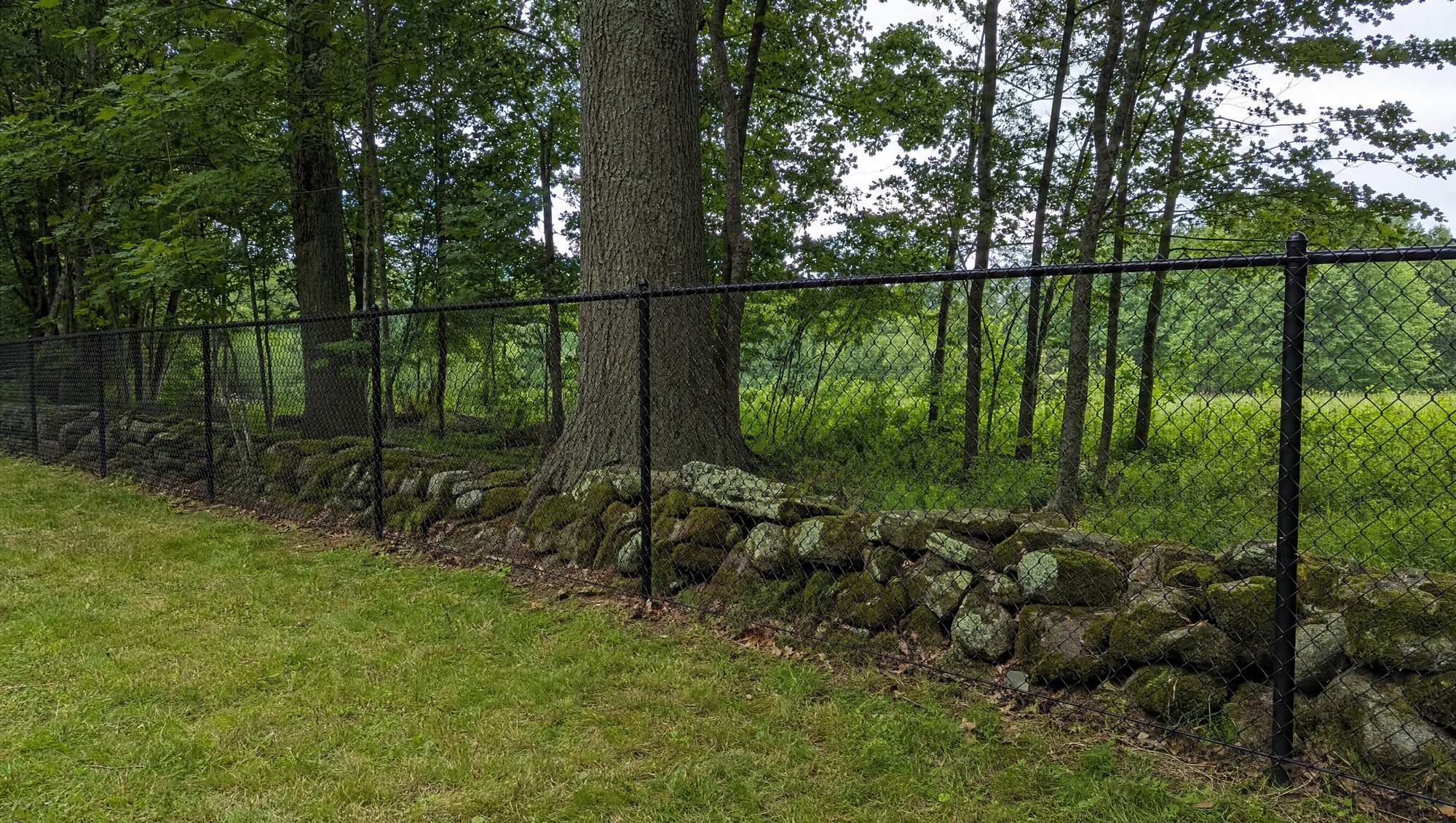
Two quotes land for the same Sherman yard. Both say six feet. Both say black. One is a few hundred dollars cheaper, so you circle it. That is usually the moment chain link fencing in Sherman, CT quietly goes wrong, because the two numbers on the front of a quote are the two that matter least. Wire gauge, mesh opening, coating, post diameter, pipe wall thickness, gate hardware, and how those posts go into rocky ground are what decide whether the line still stands straight after ten winters. None of that shows up in "six feet, black." Chain link looks like a commodity and gets priced like one, which is exactly why the specification is where the money hides. What follows is what to ask for, and what shapes the answer on a Sherman property.
Key Takeaways
Specifications outrank height and color
Gauge, mesh, coating, post sizes, rails, and gate hardware belong in writing, because two fences described the same way can be built from very different parts.
Galvanized and black are different systems
Galvanized uses a zinc coating over steel, while black chain link typically adds a polymer coating that brings its own appearance and its own inspection points.
Privacy slats add wind load
Slats turn open mesh into a surface that catches wind, so posts, footings, tension, and gates all have to suit the slatted system rather than be asked to carry it later.
Sherman handles fences through Planning and Zoning
The town's fee schedule lists a zoning permit for fences, and a pool barrier requires a permit regardless of height.
Sherman ground sets the labor
Rocky glacial soil, ledge, slopes, roots, wet low spots, and freeze-thaw movement all change post locations, excavation, and cost.
Two Quotes Can Describe the Same Fence and Deliver Different Ones
Chain link is the one fence people think they already understand. It is open, it is practical, and it has been holding in dogs and defining yards for generations. That familiarity is the trap, because the phrase "chain link fence" covers a wide range of products that look nearly identical from the driveway and behave nothing alike in year eight. The difference lives in parts most homeowners never think to ask about.
Chain Link Is a System, Not a Panel
Unlike a wood or vinyl fence built from panels, chain link is assembled on site from woven wire fabric stretched across terminal posts, line posts, a top rail or top tension wire, and a set of fittings. The finished fence is only as strong as the combination. Tension bars, tension bands, brace rails, tie wires, hog rings, and gate frames all carry part of the load, and a light component anywhere in that chain becomes the failure point. A crew can hang heavy fabric on undersized pipe and the fence will look correct on handover day. It will not look correct after a season of wind and frost.
Where Chain Link Earns Its Place on a Sherman Property
Open mesh does several things other fences cannot. It contains without closing off the view, it lets wind and light through, it follows terrain more forgivingly than rigid panels, and it scales from a small garden enclosure to a long rural run without a redesign. That range is why the same material shows up as residential fencing around a backyard, as commercial fencing around a parking area or a work yard, and as industrial fencing where security drives the specification. The material stays the same; the parts list changes completely.
Galvanized or Black: Choosing the Finish for the Setting
Once the purpose is settled, the finish is usually the next fork in the road, and it is a bigger decision than a color swatch suggests. Both options start as steel fabric and both rely on a coating to survive New England weather, but they protect differently, they age differently, and they cost differently. The right pick depends on where the fence sits and what you want it to do visually. Here is how the two actually differ.
Zinc-Coated Galvanized Fabric
Galvanized chain link uses a zinc coating to protect the steel underneath from corrosion. ASTM A392 covers zinc-coated steel chain-link fence fabric, including fabric woven from coated wire and the requirements for mesh and edge treatment. A complete galvanized fence Sherman property owners get quoted should carry that protection all the way through: fabric, terminal posts, line posts, top rail, tension bars and bands, gate frames, and fittings. Not all galvanized is equal, either. Wire gauge, mesh opening, zinc-coating weight, post diameter, pipe wall thickness, rail size, fitting thickness, and gate reinforcement all vary between a residential and a commercial specification. Galvanized tends to win where practical containment, visibility, durability, and budget control matter more than screening.
Polymer-Coated Black Fabric
A black chain link fence Sherman homeowners choose is usually polymer-coated fabric, often paired with coated posts, rails, gates, fittings, and hardware so the whole assembly reads as one color. ASTM F934 addresses standard colors for polymer-coated chain-link fence materials. The appeal is visual: black recedes against trees, lawns, gardens, dark plantings, and house siding in a way galvanized never does. Along a wooded Sherman boundary, a black fence can nearly disappear at thirty feet. Worth asking before you sign: is the fabric polymer-coated over galvanized wire, are the posts and rails coated to match, are the fittings and gate frames coordinated, and what is the underlying wire gauge beneath the coating?
A Black Finish Still Needs Inspection
Coated does not mean sealed for life. Mower impact, plow contact, falling branches, chemicals, abrasion, and cut edges can all break a polymer coating, and once the coating opens, the wire underneath is exposed. Ask how the warranty treats fading, peeling, corrosion, and impact damage separately, because those are four different failures and some warranties only cover one or two of them. A yearly walk of the line catches most of it early.
Gauge, Mesh, and Pipe Tell You What You Actually Bought
This is the part of a chain-link quote most people skip, and it is the part that separates the two bids on your kitchen table. Fabric should never be specified by height and color alone. Wire gauge, mesh opening, coating type, coating weight, selvage treatment, and the intended application all belong on the page. Smaller mesh and heavier wire generally change strength, climb resistance, weight, and cost, so the correct answer depends on what the fence is holding in or keeping out.
Residential Versus Commercial Specifications
The same six-foot black fence can be built to a light residential specification or a commercial one, and the price gap between them is real and justified. Commercial work typically calls for heavier fabric, larger-diameter posts with thicker pipe walls, sturdier rails, stronger gate frames, and heavier fittings. ASTM F1043 covers strength and protective coatings for industrial chain-link fence posts and rails, and ASTM F1083 covers the galvanized steel pipe used in fence structures. When a bid does not name dimensions, you cannot tell which one you are buying.
Core Wire Versus Finished Coated Diameter
Here is a detail that trips up honest comparisons. On coated fabric, the wire has a core diameter and a finished diameter after the coating goes on, and those are two different numbers. A quote can list the larger finished figure while the steel underneath is lighter than a competing bid that lists the core. Ask which number a spec refers to, and compare like for like.
Knuckled and Twisted Selvage
Selvage is how the fabric is finished at the top and bottom edges. A knuckled selvage folds the wire ends over smoothly, while a twisted selvage leaves sharp points. Knuckled top and bottom is the usual call around children, pets, and pool areas. Twisted tops appear where deterrence is the point, typically on security work. It is a small line item that changes how the fence feels to live with.
Privacy Slats Buy Screening and Sell You Wind Load
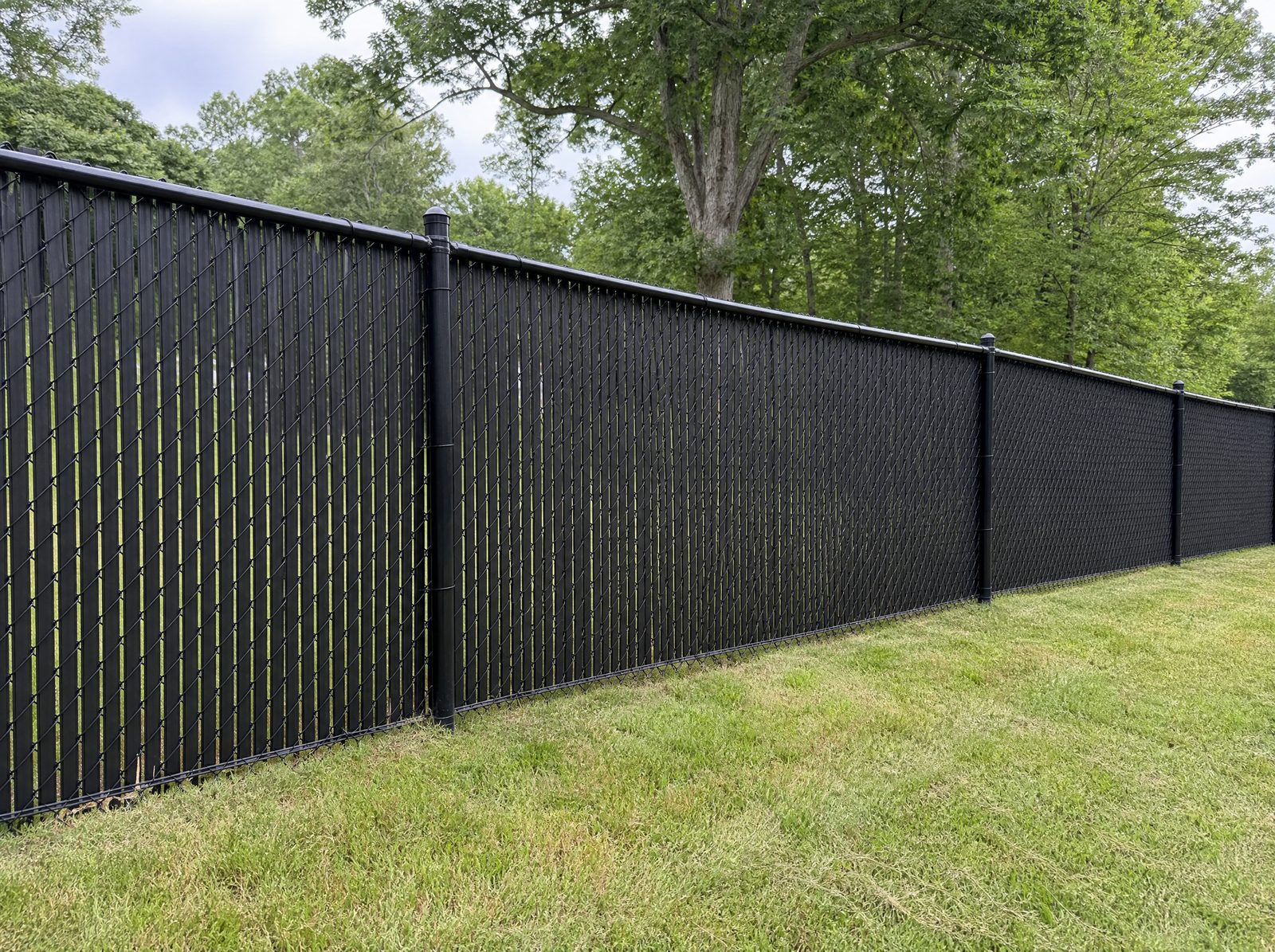
Privacy slats slide into the mesh to cut visibility, and they are a reasonable way to get screening from a fence you already like. What the brochure will not tell you is that slats change the fence into something structurally different. Open mesh lets wind pass through; a slatted fence catches it. That added surface area raises the demand on posts, footings, fabric tension, and gates, and it also changes how snow and debris collect against the line. ASTM F1043 exists because that structure has to be rated for what it carries.
The practical rule for chain link with privacy slats Sherman properties need: decide about slats before the posts are sized, not after. Adding slats to a fence that was engineered as open mesh is how a straight line starts leaning. If slats are a maybe, say so during the estimate so the posts, footings, and gate frames can be specified for the heavier condition from the start.
Be realistic about the screening, too. Privacy percentage varies by slat profile, mesh size, insertion angle, and viewing distance, so slats reduce visibility rather than eliminate it. They also add cost, add maintenance, and raise a question worth asking up front: will replacement slats in that color and profile still be available in eight years when a plow clips a section?
Pets, Pools, and Security Each Rewrite the Spec
The purpose of the fence should drive every number on the estimate, and the three most common purposes pull in different directions. A fence that is perfect for a work yard can be the wrong fence for a beagle, and a fence that suits a beagle may not be legal around a pool. Sorting this out first saves the expensive version of the lesson. Here is how each use changes the build.
Chain Link Built Around Your Dog
Chain link gives most dogs a visible physical barrier, which is why it stays popular for pet fencing. The system has to be designed around the animal, though, not around the yard. Dog height, jumping, climbing, and digging behavior all matter, and so do mesh size, fence height, bottom clearance, bottom tension wire, gate gaps, latch placement, corners, and anything climbable parked nearby. Small dogs slip through larger openings or under uneven grade. Athletic dogs climb standard fabric or clear a height that seemed generous on paper. Where digging is the issue, a buried apron or another dig deterrent may belong in the scope.
A Pool Barrier Is Its Own Approval
Sherman requires a permit for a pool barrier regardless of height, and that alone makes pool fencing a separate project rather than a section of yard fence. Chain link can serve as a pool barrier only when the complete installed system meets the applicable requirements: height, mesh opening, bottom clearance, climbability, gate direction, self-closing hinges, self-latching hardware, latch location, gate gaps, and connections to structures. Standard fabric is not automatically compliant, and mesh dimensions and gate details are where it usually fails. The Connecticut residential code frames the barrier rules, and the town confirms what applies to your lot.
Commercial, Industrial, and Agricultural Enclosures
Heavier work asks for heavier parts. Commercial sites may want taller fabric, smaller mesh, sturdier gate frames, slats, and access-control gates. Industrial sites may add protective coatings, anti-climb features, and planning appropriate to the actual security risk. On larger Sherman parcels, agricultural fencing uses chain link for kennels, equipment areas, poultry runs, gardens, and small livestock enclosures, where the pressure on the fabric is constant rather than occasional. Wide vehicle openings are their own conversation; double swing gates, cantilever slide gates, and estate gates each need their own posts, support, and clear operating path.
Sherman Settles the Permit Question Before You Order
Do not assume chain link is automatically permit-free. Sherman processes fences through its Planning and Zoning Department, and the town's fee schedule lists fences under miscellaneous structures with a zoning permit fee. Sherman also publishes current zoning regulations and revises them periodically, which is a good reminder that dimensional and application requirements change and should be confirmed rather than remembered. Height, placement in required yards, road and driveway sight lines, easements, wetlands and watercourses, pool-barrier use, security extensions, gates near roads, and private association rules can all apply to a specific lot. Confirm the current requirements with the town before anything is ordered.
An Old Stone Wall Is Not a Property Line
Sherman has plenty of old stone walls, tree lines, hedges, and mowing edges that everyone treats as the boundary. None of them are. A fence set in the wrong place is expensive to move and worse to argue about, and a contractor can lay out the run but only a licensed surveyor establishes the legal line. A survey earns its cost when markers are missing, when the fence will sit close to the line, when the lot has irregular boundaries or a shared driveway, when an easement may exist, when a neighbor has questioned the route, or when a wetland or watercourse is nearby. Recorded plans often start with the town clerk.
Call 811 Before the First Post Hole
Chain-link posts mean digging, so buried lines come first. Connecticut's Call Before You Dig service should be contacted before excavation by calling 811 or filing online. Public marking does not cover everything, though. Septic and well lines, irrigation, plantings lighting, pool equipment lines, propane, generator feeds, private electrical service, drainage pipes, and invisible pet-fence wire are often privately owned and may need a separate private locate. The written contract should say who submits the request and who handles private-line locating, so it never falls between the two of you.
Sherman Ground Decides How the Posts Go In
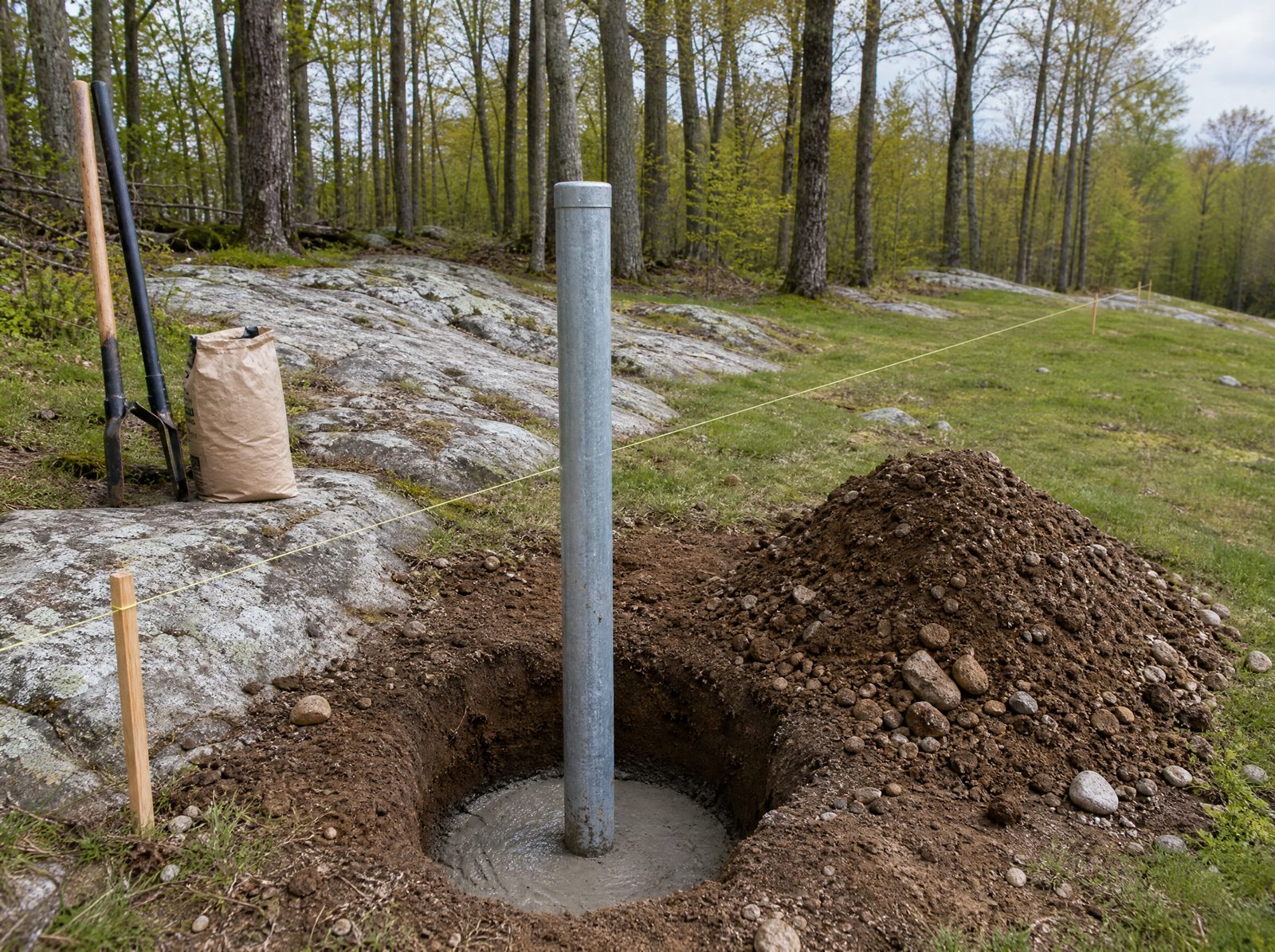
Sherman properties bring rocky glacial soil, ledge, slopes, wooded edges, large roots, wet ground, drainage swales, stone walls, narrow equipment access, and long runs, sometimes on the same job. All of it affects post locations, excavation, fabric tension, bottom gaps, gate operation, labor, and cost. There is no single universal post depth for every chain-link fence, and anyone quoting one number for every condition is guessing. Depth, hole diameter, setting method, and post size depend on fence height, fabric gauge, mesh, slats or windscreen, soil and ledge, drainage, wind exposure, gate width and weight, terminal conditions, frost, and the project specification.
Slopes and the Gap Under the Fabric
Chain-link fabric follows grade more continuously than rigid panels, which is a genuine advantage on a Sherman hillside. Steep transitions still take care. Post placement, even stretching, and bottom-gap control decide whether the fence looks intentional or wavy, and the gap under the fabric is exactly where a determined dog leaves. Bottom tension wire helps hold the lower line and reduce lift, but it does not replace correct grade work or a buried dig barrier where one is needed.
Ledge, Roots, and Drainage
Ledge can force drilling, different equipment, shifted post positions, or alternative anchoring, and it should appear in the contract as a named site condition with a change-order procedure, not hide inside a vague number. Roots deserve the same respect: a fence line should avoid unnecessary root damage, and a living tree should never be drafted as a fence post, because growth and movement tear fabric apart. Posts and bottom tension wire should not block a drainage swale either. Wet low points weaken soil support, throw gates out of alignment, and erode the ground under the fabric.
Gate Posts Carry More Than Line Posts
Terminal posts, corner posts, pull posts, and gate posts all work harder than a line post, and gate posts work hardest of all. Every swing, every latch, and every frost cycle loads that one point. Wide double gates and cantilever slide gates need separate structural planning, and ASTM F900 covers industrial and commercial swing gates. Connecticut's foundation code explains why frost protection matters here even though a fence post is not regulated like a building footing. Drainage under the post matters as much as depth, because water that sits and freezes is what heaves.
What Actually Moves the Cost of a Sherman Chain-Link Fence
There is no honest one-price-fits-all figure, and chain link fence cost Sherman searches turn up broad national ranges for a reason. Published consumer guides like Angi's chain-link cost breakdown are useful as general market background, not as a quote for your run. Linear footage and height set the baseline. Gauge, mesh, and coating move it. Post diameter, pipe wall thickness, top rail, and bottom tension wire move it again. Gates move it hard, since walk gates, double gates, slide gates, and automation each carry their own posts, support, and hardware. Then the site adds its share: slopes, ledge, roots, wet soil, brush clearing, restricted access, and old-fence removal are labor before they are anything else. Pool or security requirements and custom colors sit on top. A site visit is the only way to price the actual project, and ours are free.
Hover or tap a row to highlight it.
| Cost Driver | Why It Matters |
|---|---|
| Linear footage and height | The baseline. More posts, more fabric, more hardware, more labor. |
| Gauge, mesh, and coating | Heavier wire, smaller mesh, and polymer coating each cost more than the light residential default. |
| Post and pipe dimensions | Diameter and wall thickness separate a residential build from a commercial one. |
| Gates | Walk, double, slide, and automated gates each need their own posts, support, and hardware. |
| Privacy slats | Slats add material, add wind load, and raise the post and footing specification with it. |
| Terrain and access | Ledge, slopes, roots, wet ground, brush, and a long carry all add hours. |
| Old-fence removal | Pulling posts and concrete and hauling debris is its own line item. |
How a Chain-Link Fence Installation Comes Together
A clean chain link fence installation Sherman crews run follows a predictable order, and knowing it helps you spot corners being cut. It starts with purpose and property, puts the compliance and utility checks where they belong, and ends with a walkthrough rather than a wave from the truck.
The Sherman Chain-Link Fence Installation Process
- 1
Step 1: Purpose and Property Walk
We define the goal, walk the boundaries, slopes, ledge, drainage, gates, and existing fencing, and settle approximate footage.
- 2
Step 2: Permits, Zoning, and Boundaries
Sherman zoning, pool-barrier rules, wetlands, easements, and survey questions get answered before anything is ordered.
- 3
Step 3: Specify the System
Height, gauge, mesh, coating, posts, rails, tension wire, gates, and slats are chosen and written down.
- 4
Step 4: Written Scope and Utility Marking
The scope documents removal, cleanup, permits, and hidden-condition procedure, and a Call Before You Dig request goes in with private lines identified.
- 5
Step 5: Terminal Posts, Line Posts, and Rails
End, corner, pull, and gate posts are set for height, tension, soil, and gate load, then line posts, rails, and spacing follow.
- 6
Step 6: Fabric, Gates, Slats, and Walkthrough
Fabric is stretched and tied, gates are hung and adjusted, approved slats go in, and we inspect tension, fittings, sharp edges, and bottom gaps with you.
What Separates a Chain-Link Fence Contractor Worth Hiring
Connecticut requires home improvement contractors to register with the Department of Consumer Protection, so registration and insurance are the floor rather than a selling point. The state's license verification portal takes a minute, and the DCP is direct that home improvement work requires a written contract and a registered contractor. My Fence Guy is family-owned with a local office right here in Sherman, CT, licensed and insured. Past the paperwork, a chain link fence contractor Sherman owners should trust will put specifications in writing, explain how ledge gets handled, and answer the gauge question without changing the subject.
What the Written Estimate Should Spell Out
A vague estimate is not a bargain; it is a blank check pointed at your yard. Hold any bid against this list before you compare prices:
- Height and footage: The measured run and the finished height.
- Wire gauge and mesh size: The actual numbers, and whether coated wire is quoted at core or finished diameter.
- Coating: Galvanized, aluminized, or polymer, and the coating classification.
- Post and pipe dimensions: Terminal, line, and gate post diameters and wall thickness.
- Top rail and tension wire: Whether the fence uses top rail or top tension wire, and whether bottom tension wire is included.
- Gates and hardware: Widths, swing direction, hinges, latches, and any self-closing requirement.
- Slats or screens: The product, and confirmation that posts and footings suit the wind load.
- Removal and cleanup: Who pulls the old fence, posts, and concrete, and who hauls it away.
- Permits and utility responsibility: Who files with Sherman and who submits the 811 request.
- Ledge and hidden conditions: How surprises get priced, in writing, before they happen.
- Timeline, payments, and warranties: Schedule, material lead times, payment terms, and material versus workmanship coverage.
Frequently Asked Questions About chain link fencing sherman ct
Q: What is the difference between galvanized and black chain link?
A: Galvanized chain link uses a zinc coating over steel for corrosion protection, covered by ASTM A392. Black chain link typically uses a polymer coating over metal fabric and is often paired with matching coated posts, rails, and fittings for a darker appearance that recedes against trees and lawns.
Q: Do I need a permit for chain-link fencing in Sherman?
A: Do not assume a fence is permit-free. Sherman processes fences through its Planning and Zoning Department, and the town's fee schedule lists a zoning permit for fences. A pool barrier requires a permit regardless of height, and zoning, placement, setback, sight-line, wetlands, and easement requirements may also apply. Confirm the current rules with the town.
Q: Are privacy slats completely private?
A: No. Slats reduce visibility, but the actual screening depends on the slat profile, mesh size, viewing angle, and installation. They also increase wind load, so the posts, footings, and gates need to be specified for the slatted system rather than have slats added to them later.
Q: Is chain link good for dogs?
A: It can be. Height, mesh size, bottom clearance, bottom tension wire, gate gaps, and latch placement all have to suit the specific dog, including how it jumps, climbs, and digs. Small dogs slip through larger openings or under uneven grade, and athletic dogs climb fabric that would hold a calmer animal.
Q: Can chain link be used around a pool?
A: Yes, when the complete installed barrier meets the applicable mesh, height, bottom-clearance, gate, latch, and climbability requirements and receives the required approval. Standard chain link is not automatically pool-compliant, and Sherman requires a permit for a pool barrier regardless of height.
Q: Can chain-link fencing follow a slope?
A: Yes. Chain-link fabric follows grade more continuously than rigid panels, which suits Sherman's hillsides. Steep transitions still need careful post placement, even stretching, and bottom-gap control so the fence does not leave a dog-sized opening at the low point.
Q: What gauge chain link should I choose?
A: The right gauge depends on whether the use is residential, commercial, pet, pool, security, or industrial. Compare the written wire and post specifications between bids rather than relying on a generic grade label, and ask whether a coated wire figure is the core or the finished diameter.
Q: How do I verify a chain-link fence contractor in Connecticut?
A: Use the Connecticut Department of Consumer Protection license-verification portal, request proof of insurance, and read a detailed written contract before work begins. The state is clear that home improvement work requires both a written contract and a registered contractor.
Test Your Sherman Chain-Link Knowledge
1. Which two numbers on a chain-link quote tell you the least about what you are buying?
2. What happens when privacy slats go into a fence that was engineered as open mesh?
3. On coated chain-link fabric, which wire figure can make a lighter fence look heavier on paper?
4. Does a fence used as a pool barrier in Sherman need a permit?
5. Which selvage is the usual call around children, pets, and pool areas?
Pick an answer to begin.
Final Thoughts
Chain link fencing Sherman Connecticut property owners get right tends to come down to a short list handled in order: settle the purpose, pick the finish for the setting, get the gauge, mesh, coating, and post dimensions in writing, decide about slats before the posts are sized, confirm what Sherman's Planning and Zoning Department wants, verify the boundary, mark the utilities, and set the posts for the actual soil and gate loads. Do that and the price on the page finally means something, because you know what it buys. Skip it and you are comparing two numbers that were never the point.
A chain-link fence built to the right specification is one of the least demanding things you can own. It holds the dog, defines the yard, secures the work area, and asks for little more than an occasional walk of the line to check ties, gates, and coating. That is a long payoff for one careful conversation at the estimate.
If you are planning chain-link fencing on a Sherman property, we would be glad to walk the run with you and give you a straight answer in writing. My Fence Guy is a family-owned contractor with a local office right here in Sherman, CT, and we install galvanized, black-coated, and privacy-slat chain link for residential, commercial, industrial, and agricultural properties, along with pool fencing, pet fencing, gates, and railings. We handle the specification, the Sherman permit and utility questions, and the ledge and slope details that decide how a fence holds its line. Call us at (203) 746-1100 for a free estimate, or reach out through our contact page.
Chain-Link Fencing Key Terms
Tap a term to see what it means.
Chain-Link Fabric. The woven wire mesh that forms the body of the fence, stretched on site across posts rather than delivered as a finished panel.
More about fences
Pet Fencing in Sherman, CT: What Actually Holds a Dog
Your dog already knows how it would get out. Pet fencing in Sherman, CT: height for the jumpers, buried edges for the diggers, spacing for the slippers.
Read the guide to Pet Fencing in Sherman, CTPet Fencing in Southbury, CT: What Actually Holds a Dog
A pet fence keeps your dog in and other animals out. Pet fencing in Southbury, CT: height, dig defense, picket spacing, and a gate a dog cannot nose open.
Read the guide to Pet Fencing in Southbury, CTPet Fencing in New Fairfield, CT: What Your Dog Will Test
Pet fencing in New Fairfield, CT only works if it matches your dog. How dogs jump, dig, and slip past fences, and what actually holds them in.
Read the guide to Pet Fencing in New Fairfield, CT