
Pet Fencing in Brookfield, CT: Physical Fences, Underground Systems and Gates
By Tony Pellicone14 min readPublished
- pet fencing
- brookfield ct
- connecticut
For most Brookfield dogs, a physical fence is the stronger choice because it keeps the dog in and can keep stray dogs, wildlife, people and other animals out. Start with the dog’s shoulder height, jumping, climbing, digging and squeezing habits, then choose the fence height, mesh or panel spacing, bottom protection and gate hardware around those behaviors.
An underground or wireless system may fit a large, wooded, steep or wet property where posts and panels are difficult to install, but it depends on training, power, batteries, boundary wire and the dog’s response. Brookfield’s zoning rules also affect the height, location and design, so confirm the proposed fence with the town before ordering materials.
Key Takeaways
Physical barrier
A solid fence contains the dog and helps keep outside animals away from the yard.
Height
Many small dogs start around 4 feet, medium dogs around 5 to 6 feet, and athletic jumpers may need 7 feet.
Gate safety
The gate needs self-closing, self-latching hardware, tight clearances and protection at the bottom.
Brookfield rules
Fences 8 feet or higher require Zoning Approval and a Certificate of Zoning Compliance under § 6.10.
Property conditions
Wetlands, watercourses and steep slopes can change the fence route and installation work.
Budget
National 2026 benchmarks range from about $15 to $45 per linear foot for professionally installed dog fencing.
Physical Fences, Underground Systems and Wireless Boundaries
A physical fence gives your dog a visible boundary and gives you a barrier that works without a collar battery or radio signal. It can also separate the yard from deer, stray dogs, wildlife, traffic areas and visitors. That matters if your dog reacts to animals outside the property or if you need to keep other animals away from a pool, garden, kennel or livestock area.
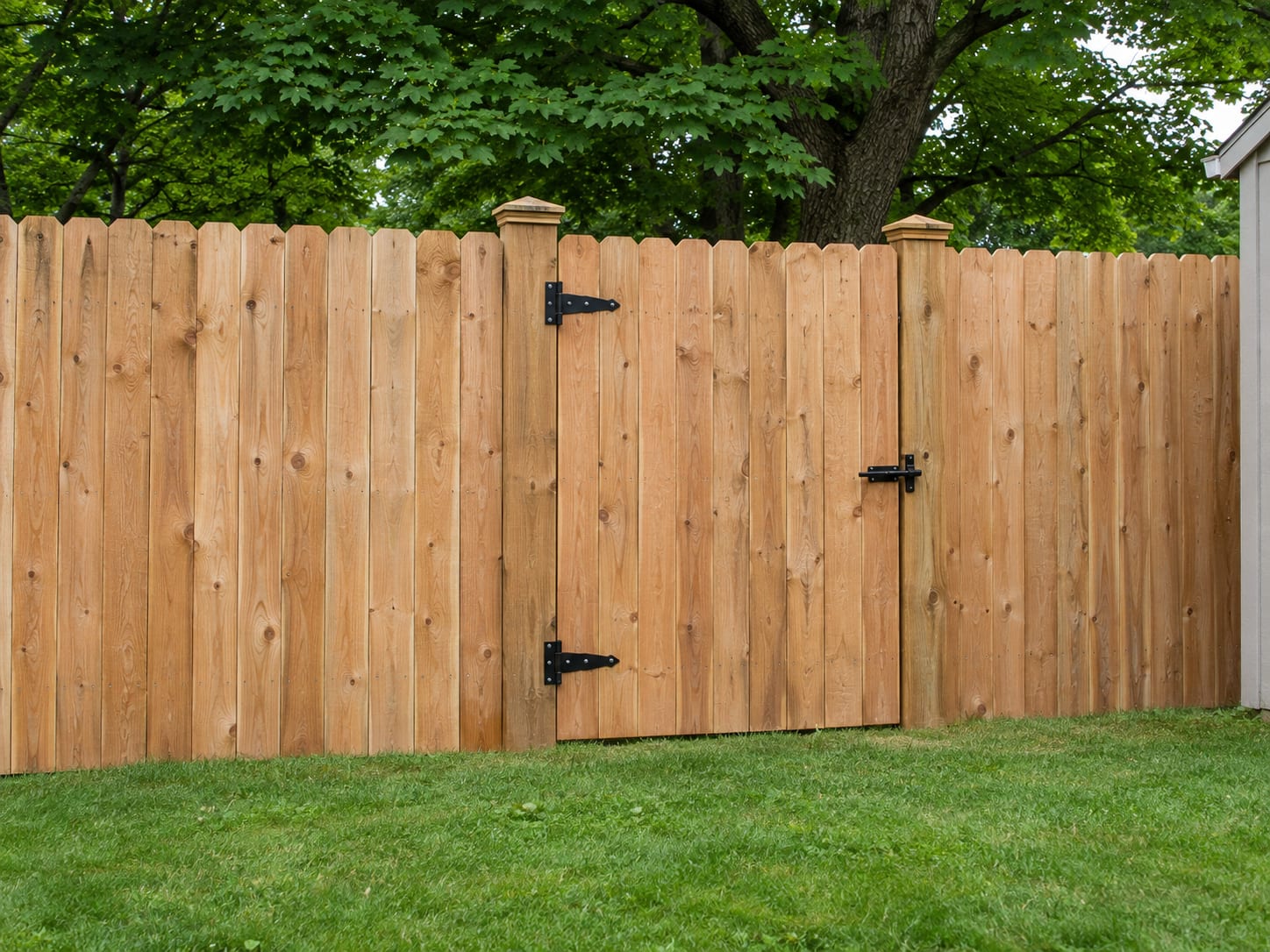
Wood privacy or solid-board fencing works well for dogs that are easily distracted, jumpers or climbers because it blocks much of the outside activity. Vinyl privacy fencing has few footholds and requires limited maintenance. Aluminum fencing can use puppy pickets or close vertical spacing, but it usually contains the dog visually without providing privacy.
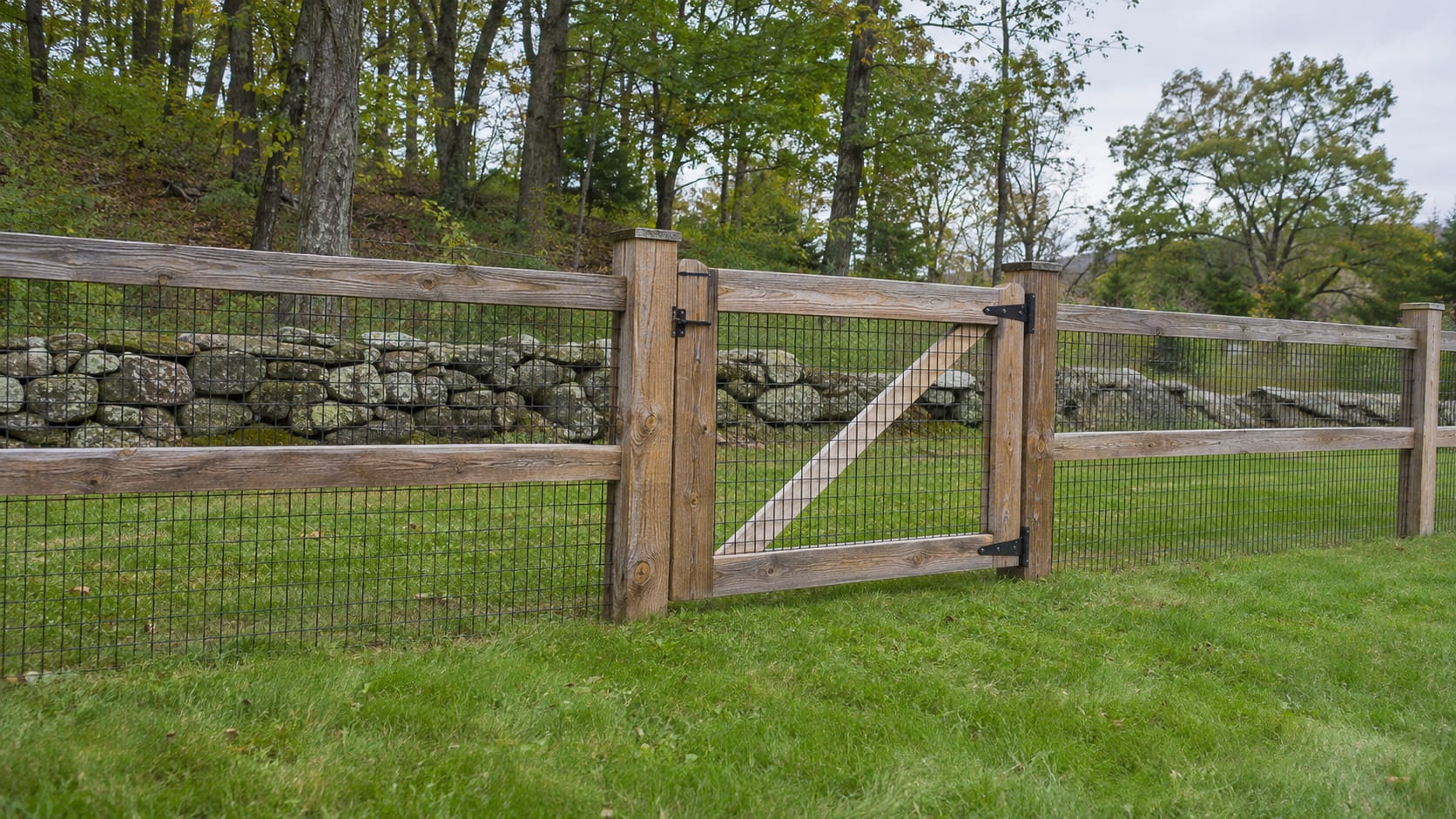
Split rail with welded wire can suit a rural property, provided the mesh is close enough that the dog cannot push through or catch its head. Chain link is another practical option, with height and mesh size selected for the dog’s size and behavior.
You can review pet fencing options for Brookfield properties when comparing these designs. The fence material is only part of the containment plan. A dog can still dig below the fence, climb it, squeeze through an opening, push through a weak gate or jump over the top.
An underground system uses buried boundary wire and a receiver collar. A wireless system uses a transmitter and radio boundary instead of a buried perimeter. The collar usually gives a warning tone and, depending on the system and setting, a static correction. Training is part of the installation process.
Electronic containment may fit a property with steep, wooded or wet sections where a conventional fence would be difficult to route. It may also cost less than a full physical perimeter. It does not keep another dog, coyote or other animal from entering, and a frightened or highly motivated dog may cross the boundary. A power failure, dead collar battery or damaged wire can also open a path out. Some dogs become frustrated when they can see people or animals beyond the boundary but cannot reach them.
A combination can make sense in Brookfield. For example, a physical fence can handle the main yard while an electronic system reinforces a difficult section near a wet area or irregular property line. The design should still give you a secure gate and a physical barrier wherever outside animals, pool access or traffic create a concern.
Choose the Height and Bottom Around the Dog
Breed labels are only a rough starting point. Shoulder height, jumping ability, climbing behavior, prey drive, age, training and nearby objects matter more when you select the fence.
A national 2026 cost guide gives these starting points: approximately 4 feet for many small dogs, at least 5 to 6 feet for medium dogs such as Golden Retrievers, Labradors and German Shepherds, and potentially 7 feet for large, athletic jumpers such as Greyhounds. The same guide offers a general starting rule of about three times the dog’s shoulder height.
Treat those figures as a starting point, not a final specification. A quiet dog that stays close to the house may need a different design from a young dog that launches toward squirrels. If your dog climbs, avoid horizontal rails, lattice and stacked objects near the fence. Trees, sheds, woodpiles and retaining walls can become launch points.
If the dog jumps, a taller solid fence may work better than an open picket fence. If the dog climbs, remove footholds and consider a top detail that does not give the paws a firm grip. Coyote rollers are rotating tubes placed along the top edge to make gaining a grip more difficult. They are a specialized anti-climb feature that works alongside adequate height, secure posts and a protected bottom edge.
Digging requires a separate decision. You can bury the fence bottom, add an inward L-footer, install a welded-wire apron that extends into the yard, use a concrete or paver strip, or attach a tight dig-resistant wire base. The gate threshold and corners deserve the same treatment because dogs often find the easiest opening there.
Brookfield’s zoning rules set another limit. Under § 6.10, a visibility-inhibiting fence made with lattice, slats, panels or boards may not exceed 8 feet. Other fence types may not exceed 12 feet. Fences 8 feet or higher require Zoning Approval before construction and a Certificate of Zoning Compliance after construction.
A physical fence may also need to fit around an old stone wall, steep ground or shallow rock. Brookfield’s regulations identify stone walls as historic and scenic assets that should be preserved in new development as much as possible. If the proposed fence crosses or runs beside one, show it on the plan before the fence line is fixed.
Hover or tap a row to highlight it.
| Dog or property concern | Fence approach to consider | Detail to specify |
|---|---|---|
| Easily distracted dog | Wood privacy or solid board | Limit visual triggers and protect the bottom |
| Low-maintenance privacy | Vinyl privacy | Use panels with few footholds |
| Small dog or puppy | Aluminum with puppy pickets or close spacing | Check every opening against the dog’s head and paws |
| Rural or open yard | Split rail with welded wire | Use close mesh with no catch points |
| Digging dog | Any suitable fence with buried mesh or an inward L-footer | Reinforce gates, corners and the full bottom edge |
| Climbing dog | Solid or climb-resistant layout | Avoid horizontal rails, lattice and nearby launch points |
Gates Are Part of the Containment System
A gate should be at least as difficult to climb, squeeze through or dig under as the adjoining fence. A strong fence with a weak gate is still an escape route.
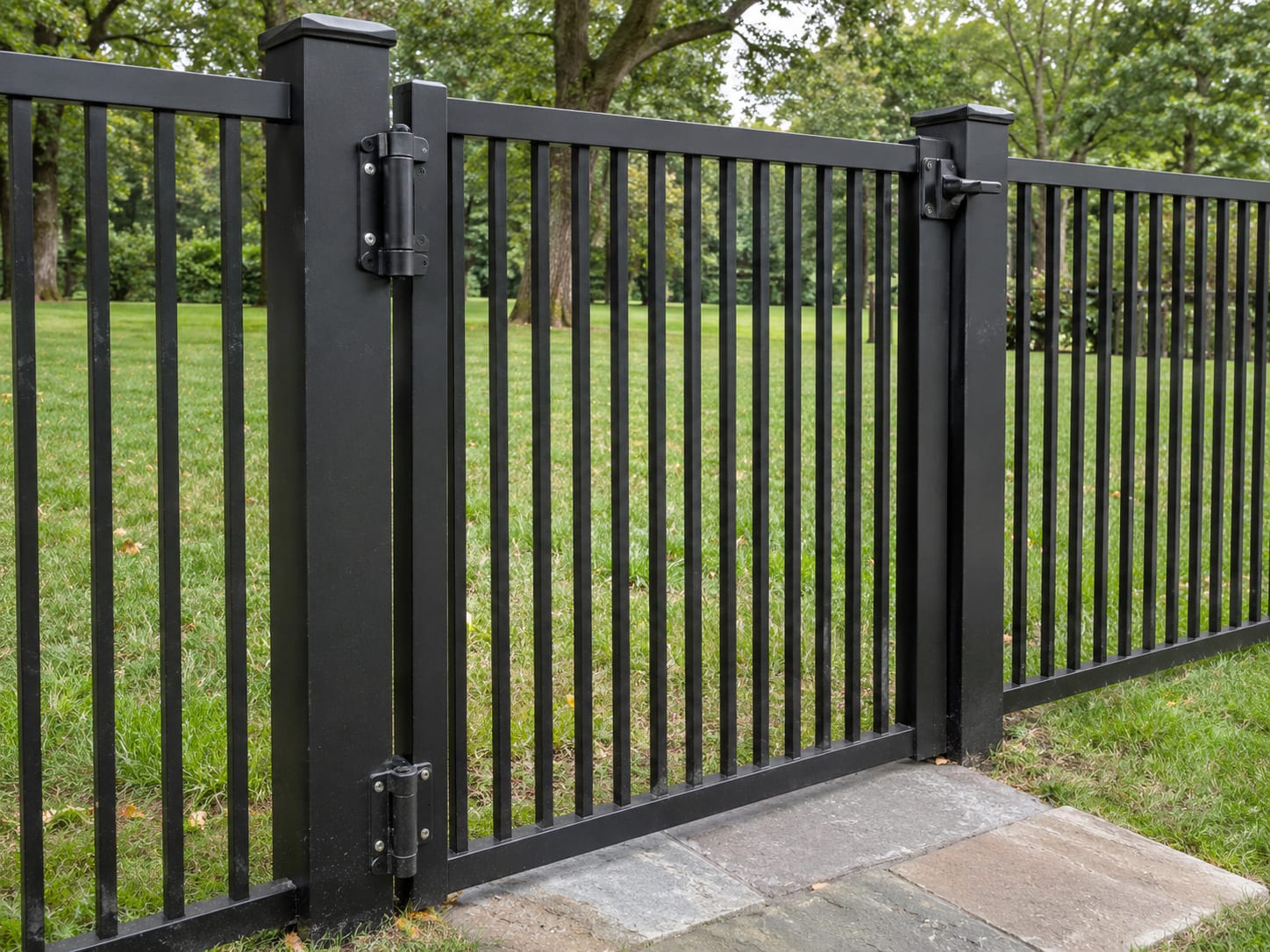
Use a self-closing hinge or closer so the gate returns to the closed position. Add a self-latching or auto-latching mechanism that engages whenever the gate closes. Place the latch where the dog cannot operate it with its nose or paws. If the gate is part of a pool barrier or needs extra security, add a locking device.
The hinge side, latch side and bottom should have tight, consistent clearances. Check the largest opening where the ground slopes instead of measuring only the smallest point. Avoid sharp projections, exposed wire ends and gaps where a paw, collar or head could become trapped.
D&D Technologies’ TruClose and MagnaLatch information shows adjustable gate clearances and self-latching hardware. One MagnaLatch installation diagram shows a latch installation gap range of approximately 3/8 inch to 1-7/16 inches. That is a hardware installation range, and the safe opening for your dog depends on its size. Measure your dog and specify the smallest practical opening that prevents passage, paw access and head entrapment.
A pool gate has additional requirements. Connecticut State Building Code materials specify a 48-inch minimum barrier, outward gate swing, self-closing and self-latching pedestrian gates, and particular latch-release placement and opening limits. A pet fence around a pool does not replace the required pool barrier.
When My Fence Guy prepares a written quote, the gate portion should identify the number of gates, width, direction of swing, hinge type, closer, latch, lock, bottom clearance, digging protection and any pool-barrier requirements.
Brookfield Rules and Property Review
Brookfield’s Article 6, § 6.10, “Fences and Walls,” allows fences under 8 feet in residential zoning districts without Zoning Approval. A fence 8 feet or higher requires Zoning Approval before construction and a Certificate of Zoning Compliance after construction. The application for an 8-foot-or-higher fence requires a site-plan sketch showing that the fence is on the subject lot.
The finished side of a fence must face the exterior of the lot. Materials and colors must be harmonious with the buildings and surrounding area as determined by the Zoning Enforcement Officer. Fences must be designed and made of materials that prevent injury, and barbed wire, razor wire and similar fencing are prohibited in all zones.
Brookfield defines a corner lot as having two front yards and two side yards, with no rear yard. That can change which yard standards apply to the fence route. The residential dimensional table in § 3.5 gives front-yard setbacks by zoning district, from 50 feet in R-100 and R-80 to 20 feet in R-7. Confirm how the applicable district and proposed fence location work together before construction.
Brookfield’s town FAQ says fences under 7 feet do not need a permit, while the current zoning regulation sets Zoning Approval at 8 feet or higher. Ask the Brookfield Land Use or Zoning Enforcement office which approval applies to your proposed height, location and design. You can also review the statewide overview, Do You Need a Permit for Fence Installation in CT?.
Wetlands and watercourses can affect the route. Brookfield’s public FAQ identifies review areas within 75 feet of wetland soils, 100 feet of a watercourse and 200 feet of the mean waterline of Candlewood Lake, Lake Lillinonah or the Still River. The town’s physical-requirements document also identifies wetlands, watercourses and slopes over 25 degrees as physical constraints.
That changes the practical order of the job. Check the parcel in Brookfield GIS, review the USDA Web Soil Survey for the proposed fence line, and ask the Land Use or Inland Wetlands office about the route before setting posts.
Wet ground can affect drainage and post installation, while slopes can change the bottom clearance and gate swing. Shallow ledge can increase excavation work, so have the fence line reviewed before the price is finalized.
Call Connecticut Call Before You Dig before excavation. If the fence is near a property line or shared boundary, use a survey or other reliable boundary information and put the agreed location, access and maintenance responsibilities in writing.
Brookfield Pet Fence Planning Sequence
- 1
Measure the dog
Record shoulder height, jumping, climbing, digging, squeezing and prey-drive behavior.
- 2
Review the property
Mark the house, pool, driveway, slopes, stone walls, trees, sheds, wet areas and possible launch points.
- 3
Confirm town requirements
Ask Brookfield Land Use or Zoning Enforcement how § 6.10 applies to the proposed height, yard and design.
- 4
Check site conditions
Review wetlands, watercourses, soil, ledge and drainage before fixing the fence line.
- 5
Call before excavation
Submit the Connecticut utility-marking request before digging post holes or burying boundary wire.
- 6
Specify the system
Write down material, height, mesh or panel spacing, bottom protection, gates, latches and locks.
- 7
Install and inspect
Set posts, attach panels or wire, fit the gates, check clearances and confirm required town or pool review.
Cost, Materials and the Written Quote
National 2026 figures give you a starting point for budgeting, and a Brookfield bid will differ. Angi reports professionally installed dog fencing at approximately $15 to $45 per linear foot, national, 2026. It reports invisible fencing at approximately $2.50 per linear foot, including collar, charger, voltage meter and batteries, national, 2026, with an average invisible-fence project cost of approximately $1,325 per project, national, 2026.
The same Angi guide gives these national 2026 project ranges: wood at $1,000 to $4,500 per project, vinyl at $3,000 to $6,000 per project, chain link at $1,500 to $4,000 per project and aluminum at $4,500 to $6,000 per project. All dog-fence installations average approximately $4,700 per project, with most projects between $2,000 and $8,000 per project.
HomeGuide reports national 2026 installed ranges of $2 to $7 per linear foot for invisible dog fencing, $10 to $34 per linear foot for black chain link, $6 to $13 per linear foot for frameless hog wire and $15 to $38 per linear foot for framed hog wire.
These project ranges apply to different scopes and do not share a common linear footage. Keep the unit with every comparison and avoid turning a project range into a local per-foot price.
Brookfield pricing can change with height, mesh gauge, puppy spacing, privacy slats, gate count, gate hardware, slopes, ledge, tree roots, old-fence removal, wetlands review and access. A written estimate should identify the linear footage, height, material, number of gates, latch and closer, bottom protection, excavation conditions, cleanup and responsibility for approvals.
Hover or tap a row to highlight it.
| Fence or system | Published benchmark | Unit and source |
|---|---|---|
| Professionally installed dog fencing | $15 to $45 | Per linear foot, national, Angi 2026 |
| Invisible fencing | About $2.50 | Per linear foot, national, Angi 2026 |
| Invisible-fence project | About $1,325 average | Per project, national, Angi 2026 |
| Wood dog fence | $1,000 to $4,500 | Per project, national, Angi 2026 |
| Vinyl dog fence | $3,000 to $6,000 | Per project, national, Angi 2026 |
| Chain-link dog fence | $1,500 to $4,000 | Per project, national, Angi 2026 |
| Aluminum dog fence | $4,500 to $6,000 | Per project, national, Angi 2026 |
Connecticut home-improvement work also calls for a clear written contract. The Department of Consumer Protection says a home-improvement contract should identify the contractor and registration number, signatures, contract and cancellation dates, start and completion dates, complete scope and price, materials, cleanup responsibility, permits and payment schedule. Fence installation is home-improvement work, subject to statutory exceptions. Ask for those details before work begins.
Frequently Asked Questions
Is an underground dog fence better than a regular fence?
A regular physical fence is usually better when you need to contain the dog and keep stray dogs, wildlife, people or traffic away from the yard. An underground or wireless system may suit a large, irregular or wet property, but it requires training and depends on the collar, power, wire, signal and the dog’s response.
Do invisible fences hurt dogs?
An electronic system uses a warning tone and a static electrical stimulus when the dog approaches or crosses the boundary. VCA describes the stimulus as startling rather than painful when set appropriately, but some dogs may find it aversive enough to develop fear of going outdoors, so the dog’s temperament and response should be considered with veterinary and training guidance.
How tall should a fence be for a dog?
Many small dogs start around 4 feet, medium dogs often need at least 5 to 6 feet, and large athletic jumpers may need 7 feet. Measure the dog’s shoulder height and account for jumping, climbing, nearby launch points and Brookfield’s height limits before selecting the final design.
How do you stop a dog from digging under a fence?
Use a buried fence bottom, an inward L-footer, a welded-wire apron, a hard strip such as concrete or pavers, or a tight dig-resistant wire base. Reinforce gates and corners, keep the mesh free of sharp ends, and supervise training while the physical protection is installed.
What is the cheapest fence for dogs?
National 2026 benchmarks place invisible fencing at approximately $2 to $7 per linear foot installed, with Angi reporting about $2.50 per linear foot and an average project cost of about $1,325 per project. Physical options can include frameless hog wire at $6 to $13 per linear foot or chain link at $10 to $34 per linear foot, but the least expensive system still needs suitable height, openings, bottom protection and a secure gate.
Pet Fence Planning Check
1. Which system creates a physical barrier against outside animals?
2. What starting height is commonly cited for many small dogs?
3. Which feature helps a gate return to the closed position?
4. What Brookfield action applies to a fence 8 feet or higher?
5. What helps stop digging beneath a fence?
Pick an answer to begin.
Final Thoughts
The right Brookfield pet fence starts with the dog and the property together. Set the height around actual behavior, close openings that invite squeezing, protect the bottom from digging, and treat every gate as part of the containment system. Then confirm the town review, wetlands conditions, utility markings and pool-barrier rules before installation.
A written quote should make the plan easy to inspect, including the fence line, height, material, gates, hardware, bottom protection, site work and approvals. My Fence Guy can help you compare the physical and electronic options around the way your dog uses the property. Call us at (203) 746-1100 for a free estimate, or reach out through our contact page.
Pet Fencing Terms
Tap a term to see what it means.
Physical fence. A fence made from panels, boards, wire or rails that creates a visible barrier.
More about fences
Chain Link Fencing in Brookfield, CT: Coated Fabric, Lake Lots and Commercial Uses
On a Candlewood Lake lot, open chain link keeps the view. Coated fabric, gauge, privacy slats, lake and commercial uses in Brookfield, CT, and national costs.
Read the guide to Chain Link Fencing in Brookfield, CTAluminum Fencing in Brookfield, CT: Lake Lots, Pools and Front Yards
On a Candlewood Lake lot, an aluminum fence in Brookfield starts with calls to Land Use and FirstLight. Grades, pool barriers, slopes and 2026 costs explained.
Read the guide to Aluminum Fencing in Brookfield, CTChoosing the Best Fence for Your Dog
Choose a fence for your dog by how it jumps, digs, climbs and chews. Heights by behavior, dig guards, gate latches, materials and invisible fences compared.
Read the guide to Choosing the Best Fence for Your Dog