
Aluminum Fencing in Brookfield, CT: Lake Lots, Pools and Front Yards
By Tony Pellicone13 min readPublished
- aluminum fencing
- brookfield ct
- connecticut
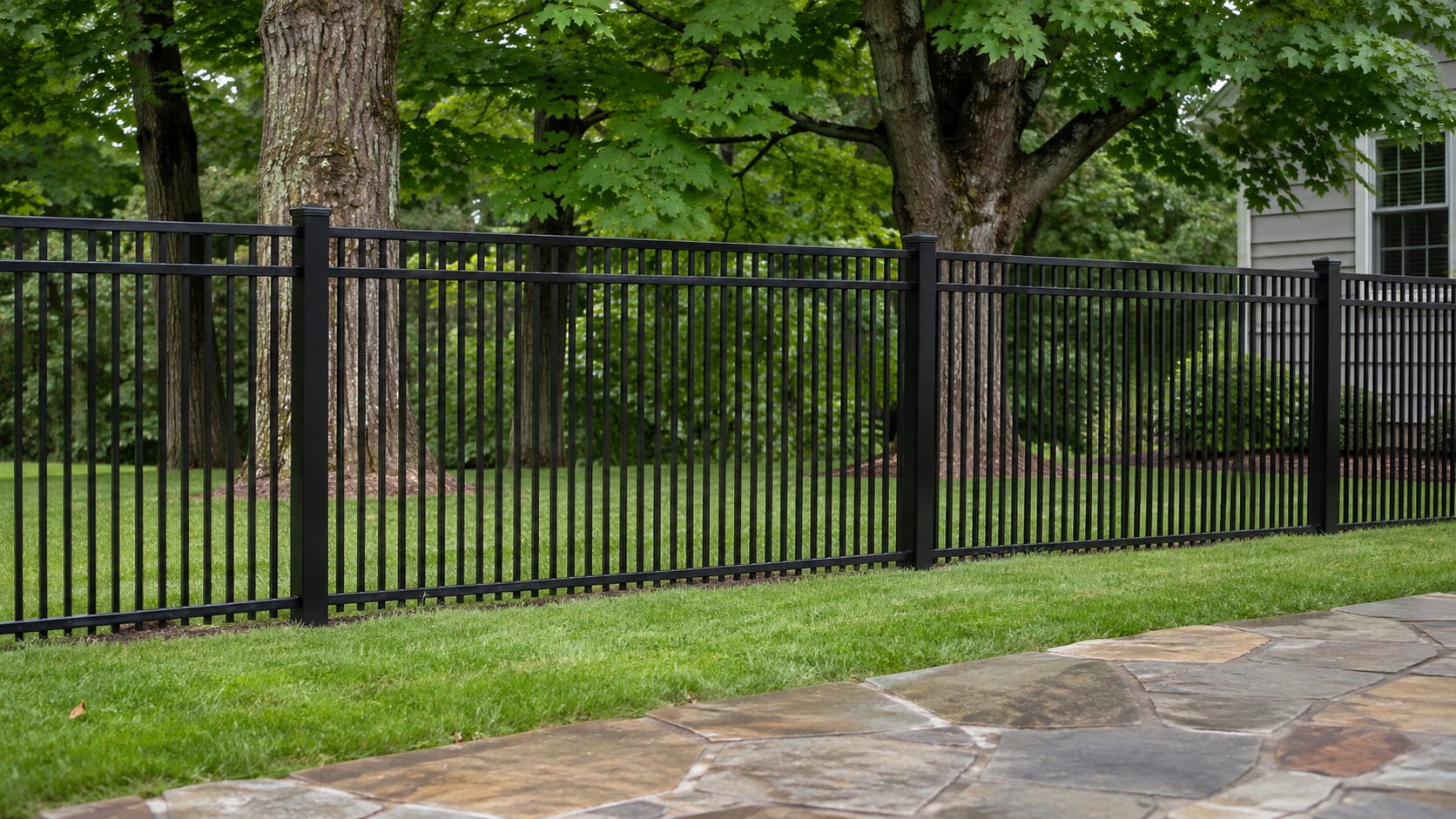
If your Brookfield property touches Candlewood Lake, start with two phone calls: Brookfield Land Use and Building, and FirstLight, the company that authorizes work inside the lake's project boundary. Everyone else can start with the grade of aluminum, since that sets the strength, the picket spacing and the price.
A 4-foot aluminum fence costs about $18 to $58 per linear foot installed nationally in 2026. Brookfield review depends on height, location, pool use, wetlands and historic districts, so the local total can land anywhere in that range.
Before you order materials, settle the fence line, height, style, gates, finish, grade, picket spacing and total price in writing. A sloped or shoreline lot may need a different layout than a level interior lot.
Key Takeaways
Cost
A 4-foot aluminum fence has a national 2026 installed range of about $18 to $58 per linear foot.
Grade
Residential, commercial and industrial grades use different profiles, wall thicknesses, posts and picket sizes.
Slope
Rackable panels glide along a hill, while stepped panels change height at each post.
Brookfield rules
Zoning Approval starts at eight feet in the revised regulations, while the town FAQ describes a seven-foot permit threshold, so confirm with the town.
Lake lots
Candlewood Lake properties may need Brookfield wetlands review and FirstLight authorization before excavation.
Pool areas
A pool fence must meet Connecticut barrier rules for height, openings, gates, latches and clearances.
Aluminum grades, spacing and style
The word “aluminum” describes the material, and the strength of the fence depends on the grade. Manufacturers separate residential, commercial, corporate and industrial lines by channel size, wall thickness, picket size, post size, spacing and intended loading.
AMD Supply lists residential channels at 1 inch by 1 inch with 0.072-inch sidewalls and 5/8-inch square pickets with 0.045-inch walls. Its commercial channels measure 1-1/4 inches by 1-1/4 inches, with 0.072-inch sidewalls and 3/4-inch square pickets with 0.045-inch walls.
Industrial channels measure 1-1/2 inches by 1-5/8 inches, with 0.100-inch sidewalls and 1-inch square pickets with 0.062-inch walls. Typical residential sections are 4, 5 or 6 feet high with 5/8-inch pickets and 1-inch rails. (AMD Supply rackable fence specifications)
Commercial and industrial grades make more sense when you need larger members, a stronger gate system, higher traffic resistance or light security. A front-yard boundary usually has different demands from a facility entrance or a long run exposed to frequent contact.
Hover or tap a row to highlight it.
| Grade | Channel profile | Picket profile | Typical use |
|---|---|---|---|
| Residential | 1 inch by 1 inch, 0.072-inch sidewalls | 5/8-inch square, 0.045-inch walls | Front yards, gardens, pools and residential boundaries |
| Commercial | 1-1/4 inches by 1-1/4 inches, 0.072-inch sidewalls | 3/4-inch square, 0.045-inch walls | Higher traffic and light-security areas |
| Industrial | 1-1/2 inches by 1-5/8 inches, 0.100-inch sidewalls | 1-inch square, 0.062-inch walls | Higher-strength runs and heavier gate systems |
Picket spacing changes the way the fence works. Ultra Aluminum lists 1-5/8-inch spacing for a residential series and 1-1/2-inch spacing for a commercial series. Puppy-picket and double-picket styles reduce openings for small dogs, while two-rail panels keep a lighter ornamental appearance. Three-rail panels add another horizontal rail for a taller or more rigid run.
A pool fence still has to meet the applicable barrier dimensions, whatever the product is called.
Common Brookfield choices include flat-top, spear-top, arched, concave, convex, double-picket, puppy-picket, smooth-bottom and ornamental finial designs. Ask for the exact manufacturer series, height, picket opening, rail layout, post size, color and warranty in the written quote. A quote that only says “aluminum fence” leaves too much open.
To weigh aluminum against another material, read Vinyl vs Aluminum Fence: Which Fits Your Connecticut Yard?. For the product range itself, see aluminum fencing options.
Plan the fence around Brookfield grades and ground
A sloped Brookfield yard can use rackable panels, stepped panels or a combination of both. Rackable panels follow the grade continuously, which usually keeps the bottom gap more consistent and reduces the visible stair-step effect. Fortress states that its Athens Residential panels rack up to 10 degrees of grade change. Ultra Aluminum states that standard panels rack up to 4 inches and that rackable and heavy-rackable options are available for steeper changes. (Fortress Athens Residential panels, Ultra Aluminum FAQ)
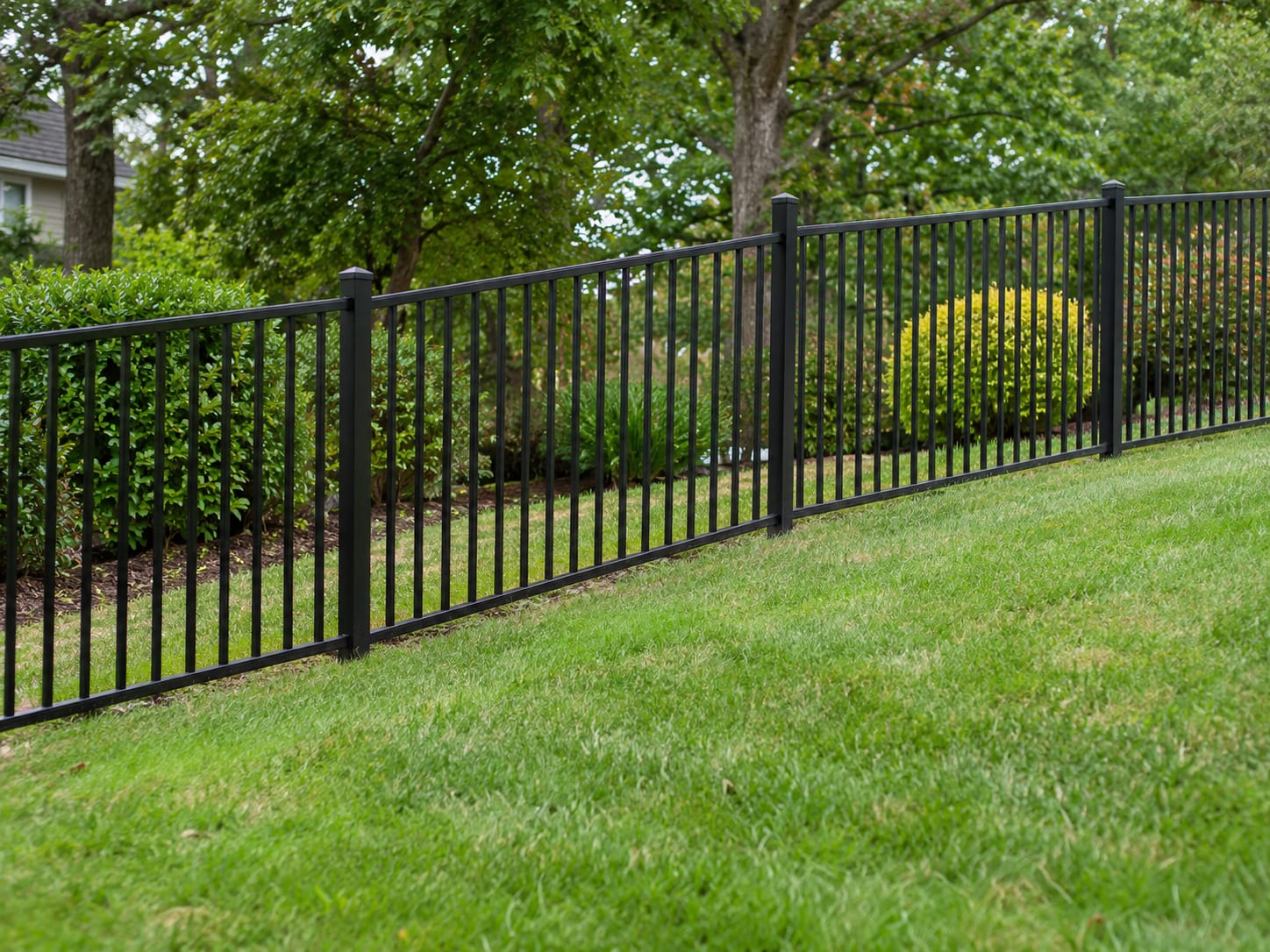
Stepping is useful when the grade exceeds the panel’s rackable range, at a gate, at a sharp change in grade or where the layout calls for level sections. Adjacent panels attach at different points on a post, so the fence follows the slope in visible increments. The quote should identify which sections are rackable and which are stepped.
Frost resistance comes from the footing design as much as from the aluminum panel. Jerith’s installation instructions state that concrete footings must extend below the frost line where freezing ground can heave posts. Its chart lists minimum hole depths of 18, 20, 24 or 36 inches depending on fence height.
Another aluminum installation guide gives examples from 27 to 35 inches depending on panel height. The selected product instructions, Brookfield requirements and the actual soil conditions control the final approach. (Jerith aluminum fence installation instructions, iDeal aluminum fence instructions)
Shallow bedrock can change drilling and footing work. Check the parcel in the USDA Web Soil Survey for site soil information, then have the contractor write down the excavation assumptions. A fence crew should also mark the location of gates, corners, transitions and any stone wall before digging.
Aluminum does not rust like ferrous steel. AMD Supply states that its AAMA 2604 powder coating resists G85 salt spray, which supports aluminum where winter road-salt spray reaches the fence. Scratches, impact damage, incompatible fasteners and poor surface preparation can still affect the coating and attached hardware. Ask who will handle touch-up work and hardware maintenance.
Lake lots, pools and open boundaries
Open aluminum pickets work well when you want a defined boundary without a solid visual wall. A two-rail or three-rail residential fence can mark a front yard, separate a garden or enclose a general yard while preserving views. Closely spaced pickets can help with pet containment, but small dogs may still require a puppy-picket configuration and carefully sized gates.
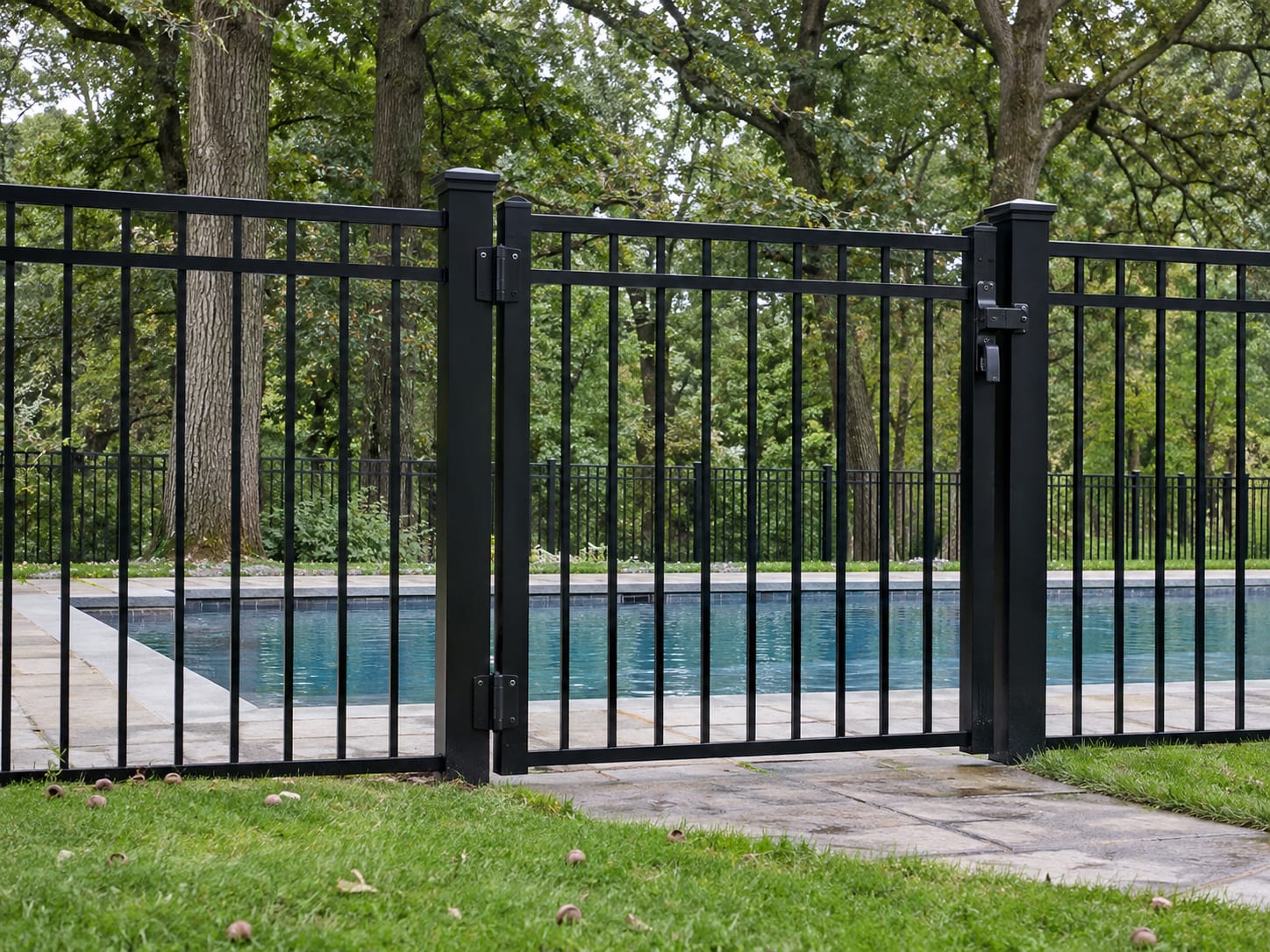
For a pool, the complete fence and gate assembly must meet the Connecticut State Building Code. The state pool-barrier rules call for a barrier at least 48 inches high, openings that stop a 4-inch sphere from passing, and gates that are self-closing, self-latching and able to accept a locking device. Pedestrian gates open outward away from the pool. A release mechanism below 54 inches has additional pool-side placement and opening requirements. (Connecticut pool barrier handout, Connecticut State Building Code pool provisions)
Brookfield zoning allows residential swimming pools in any zoning district when applicable Connecticut Building Code requirements are met, and pools may not be located in the front yard. District-specific pool and deck or apron setbacks also apply. Place the pool, fence and gates on the same sketch before review.
Candlewood Lake requires a separate property check. FirstLight materials state that shoreline and land uses within the project boundary must be authorized by FirstLight. Proposed work within that boundary requires an Activity Permit before work starts.
FirstLight’s Shoreline Management Plan identifies fences as land-based uses and states that fences no greater than six feet high may be permitted at FirstLight’s discretion when they keep public access, wildlife passage and project waters clear. (FirstLight shoreline and land use applications, FirstLight Shoreline Management Plan)
Brookfield Inland Wetlands review applies to activities within 200 feet of Candlewood Lake, Lake Lillinonah and the Still River, within 100 feet of another watercourse, and within 75 feet of a wetland. On slopes above 5 percent, the regulated distance increases by five feet for each additional percentage point, up to 200 feet.
Fence-post excavation can therefore affect the review path even when the finished fence is open and lightweight. Read Building a Fence Near Wetlands, Streams or Lakes in Connecticut to prepare your questions before scheduling excavation.
Brookfield zoning, visibility and historic features
Brookfield’s revised zoning regulations state that fences under eight feet may be constructed in a residential zoning district without Zoning Approval. Fences eight feet or higher require Zoning Approval before construction and a Certificate of Zoning Compliance after construction, along with a site-plan sketch. Visibility-inhibiting fences, including lattice, slats, panels or boards, may be no taller than eight feet. Other fence types may be up to 12 feet. (Brookfield zoning regulations)
The same section requires a finished side to face the exterior of the lot. Material and color must be in harmony with the buildings and surrounding area as determined by the Zoning Enforcement Officer. Fences must be built to prevent injury, and Brookfield prohibits barbed wire and razor wire in all zones. A fence must also be kept in good repair and placed so it keeps sight lines and traffic safety clear.
The town FAQ describes a different threshold: fences under seven feet need no permit, and taller fences need a building permit. Confirm the current requirement with Brookfield Land Use and Building for the parcel, height, use and location before ordering materials. For the statewide permit background, see Do You Need a Permit for Fence Installation in CT?.
Corner lots deserve a separate sight-line review. Brookfield’s front-yard dimensions are building setbacks, and the fence itself is judged on whether it protects traffic visibility. An open aluminum design may help, and the exact placement should be shown on the site sketch.
Brookfield identifies stone walls as historic and scenic assets that should be preserved in new development to the maximum extent possible. A fence line that crosses or runs beside an old stone wall needs careful layout. The town also has a Historic District Commission, a 2021 map and names document, historic-district regulations and a certificate-of-appropriateness process. Ask whether exterior fence work on your parcel requires that review.
Cost, warranty and the written estimate
All cost figures below are national budgeting ranges, and local contractor pricing in Brookfield will differ. Angi reports national installed aluminum-fence costs of $22 to $72 per linear foot in 2026, including labor and materials. A national cost calculator gives a 4-foot installed range of $18 to $58 per linear foot, with a midpoint of about $33 per linear foot. (Angi aluminum fence costs, national aluminum fence cost calculator)
Hover or tap a row to highlight it.
| Height or style | National installed range |
|---|---|
| 4-foot fence | $18 to $58 per linear foot |
| 5-foot fence | $20 to $65 per linear foot |
| 6-foot fence | $22 to $72 per linear foot |
| 8-foot fence | $29 to $97 per linear foot |
| Pool style | $15 to $25 per linear foot |
| Picket style | $25 to $50 per linear foot |
| Ornamental style | $15 to $55 per linear foot |
For a 150-linear-foot 4-foot fence, the national calculator gives about $2,700 at the low end, $4,950 at the midpoint and $8,700 at the high end. A separate national example gives a midpoint of about $5,070 for the same length and height. Gates, demolition, pool-code hardware and stepped or rackable sections can change the local total.
HomeGuide reports a national range of $5,000 to $15,000 for 200 linear feet of aluminum fencing for pool, picket or ornamental work. It also lists steep slopes and rocky clay soils as possible labor cost factors of $15 to $20 or more per linear foot. (HomeGuide aluminum fence costs)
Warranties vary by manufacturer and product line. Antebellum identifies limited lifetime residential coverage and a qualifying 30-year commercial project warranty. IAUSA states that its aluminum carries a limited lifetime manufacturing-defect warranty and its powder coat carries 20-year warranties for film integrity and color and gloss retention. (Antebellum aluminum fence FAQ, IAUSA FAQ)
A written estimate from My Fence Guy shows the measured linear footage, height, grade, style, picket spacing, manufacturer series, color, gate count, hardware, demolition and restoration. It also spells out the post-hole assumptions, who handles permits and reviews, and how rock, wet soil, rackable sections and stepped sections are priced.
The installation questions to settle first
Use a property survey, plot plan or other reliable boundary information before choosing the fence route. Mark the house, driveway, pool, shoreline, stone wall and gates on one sketch, along with any suspected easement. If the fence is on a shared boundary, put the line, ownership, payment, access and repair duties in writing. A specific boundary dispute belongs with a Connecticut real estate attorney.
Connecticut’s Call Before You Dig rules require excavators using power-operated equipment to contact the central clearinghouse at least two full days, excluding weekends and holidays, and no more than 30 days before excavation. Call 811 or 1-800-922-4455. (Connecticut Call Before You Dig provisions)
Connecticut home-improvement contractors and salespeople must be registered with the Department of Consumer Protection. Verify registration through eLicense, and confirm the contract includes the signing date, start date, completion date and cancellation rights. (Connecticut Department of Consumer Protection home improvement, Connecticut Attorney General home-improvement information)
Brookfield Aluminum Fence Planning Sequence
- 1
Property line
Confirm the fence route, corners, gates, pool, driveway, shoreline, wetlands and stone walls.
- 2
Town review
Ask Brookfield Land Use and Building about zoning, building, pool, wetlands and historic-district requirements.
- 3
FirstLight review
Confirm the project-boundary map and authorization requirement for Candlewood Lake work.
- 4
Utility marking
Call 811 or 1-800-922-4455 before power excavation.
- 5
Written scope
Settle grade, height, spacing, finish, footing, gates, inclusions and change orders.
- 6
Installation
Set posts and footings, install panels and gates, then complete cleanup and restoration.
Ask Brookfield which office handles the proposed work before you order materials.
Frequently Asked Questions
How much does a 4-foot aluminum fence cost?
A 4-foot aluminum fence costs about $18 to $58 per linear foot nationally in 2026, with a midpoint near $33 per linear foot. A 150-linear-foot project is about $2,700 to $8,700 in the national calculator, before local gates, excavation, review costs and site conditions.
What is cheaper, aluminum or steel fencing?
Aluminum and steel prices overlap, so the cheaper choice depends on comparable grade, height, style, coating, posts, gates and labor. Angi lists national 2026 material-only ranges of $7 to $32 per linear foot for aluminum and $10 to $30 per linear foot for steel, while installed aluminum ranges from $22 to $72 per linear foot and installed steel ranges from $17 to $90 per linear foot.
How long will an aluminum fence last?
An aluminum fence can serve as a long-term fence system when the alloy, coating, footing, hardware and installation suit the property. Manufacturer warranties range from long-term powder-coat coverage to limited lifetime product coverage, but actual performance depends on impact, soil movement, coating damage, gates and maintenance.
Is aluminum fencing good near a lake?
Aluminum can suit lake property because it does not rust like ferrous steel and open pickets preserve views. Near Candlewood Lake, confirm Brookfield wetlands jurisdiction and FirstLight project-boundary authorization before excavation, especially where the fence could affect public access, wildlife passage or project waters.
Do I need a permit for a fence in Brookfield CT?
Confirm the answer with Brookfield Land Use and Building before ordering or digging. Brookfield’s revised zoning regulations use an eight-foot Zoning Approval threshold, while the current FAQ describes a seven-foot permit threshold, and pool, wetlands, historic-district or FirstLight review may add requirements.
Aluminum Fence Planning Check
1. Which aluminum grade uses the largest pickets and channels?
2. What does a rackable panel do on a sloped yard?
3. What height does the Connecticut pool-barrier rule require at minimum?
4. Which Brookfield condition may require FirstLight authorization?
5. What should a written aluminum fence quote identify?
Pick an answer to begin.
Final Thoughts
Aluminum fencing can give a Brookfield property a clear boundary while keeping views open around a front yard, pool, pet area, garden or lake lot. Match the grade and spacing to the use, match rackable or stepped panels to the slope, and confirm town, wetlands, pool, historic-district and FirstLight requirements before excavation.
My Fence Guy can put the footage, grade, gates and footing assumptions into one written estimate so you can compare the complete project. Call us at (203) 746-1100 for a free estimate, or reach out through our contact page.
Aluminum Fence Terms
Tap a term to see what it means.
Rackable panel. A fence panel designed to follow a slope continuously.
More about fences
Chain Link Fencing in Brookfield, CT: Coated Fabric, Lake Lots and Commercial Uses
On a Candlewood Lake lot, open chain link keeps the view. Coated fabric, gauge, privacy slats, lake and commercial uses in Brookfield, CT, and national costs.
Read the guide to Chain Link Fencing in Brookfield, CTAluminum Fencing in New Milford, CT: What Holds Up on Riverfront and Hillside Lots
Rackable or stepped aluminum fencing for New Milford hillsides, the 8-foot residential limit, river and lake review, and 2026 national cost ranges.
Read the guide to Aluminum Fencing in New Milford, CTPet Fencing in Brookfield, CT: Physical Fences, Underground Systems and Gates
Pet fencing in Brookfield, CT: why a physical fence usually beats an underground system, how tall to build for your dog, and the gates and latches that hold.
Read the guide to Pet Fencing in Brookfield, CT