
Aluminum Fencing in New Milford, CT: What Holds Up on Riverfront and Hillside Lots
By Tony Pellicone12 min readPublished
- aluminum fencing
- new milford ct
- connecticut
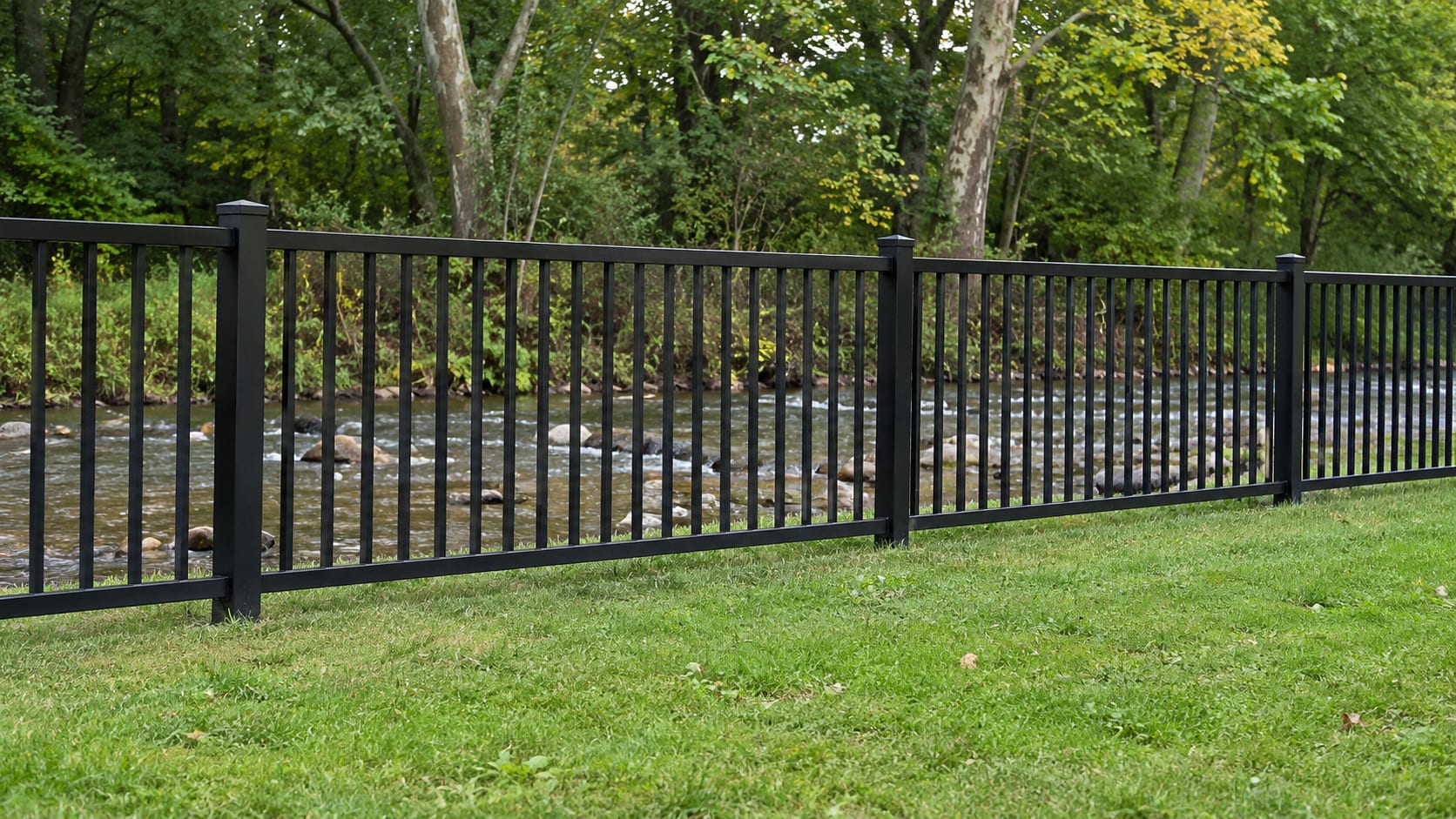
On a New Milford hillside, rackable aluminum panels follow a moderate slope with fewer gaps, while stepped panels keep each section level where the ground drops faster. Near Candlewood Lake or a river, the fence location matters as much as the style, because wetlands or shoreline review can apply.
Residential fences in New Milford can reach 8 feet, subject to sight-line and traffic-safety rules. National installed pricing for open aluminum runs from about $22 to $75 per linear foot, and a New Milford estimate depends on the actual route, soil, slope, corners and gates.
Key Takeaways
Slope
Rackable panels follow a grade continuously, while stepped panels remain level between posts.
Height
New Milford residential zoning allows fences up to 8 feet, subject to sight-line and traffic-safety rules.
Spacing
Narrower 1-1/2-inch or selected 1-5/8-inch spacing can suit pets and pool areas.
Site review
Wetlands review, Candlewood Lake and Housatonic River shoreline rules and road locations can affect placement.
Budget
National installed aluminum fencing ranges from about $22 to $75 per linear foot, depending on style and project conditions.
Why aluminum can fit New Milford properties
Open aluminum fencing gives you a defined boundary without blocking the view across a yard, driveway, lake edge or rural property. It can suit a pool enclosure, dog area, front yard, estate entrance or property line where you want the fence to remain visually open.
The material is commonly described as rust resistant because aluminum does not rust in the same way steel or iron does. The full system still depends on the coating, post installation, drainage and maintenance. Jerith states that its FencCoat finish was tested for 3,000 hours of salt-spray and humidity resistance and five years of continuous coastal exposure without failure.
That is a manufacturer test claim, so your installer should still address winter moisture, road salt, footing conditions and damaged coatings.
You can compare open aluminum with other materials in the vinyl vs aluminum fence comparison. Vinyl may provide privacy or a different maintenance profile, while wood can offer a warmer solid appearance. Chain link can be practical for utility areas, pets and larger boundaries. Steel and ornamental iron can provide heavier construction, but they require a different approach to corrosion protection and weight.
For a closer look at available styles, see the aluminum fencing product page. Check that the fence grade, spacing, rail design and post size match the job.
Picket spacing, rails and posts for the job
Manufacturers distinguish aluminum grades through picket thickness, rail construction, post dimensions, spacing choices and intended use. A small residential boundary does not always need the same construction as a commercial entrance, facility perimeter or agricultural property.
Ultra publishes residential, commercial and industrial product lines. Its commercial fencing uses 3/4-inch square pickets with a 0.055-inch wall thickness. Standard commercial sections are 6 or 8 feet wide, with heights of 48, 60 or 72 inches. Standard commercial spacing is 3-5/8 inches, with a 1-1/2-inch option.
Commercial Premium uses a two-piece, fully enclosed rail with concealed fasteners. That construction can provide a cleaner appearance and additional strength where the fence will receive more use or where you want the rail hardware enclosed. Commercial posts are available in 2-inch, 2-1/2-inch, 3-inch and 4-inch square sizes, with several wall thicknesses.
Ultra’s residential products include selected pet and pool styles with 1-5/8-inch picket spacing. Its commercial and Commercial Premium options include 1-1/2-inch spacing. Smaller openings can be useful when you are containing a small dog or designing a pool barrier, but the fence still has to meet the applicable pool-barrier requirements when it surrounds a pool.
Jerith describes its Liberty residential product as a 5/8-inch-picket ornamental aluminum fence. Jerith also publishes industrial fencing with 1-inch pickets. The proper grade depends on the use, height, span, gates, wind exposure, expected contact and appearance you want.
Rail choices include standard, flush-bottom and enclosed designs. Styles include flat-top, spear-top, three-rail and decorative configurations. A flush-bottom rail may be useful where you want a more finished lower edge. A three-rail layout can suit a boundary or rural setting where visibility matters more than privacy.
Hover or tap a row to highlight it.
| Product detail | Published example |
|---|---|
| Ultra commercial picket | 3/4-inch square, 0.055-inch wall |
| Ultra commercial section width | 6 or 8 feet |
| Ultra commercial heights | 48, 60 or 72 inches |
| Ultra commercial standard spacing | 3-5/8 inches |
| Ultra commercial narrow spacing | 1-1/2 inches |
| Jerith Liberty residential picket | 5/8 inch |
| Ultra commercial post sizes | 2, 2-1/2, 3 and 4 inches square |
The written estimate should identify the manufacturer, product line, picket size, spacing, rail style, post size, finish and warranty. My Fence Guy can also document the gates, slope sections, post installation and excavation assumptions so you can compare proposals on the same terms.
Rackable, heavy rackable or stepped on a hillside
Aluminum fence panels can follow a slope in two main ways. Rackable panels angle between posts, allowing the fence to follow the grade continuously. Stepped panels remain level between posts, with the next section installed at a different elevation.
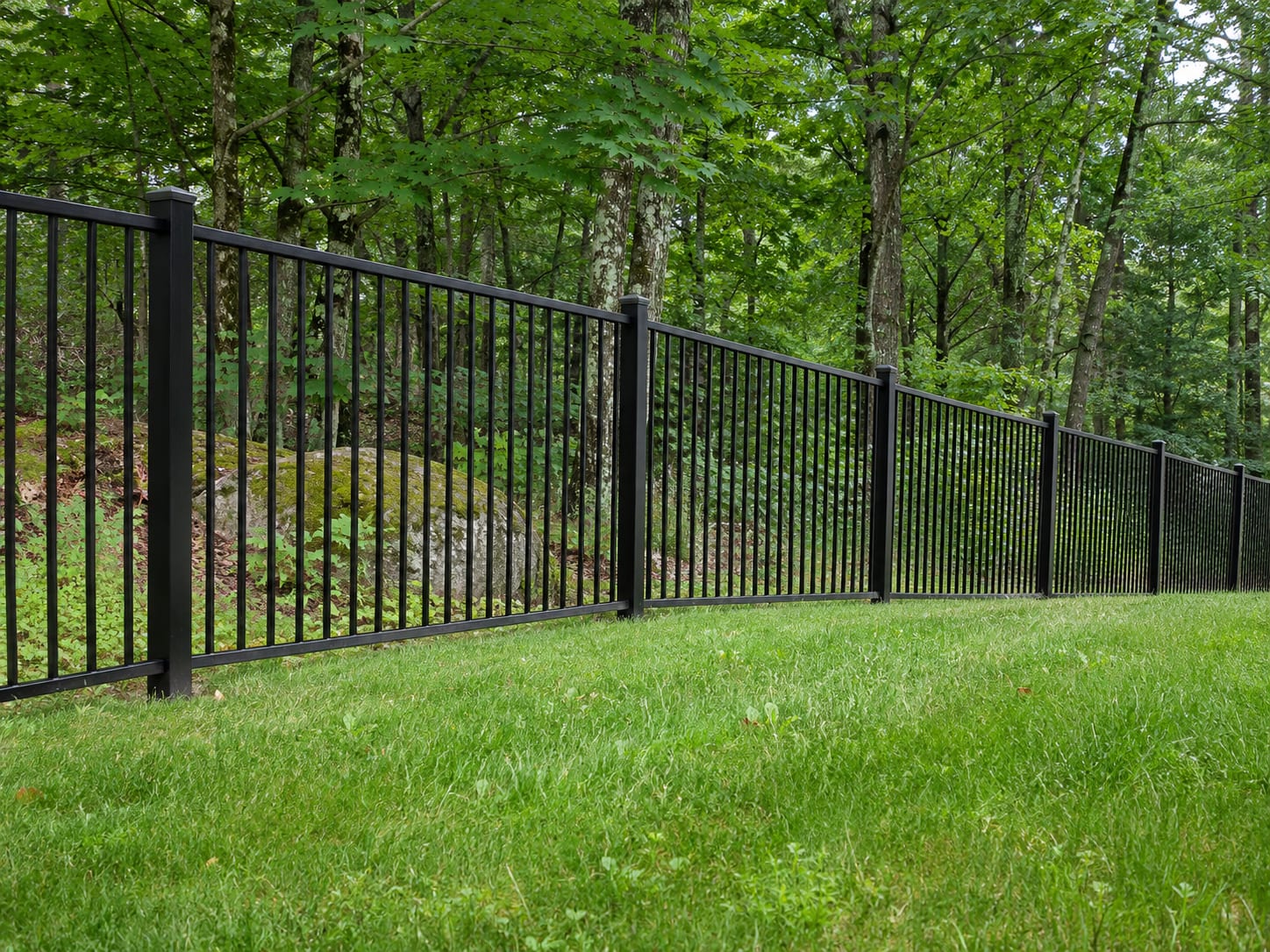
Jerith lists standard Liberty rackability at 11 inches, or 9 degrees, per panel. Liberty Hill Country is listed at 26 inches, or 22 degrees, per panel. Ultra states that standard panels rack up to 4 inches and offers Rackable and Heavy Rackable options for larger changes. Ultra also describes attachment accessories that allow panels to be stepped.
Rackable sections can reduce abrupt gaps beneath the panels on moderate slopes. They are often a natural choice when your fence follows a driveway, lawn grade or hillside boundary. Stepped sections can work better where the grade changes sharply, where a retaining wall affects the route or where a level top line matters more than a continuous angle.
New Milford soil mapping includes stony and sloping soil units. Canton and Charlton soils, along with Paxton and Montauk fine sandy loams, are identified with 3 to 8 percent slopes and very stony conditions in local farmland information. A soil map helps with planning, but the actual post locations still need to be examined for stones, ledge, drainage and access.
Post depth, concrete placement and drainage matter on a slope. Frost heave is mainly a site, soil, drainage and footing issue. Ask the installer to document the planned post depth, concrete work, drainage approach and treatment of any ledge or rock in the proposal.
The guide to fencing a sloped yard: stepped vs racked fences covers related layout decisions. For your property, the installer should measure the grade change between posts before selecting standard, rackable, heavy rackable or stepped sections.
How a Sloped Aluminum Fence Is Planned
- 1
Property line
Confirm the route with a survey, deed, recorded plan or other reliable boundary information.
- 2
Grade measurement
Measure the elevation change between planned post locations.
- 3
Panel choice
Select standard, rackable, heavy rackable or stepped sections based on the measured grade.
- 4
Post installation
Address soil, stones, ledge, concrete, drainage and access at each post.
- 5
Gates and transitions
Set gate elevations and handle changes at driveways, walls, corners and property breaks.
Riverfront, lakefront and wetland review
On a riverfront or lakefront property, the fence location matters as much as the material. New Milford’s inland wetlands regulations define upland review areas within 200 feet of the ordinary high-water line of Candlewood Lake, the East or West Aspetuck River, the Still River, the Housatonic River and watercourses within the West Aspetuck River watershed.
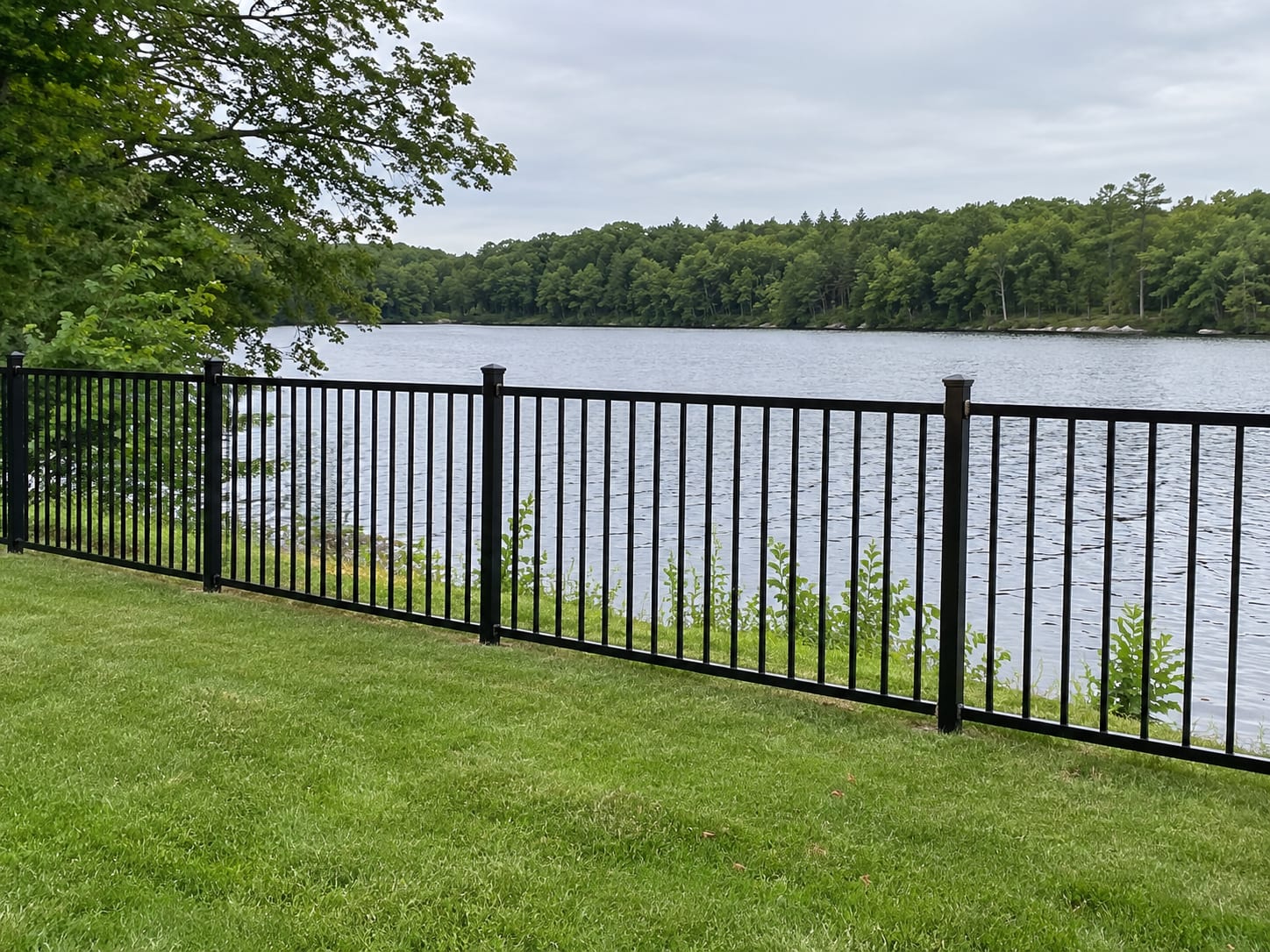
The review area also includes land within 100 feet of other watercourses or wetlands, whichever is greater. New Milford Inland Wetlands directs projects within 100 feet of a wetland or watercourse, or within 200 feet of a major river or Candlewood Lake, toward its application process. Contact the New Milford Inland Wetlands Commission before setting the fence route if the property falls in one of those areas.
FirstLight manages shoreline property within its federal hydroelectric project boundaries. Its Connecticut permit materials cover Candlewood Lake and the Housatonic River north of Lake Lillinonah. The FirstLight Shoreline Management Plan states that fences no higher than 6 feet may be permitted at FirstLight’s discretion when they do not interfere with public access, wildlife passage or project waters.
If your property is on Candlewood Lake or within a FirstLight project boundary along the Housatonic River, contact FirstLight about shoreline permits and land use.
A fence near water may also cross an easement, flood-prone area, conservation restriction or neighboring boundary. Confirm the parcel line before placing posts near the edge of the property. A fence that looks properly placed from the yard can still be in the wrong location if the boundary or right-of-way is assumed incorrectly.
New Milford height, visibility and road rules
Section 025-110(C) of New Milford’s zoning regulations states that fences cannot be placed in a way that inhibits lines of sight or affects traffic safety. It also prohibits razor wire and similar hazardous fencing in residential zones. Residential fences may not exceed 8 feet from ground level to the top of the fence.
The 8-foot maximum applies to residential fencing generally, and aluminum has no separate height limit. Front yards, driveways, intersections and corner lots need particular attention because a fence can affect visibility even when it is below the maximum height.
New Milford’s Section 020-010 identifies side-corner yard standards by residential zone. Examples include 70 feet in R-160, 50 feet in R-80 and R-60, 30 feet in R-40, 25 feet in R-20, and 10 feet in R-8, R-8-2 and R-5. Ask the Zoning Enforcement Officer how the standard applies to your proposed fence location.
Public Works states that the allowable distance from a road varies by road, so contact the department when the fence is near a road right-of-way.
If your property is in a historic or special district, ask the New Milford land-use office about additional review before ordering materials. If you are still deciding whether a permit or review applies, see Do You Need a Permit for Fence Installation in CT?, then confirm the project with the town office.
Pool, pet and property-boundary planning
Pool fencing has a separate safety concern from an ordinary decorative boundary. Connecticut State Building Code pool-barrier provisions require a barrier at least 48 inches high, limit openings so a 4-inch sphere cannot pass and regulate gates, vertical members and horizontal members. Check the current requirements through the Connecticut State Building Code before selecting a pool fence.
For a pool, measure the actual finished grade around the barrier and identify any nearby deck, retaining wall, equipment pad or structure that could affect the required height. Narrow picket spacing and a self-closing, self-latching gate may be part of the design, depending on the pool and applicable code provisions.
The post on pool fence materials compared: aluminum, mesh, glass and vinyl covers the main choices, while How Much Does a Pool Fence Cost in Connecticut? addresses planning ranges.
For pets, ask about the dog’s size, ability to climb, digging behavior and gate habits. A 1-1/2-inch or 1-5/8-inch spacing option may address some containment needs, but small pets can still pass beneath a fence if the grade leaves a gap. On a slope, the bottom edge needs as much attention as the picket spacing.
Before excavation, call 811 or submit a CBYD request. Connecticut requires excavators using power-operated equipment to notify Call Before You Dig at least two full working days before digging. The Connecticut Call Before You Dig requirements apply before post holes, gate posts and other excavation.
What should be in the estimate?
A useful estimate should show the linear footage, height, product line, picket spacing, rail design, finish, post size, number of gates and whether the panels are standard, rackable or stepped. It should also state what happens if the crew encounters ledge, large stones, concrete, roots or difficult access.
Ask how the proposal handles removal of an existing fence, soil disposal, lawn repair, driveway crossings, drainage, gate hardware and changes requested after layout. If the fence follows a hillside, ask for the expected post spacing and where the panel transitions will occur.
For a riverfront or lakefront property, include zoning, wetlands, shoreline and boundary questions before the installation date. If a permit or review is required, connect the responsibility for applications, fees and scheduling to a named party in the contract.
For residential work, verify the contractor’s active Connecticut Home Improvement Contractor registration through the Department of Consumer Protection.
A written contract should identify the contractor, work description, timing, cost, payment method and cancellation information. It should also state the manufacturer warranty, coating warranty, change-order process and restoration work. For a fence near a neighbor’s property, put the agreed line, gate access, maintenance and cost-sharing terms in writing.
Frequently Asked Questions
How much does 200 feet of aluminum fence cost?
National installed ranges place 200 linear feet at about $4,400 to $15,000. Angi’s national range of $22 to $72 per linear foot produces $4,400 to $14,400, while HomeGuide’s $25 to $75 per linear foot range produces $5,000 to $15,000 for picket, pool or ornamental aluminum fencing six feet tall or less. New Milford costs can change with gates, ledge, slope, access, removal, permits and review requirements.
Is aluminum fence cheaper than wood?
Aluminum is often more expensive than basic wood fencing at the initial installed price, although the ranges overlap. HomeGuide lists aluminum picket, pool or ornamental fencing at $25 to $75 per linear foot installed and wood fencing at $20 to $50 per linear foot. Compare height, gates, maintenance, terrain and expected replacement before choosing.
Why is aluminum fencing expensive?
Aluminum fencing costs more when the project uses thicker pickets, enclosed rails, larger posts, narrow spacing, decorative tops, custom gates, taller panels or specialty slope sections. Ledge, difficult access and wetlands or shoreline review can add project costs.
Does an aluminum fence increase property value?
An aluminum fence can improve function and appearance when it is properly located, maintained and suited to the property. Resale value depends on comparable sales, so ask a local appraiser or real-estate agent what a fence adds for your New Milford property.
Can aluminum fence go on a slope?
Yes. Rackable panels angle between posts, and stepped panels remain level between posts with adjacent sections at different elevations. Jerith lists Liberty rackability at 11 inches or 9 degrees per panel and Liberty Hill Country at 26 inches or 22 degrees, while Ultra lists standard panels up to 4 inches and specialty rackable options for larger changes.
Aluminum Fence Planning Check
1. What does a rackable aluminum panel do?
2. What is New Milford’s residential maximum fence height in Section 025-110(C)?
3. Which location may require New Milford wetlands review?
4. What is one published Ultra commercial spacing option?
Pick an answer to begin.
Final Thoughts
Aluminum can work well on New Milford hillside, lakefront and riverfront properties when the fence route is settled before materials are ordered. Confirm the boundary, zoning district, road conditions, slope, wetlands or shoreline review, pool requirements and utility markings. Then compare estimates that identify the exact grade, spacing, rails, posts, gates and excavation plan.
For a project near ledge, water or a changing grade, the details below ground matter as much as the panel style above ground. A clear written proposal gives you a better basis for deciding between standard, rackable and stepped construction. Call us at (203) 746-1100 for a free estimate, or reach out through our contact page.
Aluminum Fence Terms
Tap a term to see what it means.
Rackable panel. A fence panel that angles between posts to follow a continuous slope.
More about fences
Aluminum Fencing in Brookfield, CT: Lake Lots, Pools and Front Yards
On a Candlewood Lake lot, an aluminum fence in Brookfield starts with calls to Land Use and FirstLight. Grades, pool barriers, slopes and 2026 costs explained.
Read the guide to Aluminum Fencing in Brookfield, CTChain Link Fencing in New Milford, CT: Residential, Farm and Commercial Uses
Chain link fencing in New Milford, CT: wire gauge, mesh, privacy slats, town rules and 2026 national cost ranges for homes, farms and businesses.
Read the guide to Chain Link Fencing in New Milford, CTAluminum Fencing in Wilton, CT: Styles, Pool Barriers and Town Rules
Wilton allows aluminum fences up to 6 feet in required yards. Compare slope options, pool barrier rules, footing depths and 2026 cost ranges.
Read the guide to Aluminum Fencing in Wilton, CT