
Pool Fencing in New Fairfield, CT: Code, Gates, and Permits
By Tony Pellicone23 min readPublished
- pool fencing
- new fairfield ct
- pool safety
- connecticut
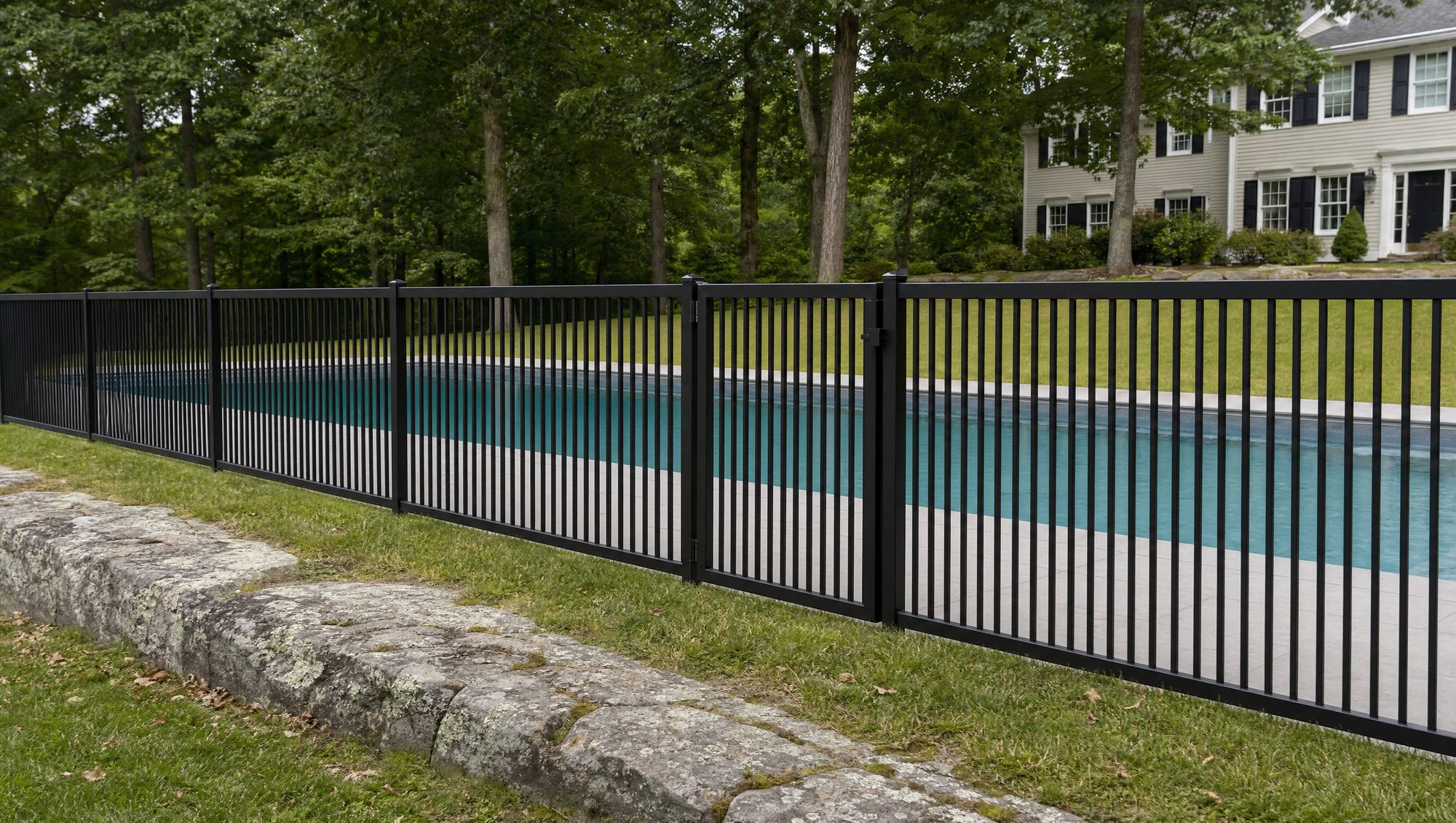
You came looking for a fence, and what you actually need is a life-safety system. That is the part most homeowners do not see coming when they start pricing pool fencing in New Fairfield, CT. A pool barrier is not judged the way a privacy fence is judged. The town reviews it, an inspector walks it, and the standard it has to meet is not "does this look finished" but "can a small child get to the water when nobody is watching." That shift catches people in two different ways. Some find out at inspection, when the pool sits full and unusable while a gate gets rehung. Others find out much later, on an August afternoon, when a latch that stopped engaging in June turns out to have been the only thing between a toddler and the deep end. Both are avoidable, and the difference usually comes down to decisions made before anyone orders a panel. Here is what the code asks of a pool barrier in New Fairfield, what the town needs from you, and where these systems actually fail.
Key Takeaways
A pool barrier always needs a permit
New Fairfield generally exempts fences up to seven feet from a building permit, but a fence used as a swimming pool barrier requires one regardless of height.
The whole system is reviewed, not the panels
Height, openings, bottom clearance, climbability, gates, hinges, latches, house doors, decks, and grade transitions are all part of the barrier.
Gates carry the safety
Pedestrian pool gates have to self-close and self-latch reliably, and gate swing direction and latch location are regulated.
Not every fence product qualifies
Standard chain-link mesh, decorative panels with wide spacing, and climbable horizontal rails can all fail even when the fence looks correct.
Passing inspection is not the finish line
Erosion, sag, snow, furniture, and worn hinges can turn an approved barrier into an open one, so it has to be checked every season.
A Pool Fence Is a Life-Safety Barrier, Not a Yard Fence
The difference between a pool fence and any other fence on your property is what happens when it does not work. A boundary fence that leans is an annoyance. A pool barrier that leaves a gap is a hazard, and that is why it gets treated as a regulated system instead of a purchase. The U.S. Consumer Product Safety Commission frames a barrier as one part of a broader approach to keeping children away from water, which is a useful way to think about the whole project. Once you see the barrier as a system, the questions change from what material you like to what the enclosure has to stop.
Layers of Protection Around the Water
A fence reduces unauthorized access to a pool. It does not replace an adult watching the water. CPSC guidance on drowning prevention describes layers that work together: a compliant physical barrier, self-closing and self-latching gates, door and pool alarms, safety covers, active supervision, swimming instruction, CPR knowledge, and clear emergency procedures. A pool safety fence in New Fairfield is the layer that holds when the others lapse, which is exactly why the code cares so much about the details. Think of it as the layer that has to work on the day everything else does not.
A Fence Can Look Finished and Still Fail
Plenty of barriers fail with every panel standing. The common causes are ordinary: openings that are too wide, a gate that does not swing itself shut, a latch that does not engage, too much space under the bottom rail, horizontal rails that give a small foot somewhere to push off, chain-link mesh with openings larger than the code allows, patio furniture or a pool pump parked against the fence, a gap where the fence meets a house or a deck, ground that has eroded away underneath, a cracked panel, or the simplest one of all, a gate propped open on a hot day. None of those show up in a photograph of a finished fence. All of them show up in an inspection or in an accident.
New Fairfield Requires a Permit for a Pool Barrier Regardless of Height
This is the local rule most homeowners get backwards, and it is worth being blunt about. New Fairfield states that fences not over seven feet high are exempt from a building permit. Many people hear that and assume it covers the fence going around the new pool. It does not. The town's own building permit information carves out fences used as swimming pool barriers, which require a permit no matter how tall they are. Because local rules and code editions change, confirm the current requirements with the town before you order anything.
The Seven-Foot Exemption Stops at the Pool
The exemption exists for ordinary yard fencing, and pool barriers were deliberately taken out of it. That makes sense once you understand what the permit is for. A building permit on a yard fence would be checking almost nothing. On a pool barrier it is the mechanism that gets a trained set of eyes on the height, the openings, the clearances, the gate hardware, and the way the enclosure ties into the house and the deck. Skipping it is not a shortcut around paperwork. It is skipping the only independent review the safety system will ever get.
What Gets Reviewed Alongside the Fence
The fence is one piece of a larger pool project, and the review reaches further than people expect. Depending on the property, that can include zoning placement and setbacks, property lines, driveway sight lines, inland wetlands and watercourses, septic and well locations, deck and stair access, electrical bonding and pool equipment, retaining walls, easements, and any private association restrictions. New Fairfield publishes its applications and current requirements through the building department and the zoning department. The cheapest version of this conversation happens before the material is ordered.
What the Pool Fence Code Regulates on a New Fairfield Barrier
Connecticut's building code is administered by the Office of the State Building Inspector, and the state's building code regulations page is where the adopted code and current materials live. The pool-barrier provisions come from the International Swimming Pool and Spa Code, and the state publishes interpretations addressing how those provisions apply to one- and two-family residential pools. Because editions, amendments, interpretations, and your permit date all affect which text governs your project, treat what follows as the shape of the requirements rather than the final word. New Fairfield's building department is the authority on what applies to your permit, and this is one topic where a wrong answer has real consequences.
Barrier Height
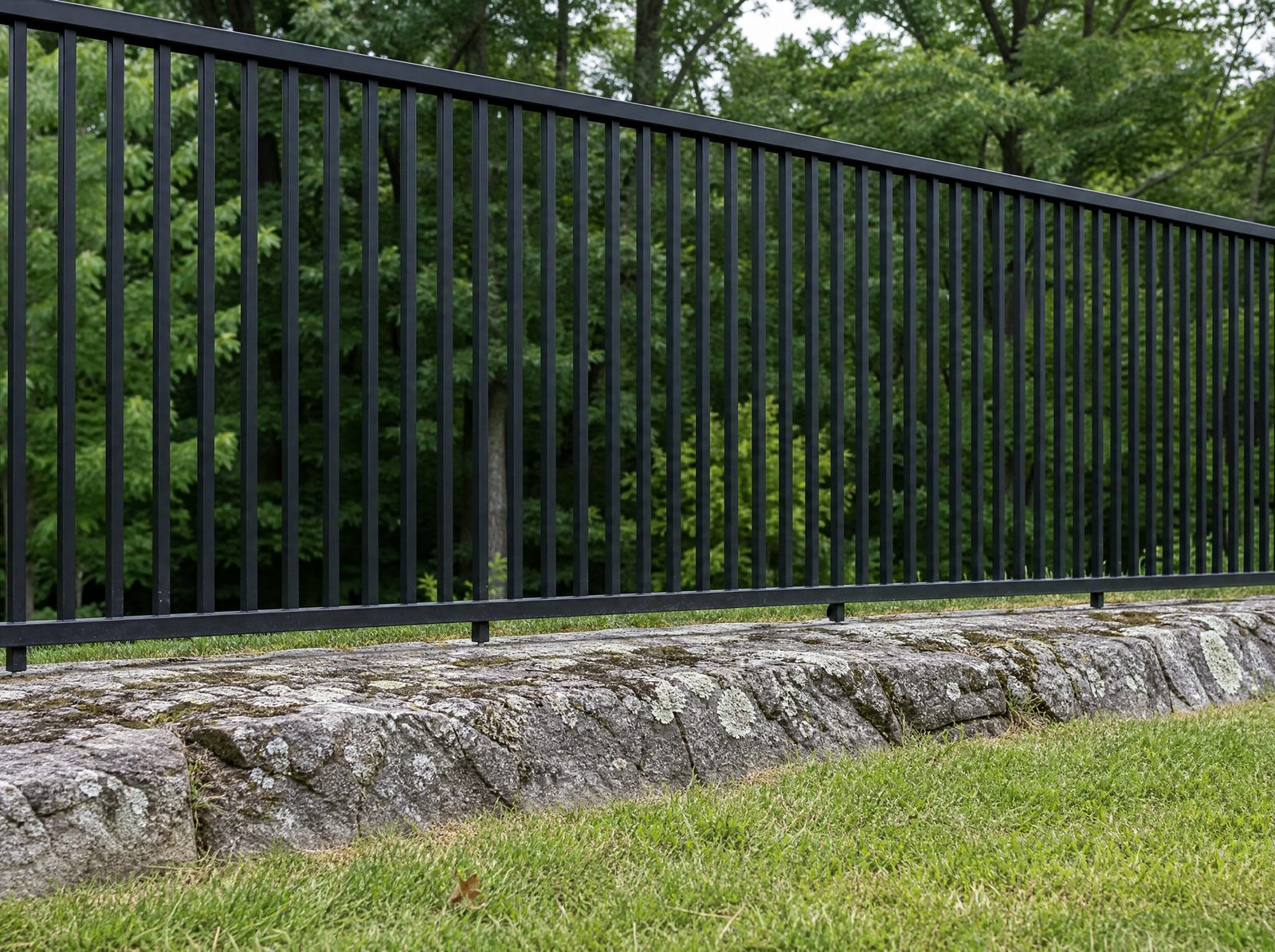
Residential pool barriers are generally required to be at least 48 inches high, measured on the side facing away from the pool. That last part matters more than the number. The measurement is taken from the outside, where a child would approach, so anything that raises the ground on that side reduces the effective height even though the fence itself never changed. A raised patio, a berm, or a retaining wall can quietly turn a compliant barrier into a short one.
Bottom Clearance and Openings
The space between the finished ground and the bottom of the barrier is limited, and the allowed amount can depend on the surface underneath and how the barrier is configured. Openings in the barrier are limited too, sized so a young child cannot pass through. There is no single number that covers every product and every surface, which is why the specific dimensions belong in your written scope and get confirmed against the code that applies to your permit. Anyone quoting you one universal figure for every yard is guessing.
Climbability
Code treats a barrier as something a child will try to climb, not just something they will try to walk through. Horizontal and vertical members are regulated to limit footholds, which is why rail placement is a compliance question and not a style question. The same logic reaches past the fence itself. A pool pump, a stack of chairs, a firewood pile, or a planter set against the barrier is a ladder, and putting one there after the inspection undoes the thing you paid for.
Chain-Link Mesh
Chain link can work around a pool, but standard mesh often cannot. The 2021 edition of the International Swimming Pool and Spa Code limits chain-link openings to 1 3/4 inches unless slats fastened at the top and bottom reduce the openings to the permitted dimension. That single line rules out a lot of what sits on a fence supply yard's shelf. If chain link is the plan, it has to be pool-specific mesh or properly slatted fabric, specified that way in writing, and confirmed against the edition that governs your permit.
Pool Gates Carry the Whole Barrier
Every other part of the barrier just stands there. The gate moves, gets used daily, holds hardware that wears, and sits exposed to weather, which is why it is where these systems fail most often. A pool barrier is only as good as its worst gate, and the worst gate is usually the one people stopped thinking about after it passed. Understanding what the gate has to do makes it much easier to spot a bad one.
Self-Closing, Self-Latching, and the Swing Direction
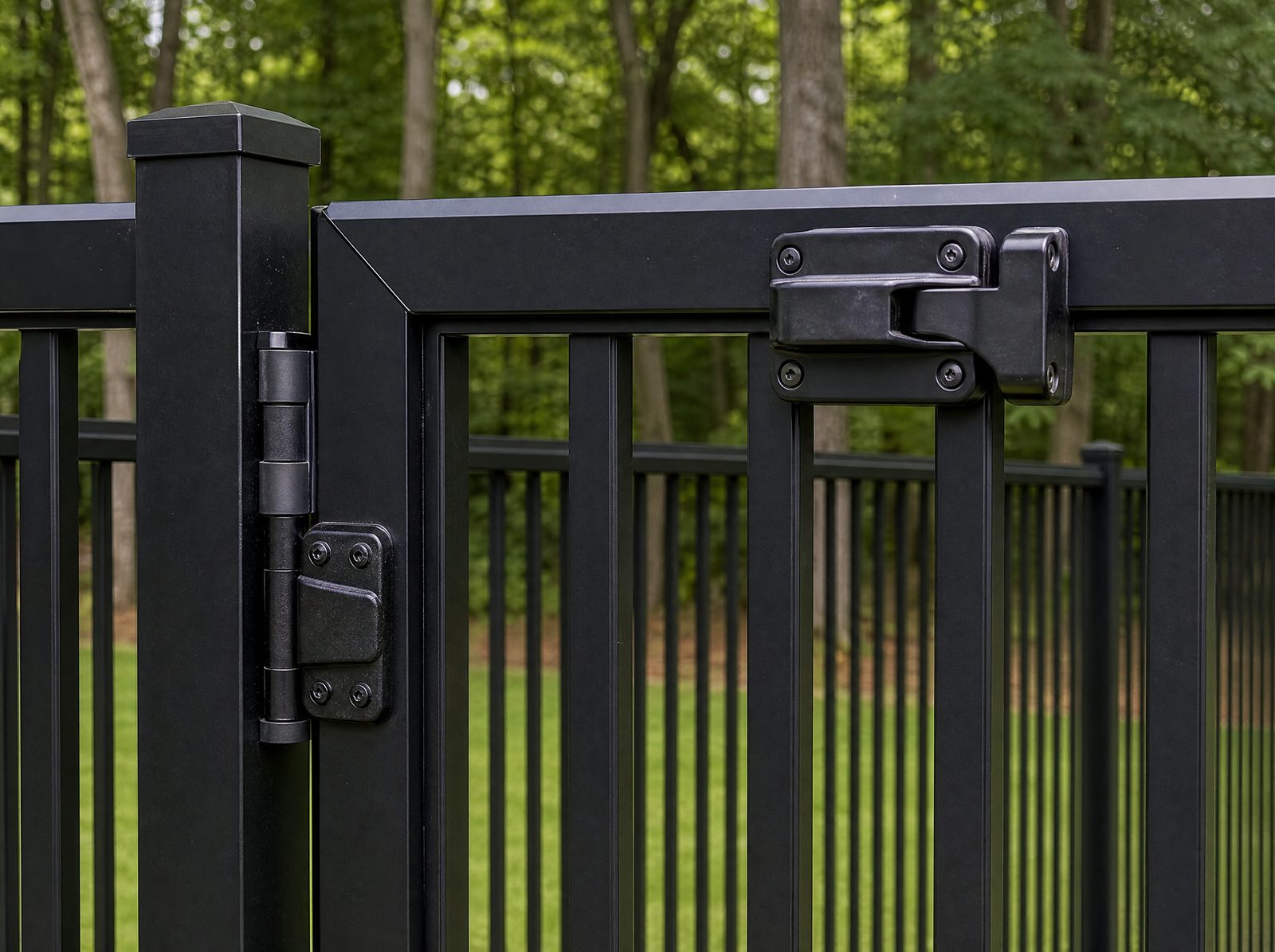
Pedestrian access gates have to meet the barrier requirements themselves and use self-closing and self-latching hardware. The plain-language test is simple: the gate should close and latch on its own from every position it is normally left in, without anybody helping it. Gate swing direction and latch location are regulated as well, and CPSC's safety barrier guidelines for home pools explain the reasoning behind the hardware rules in ordinary terms. Hinge-side and latch-side gaps, bottom clearance, and the lock all get looked at too.
The Gate Failures We See Most
Gate problems are predictable, which is the good news. Undersized hinges and a gate that has started to sag will drop the latch out of alignment until it no longer catches. A post that has moved with frost does the same thing. Gravel, ice, or snow under the gate stops the swing before the latch engages. A closer adjusted too weakly gets the gate most of the way home and no further. Landscaping grows into the swing path. And then there is the human version: a gate propped open with a rock, or a latch tied back because it was inconvenient. Any of those turns a permitted barrier into an open one, and the fix is almost always cheaper than the failure.
A Pool Enclosure Includes Every Route to the Water
Designing a pool enclosure in New Fairfield means mapping every way a child could reach the pool, not just fencing the pretty side of the yard. CPSC recommends a barrier that completely surrounds the pool and separates it from the house and the yard where that is practical, which is the four-sided isolation approach. Other configurations can work, including perimeter fencing combined with house walls, fencing tied into a deck, above-ground pool walls, masonry walls, and mixed materials with multiple gates. The test is whether the finished arrangement closes off the house, yard, driveway, garage, deck, patio, walkways, stairs, retaining walls, and any pool ladder.
House Walls, Doors, and Windows
When a wall of the house forms part of the barrier, the doors and windows in that wall become part of the safety question. Those openings can trigger additional protective requirements, which may include door alarms, self-closing and self-latching doors, or other approved protection. Requirements and interpretations in this area can change, so do not assume a powered safety cover substitutes for fencing on your project. That is a question for the building department against your permit date, not a question for a sales conversation.
Decks, Retaining Walls, and Above-Ground Pools
Grade and structure create most of the gaps we find. A retaining wall on the outside of the barrier can shorten the effective height. A deck that meets the fence can leave a gap beside it or offer a route over it. An above-ground pool wall may serve as part of the barrier, but only when the complete arrangement meets the applicable code, including how the ladder or stairs are secured. A removable or lockable ladder is not automatically enough on its own. Pools able to hold more than 24 inches of water have historically triggered Connecticut permit and barrier requirements, so above-ground pools, on-ground pools, swim spas, and hot tubs all deserve a code check rather than an assumption.
Not Every Fence Product Is Pool-Compliant
Every common fence material can work around a pool, and every one of them can also fail if the specific product configuration is wrong. What decides compliance is the exact panel, the picket spacing, the rail arrangement, the mesh, the bottom clearance, and the gate hardware, not the category on the brochure. So, the useful question about each material is not what it looks like, it is where it tends to trip up as a barrier. Here is how the usual choices land on New Fairfield properties.
Ornamental Aluminum
Aluminum fencing is a common pool choice for open sight lines to the water, corrosion resistance, and pool-specific panel configurations. The catch is that not every ornamental panel is pool-compliant. Decorative rings, horizontal rails in the wrong place, picket spacing, lower decorative sections, and gate hardware all affect whether the finished barrier meets the requirements.
Ornamental Steel
Ornamental styles in steel bring heavier construction and strong gate frames, which matters on wide openings. Watch corrosion protection, coating damage, and the extra post and footing support a heavier gate needs. Worth knowing: a lot of fence described casually as wrought iron is really ornamental steel or aluminum, so specify the actual product rather than the nickname.
Vinyl
Vinyl fencing gives privacy and a smooth surface with little to climb, but no privacy panel configuration is automatically compliant. Openings, rails, gates, bottom clearance, and drainage still get reviewed, and solid panels carry real wind load, so posts and gate reinforcement decide how it holds up. You also lose the ability to see the water from the house.
Wood
Wood fencing allows custom height and easy coordination with a deck, and it asks the most attention over time. Board spacing, horizontal rail placement, fasteners, bottom clearance, and gate alignment matter at install, and warping, shrinking, rot, or a loose board can open a prohibited gap years later. It suits an owner who will keep after it.
Pool-Specific Chain Link
Chain-link fencing brings visibility, durability, and adaptability to grade at a practical price. Around a pool it needs the mesh conversation above, plus attention to selvage, top and bottom restraint, bottom clearance, gate hardware, and post support. Specified properly it is a legitimate pool barrier. Grabbed off the shelf in a standard mesh, it is a failed inspection.
New Fairfield Terrain Decides How the Barrier Gets Built
New Fairfield yards bring sloping grade, retaining walls, raised patios, decks, ledge near the surface, boulders, and drainage swales, and every one of those touches the barrier. Grade changes can create excessive bottom gaps, climbable conditions, a shortened effective height, gate alignment problems, erosion, water running beneath the panels, and step transitions that open a hole where two sections meet. The finished barrier has to be evaluated from the side facing away from the pool and at every transition, not just where it looks good from the deck. Depending on the site, that means racked panels, stepped panels, custom transitions, masonry connections, grade correction, or a custom-fabricated gate.
Posts are the other half. Fence height, material, gate width, wind load, soil, ledge, drainage, frost, and the manufacturer's specifications all feed into how a post gets set, and gate posts, corners, and terminal posts generally need more support than a line post. Connecticut's residential code for foundations frames why frost protection matters here. Ledge can call for drilling, specialty anchoring, adjusted post locations, or core drilling into concrete. Drainage should never be blocked, because water that sits and freezes is what causes the settlement, the leaning post, and the gate that stops latching by spring.
What Moves the Cost of Pool Fencing in New Fairfield
There is no honest one-price-fits-all figure for a pool barrier, and any number you see online is general market context rather than a quote for your yard. A short aluminum barrier on level ground and a large privacy enclosure with multiple gates, ledge, retaining walls, and deck transitions are simply different projects. Published consumer guides can help you sanity-check a bid, but they cannot see your grade. One thing worth watching on a pool barrier specifically: the cheapest bid is often the one that priced a standard fence, not a compliant barrier, and that gap shows up at inspection rather than on the estimate. When you compare bids, make sure they all cover the same scope, including gates, hardware, permits, and inspection, or you are not comparing the same job.
Hover or tap a row to highlight it.
| Cost Driver | Why It Matters |
|---|---|
| Footage and barrier height | More posts, panels, and labor, and a taller barrier uses more of everything. |
| Pool-compliant configuration | The specific mesh, picket spacing, and rail arrangement that meet the barrier rules can cost more than a standard panel. |
| Gates and hardware | Each gate needs its own posts, footings, self-closing hinges, self-latching hardware, and locks. |
| Slopes, ledge, and transitions | Racking, stepping, core drilling, retaining-wall and deck connections all add labor. |
| Permits, inspections, and removal | Pulling the pool-barrier permit, meeting the inspector, and taking out an old fence are each their own line item. |
How Pool Fence Installation Comes Together in New Fairfield
A clean pool fence installation in New Fairfield runs in an order, and the order is what keeps compliance from becoming a surprise at the end. It starts with the code and the plans, not with a material. Knowing the sequence also helps you spot a crew that intends to skip a step, because the steps that get skipped are almost always the boring ones. The compliance and utility checks belong early, where they are cheap.
The New Fairfield Pool Fence Installation Process
- 1
Step 1: Confirm the Code and the Permit
We verify the current Connecticut pool-barrier requirements and the New Fairfield permit process before anything else.
- 2
Step 2: Review the Pool and Property Plans
We locate the pool, patio, deck, house, retaining walls, utilities, septic, well, and property lines.
- 3
Step 3: Design the Enclosure and the Gates
The strategy, material, and every gate get specified down to swing, width, hardware, locks, and bottom clearance.
- 4
Step 4: Written Scope and Utility Marking
The scope documents materials, dimensions, posts, permits, and inspections, then a Call Before You Dig request goes in and private lines are located.
- 5
Step 5: Set Posts, Panels, and Gates
Posts are set for the soil, ledge, and gate loads, panels go up holding openings and clearance, and gates are adjusted until they self-close and self-latch.
- 6
Step 6: Inspection and Closeout
We check every panel, gate, transition, and connection, then the municipal inspection closes the job out before the pool area is used.
Two of those steps get rushed most often. The first is utility marking: a Connecticut Call Before You Dig request is free and required by law before any excavation, and it does not cover private systems, so septic, irrigation, propane, pool plumbing, and lighting may need a separate locate. The second is the ending. Gates get adjusted until they close and latch from every normal position, not until they close once while somebody is watching, and the pool area is not ready for use until the required approvals are complete.
What Separates a Pool Fence Contractor Worth Hiring
Connecticut requires home improvement contractors to register with the Department of Consumer Protection, and the state makes it easy to verify a license before you sign anything. DCP also advises consumers to use a registered contractor and a written contract for covered home-improvement work, and their guidance on home improvement contracts is a good checklist to hold a bid against. Registration and insurance are the floor, not a selling point. For a pool fence contractor in New Fairfield specifically, look for someone who talks fluently about current barrier requirements, has been through the town's permit and inspection process, and can tell you how they handle slopes, retaining walls, and ledge before you ask.
What the Written Proposal Should Cover
A vague proposal is where pool-barrier problems get born, because the details that decide compliance are exactly the ones that go missing. Before work starts, the scope should spell out:
- Material and model: The actual product, not just "aluminum" or "vinyl."
- Height and openings: Finished barrier height plus picket, mesh, or opening dimensions.
- Rail arrangement and bottom clearance: Where the rails sit and how much space is under the barrier.
- Gates: Locations, widths, swing direction, self-closing hinges, self-latching hardware, and locks.
- Posts and foundations: Post sizes, footings, and how ledge or a retaining wall is handled.
- Slope, deck, and wall connections: How every transition gets closed.
- Permit and inspection responsibility: Who pulls the permit and who meets the inspector.
- Utility locating: Who files the 811 request and who arranges any private locate.
- Schedule, payments, and change orders: Including how a surprise like ledge gets priced.
- Removal, cleanup, and warranty: In writing, with the workmanship and manufacturer terms named.
An Approved Barrier Still Needs Checking Every Season
Passing inspection means the barrier was compliant on one day. Keeping it compliant is the owner's job, and the check takes a few minutes. Walk the barrier before you open the pool, again through the season, and after storms, snow, landscaping, or any fence or gate repair. Look at gate self-closing and latch engagement first, then hinge wear, gate sag, bottom clearance, picket spacing or mesh, loose boards, leaning posts, erosion at the ground line, deck and retaining-wall transitions, and anything climbable that has drifted near the fence. Furniture and pool equipment migrate over a summer. A gate that does not close and latch reliably should be corrected right away, not added to a list for the fall.
Frequently Asked Questions About pool fencing new fairfield ct
Q: Does pool fencing require a permit in New Fairfield?
A: Yes. New Fairfield generally exempts fences not over seven feet from a building permit, but a fence used as a swimming pool barrier requires a permit regardless of height. Zoning, wetlands, septic, well, deck, and electrical requirements may also apply, so confirm the current requirements with the town before installation.
Q: How high must a pool fence be in New Fairfield?
A: Residential pool barriers are generally required to be at least 48 inches high, measured on the side facing away from the pool. Because code editions, amendments, and your permit date all matter, confirm the requirement that applies to your project with New Fairfield's building department.
Q: Does a pool gate have to self-close and self-latch?
A: Yes. Pedestrian pool-barrier gates must use self-closing and self-latching hardware under the applicable barrier provisions, and gate swing direction and latch location are regulated as well. A good field test is whether the gate closes and latches on its own from every position it is normally left in.
Q: Can chain link be used for a pool fence?
A: Yes, when the complete system complies. The 2021 International Swimming Pool and Spa Code limits chain-link openings to 1 3/4 inches unless slats fastened at the top and bottom reduce the openings to the permitted dimension, so standard mesh often needs to be swapped for a pool-specific product.
Q: Can the house form one side of the pool enclosure?
A: It may be allowed, but the doors and windows in that wall become part of the safety question and can trigger additional protective measures such as alarms or self-closing and self-latching doors. Confirm the current requirements with the building department rather than assuming.
Q: Can a safety cover replace a fence?
A: Do not assume that it can. Requirements and interpretations in this area can change, so the rule that applies to your permit date is the one that counts, and New Fairfield's building department is where you confirm it.
Q: Can an above-ground pool wall serve as the barrier?
A: It may serve as part of the barrier when the wall and the access system meet the applicable code, including how the ladder or stairs are secured. A removable or lockable ladder is not automatically sufficient on its own, and pools able to hold more than 24 inches of water have historically triggered Connecticut permit and barrier requirements.
Q: How much does pool fencing in New Fairfield, Connecticut cost?
A: Cost depends on footage, barrier height, material, pool-compliant configuration, the number and size of gates, hardware, slopes, ledge, patio or deck connections, retaining walls, removal, permits, surveys, and inspections. A site visit is the only honest way to price it, which is why the estimate is free.
Q: How often should a pool barrier be inspected?
A: Check it before opening the pool, throughout the swimming season, and after storms, snow, landscaping, or repairs. Gate closing and latching deserve the most frequent look, because that is where these systems fail first.
Test Your New Fairfield Pool Barrier Knowledge
1. Does a fence used as a pool barrier need a permit in New Fairfield?
2. Where is a pool barrier's height measured from?
3. What must a pedestrian pool gate do?
4. Can standard chain-link mesh be used as a pool barrier?
5. What most often turns an approved pool barrier into an open one?
Pick an answer to begin.
Final Thoughts
A pool barrier in New Fairfield comes down to getting a short list of things right in the right order: confirm the current code and pull the permit, treat the whole enclosure as the safety system, close every route to the water, pick a product configuration that actually complies, build the gates so they close and latch on their own, and set the posts for real ground and real winters. The seven-foot exemption you may have heard about does not reach your pool fence, and that is the single most useful thing to know before you start. When the details are settled up front, the inspection stops being a hurdle and becomes a confirmation.
Done right, a pool barrier fades into the background and quietly does the most important job on the property, season after season, while you enjoy the water instead of worrying about it. That is worth the extra care at the planning stage.
If you are planning pool fencing in New Fairfield, we would be glad to walk your property and give you a straight answer about what the barrier needs. My Fence Guy is a family-owned contractor with our office right here in New Fairfield, CT, licensed and insured, and we install pool fencing along with residential, commercial, industrial, and agricultural fencing, gates, and railings across Connecticut and New York. We handle the layout, the permit and inspection questions, the gate hardware, and the transitions that decide whether an enclosure holds. Call us at (203) 746-1100 for a free estimate, or reach out through our contact page.
Pool Fencing Key Terms
Tap a term to see what it means.
Pool Barrier. The complete system that limits unsupervised access to a pool, including panels, posts, openings, clearances, gates, hardware, and every connection to a house, deck, or wall.
More about fences
Connecticut Pool Fence Requirements: Height, Gates and Permits
Connecticut pool fence requirements under the 2022 State Building Code: 48-inch height, gaps, self-closing and self-latching gates, alarms and town permits.
Read the guide to Connecticut Pool Fence RequirementsDoes an Above-Ground Pool Need a Fence in Connecticut?
Above-ground pools in Connecticut: when the pool wall counts as the barrier, the 24-inch water depth rule, ladders and decks, and when a permit applies.
Read the guide to Does an Above-Ground Pool Need a Fence in Connecticut?Pool Fencing in Southbury, CT: Code, Gates, and Child Safety
The gate is what fails an inspection. Pool fencing in Southbury, CT: self closing hardware, latch height, the 4 inch rule, and clearance underneath.
Read the guide to Pool Fencing in Southbury, CT