
Aluminum Fencing in Sherman, CT: Styles, Cost, and Permits
By Tony Pellicone19 min readPublished
- aluminum fencing
- sherman ct
- ornamental fencing
- connecticut
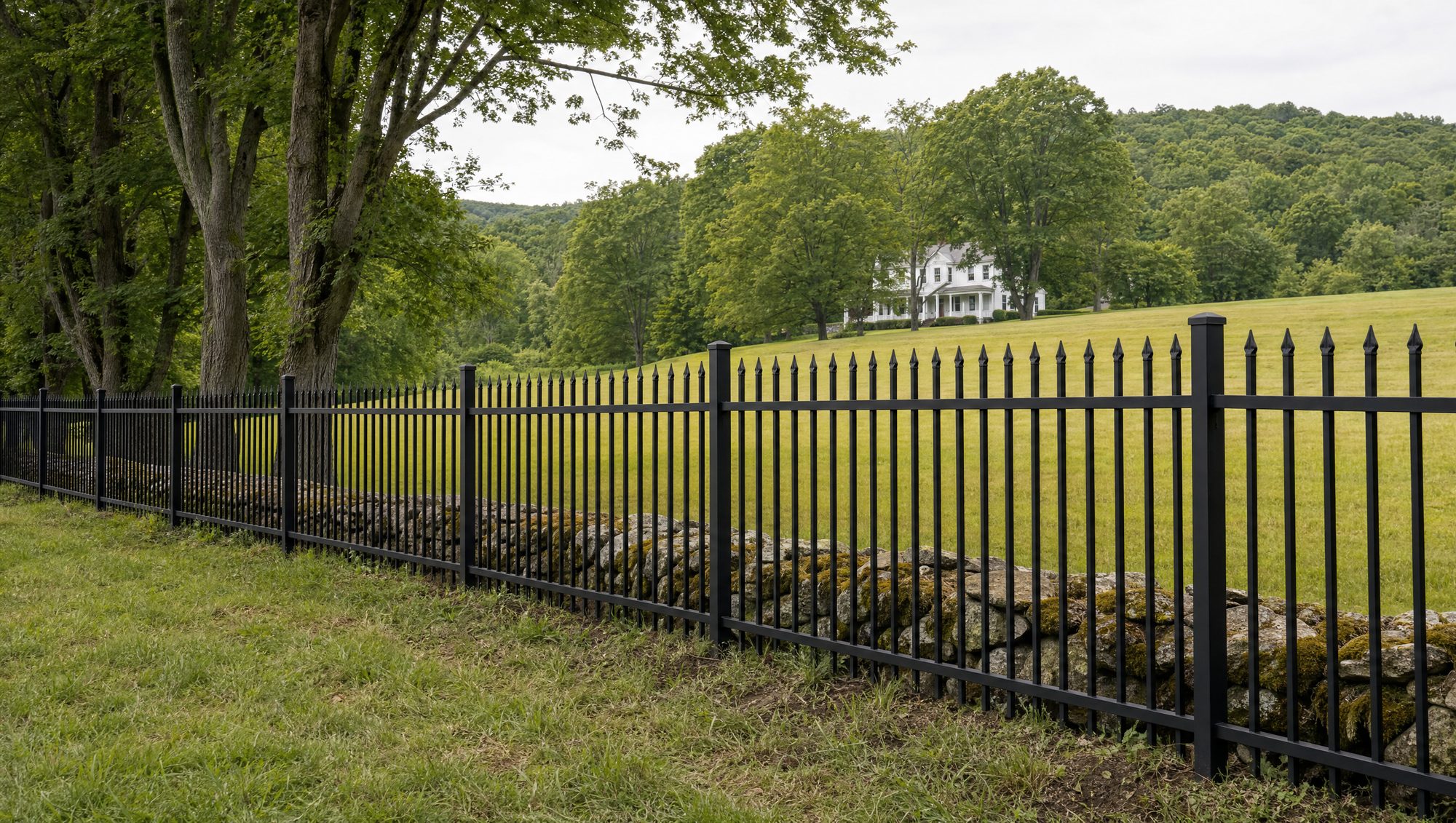
You want the black metal pickets, the clean vertical lines, the look of old wrought iron around the pool or across the front of the property. What you do not want is sanding rust off it every few springs. That is usually the moment aluminum fencing in Sherman, CT enters the conversation, and it is also the moment things get murky. Two bids can both say "black aluminum, four feet, spear top" and describe fences that are not remotely the same product. One may hold its line for decades. The other may gap on your slope, sag at the gate after a single winter, and fade unevenly where the mower keeps clipping it. The difference almost never shows up in the color or the height. It shows up in the specifications and in how the fence gets put in the ground on your particular lot. Here is what separates a good aluminum fence from a good-looking one.
Key Takeaways
Aluminum imitates wrought iron, it does not replace it
Ornamental aluminum gives you the look without the same weight or rust behavior, but iron and steel still have a place where mass and impact resistance matter.
The spec sheet is the product
Post size, rail count, picket spacing, wall thickness, gate frame, and coating decide quality. Labels like "heavy duty" decide nothing.
Sherman handles fences through Planning and Zoning
The town lists a zoning permit for fences in its fee schedule, and a pool barrier is treated as its own approval regardless of height.
Slopes and ledge are design decisions, not surprises
Racking, stepping, bottom gaps, and rock conditions should be settled in the estimate, not discovered on install day.
Gates fail first when posts are undersized
Gate width, weight, hinge load, and the footing under the post decide whether the latch still lines up in year five.
Aluminum Fencing Sells the Wrought Iron Look, Not the Wrought Iron
The phrase "wrought iron look fence" in Sherman almost always describes a style, not a metal. Homeowners think of the tall black pickets on an older estate and assume the material is the point. It is not. What they actually want is the visual language: narrow vertical members, open sight lines, a dark finish, maybe a spear top or a decorative finial. Ornamental aluminum delivers that language in an extruded, prefabricated system. Whether it is the right call depends on what you need the fence to do besides look good.
What Ornamental Aluminum Actually Is
Ornamental aluminum fencing uses extruded aluminum posts, rails, and pickets assembled into open panels. ASTM F2957 is the standard specification that sets minimum requirements for architecturally coated tubular picket ornamental aluminum fence systems, covering materials and manufacture, structural testing, physical dimensions, workmanship, surface finish testing, and certification. That standard exists precisely because the category is so wide.
The material earns its reputation honestly. The Aluminum Association notes that aluminum is lightweight, durable, corrosion resistant, and recyclable, and identifies 6xxx series alloys as common choices for architectural extrusion because they combine formability, weldability, strength, and corrosion resistance. Aluminum does not rust the way iron and carbon steel do. It forms a protective oxide layer instead. The coating on top of it is about appearance and long term finish performance, not about holding back rust the way paint does on iron.
Where Iron and Steel Still Make Sense
Aluminum is not universally better than iron. It is lighter, which makes it easier to handle and install, and it comes in rackable panels that follow grade. Traditional wrought iron and ornamental steel are heavier, can offer more mass and impact resistance depending on the design, often use welded or forged components, and tend to support highly customized fabrication. They also need an effective protective coating to hold off corrosion, and they can be harder and costlier to install.
The right metal depends on security needs, span, impact exposure, appearance, how custom you want to go, maintenance tolerance, and budget. If a contractor tells you aluminum is simply stronger, that is a sales line, not a specification.
Black Is the Default Finish, and the Finish Is Part of the Product
A black aluminum fence in Sherman works for a reason that has nothing to do with fashion. Black reads as contrast near a house and as near invisibility against trees, lawn, water, and distance. On a wooded lot the pickets almost disappear and you keep the view. On a colonial or a Cape the dark line frames the front yard the way a black shutter frames a window. On a contemporary home a flat top black panel reads as a clean edge rather than a decoration.
Flat Top, Spear Top, and the Styles In Between
The style choices are more consequential than they look, because several of them interact with safety rules and with pets.
- Flat top: A clean horizontal top rail with no pickets rising above it. Common around pools, around dogs, and on understated or contemporary properties.
- Spear top: Pickets extend past the top rail, often with pointed or decorative finials. Traditional and ornamental, but it needs to be evaluated against the location, safety, and pool barrier requirements.
- Alternating spear top: Every other picket rises above the rail, giving a lighter decorative rhythm.
- Arched and scalloped panels: The top line rises or falls between posts. Usually reserved for entrances and feature sections.
- Puppy picket panels: Tighter spacing in the lower portion of the panel to close the gaps a small dog would slip through.
- Rail count: Two rail and three rail systems look different and often relate to height, product grade, and structural design.
Coating, Touch-Ups, and Color Consistency
Low maintenance does not mean no maintenance. The architectural coating is a manufactured finish with its own standards, its own warranty terms, and its own limits. Scratches from a string trimmer, pool chemical residue, an incompatible touch-up paint, or a branch coming down in a storm all affect how the finish holds up. Two details get skipped at the bid stage: finish warranties carry exclusions worth reading before you assume the color is covered forever, and color consistency between panels, posts, and gates is a real issue when components come from different production runs. Ask how touch-ups are handled and whether every piece comes from the same product line.
The Word "Aluminum" on a Bid Tells You Almost Nothing
This is where most Sherman homeowners lose money without knowing it. They collect three estimates, see similar heights and identical colors, and pick the lowest number. What they have actually done is compare a light residential panel against a heavier system and declare the light one a bargain. Aluminum fence products vary in alloy, dimensions, coating, rail count, post size, and reinforcement. None of that is visible in a color photo.
Specifications That Separate One Panel From Another
An estimate for ornamental aluminum fencing in Sherman should identify the product with enough precision that you could look it up yourself:
- Manufacturer and product line: The actual system, not a category.
- Height and panel width: Both, since panel width affects post count and rigidity.
- Rail count and rail dimensions: How many and how big.
- Picket dimensions and spacing: The numbers that decide pet safety and pool compliance.
- Post dimensions and wall thickness: The single best proxy for how the fence will hold up.
- Gate frame and reinforcement: Gates are the weak point, so this line matters most.
- Rackability: How far a panel can follow grade before you have to step it.
- Finish, warranty, and any ASTM F2957 claims: In writing, tied to the product line.
Residential, Commercial, and Industrial Are Labels, Not Specs
Those three words are useful shorthand only when actual numbers sit behind them. There is no universal rulebook that says what a commercial grade panel must measure. One supplier's commercial is another's residential. Compare post dimensions, rail and picket dimensions, wall thickness, panel width, gate frame, reinforcement, hardware, coating, structural testing, warranty, and intended application. If a bid reduces all of that to "heavy duty," ask for the spec sheet. A contractor who works with these systems every week will have it ready.
Sherman Runs Fences Through Planning and Zoning
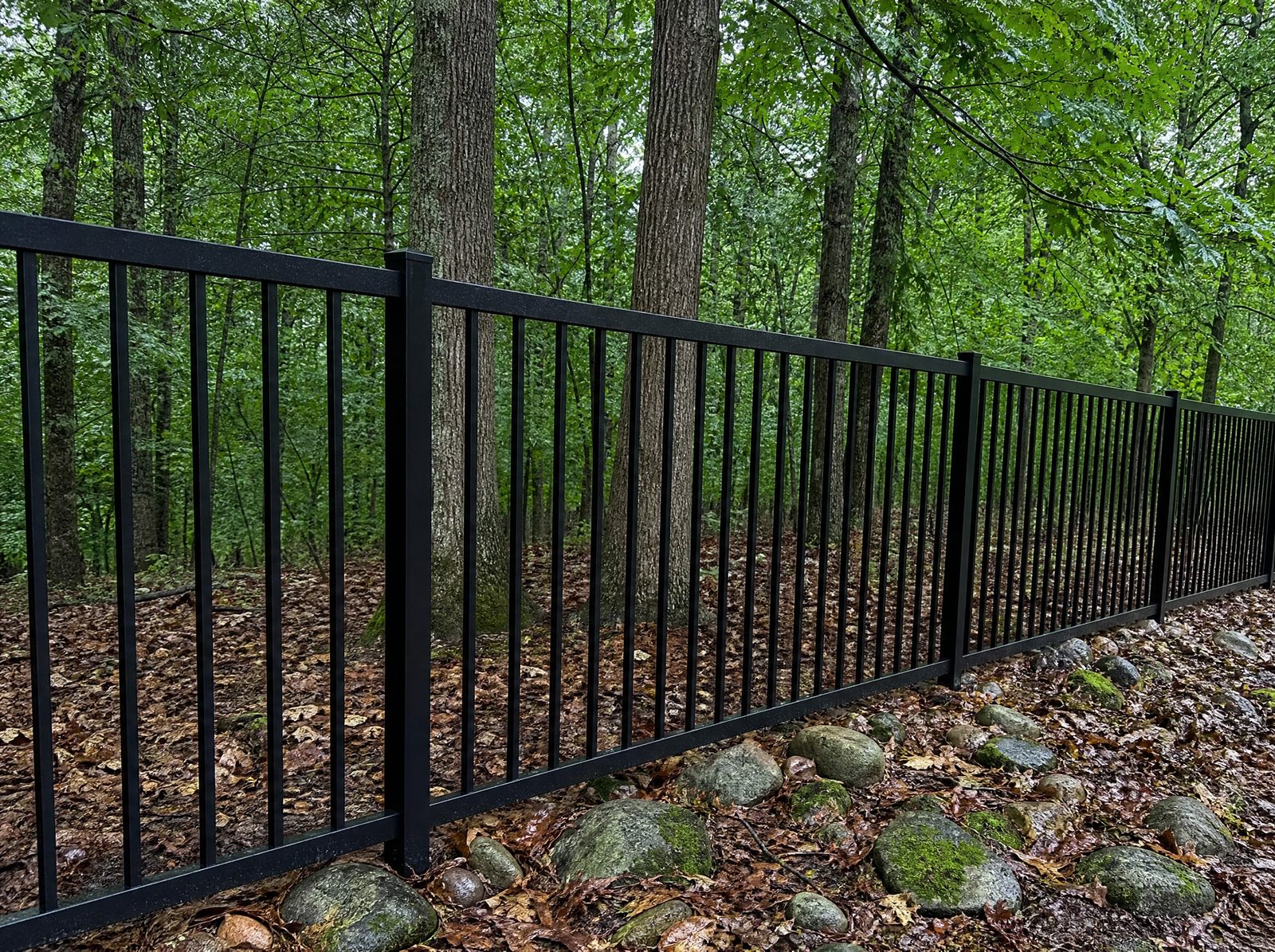
Do not assume your aluminum fence is paperwork free. Sherman's Planning and Zoning Department handles fence related land use applications, and the town's fee schedule lists fences under miscellaneous structures and equipment with a zoning permit fee. Sherman also publishes current zoning regulations, and revises them periodically. Requirements can change and can vary by parcel, so confirm what applies to your lot before anything gets ordered.
The issues that surface on a specific property are predictable: fence height, yard placement, road and driveway sight lines, boundaries, easements, wetlands and watercourses, pool barrier compliance, electric gate equipment, and private association or deed restrictions. None of those are exotic in a town with the terrain Sherman has.
A Pool Barrier Is Its Own Project
If the fence is there to enclose a pool, treat it as a separate approval rather than a yard fence that happens to be near water. Sherman requires a permit for a swimming pool barrier regardless of its height, and the review looks at the entire installed system against the applicable residential code: barrier height, maximum openings, bottom clearance, non climbable design, gate swing direction, self closing hinges, self latching hardware, latch placement, connections to structures, and climbable objects sitting nearby.
Here is the part worth underlining. A panel marketed as a pool fence is not automatically compliant. Compliance is a property of the complete installed barrier and the code that applies to it, which is why pool fencing deserves its own conversation, its own hardware list, and its own inspection.
An Old Stone Wall Is Not a Property Line
Sherman has plenty of old stone walls, mowing lines, hedge rows, and previous fences that everyone assumes mark the boundary. They do not. A fence contractor can lay out the run, but a licensed surveyor is the professional who establishes the legal line, and recorded plans often live with the town clerk.
A survey earns its cost when the markers are missing, when the fence will sit close to the line, when the lot is irregular, when an easement may exist, when a shared driveway is nearby, when a neighbor has questioned the layout, or when the property sits near a wetland. Moving a finished fence is far more expensive than confirming the line first.
Call 811 Before the First Post Hole
Aluminum posts require excavation, so buried lines come first. Connecticut's Call Before You Dig service should be contacted before digging, by calling 811 or 1-800-922-4455, and the state's guidance explains how the process works.
Public marking has a real blind spot. Privately owned lines usually go unmarked: septic, irrigation, yard lighting, well lines, pool equipment, propane, generator feeds, drainage piping, and invisible pet fence wire. On a property with a pool and a generator, that list covers most of the yard. The written contract should say who submits the request and who is responsible for identifying private lines.
Sherman Ground Decides Where the Posts Go
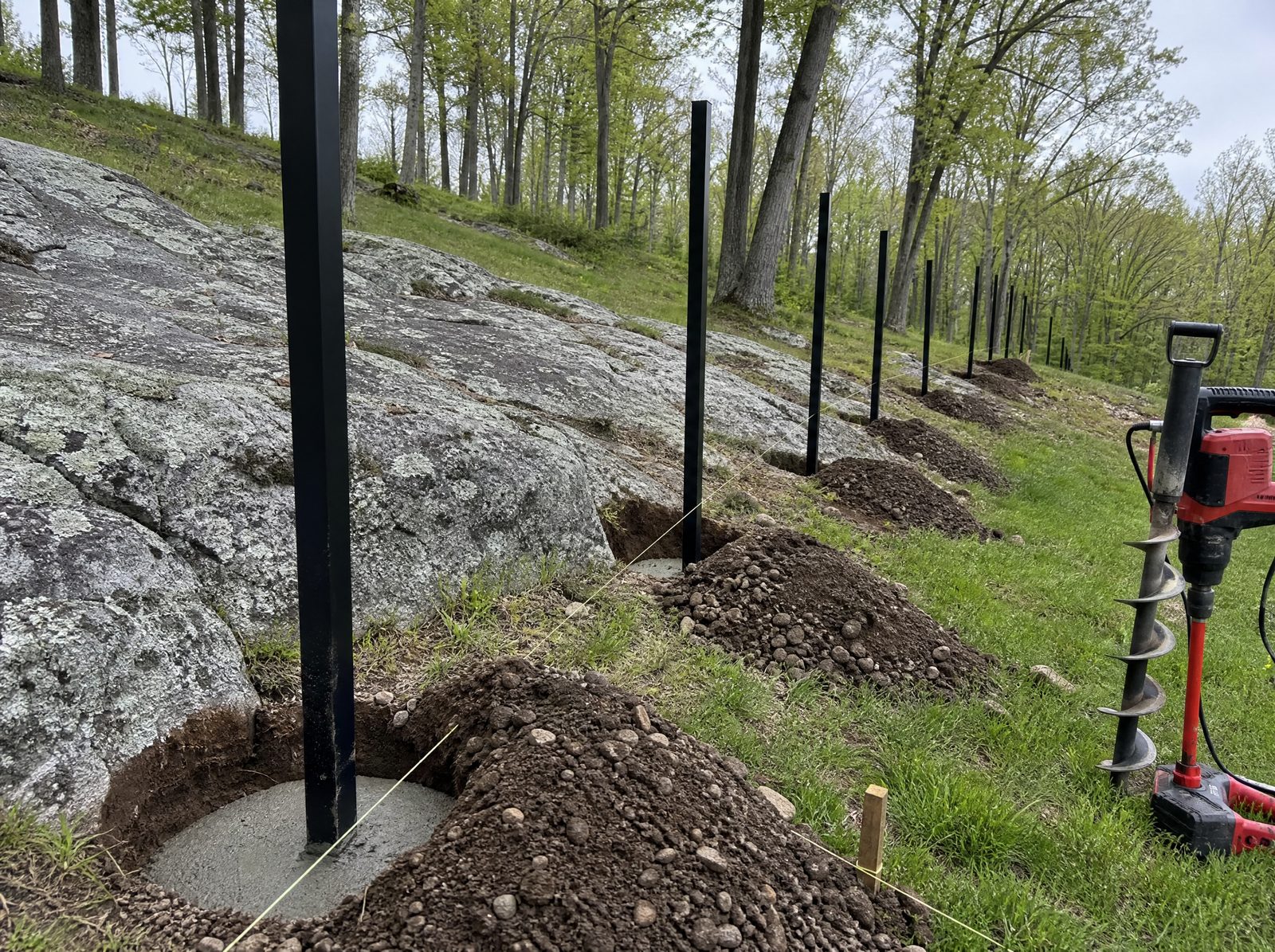
Sherman properties bring rocky glacial soils, ledge, sloped yards, wooded boundaries, large roots, wet ground, drainage swales, stone walls, narrow machine access, freeze thaw movement, and the occasional branch coming down across the line. Every one of those touches post location, excavation, panel transitions, gate operation, labor, and price. A fence that ignores them is a fence that moves.
Racking Versus Stepping on a Slope
Rackable aluminum panels follow moderate grade by letting the pickets stay vertical while the rails angle with the slope. Stepping is the alternative: level panels dropped down the hill in stages, leaving a triangular gap under each section. Neither is automatically right.
The choice drives bottom gaps, pet containment, appearance, post height, gate transitions, and whether the panel you selected is even compatible with the method. A steep grade with a small dog is exactly where a stepped fence quietly fails at its actual job. Settle this at the estimate, on the ground, not on install day.
Ledge, Roots, and Hidden Conditions
Ledge is the Sherman wildcard. It may call for drilling, alternative anchoring, adjusted post positions, or different equipment, and it does not announce itself before the first hole goes down. That is not a reason to fear the project. It is a reason to insist the estimate spells out how hidden rock gets handled and priced through a change order, so a surprise becomes a documented decision instead of an argument. Drainage deserves the same attention, since posts and gates should not block a swale or pond water against a foundation, and wet low points feed the soil movement that pulls a gate out of alignment.
Gates Take More Support Than Line Posts
There is no universal post depth for every aluminum fence. Depth, hole size, the setting method, and reinforcement depend on fence height, panel grade, post dimensions, soil and ledge, drainage, wind exposure, gate width and weight, corner conditions, manufacturer specifications, and local frost conditions. Connecticut's residential code for foundations frames why frost protection and drainage matter here even when a fence post is not regulated like a building footing.
Gate posts need more support than intermediate line posts, full stop. Wide double gates, driveway gates, and automated gates should never be treated like an ordinary walk gate on an ordinary post. When a gate sags, drops its latch out of line, or drags after the first hard winter, the post and the footing are almost always the reason.
What Actually Moves Aluminum Fence Cost in Sherman
There is no reliable one price fits all figure for aluminum fence cost in Sherman. Published consumer guides such as Angi's aluminum fence cost breakdown and HomeAdvisor's aluminum and steel fence pricing show broad ranges, and they are worth reading as general market background. They are not a quote for your property, because they cannot see your product line, your slope, or your ledge.
What moves the number is the whole system. Footage and height set the baseline, then grade, rail count, picket style, and decorative details stack on top. After that the site takes its share, and so does anything custom.
Hover or tap a row to highlight it.
| Cost Driver | Why It Matters |
|---|---|
| Linear footage and height | Longer, taller runs need more posts, panels, and labor, and taller panels often move you up a grade. |
| Product grade and rail count | Post size, wall thickness, and two rail versus three rail construction separate a light panel from a heavy one. |
| Style and decorative details | Spear tops, finials, arched or scalloped sections, and puppy pickets all add material and fabrication. |
| Gates and pool hardware | Walk, double, and driveway gates each need their own posts, footings, and hardware, and pool rated hinges and latches are their own line. |
| Slopes, ledge, and access | Racking or stepping, rock and roots, wet soil, brush clearing, and a tight equipment path all add hours. |
| Removal and customization | Pulling an old fence and hauling it away, custom colors, made to order panels, and gate automation each carry their own cost. |
How an Aluminum Fence Installation Comes Together in Sherman
A clean aluminum fence installation in Sherman runs in a predictable order, and the order is how you spot a crew that skips steps. It starts with a walk of the property and ends with a walkthrough, with the compliance and utility checks sitting where they belong rather than bolted on at the end. Each step closes a decision that would otherwise get made badly under time pressure with a truck already in the driveway.
The Sherman Aluminum Fence Installation Process
- 1
Step 1: Purpose and Property Walk
We settle whether the fence is for a pool, pets, decoration, security, gardens, or the boundary, then walk the slopes, ledge, roots, drainage, and gate locations.
- 2
Step 2: Zoning and Boundary Review
The zoning permit, pool barrier rules, wetlands, easements, and the property line get confirmed with the town before anything is ordered.
- 3
Step 3: Product Selection and Written Scope
Height, grade, rail count, picket style, finish, posts, gates, and hardware are chosen by name and documented with removal, cleanup, and hidden condition procedures.
- 4
Step 4: Utility Marking and Site Prep
A Call Before You Dig request goes in, private lines like septic, irrigation, and pet fence wire are identified, and the run is cleared.
- 5
Step 5: Post Setting and Panel Installation
Posts are set for the soil, frost, gate load, and manufacturer specifications, then panels rack or step to hold the planned bottom clearances.
- 6
Step 6: Gates, Inspection, and Walkthrough
Swing, self closing operation, latch alignment, and clearances are set, then alignment, finish, fasteners, and bottom gaps get checked with you.
What to Ask an Aluminum Fence Contractor in Sherman
Connecticut requires home improvement contractors, fence installers included, to register with the Department of Consumer Protection. The state's guidance for consumers is worth reading before you sign anything, and you can verify a registration in a couple of minutes. My Fence Guy is licensed and insured. Registration and insurance are the floor, though, not the qualification.
The questions that actually sort out an aluminum fence contractor in Sherman are specific. Which manufacturer and product line, and can I see the spec sheet? What are the post dimensions and wall thickness? How are you handling that slope, racking or stepping, and what does it do to my bottom gaps? What size posts are the gates hanging on? If you hit ledge, what happens to my price and who decides? Have you done pool barriers in this town, and who pulls the zoning permit? A contractor who works with these systems has those answers ready. One who does not will retreat to "heavy duty" and "we do this all the time."
What the Written Estimate Should Include
Connecticut's contracting guidance is a good checklist to hold any bid against. For aluminum specifically, the scope should cover:
- Contractor identity and HIC number: The registered name, address, and registration number.
- Manufacturer and product line: The system by name, with the spec sheet attached or referenced.
- Height, footage, and panel layout: The measured run and how it breaks into panels.
- Rail, picket, and post specifications: Dimensions, spacing, and wall thickness, in numbers.
- Gates and hardware: Widths, frames, reinforcement, hinges, latches, and pool hardware where it applies.
- Removal and disposal: Who takes out the old fence and hauls it away.
- Permit and utility responsibility: Who files with Planning and Zoning and who submits the 811 request.
- Ledge and hidden conditions: How rock is priced and how a change order gets approved.
- Timeline, payments, and warranties: Lead times on made to order panels, the payment schedule, and workmanship and finish terms in writing.
Frequently Asked Questions About aluminum fencing sherman ct
Q: Does aluminum fencing rust?
A: Not the way iron or carbon steel does. Aluminum forms a protective oxide layer rather than rusting through, which is why it is widely used in construction for corrosion resistance. The architectural coating still matters, since it protects appearance and finish durability over time.
Q: Is aluminum fencing the same as wrought iron?
A: No. Ornamental aluminum can imitate the look of wrought iron, but it is lighter and has different corrosion, fabrication, and structural characteristics. Which one fits depends on security needs, span, impact exposure, customization, maintenance, and budget.
Q: Do I need a permit for aluminum fencing in Sherman?
A: Sherman handles fences through its Planning and Zoning Department, and the town's fee schedule lists a zoning permit for fences. Height, placement, setbacks, sight lines, wetlands, and easements may also apply to your specific lot, so confirm the current requirements with the town before installation.
Q: Can aluminum fencing be installed on a slope?
A: Yes. Rackable panels follow moderate grade while the pickets stay vertical, and stepped sections handle steeper grades or less rackable products. The method affects bottom gaps and pet containment, so decide it during the estimate.
Q: Is aluminum fencing good for dogs?
A: It can be, but height, picket spacing, bottom gaps, gate clearances, digging, jumping, and nearby objects a dog can climb all matter. For very small dogs, standard ornamental spacing may be too wide, and puppy picket panels may be the better option depending on the product.
Q: Can aluminum fencing be used around a pool?
A: Yes, when the complete installed barrier meets the applicable height, opening, bottom clearance, gate, latch, and non climbable requirements and receives the required approval. A panel marketed as a pool fence is not compliant on its own; compliance depends on the whole installed system.
Q: How much does aluminum fencing cost in Sherman?
A: It depends on footage, height, grade, rail count, style, gates, pool hardware, slopes, ledge, removal, access, permits, and customization. Published averages are general market background, not a quote, so a site specific estimate is the only reliable number.
Q: Should I get a survey before installing an aluminum fence?
A: It is worth it when boundary markers are missing, the fence will sit close to the line, the lot is irregular, an easement may exist, or a neighbor has questioned the layout. A contractor can lay out the run, but only a licensed surveyor establishes the legal boundary.
Test Your Aluminum Fence Knowledge
1. Does ornamental aluminum fencing rust like iron?
2. Which department handles fences in Sherman?
3. What does ASTM F2957 cover?
4. A panel marketed as a pool fence is automatically pool compliant.
5. What most often makes an aluminum gate sag or lose its latch alignment?
Pick an answer to begin.
Final Thoughts
Aluminum fencing in Sherman Connecticut can give you the open, decorative, corrosion resistant boundary you are after around a pool, a garden, a front yard, an estate entrance, or a commercial property, without the upkeep that pushed you away from iron in the first place. What decides whether it performs is not the color. It is the product grade and the coating, the posts and the gates, how the panels handle your slope, what the soil and ledge do to the install, and whether the whole thing is written down before work starts. Sherman's Planning and Zoning Department is where the permit question gets answered, and a pool barrier is its own approval every time.
Get those pieces right and an aluminum fence quietly does its job for decades. It holds its line through freeze thaw cycles, keeps the dog where he belongs, frames the yard instead of walling it off, and never asks you for a weekend of scraping and painting.
If you are thinking about aluminum fencing in Sherman, we would be glad to walk the property and give you a straight answer, spec sheet included. My Fence Guy is a family owned contractor with a local office right here in Sherman, CT, and we install aluminum, ornamental, pool, pet, residential, commercial, industrial, and agricultural fencing, along with estate gates and railings, throughout Connecticut and New York. Call us at (203) 746-1100 for a free estimate, or reach out through our contact page.
Aluminum Fencing Key Terms
Tap a term to see what it means.
Ornamental Aluminum. An open fence system of extruded aluminum posts, rails, and pickets, often chosen for the wrought iron look without iron's weight or rust behavior.
More about fences
Ornamental Fencing in Sherman, CT: Choosing the Right Style
Ornamental fencing in Sherman, CT should look like it came with the house. How profile, finial, spacing, and height read against a colonial or a farmhouse.
Read the guide to Ornamental Fencing in Sherman, CTRailings in Sherman, CT: What the Code Actually Requires
Railings almost never break in the middle. They let go where they meet the deck. What that means for railings in Sherman, CT, from ledger to post base.
Read the guide to Railings in Sherman, CTOrnamental Fencing in Southbury, CT: Style That Fits the House
Spear, flat top, or scroll? Ornamental fencing in Southbury, CT, and how picket profile, finials, and height decide whether a fence flatters the house.
Read the guide to Ornamental Fencing in Southbury, CT