
Deer Fencing in Southbury, CT: Height, Setbacks and What Works
By Tony Pellicone12 min readPublished
- farm fencing
- southbury ct
- connecticut
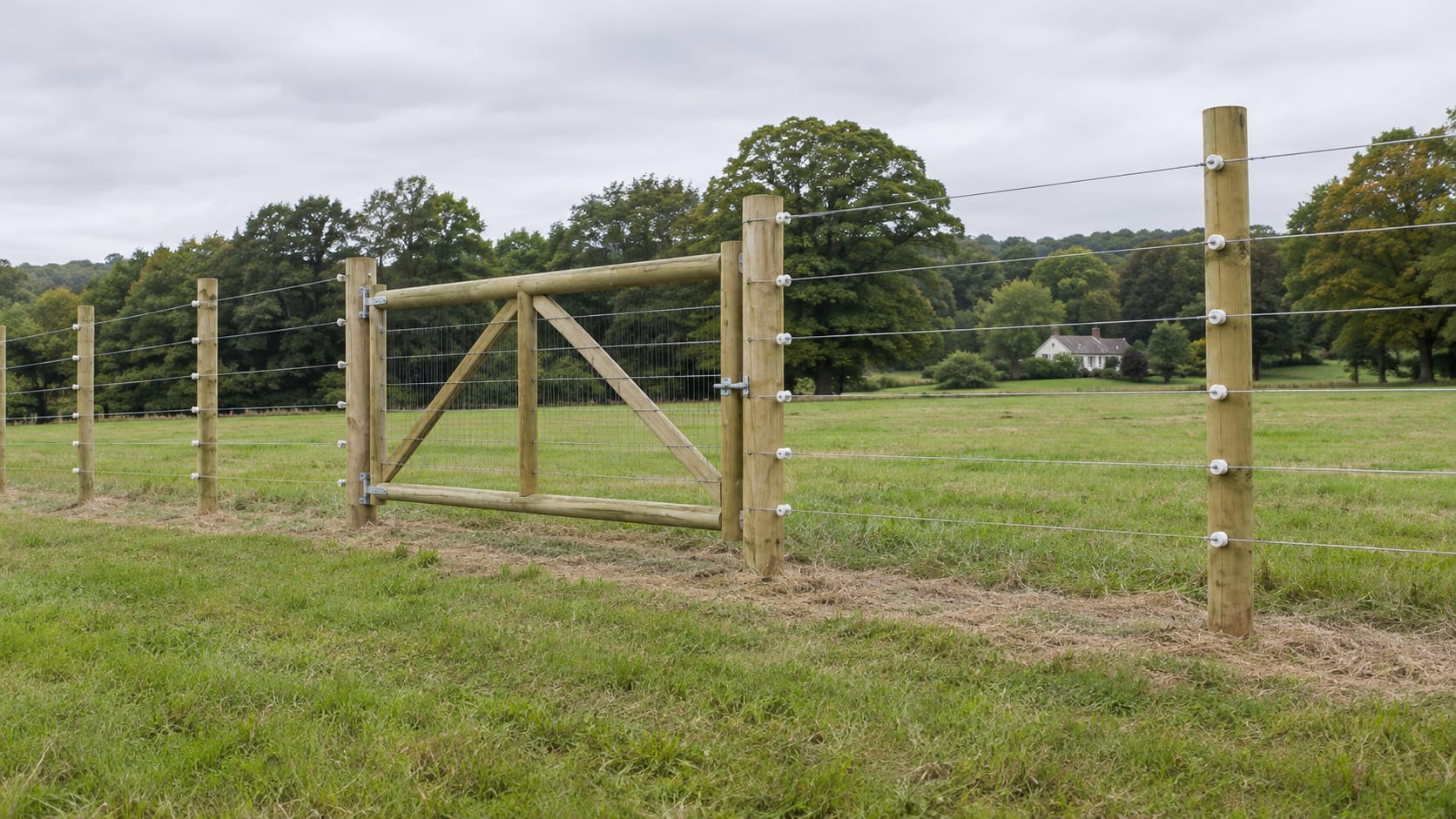
A deer fence in Southbury should be about 8 feet high, and that height goes past the 6-foot line in the town's setback rule. Fences 6 feet or lower are exempt from setbacks, while an 8-foot fence has to sit back from the lot line by the distance your zoning district sets.
The first call is Southbury Zoning, then the Building Department, and Inland Wetlands if the route runs near water or wet soil. Total linear footage and the number of gates drive the price most, so measure the protected area before you ask for quotes.
Key Takeaways
Height
An approximately 8-foot fence is the practical starting point for reliable deer exclusion.
Zoning
Southbury's 6-foot setback exception does not cover an 8-foot deer fence.
Layout
A closed perimeter, secure gates and a bottom edge that reaches the ground matter as much as height.
Materials
Black plastic mesh can cost less, while chain link and other metal fencing provide a longer-service physical barrier.
Site conditions
Wetlands, slopes and property boundaries can change the route and installation cost.
First calls
Contact Southbury Zoning, Building, Inland Wetlands and Call Before You Dig before work begins.
How tall should a deer fence be in Southbury?
A deer fence should generally be about 7 to 8 feet high for effective exclusion. The Connecticut Department of Energy and Environmental Protection recommends fencing approximately 8 feet high, while UConn Extension places the practical minimum at 7 to 8 feet. The Connecticut Agricultural Experiment Station describes effective deer exclusion fencing as approximately 7 to 10 feet high.
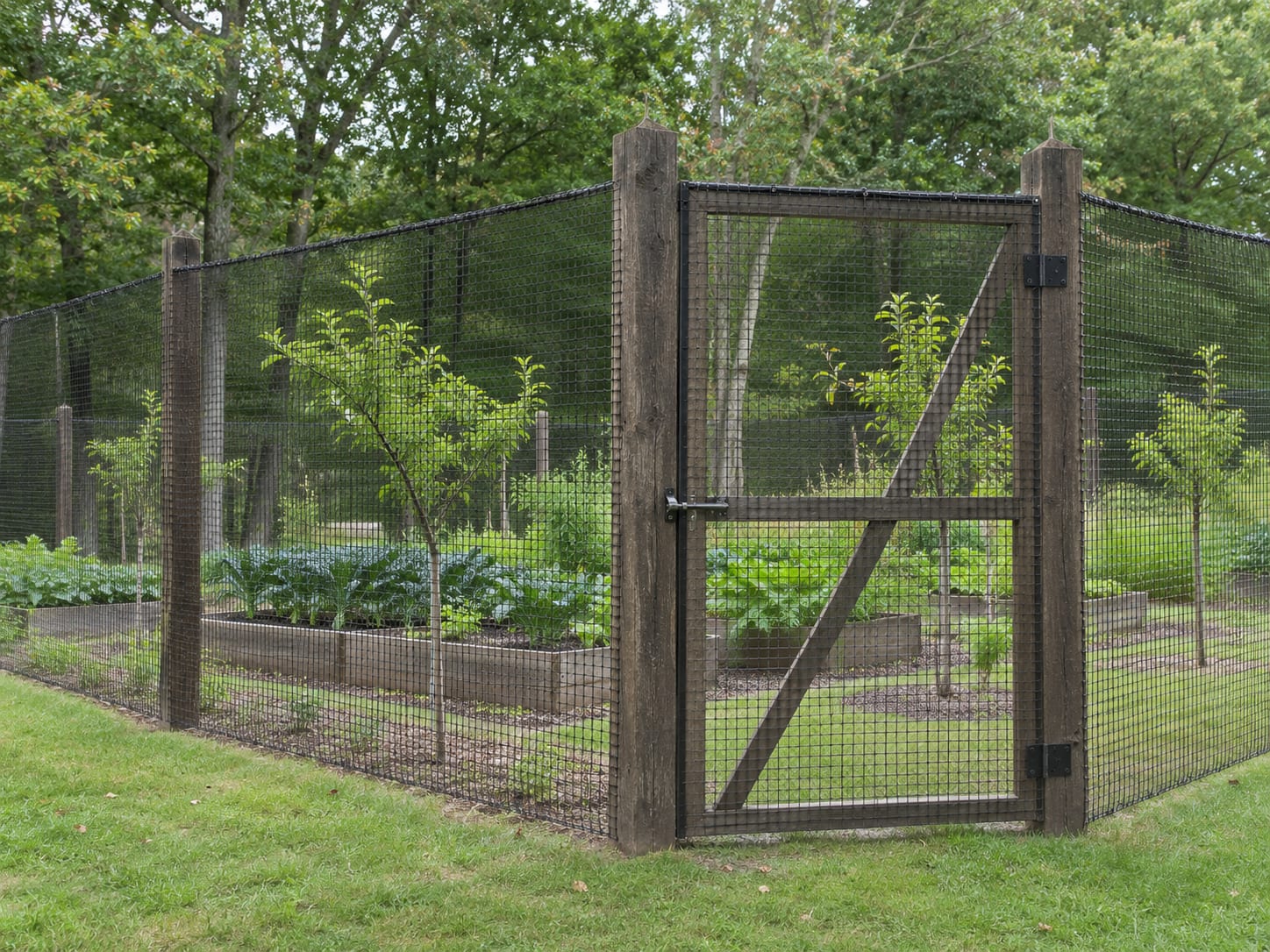
Beyond height, the fence should reach the ground, have gaps no larger than about 6 by 6 inches where mesh is used, and include gates that close the full opening. A driveway, pedestrian gate or low spot beneath the fence can give deer an entry point even when the rest of the fence is tall.
For a garden or orchard, you may not need to enclose the entire home lot. A separate protected planting area can reduce the amount of fencing while keeping the barrier tall and continuous around the plants that matter most. For a farm, nursery, or larger rural property, fencing the full perimeter may provide better control than protecting individual rows.
DEEP recommends approximately 8-foot fencing for deer exclusion, and UConn Extension provides additional guidance on height, mesh openings and the bottom edge.
Hover or tap a row to highlight it.
| Design point | Practical guidance |
|---|---|
| Recommended height | Approximately 8 feet for reliable exclusion |
| Lower working range | About 7 to 8 feet, depending on design and site |
| Mesh openings | No larger than 6 by 6 inches |
| Bottom edge | Extend to the ground so deer cannot pass underneath |
| Gate coverage | Close the entire fence opening, including driveways |
| Electric options | Seven-strand slant-wire or six-wire vertical designs, with wires about 8 to 10 inches apart |
What Southbury's setback rule means for an 8-foot fence
Southbury's zoning regulations define setbacks as not applying to "fences or walls six (6) feet or less in height." That provision appears in Section 2 under "Setbacks, Fences, Walls and Terraces."
An 8-foot deer fence is above that height. For fences over 6 feet, the applicable zoning-district setbacks must be reviewed. Schedule B, Section 4, item 8 lists minimum setbacks from property lines ranging from 10 to 50 feet by zoning district. Schedule B, Section 4, items 7.1 and 7.2 list street setbacks that generally range from 20 to 100 feet by zoning district.
The exact answer depends on your parcel, zoning district, fence location and property boundaries. Contact the Southbury Zoning Department at 203-262-0665 before installation. The department determines whether structures conform to the zoning regulations and may require a site plan.
Bring a recent survey or plot plan if you have one. Mark the proposed fence, gates, driveway openings, neighboring boundaries, easements, rights-of-way and existing stone walls. A fence that appears to sit well inside the yard from the driveway may be closer to a property line than expected once the boundary is measured.
For a broader look at how local requirements can differ, see How Tall Can a Fence Be in Connecticut? Height Rules for Front, Back and Corner Lots.
The Building Department and Inland Wetlands
Southbury zoning review and building-code review are separate questions. The State Building Code exempts ordinary fences not over 7 feet from a building permit. An 8-foot deer fence is above that exemption, so ask the Southbury Building Department whether a building permit is required for your proposed height and construction.
The Building Department can be reached at 203-262-0609 or building@southbury-ct.gov. It is located at 501 Main Street South, third floor. A fence associated with a swimming pool is a separate situation because pool barriers are treated under their own building-code requirements.
Wet ground can affect both approval and construction. Southbury's Inland Wetlands Department states that upland review areas extend 50 feet from wetlands, watercourses and ponds, and 100 feet from named watercourses and waterbodies. The town identifies the Pomperaug River, Shepaug River, Housatonic River, Lake Lillinonah, Lake Zoar, Bullet Hill Brook, Eight Mile Brook and Transylvania Brook as watercourses or waterbodies requiring attention during wetlands review.
If your proposed route is near any of those features, contact the Southbury Inland Wetlands and Watercourses Department at 203-262-0624. The department is at 501 Main Street South, third floor.
Uneven ground and old stone walls can change a Southbury route. Use the USDA Web Soil Survey for site-specific information about soil, drainage, slope and installation limitations. A fence crew still needs to evaluate the actual route before finalizing post depth, equipment access and clearing.
Contact Call Before You Dig before excavation or post installation. If you hire a contractor, you can also use the Connecticut Department of Consumer Protection's building information page to verify registration requirements.
Southbury Deer Fence Planning Sequence
- 1
Define the protected area
Decide whether you are enclosing the whole property, a garden, orchard, crop block or individual planting area.
- 2
Map the route
Mark property lines, gates, driveways, slopes, wet areas, stone walls, watercourses and existing structures.
- 3
Ask Southbury Zoning
Confirm the height, setbacks, zoning approval and whether a site plan is required.
- 4
Ask Building and Inland Wetlands
Confirm building-code requirements and whether the route enters a wetland or upland review area.
- 5
Call Before You Dig
Complete utility marking before posts, anchors or other excavation.
- 6
Install the perimeter
Set posts, attach mesh or wire, close the bottom edge and install gates that cover the full opening.
- 7
Inspect and maintain
Check for sagging, tears, vegetation contact, gaps under gates and openings at fence ends.
For more preparation on a rural or crop property, see Agricultural Fencing in Southbury, CT: Start With the Animals.
Choosing a deer fence material
Black polypropylene or plastic mesh is often a practical choice for a garden, orchard or planting block. CAES describes black plastic mesh as lightweight, sturdy, relatively unobtrusive and commonly about 8 feet high. It can reduce the visual weight of a tall fence, but it still needs strong posts, a secure gate and regular inspection for tears, sagging and gaps.
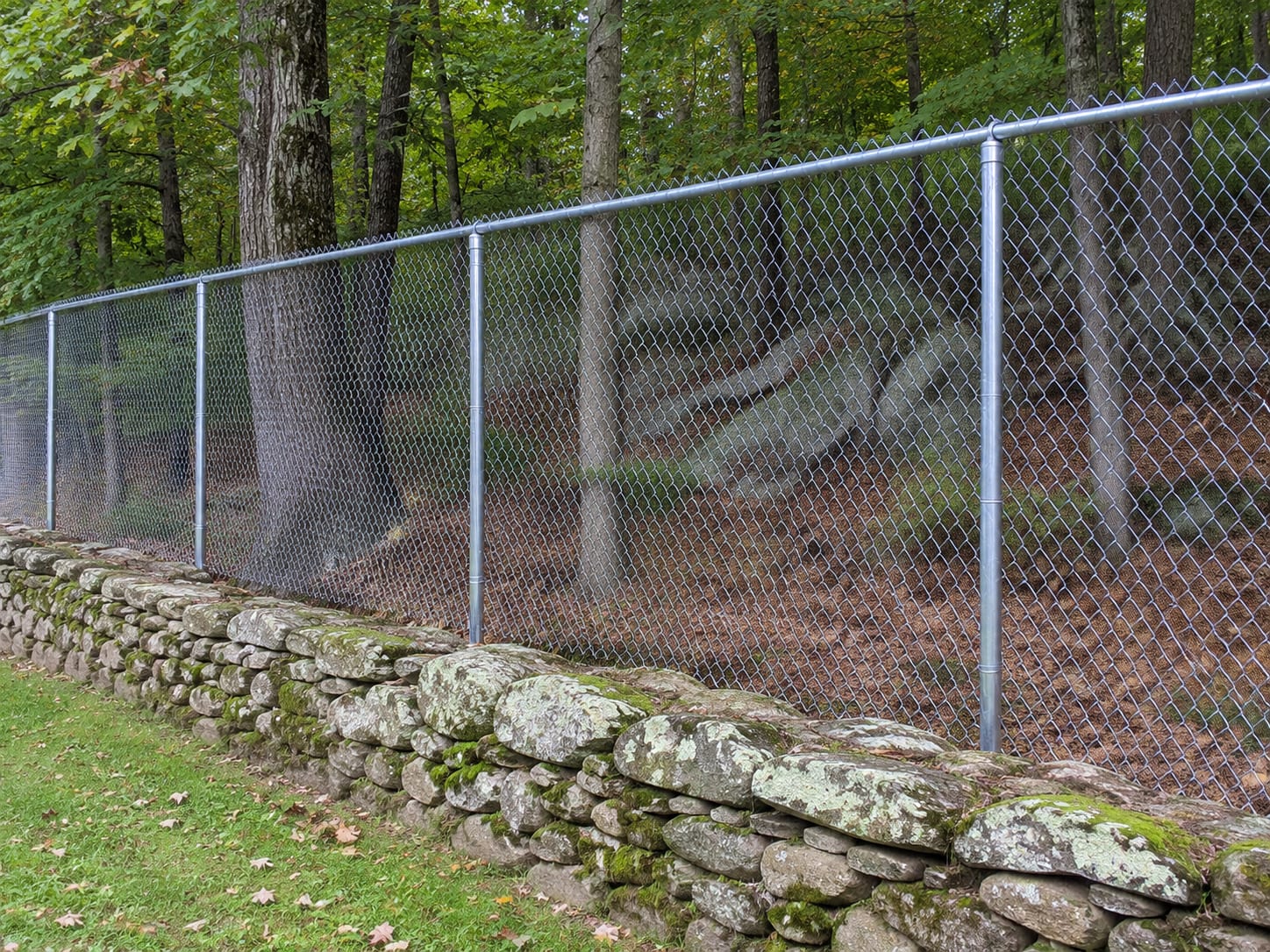
Woven wire and cattle fencing can work where you need a more physical barrier. Permanent chain link is reliable and durable, although CAES describes it as more expensive than lighter mesh options. Metal fencing may make sense around a property where the fence must withstand repeated contact, animals, snow or long-term use.
Electric high-tensile wire is another option. DEEP identifies a seven-strand slant-wire fence and a six-wire vertical fence, with spacing of about 8 to 10 inches. Vegetation must be cleared from the fence line so plants do not short the system. Electric fencing requires regular upkeep and careful placement around children, pets, livestock and public access.
A double-fence layout can help when a single tall fence is difficult to place. Two lower fences separated by several feet can be harder for deer to clear in one jump. A slanted or offset fence can also reduce the apparent height from one side while adding distance to the jump. These designs still need a continuous route, secure ends and gates that close properly.
For a permanent metal barrier, Chain Link Fencing in New Milford, CT: Residential, Farm and Commercial Uses shows how chain link fits a rural property.
Hover or tap a row to highlight it.
| Item | Published cost |
|---|---|
| Plastic wire | $6 to $10 per linear foot, national HomeAdvisor estimate |
| Metal wire | $10 to $15 per linear foot, national HomeAdvisor estimate |
| Deer fence installation | $1,400 to $7,000 per project, national HomeAdvisor estimate |
| Gates | $150 to $1,000 per gate, national HomeAdvisor estimate |
| Southbury project price | Depends on footage, gates, materials, access and permit-related work |
The national figures above come from HomeAdvisor's deer fence installation cost estimate, updated in 2026. They are national planning numbers, not Southbury prices. Ask for a written estimate that states the fence height, material, linear footage, number and type of gates, post system, clearing, excavation, access requirements and permit-related costs.
My Fence Guy writes quotes that separate fencing, gates and site work, so each line can be compared.
Whole property, garden area or individual plants?
The best fence size depends on what you are protecting. If deer are damaging a vegetable garden, berry patch or small orchard, enclosing that area can be more practical than fencing the whole lot. The fence should surround the planting area completely, including the side where deer approach from the woods.
For larger farms or properties with several planting areas, a full perimeter may reduce repeated repairs and make gate use simpler. It costs more because the linear footage increases, but the protected area may be easier to manage once the fence is complete.
Individual plant guards can work for young trees, shrubs or specimens that need short-term protection. DEEP identifies wire mesh around individual plants as an option. Plant guards do not protect a group of plants, and they need to be checked as plants grow.
Plant selection can reduce browsing pressure, but it does not replace a fence when you need reliable exclusion. Deer preferences change with season, location, food supply and deer density. DEEP lists black cohosh, wild columbine, wild ginger, butterfly milkweed, Pennsylvania sedge, hay-scented fern, winterberry, switchgrass, little bluestem, foamflower and New England aster as examples of less-desirable plants.
UConn Extension lists sweetfern, wild ginger, winterberry, switchgrass, little bluestem and New England aster among plants rated rarely damaged or seldom severely damaged. It also identifies apple, pear, plum, blueberry, arborvitae, azalea, rhododendron, rose and strawberry as highly susceptible to deer damage. CAES lists commonly resistant garden plants such as daffodil, snowdrop, lavender, lemon balm, mint, catmint, oregano, thyme, yarrow, Russian sage, boxwood, barberry, birch, spruce, spirea and potentilla.
No plant should be treated as completely deer-proof. When food becomes scarce or deer pressure rises, animals may eat plants they usually avoid.
Southbury is in Deer Management Zone 6 on the DEEP Deer and Turkey Management Zone map. DEEP's 2024 Connecticut Deer Program Summary reported 60 deer harvested in Southbury, including 31 during fall archery, 10 by muzzleloader, 4 in lottery hunting, 2 in no-lottery hunting and 12 by other listed methods, with one additional category entry in the table. Harvest totals are not a population-density estimate.
DEEP reports that deer densities above approximately 10 to 20 deer per square mile can negatively affect natural plant communities. A historical DEEP estimate for Deer Management Zone 11, which is a different zone, was 61.8 deer per square mile in 2009. That figure should not be used as Southbury's current density.
Property boundaries and neighbor questions
Place the fence from a measured boundary rather than relying on a visual line, old posts or the edge of a mowed area. An old stone wall may be near a boundary, but it should not be treated as the legal property line without checking your survey or other property records.
If the fence sits near a neighbor, driveway, shared access route or easement, put the location and maintenance responsibilities in writing. Discuss who can open the gate, who handles repairs, whether either party needs access for mowing or tree work, and how changes to drainage or vegetation will be handled.
Connecticut General Statutes Sections 47-43 through 47-56 address sufficient fences and division fences. Sections 52-480 and 52-570 address malicious structures intended to annoy or injure a neighboring property owner. For a specific boundary dispute or disagreement about a fence, talk with a Connecticut real estate attorney.
A written contractor quote should identify the fence line, height, material, gate locations, bottom treatment, removal or trimming of vegetation, post installation, cleanup and any work that depends on town approval. That detail gives you a clearer basis for comparing bids.
Frequently Asked Questions
How tall does a deer fence need to be in Southbury?
Plan on approximately 8 feet for reliable deer exclusion. DEEP recommends about 8 feet, UConn Extension recommends at least 7 to 8 feet, and CAES describes effective fencing as approximately 7 to 10 feet high.
Can I put up an 8-foot deer fence in my yard?
An 8-foot deer fence may be possible, but Southbury zoning review depends on your parcel, zoning district, setbacks, fence location and site conditions. Ask Southbury Zoning about approval and setbacks, then ask the Building Department about building-code requirements.
Do deer jump a 6-foot fence?
Yes, deer can jump up to 8 feet. A 6-foot fence may reduce entry in some locations, but a double-fence, slanted design or suitable electric-wire system may be needed when an 8-foot fence cannot be used.
What is the cheapest deer fence that works?
For a small garden or orchard, black plastic mesh is generally the lowest-cost full-height option described in the cited Connecticut guidance. National HomeAdvisor estimates place plastic wire at $6 to $10 per linear foot, but your Southbury price depends on footage, gates and access.
Will deer jump into a small fenced area?
Yes, deer can enter a small area if the fence is too low, the gate is open, the bottom has gaps or the fence stops at a driveway. A properly installed 7 to 8-foot fence around the entire planting area can protect a small garden or orchard.
Do I need a permit for a deer fence?
Ask both Southbury Zoning and the Building Department before work begins. The State Building Code exempts ordinary fences not over 7 feet from a building permit, while Southbury zoning treats fences over 6 feet under its applicable setback standards. Wetlands review may also apply near wetlands, watercourses, ponds or named waterbodies.
Southbury Deer Fence Check
1. What height does DEEP recommend for effective deer exclusion?
2. What should you do before digging fence posts in Southbury?
3. Which Southbury office should you contact about setbacks and zoning conformity?
4. Which fence feature helps prevent deer from passing beneath the barrier?
5. Which plant group includes examples of highly susceptible plants?
Pick an answer to begin.
Final Thoughts
For a Southbury deer fence, start with the protected area and the height, then work through the route, setbacks, gates, wetlands and permit questions. An 8-foot mesh fence can be a practical choice for a garden, orchard or crop area, while chain link or another metal system may fit a property that needs a more permanent physical barrier.
Get the fence line measured, confirm the town requirements, and ask for a written estimate that separates materials, gates and site work. Call us at (203) 746-1100 for a free estimate, or reach out through our contact page.
Deer Fencing Terms
Tap a term to see what it means.
Closed perimeter. A fence route that surrounds the protected area, including gates and driveway openings.
More about fences
Agricultural Fencing in Southbury, CT: Start With the Animals
A farm fence in Southbury, CT has to outlast the animals leaning on it. Species, spacing, gates, and zoning, before you set the first post.
Read the guide to Agricultural Fencing in Southbury, CTDeer Fencing in New Fairfield, CT: The Six-Foot Limit and What Works
Deer fencing in New Fairfield starts with how much ground to protect: an 8-foot garden enclosure, the town's 6-foot limit and Special Permit, and costs.
Read the guide to Deer Fencing in New Fairfield, CTFarm and Livestock Fence Types: What Works for Goats, Sheep, Cattle and Poultry
Fencing for goats, sheep, cattle, pigs and poultry: woven wire, cattle panels, electric netting, predator protection in Connecticut and NRCS cost-share.
Read the guide to Farm and Livestock Fence Types