
Vinyl Fencing in Monroe, CT: Styles, Costs and Town Rules
By Tony Pellicone13 min readPublished
- vinyl fencing
- monroe ct
- connecticut
Vinyl fencing can work well in Monroe when you match the style to the job and confirm the fence line with town offices first. Monroe’s ordinary fence limit is six feet, and a 100-foot project can range from about $1,400 for national picket pricing to $6,000 for national privacy pricing, before gates and removal.
The main choice is how much of the view you want to block and how much wind you want the fence to pass. A privacy panel gives the most screening but creates the greatest continuous wind surface. A picket or ranch-rail fence allows more airflow.
Before ordering materials, ask Monroe Planning and Zoning about the proposed height, location and gates.
Key Takeaways
Height
Monroe’s zoning regulations limit ordinary fences, gates and walls to six feet.
Style
Privacy panels block the most view, while picket and ranch-rail styles allow more airflow.
Footings
Post holes commonly run about 30 to 36 inches deep, depending on height, soil, frost line and wind exposure.
Cost
National 2026 installed pricing ranges from about $14 to $60 per linear foot, depending on style.
Town review
Ask Monroe Planning and Zoning before work about approvals, setbacks, right-of-way and corner-lot sight lines.
Site work
Slope and old stone walls can change the written estimate.
Choosing the right vinyl fence style
Vinyl fencing comes in several construction types. The picket shape, spacing, rail reinforcement, post design and panel height affect privacy, airflow and how the fence handles a particular site.
Privacy fencing
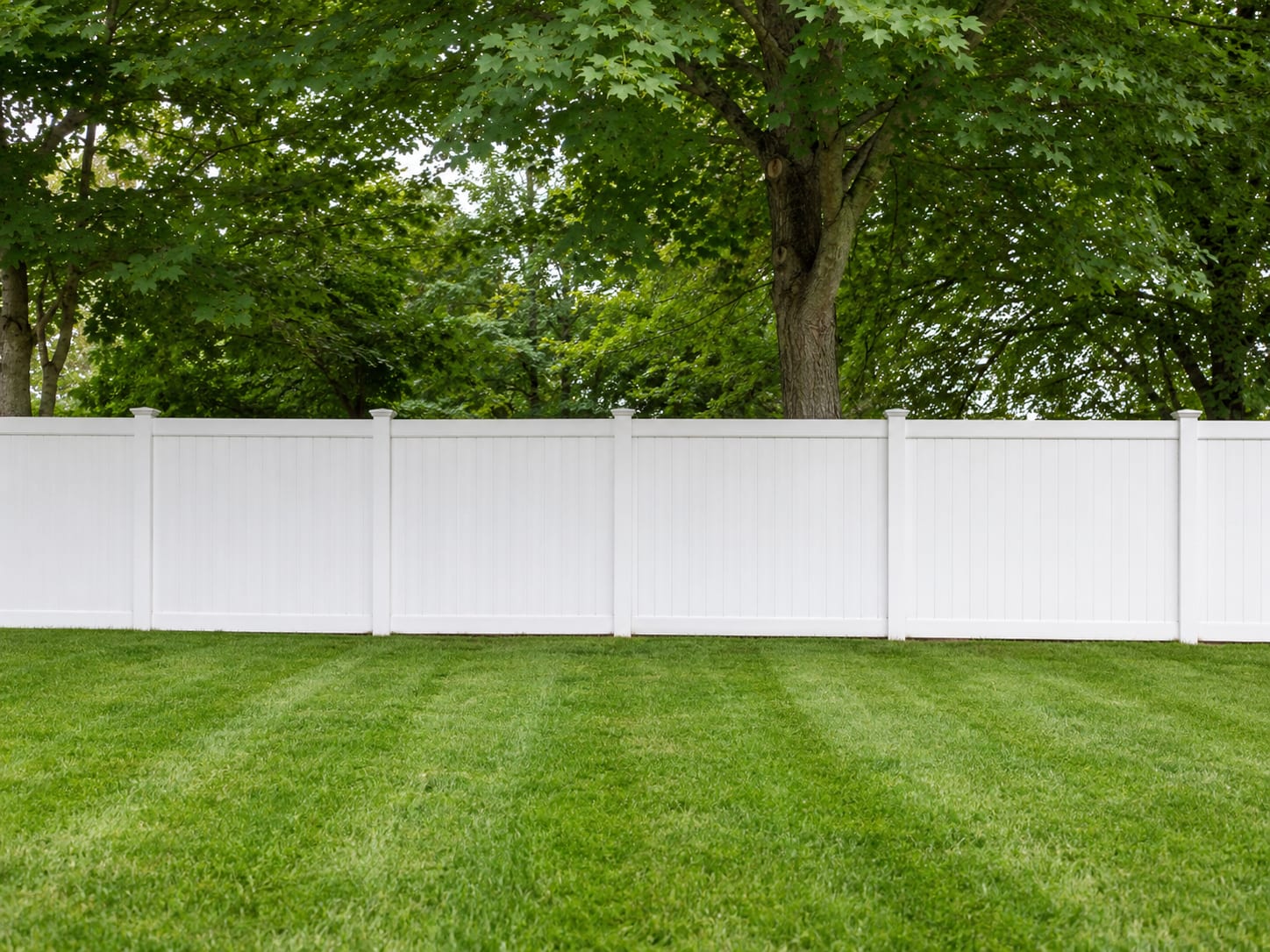
Published privacy models range from four to eight feet, depending on the model. A Savannah-style panel uses 7/8-inch by 6-inch tongue-and-groove pickets, creating a nearly continuous surface. Privacy fencing suits backyard screening, dog containment and property definition when you want limited visibility through the fence.
That solid surface also receives more wind than an open picket or ranch-rail fence. Published installation results for qualifying privacy panels six feet and shorter report up to 110 mph sustained wind and 130 mph gusts when the reinforced installation method is followed. The result depends on the exact model, post reinforcement, footing work and installation method.
Monroe’s six-foot ordinary fence limit matters here. A manufacturer’s eight-foot model may be available, and an eight-foot fence still needs the town’s approval on a Monroe parcel. Confirm the height with Planning and Zoning before you price a taller design.
Semi-privacy fencing
Semi-privacy styles screen part of the yard while leaving openings for airflow and limited visibility. Huntington uses three-inch pickets with approximately 7/8-inch spacing. Alden alternates six-inch and three-inch pickets with approximately 7/8-inch spacing.
This style can be a practical middle ground when you want more screening than a picket fence but less continuous wind surface than a solid privacy panel. It also gives you a different view from each side, depending on the picket arrangement and fence height.
Published model information lists several semi-privacy styles in five- and six-foot heights. Monroe’s six-foot limit makes these models especially relevant for residential side and rear yards, subject to the fence location and other zoning conditions.
Picket fencing
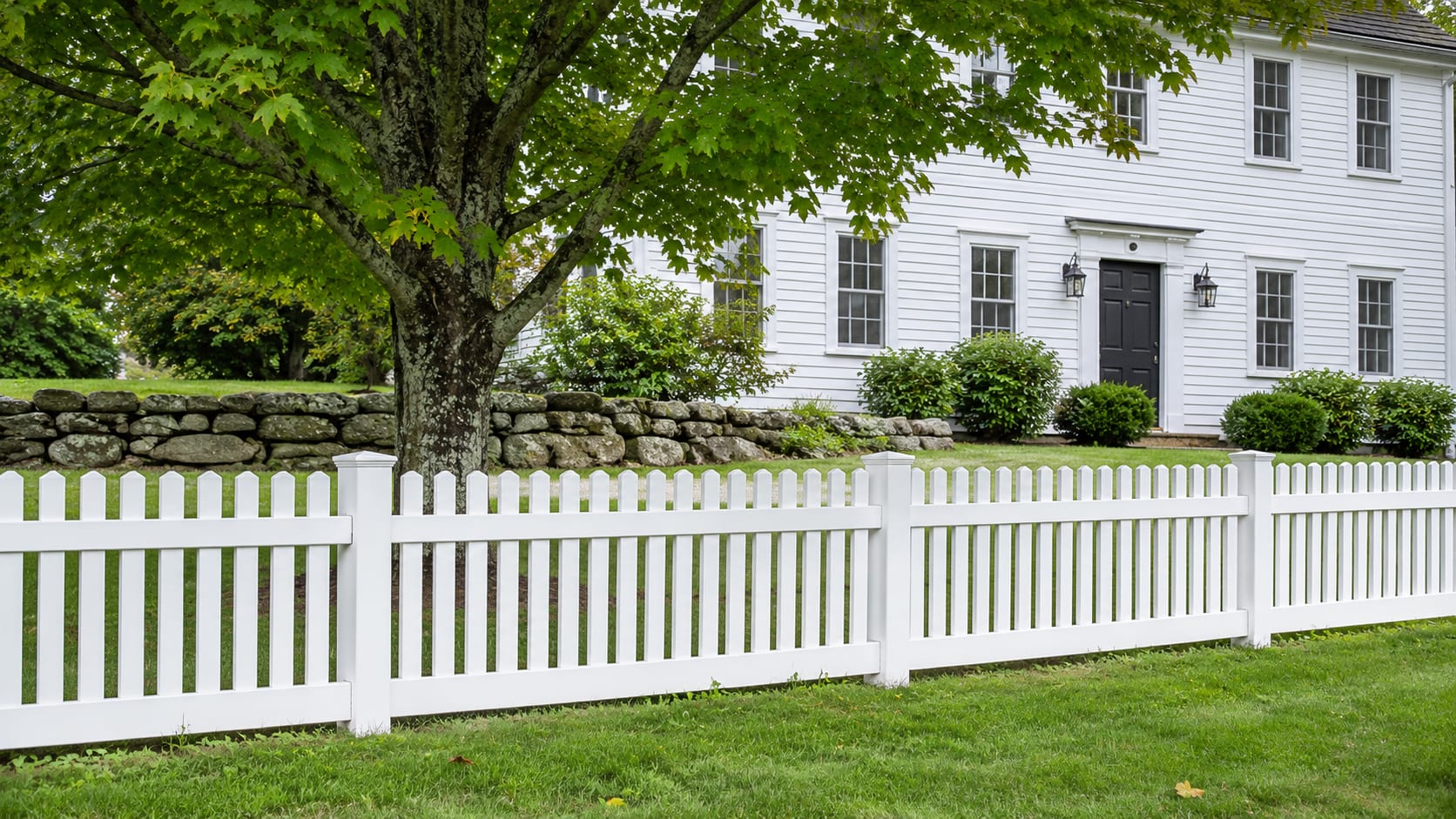
Open picket styles, including three- and four-foot configurations, provide a clear property boundary with substantial airflow. They work well for front-yard definition, decorative frontage, gardens and places where you want the yard to remain visible from the street.
Picket fencing gives little privacy, and the open spacing reduces the wind surface compared with a solid panel. If the purpose is to keep a dog in the yard, the picket spacing, gate latch and bottom clearance matter as much as the material.
For a comparison of materials before you choose, see Wood vs Vinyl Fence: Cost, Upkeep and Lifespan in Connecticut.
Post-and-rail or ranch rail
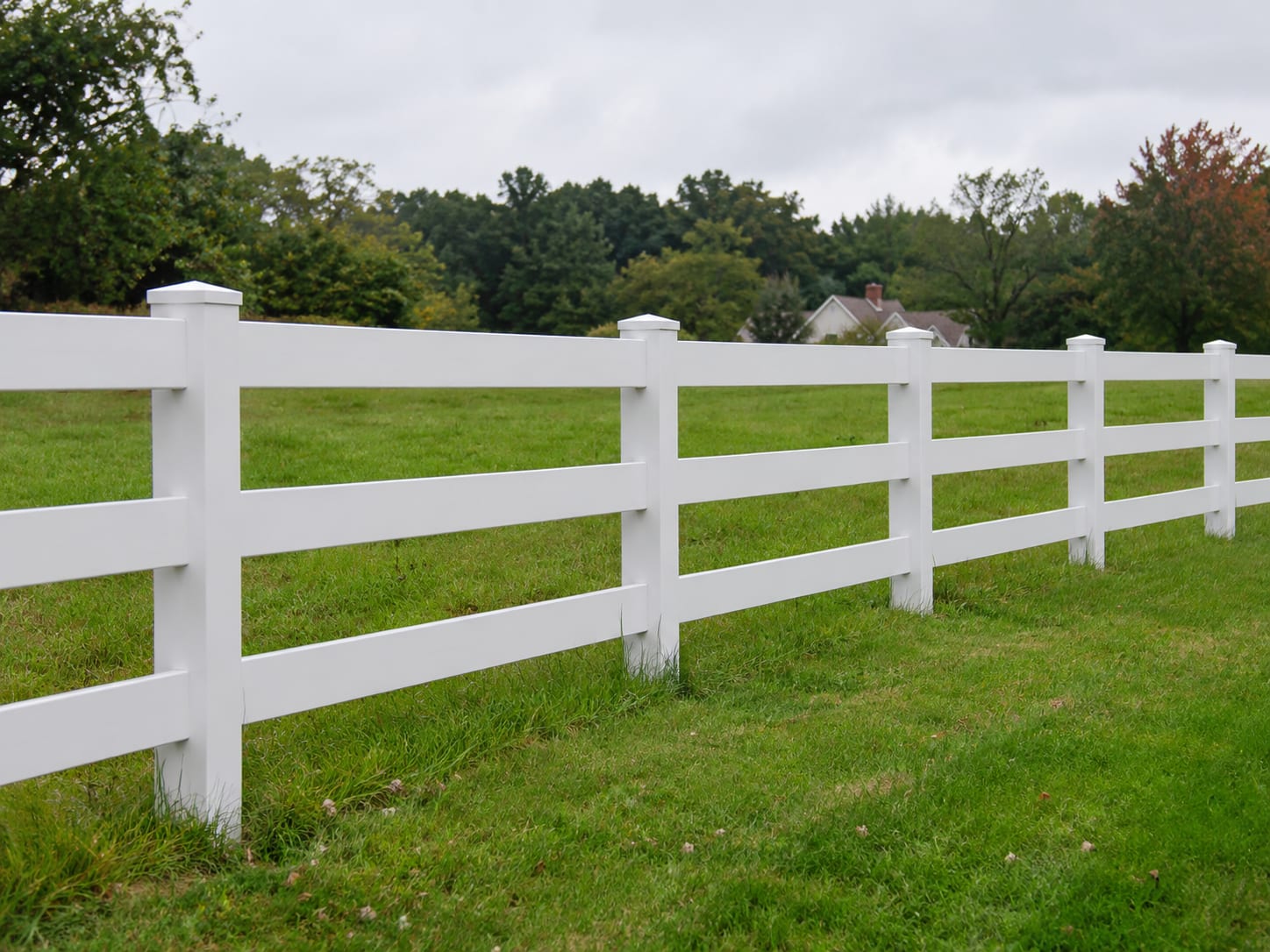
Two-, three- and four-rail vinyl systems are commonly used for agricultural areas, perimeter definition, livestock areas and large properties. They allow substantial airflow and give minimal privacy.
Ranch rail can mark the edge of a field or driveway without making the property feel closed in. A close-spaced pet fence or a pool barrier is a different product. Livestock containment also depends on the animal, rail spacing, corner layout and gate design.
Wall thickness, rail reinforcement, routed posts, wind instructions and the installation depth specified for the model all affect structural quality. Some published vinyl products use wall thicknesses around .060 or .065 inches and aluminum reinforcement in bottom rails. Warranty terms vary by manufacturer and model, so read the installation and warranty requirements with the product specifications.
You can compare available options on the vinyl fencing product page.
Hover or tap a row to highlight it.
| Style | Published examples | Privacy and airflow |
|---|---|---|
| Privacy | Four to eight feet, depending on model; tongue-and-groove pickets | Highest privacy and greatest continuous wind surface |
| Semi-privacy | Generally five or six feet; three-inch or alternating pickets with spacing | Partial screening with moderate airflow |
| Picket | Commonly three- and four-foot configurations | Little privacy and substantial airflow |
| Ranch rail | Two-, three- and four-rail systems | Minimal privacy and high airflow |
Monroe height, location and permit questions
Monroe’s published fence FAQ says residents should refer to Article 1, Section 1.9.11 and check with the Zoning Office because exceptions exist. The town’s zoning regulations state that fences, gates and walls shall not exceed six feet, measured from adjacent ground level to the top of the fence, gate, wall or combination.
The same regulations address placement. A fence cannot be located within an abutting public street right-of-way. It cannot obstruct a clear line of sight for traffic. The finished side must face outward toward the street or neighboring property.
Front-yard rules apply to property lines along streets, and additional sight-line restrictions apply near curves, intersections and corner lots. Within the corner-lot area described by the regulations, maintained clearance is limited to 24 inches above street grade within 25 feet of intersecting lot lines.
The practical first call is Monroe Planning and Zoning. Ask whether your proposed height, location, style and parcel conditions require zoning approval, a Certificate of Zoning Compliance or a building permit. Monroe’s online permitting system connects Building, Planning and Zoning, and Inland Wetlands departments.
A building permit, when required, carries the town’s published building-fee schedule, including $30 for the first $1,000 of estimated work and $10 for each additional $1,000 or portion. Ask the town which approval and current fee apply to your fence.
For broader Connecticut permit questions, see Do You Need a Permit for Fence Installation in CT?.
A fence used around a pool has another layer of requirements. Connecticut pool-barrier rules generally require a residential pool barrier at least 48 inches above grade, along with limits on bottom clearances and gate requirements under the applicable building-code provisions. Ask the Building Department how the pool barrier rules apply to your fence design.
Ground conditions change the installation
Vinyl resists rot, rust, insects and moisture, with UV inhibitors intended to limit fading. That suits wet Connecticut weather, and the posts still depend on sound excavation and concrete placement.
Published installation guidance commonly calls for post holes about 30 to 36 inches deep. The final depth depends on fence height, soil, frost line, wind exposure and local requirements. Ranch-rail instructions describe standard posts set about 2.5 feet into the ground with cement.
That depth matters in frost-prone soil. If a post is shallow, poorly compacted or set in unsuitable material, freeze-thaw movement can push the fence out of alignment. A written estimate should identify post depth, concrete work and any extra excavation.
Slopes, ledge and old stone walls
A slope may call for stepped panels, racking, transition brackets, special posts or another style. Published slope limits vary by model. Examples include approximately five inches over eight feet for a Savannah privacy model, four inches over eight feet for Bradford, and three inches over eight feet for several semi-privacy models.
If the slope exceeds the model’s limit, a stepped layout may leave visible gaps below panels unless the bottom line is carefully planned. A gate on a slope also needs enough clearance to swing or roll without dragging.
Ledge and old stone walls change the post layout. A standard in-ground post may be impossible where solid rock or a wall blocks excavation. The fence may need to sit beside the wall, use a suitable surface-mounted connection, or follow a different line. Fastening vinyl to an old stone wall takes a site-specific structural plan.
Monroe’s soil mapping can help identify general soil limitations for a parcel. For difficult post locations, ask about test holes or field investigation before the material order is placed.
Wetlands, watercourses and parcel layout
Monroe directs property owners to discuss disturbance near wetlands and watercourses with the Inland Wetlands Office. Activities such as clearing, grading, filling, excavating, paving, constructing or placing structures can bring the project into wetlands review areas.
The town identifies a 100-foot area around designated wetlands and a 150-foot area around designated major watercourses or recognized bodies of water for discussion with Inland Wetlands. A fence near Lake Zoar or the Housatonic River may also raise questions about floodplain conditions, access and erosion.
Bring the property address, a sketch or survey, proposed fence line, height, style, gates and information about wetlands, watercourses, stone walls and unusual grade. Ask whether the fence is within the applicable review area and which office should review the plan.
Monroe’s zoning map also identifies historic-district boundaries. If your parcel lies within a mapped historic district, ask Planning and Zoning or the applicable historic authority what review applies before installation.
Call 811 before digging. Connecticut’s Call Before You Dig requirements apply before excavation, even for a residential fence project.
Before vinyl fence installation
- 1
Confirm the line
Review the property line, street frontage, corner conditions, gates and any survey or recorded plan.
- 2
Call Monroe Planning and Zoning
Ask about height, placement, zoning approval, Certificate of Zoning Compliance and building permits.
- 3
Ask about wetlands
Contact Inland Wetlands when the fence is near wetlands, a watercourse, Lake Zoar or the Housatonic River.
- 4
Call 811
Request utility marking before post-hole excavation.
- 5
Settle the design
Choose privacy, semi-privacy, picket or ranch rail, then confirm slope, post depth, gate swing and reinforcement.
- 6
Put the scope in writing
List materials, height, fence line, gates, removal, cleanup, payment schedule, permit responsibility and warranty.
- 7
Install and inspect
Set posts, place concrete, align panels, hang gates and complete any town review that applies.
What a Monroe vinyl fence may cost
National 2026 pricing gives you a starting point for a Monroe bid. Style, length, gates, height, excavation and old-fence removal drive most of the difference.
Angi reports national installed pricing of about $15 to $40 per linear foot for standard four- or six-foot vinyl fencing, $14 to $20 per linear foot for picket fencing and $25 to $60 per linear foot for privacy fencing. Materials alone run about $10 to $30 per linear foot in the same national data.
For a 100-foot fence, that works out to approximately $1,500 to $4,000 for standard vinyl, $1,400 to $2,000 for picket and $2,500 to $6,000 for privacy. A gate may add about $300 to $1,500 each. Removal may add about $3 to $5 per linear foot, or approximately $300 to $500 for 100 feet.
Angi reports a national average installed vinyl-fence project cost of $4,164 in 2026, with most projects between $2,340 and $6,001. The figure covers national projects, so treat it as a budgeting reference and get a local Monroe quote for the real number.
Hover or tap a row to highlight it.
| Work or style | National unit cost | 100-foot illustration |
|---|---|---|
| Standard four- or six-foot vinyl | $15 to $40 per linear foot | $1,500 to $4,000 |
| Vinyl picket | $14 to $20 per linear foot | $1,400 to $2,000 |
| Vinyl privacy | $25 to $60 per linear foot | $2,500 to $6,000 |
| Materials only | $10 to $30 per linear foot | $1,000 to $3,000 |
| Labor component | $5 to $10 per linear foot | $500 to $1,000 |
| Gate | About $300 to $1,500 each | Added to fence total |
| Old-fence removal | About $3 to $5 per linear foot | About $300 to $500 |
A local quote should separate panels, posts, rails, reinforcement, concrete, excavation, gates, corners, removal, disposal and cleanup. My Fence Guy can also point out where slope or an old wall changes the installation scope.
For more general planning numbers, read How Much Does a Fence Cost in Connecticut? What Drives the Price. For a specific site, a written quote is more useful than a national range applied without a look at the ground.
What to settle before ordering
Start with the purpose. Privacy, pet containment, pool safety, children, decorative frontage, livestock control and simple property definition each point toward a different style.
Then confirm the height and line. Monroe’s six-foot limit applies to ordinary fences, and the measurement is from adjacent ground level to the top. A changing grade can affect how the height is measured along the run. A corner lot or driveway entrance may require extra clearance for traffic visibility.
The written scope should cover the exact fence model, color, height, post spacing, rail reinforcement, gates, hardware, removal, disposal, cleanup and warranty. It should also state who handles town approvals and what happens if excavation hits ledge or an old wall.
For residential work, Connecticut’s Department of Consumer Protection requires a written contract for covered home-improvement work and regulates Home Improvement Contractor registration. A homeowner doing work on the homeowner’s own property is treated differently from a consumer hiring a contractor. Ask for the contractor’s registration information and keep the signed contract.
If a boundary disagreement develops, speak with a Connecticut real-estate attorney. Fence placement, boundary ownership and division-fence issues can involve property rights beyond the installation itself.
Frequently Asked Questions
How much does a 100-foot vinyl fence cost in Monroe, Connecticut?
A 100-foot vinyl fence has a national 2026 planning range of about $1,400 to $2,000 for picket, $1,500 to $4,000 for standard four- or six-foot vinyl and $2,500 to $6,000 for privacy fencing. A Monroe quote can change with gates, slope, ledge, wetlands review, removal, access and excavation.
How much does labor cost to install a vinyl fence?
National 2026 labor pricing is about $5 to $10 per linear foot, or roughly $500 to $1,000 for 100 feet. Ask whether the labor amount includes layout, post-hole excavation, concrete, reinforcement, gates, removal, disposal and cleanup.
Can a homeowner install vinyl fencing?
Yes, a homeowner can install many vinyl systems by following the model’s layout and footing instructions. You still need to address Monroe’s height and placement rules, wetlands review, pool-barrier requirements when applicable, utility marking and safe post installation.
Does vinyl fencing increase home value?
Vinyl fencing can improve privacy, pet containment, pool safety, outdoor use and curb appeal, but the resale effect varies by property and buyer expectations. Compare similar Monroe properties and ask a local real-estate professional how buyers respond to the proposed style.
Do I need a permit for a fence in Monroe, Connecticut?
Monroe’s published FAQ says a fence generally does not require a permit, while directing residents to check with the Zoning Office because exceptions exist. Ask Monroe Planning and Zoning whether your location, height, style, pool, wetlands, right-of-way or corner-lot conditions require zoning approval, a Certificate of Zoning Compliance or a building permit.
Vinyl fencing in Monroe
1. What is Monroe’s ordinary maximum fence height?
2. Which vinyl style provides the most visual privacy?
3. What should you do before digging post holes?
4. Which condition can change the post installation?
5. Which office should you contact first about Monroe fence height and placement?
Pick an answer to begin.
Final Thoughts
Vinyl can be a good fit for a Monroe property when the style matches the purpose and the installation matches the ground. Check the six-foot height limit, confirm the fence line, ask about wetlands and sight lines, call 811, and get a written estimate that separates ordinary installation from slope, wall, removal and gate work.
My Fence Guy can help you compare the style, layout and installation scope before materials are ordered. Call us at (203) 746-1100 for a free estimate, or reach out through our contact page.
Vinyl fencing terms
Tap a term to see what it means.
Privacy fence. A close-spaced vinyl fence designed to block most views.
More about fences
Vinyl Fencing in Bethel, CT: Privacy, Picket and Pool Styles for Bethel Yards
Vinyl fencing in Bethel, CT: privacy, picket and pool styles, how a 6-foot solid fence handles wind, what Bethel's rules allow, and 2026 cost ranges.
Read the guide to Vinyl Fencing in Bethel, CTWood vs Vinyl Fence: Cost, Upkeep and Lifespan in Connecticut
Wood or vinyl fence in Connecticut: installed cost, lifespan in freeze-thaw winters, staining and cleaning, storm repairs and how each looks over the years.
Read the guide to Wood vs Vinyl FenceVinyl vs Aluminum Fence: Which Fits Your Connecticut Yard?
Vinyl or aluminum fence for your Connecticut yard? Privacy, strength in wind and cold, pool use, slopes, upkeep, lifespan and installed cost compared.
Read the guide to Vinyl vs Aluminum Fence