
Vinyl Fencing in Bethel, CT: Privacy, Picket and Pool Styles for Bethel Yards
By Tony Pellicone13 min readPublished
- vinyl fencing
- bethel ct
- connecticut
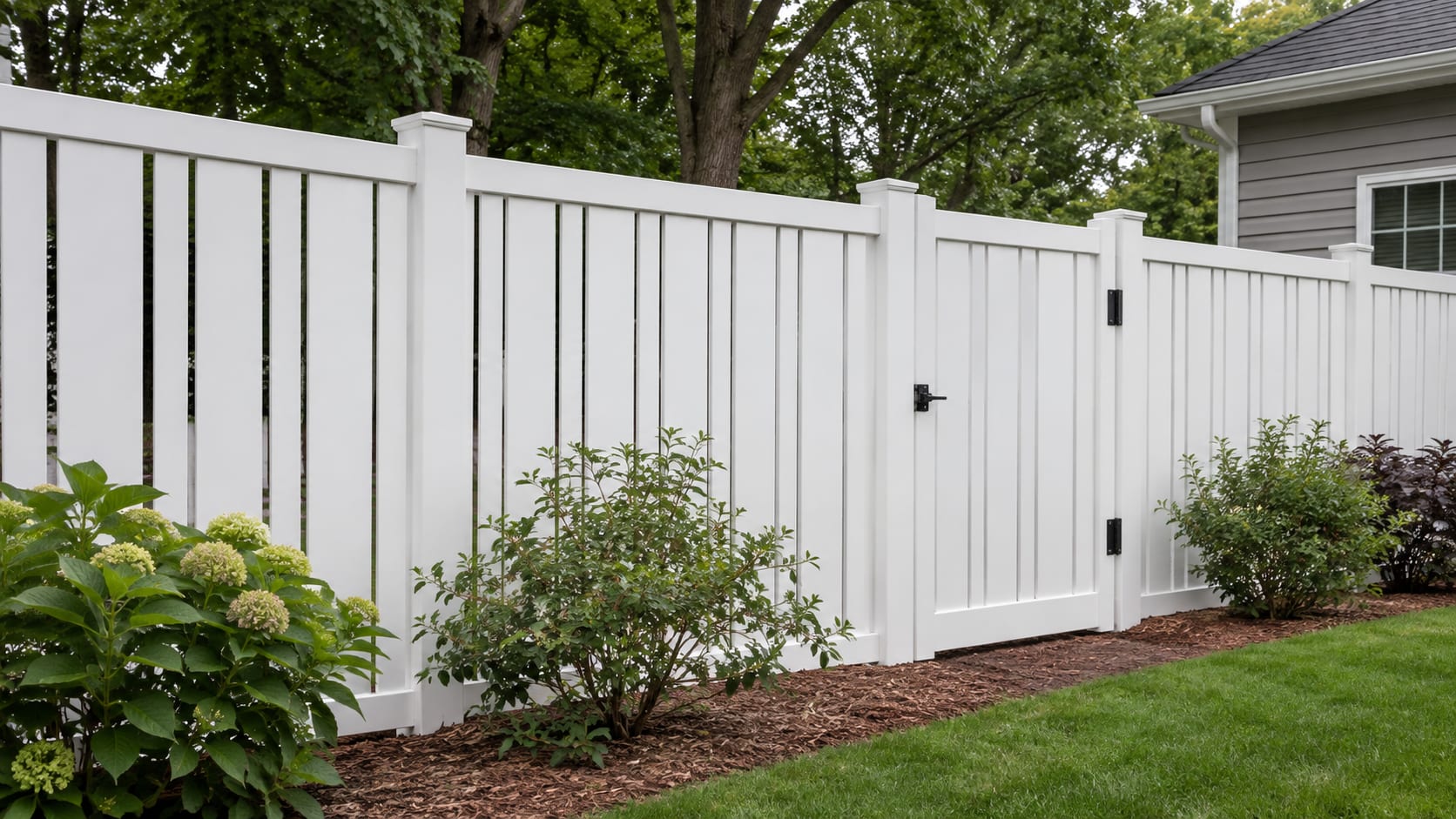
Vinyl fencing suits a Bethel yard that needs low routine maintenance, and the style you pick decides how much privacy and wind exposure you get. A six-foot solid privacy fence catches far more wind than a four-foot picket fence, so posts, reinforcement and footing depth matter as much as the vinyl profile.
Start with the property line, proposed height, setback and corner-lot visibility, then check for a pool or wetlands. National 2026 estimates place installed six-foot vinyl fencing at about $25 to $40 per linear foot in Angi's estimate, and site conditions and gates move the final price.
Key Takeaways
Privacy style
Closely spaced or tongue-and-groove boards provide the most screening and the greatest wind exposure.
Open style
Picket and post-and-rail fences reduce wind load but provide less privacy.
Bethel height
Bethel generally limits fences to four feet in a front setback and six feet in side or rear setbacks.
Pool barrier
A vinyl fence around a pool must meet Connecticut State Building Code barrier requirements.
Site review
Slopes, ledge, wetlands, drainage, sunlight, and the property line can change the design and price.
Written quote
Ask for measured footage, panel specifications, reinforcement, gates, excavation, cleanup, permits, and warranty terms.
Choosing the Vinyl Style for Your Yard
Vinyl fencing comes in several basic layouts, and each one changes the amount of privacy, wind exposure, material, and maintenance access you have.
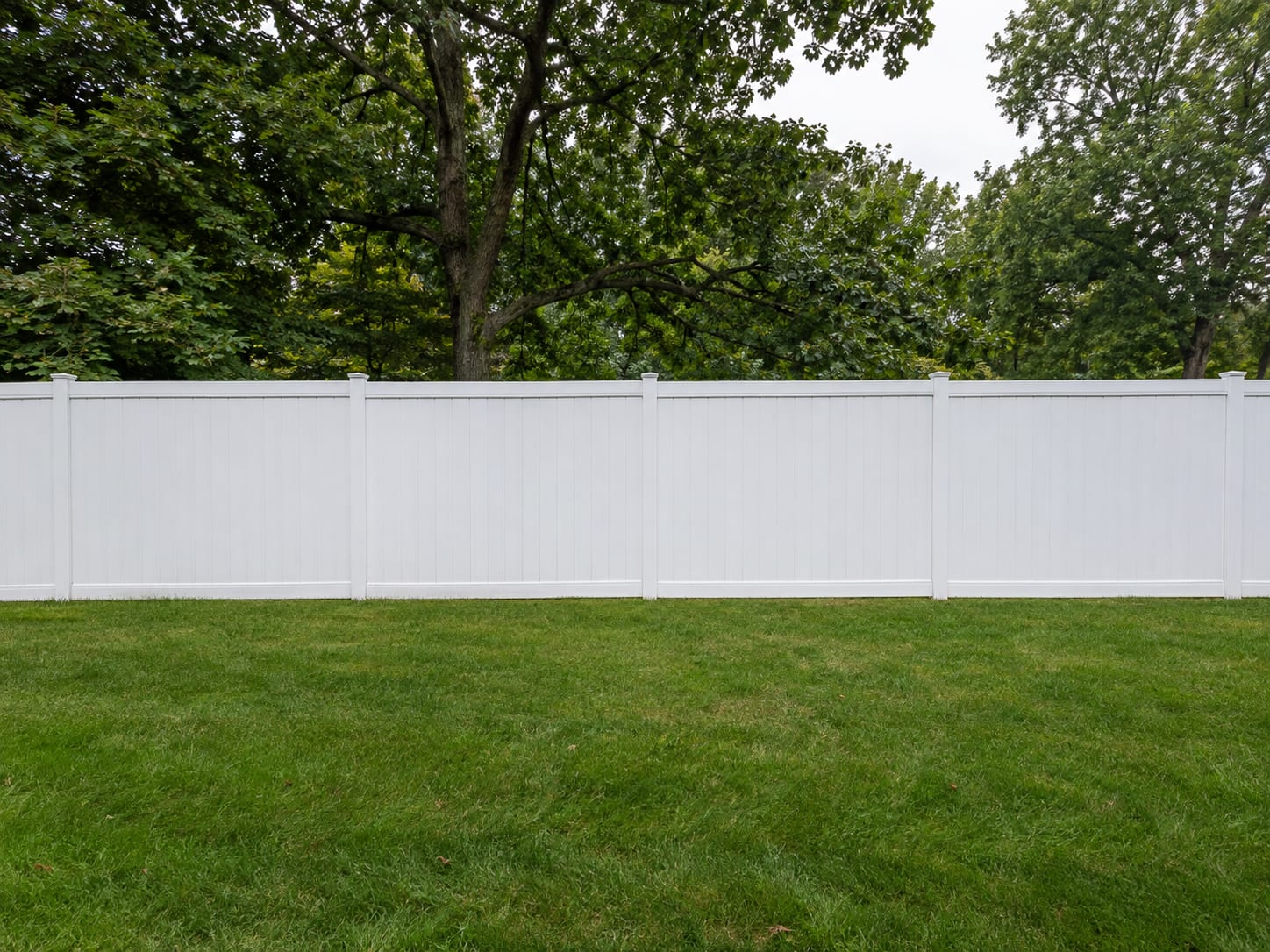
Privacy fencing uses closely spaced boards or tongue-and-groove panels. It gives the highest visual screening for a pool area, back yard, dog run, or boundary beside a neighboring property. The tradeoff is wind. A six-foot solid panel presents much more surface area than a four-foot picket or three-rail fence, so the posts, rails, reinforcement, and footings need to be selected for that load.
Semi-privacy fencing uses spaced pickets, lattice, or partial-height screening. It gives you some separation without closing off the entire yard. Because more air can pass through the fence, wind exposure is generally lower than with a solid privacy panel, but privacy is lower as well.
Picket fencing has open spacing and usually creates a lighter boundary around a front yard, garden, walkway, or pool area. The openings can also make it easier to see children, pets, driveways, and approaching vehicles. For a more detailed comparison of vinyl with another common residential material, see Wood vs Vinyl Fence: Cost, Upkeep and Lifespan in Connecticut.
Post-and-rail vinyl fencing is the most open style. It defines a property boundary without providing privacy and may suit larger lots, rural properties, horse areas, and some agricultural layouts. It works as a boundary fence, and a solid dog enclosure or a privacy screen needs a different style. If you are comparing open rail layouts, Split Rail Fence Guide: Cedar or Pressure-Treated, 2 or 3 Rails, and Cost covers the same basic planning questions for wood systems.
Hover or tap a row to highlight it.
| Style | Privacy | Wind exposure | Common use |
|---|---|---|---|
| Solid privacy | Highest | Highest | Back yards, pool areas, neighbor screening |
| Semi-privacy | Moderate | Lower than solid privacy | Partial screening and side yards |
| Picket | Low | Generally lower | Front yards, gardens, open boundaries |
| Post-and-rail | Minimal | Lowest | Large lots, rural boundaries, livestock-compatible layouts |
A product quote should identify the exact manufacturer and profile, post size, rail size, reinforcement, maximum panel width, color, gate construction, and warranty exclusions. Ask for the profile dimensions and wind-load information before approving the material.
Warranty examples vary. Daytona Vinyl publishes a lifetime residential warranty and 30 years for commercial purchasers. USAVinyl Weatherables publishes a 30-year residential material warranty and 20 years for commercial or other non-individual residential owners. Those warranties include conditions involving installation, reinforcement, heat, ground movement, impact, and weathering.
You can review the available vinyl fencing styles and applications before asking for a quote, but the installed design should be based on your actual yard.
How Vinyl Handles Bethel Sun, Cold and Slopes
Vinyl is resistant to rot, peeling, flaking, and corrosion, and manufacturers use UV stabilizers and titanium dioxide to reduce ultraviolet degradation. You generally will not need to paint or stain it. The surface can still collect dirt, mildew, and algae where the fence stays damp, especially near shaded structures, wet ground, dense plantings, or drainage paths.
South-facing runs receive longer periods of direct sunlight. Reflected or concentrated heat from windows, light-colored walls, or other surfaces can affect some products. Daytona Vinyl treats distortion from reflected or concentrated heat separately from normal weathering, and gradual color change from ordinary weather exposure is handled under its warranty terms. Sections shaded by a house, trees, roof overhangs, or neighboring structures can weather differently from sections in full sun.
Cold weather also matters. Prizm Vinyl states that its products become less flexible in the coldest weather and are engineered for temperatures from -65°F to 120°F. Unusual impact during cold conditions can cause damage. That matters when a crew installs panels in winter, when a snowblower or plow passes near the fence, when lawn equipment strikes a post, or when a branch falls onto a panel.
Sloped yards need a layout decision before the posts are set. A fence may use stepped panels, a specially adapted grade change, or a combination of sections that maintains bottom clearance while keeping the posts plumb. Panels should be installed within the manufacturer's slope instructions. Barrette Outdoor Living installation guidance calls for post holes approximately 12 inches in diameter and 30 inches deep, with deeper installation where the local frost line exceeds 30 inches.
Shallow ledge or an old stone wall can change post locations and footing work in Bethel. A fence line near a slope may also involve grading, erosion, drainage, or excavation rules. Ask Bethel Land Use Planning and Zoning about the proposed line before moving soil near a property boundary.
Bethel Height, Setbacks and Property Lines
Bethel Zoning Regulations Section 6.5 controls the size, location, and type of fences and walls in all zoning districts. Section 6.5.B.1 requires a fence or wall to be located inside all lot lines. That makes the property-line decision important before you order panels or place posts.
Section 6.5.B.2 generally limits a fence to four feet within a front setback and six feet within a side or rear setback. A fence outside a required setback may be built to a maximum of eight feet. Bethel also identifies exceptions for property housing horses, ponies, or livestock under Section 6.11, and for a residential property abutting a commercial or industrial use.
Corner lots have an additional visibility issue. Under Section 6.5.B.4 and Section 6.7, a fence or other obstruction more than three feet high cannot be placed inside the specified residential-zone visibility triangle formed by the intersecting street lines and points 25 feet from the intersection. A six-foot privacy panel may work along one part of a corner property and need to stop or change height near the street.
Bethel also requires the finished or more attractive side of a fence in a required yard to face the neighboring property or street. Put the finished side, gate swing, and maintenance access into the written plan. If the fence sits close to a neighbor, confirm the line with a survey, recorded plan, or other reliable boundary documentation. A GIS parcel map helps with planning, but it is not a legal boundary survey.
The fence permits in Bethel, CT guide has additional town-specific planning information. You can also use the town's Planning and Zoning page and contact the appropriate Bethel office with the proposed height, location, setback, corner-lot status, and plot plan.
Pool Barriers Need a Separate Code Check
A vinyl fence can serve as part of a pool barrier, but a decorative fence is not automatically a compliant barrier. The 2022 Connecticut State Building Code applies to permit applications filed in 2022 and later. Section 3109.3 requires residential and public swimming-pool barriers to comply with the 2021 International Swimming Pool and Spa Code portion of the Connecticut State Building Code.
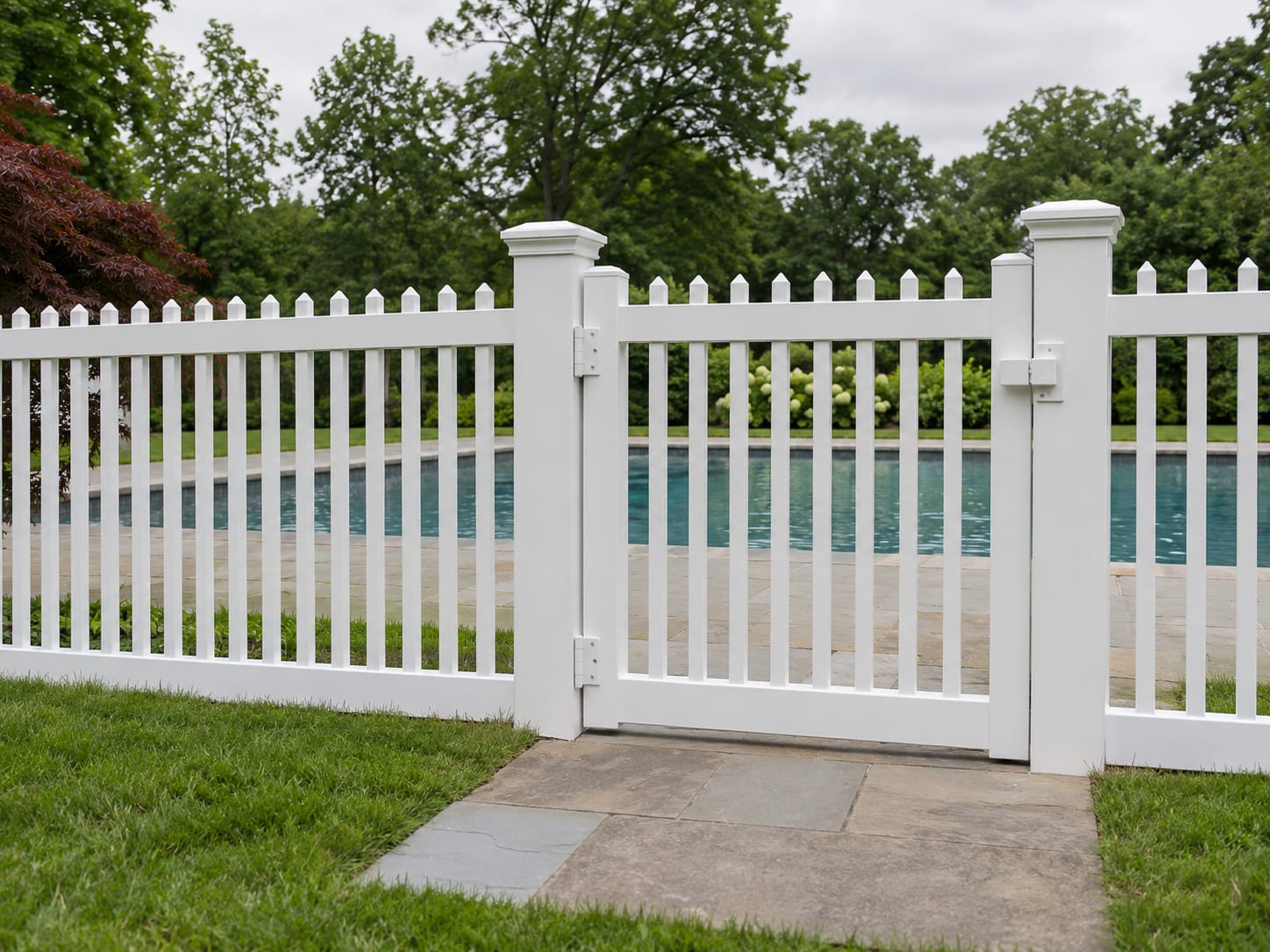
The barrier generally must be at least 48 inches high. Openings must not allow passage of a four-inch-diameter sphere, and the bottom clearance generally cannot exceed four inches on the side facing away from the pool. A solid barrier must not contain indentations or protrusions that create handholds or footholds.
Rail spacing matters on an open vinyl design. Where horizontal and vertical members are used and the horizontal members are less than 45 inches apart, the horizontal members must be on the pool side, with vertical spacing no greater than 1 3/4 inches. Where horizontal members are 45 inches or more apart, vertical spacing cannot exceed four inches.
The gate also needs a careful check. A pedestrian gate must open outward away from the pool, be self-closing, and have a self-latching device. A residential latch release outside the barrier generally must be at least 54 inches above the finished ground or floor surface, subject to the code's provisions for self-locking devices and inside releases.
A solid privacy panel may avoid some open-rail climbability concerns, but its height, bottom clearance, gate, latch, nearby structures, and surrounding equipment still need to meet the code. If you are comparing materials for a pool area, Pool Fence Materials Compared: Aluminum, Mesh, Glass and Vinyl explains how the main options differ. The town's Building Department should review the proposed pool barrier before installation.
Wetlands, Drainage and Excavation
A small residential fence can still cross a regulated site condition. Bethel has an Inland Wetlands Commission, and the town application identifies activities within wetlands and a 100-foot regulated upland review area. A fence near a pond, stream, wetland, or watercourse may require wetlands review depending on clearing, excavation, fill, grading, drainage, and proximity to the regulated resource.
Contact the Bethel Inland Wetlands Commission before work near those areas.
The practical sequence is simple, and it keeps the fence line from being designed twice.
Before Vinyl Fence Installation
- 1
Confirm the boundary
Use a survey, recorded plan, or reliable boundary document to establish the proposed line.
- 2
Check Bethel zoning
Ask about height, front setback, side and rear setbacks, corner-lot visibility, and the finished side.
- 3
Check site conditions
Ask about wetlands, watercourses, drainage, slope work, ledge, retaining conditions, and related approvals.
- 4
Call before you dig
Contact Connecticut Call Before You Dig at 811 or 1-800-922-4455 before excavation.
- 5
Settle the design
Choose the style, height, panel width, reinforcement, gates, swing direction, and bottom clearance.
- 6
Get the written quote
Put footage, materials, excavation, rock handling, removal, cleanup, permit responsibility, and warranty terms in writing.
Connecticut Call Before You Dig rules require excavators using power-operated equipment to contact the central clearinghouse at least two full days, excluding weekends and holidays, and not more than 30 days before excavation. Use the Connecticut Call Before You Dig information before post holes are marked for digging.
My Fence Guy can put the measured layout into a written estimate. The quote should state whether it includes concrete, excavation, rock or ledge handling, removal of an old fence, permits, cleanup, and any allowance for difficult access.
Connecticut's Department of Consumer Protection says residential home-improvement work includes fences and that covered contractors must be registered. Its home-improvement contract guidance calls for a written, signed, dated contract with the scope, materials, schedule, price, payment terms, permit responsibility, and cancellation notice.
National Budget Ranges for Vinyl Fencing
National 2026 figures are useful for preliminary budgeting, and a Bethel contractor price will differ. Angi estimates six-foot vinyl fencing at approximately $25 to $40 per linear foot installed. Ballpark Lab places six-foot vinyl fencing at approximately $26 to $58 per linear foot installed. For six-foot privacy fencing, the higher material use and wind exposure can affect the price.
For a 100-linear-foot project, those national ranges imply approximately $2,500 to $5,800 installed before project-specific additions. The final estimate may change with the number of gates, demolition, short runs, corners, ledge, steep slopes, poor access, drainage work, reinforcement, and the need to adjust the fence around an existing wall or structure.
Other national 2026 figures include approximately $20 to $45 per linear foot installed for four-foot vinyl fencing, $23 to $50 per linear foot for five-foot vinyl fencing, and $35 to $68 per linear foot for eight-foot vinyl fencing. Each figure is a national range and should be labeled that way when you compare estimates.
Ask for a written, itemized price based on measured linear footage and the exact style. A per-foot number should identify whether it includes posts, concrete, caps, rails, gates, removal, excavation, rock handling, permits, and cleanup. The Vinyl Fence Repair: Cracked Panels, Loose Rails and Leaning Posts guide may help if you are comparing replacement with repairing cracked panels, loose rails, or leaning posts.
Frequently Asked Questions
How much does it cost to install a 6-foot vinyl fence?
A six-foot vinyl fence costs approximately $25 to $40 per linear foot installed in Angi's 2026 national estimate, $26 to $58 per linear foot in Ballpark Lab's 2026 national estimate, and about $30 to $55 per linear foot for six-foot privacy fencing in another national 2026 estimate. A 100-linear-foot project therefore falls around $2,500 to $5,800 before gates, demolition, ledge, slopes, access, drainage, reinforcement, and other site additions.
What are the downsides of vinyl fencing?
The main downsides are higher initial cost than many basic wood fences, greater wind exposure with solid privacy panels, reduced flexibility in cold weather, possible heat distortion, and the need for matching replacement parts after impact. Vinyl also cannot normally be painted or stained, and a vinyl pool fence still has to meet the state barrier code.
How long does a vinyl fence last?
A properly selected and installed vinyl fence commonly has a service life measured in decades. Published warranty examples include a lifetime residential warranty from Daytona Vinyl and a 30-year residential material warranty from USAVinyl Weatherables, with exclusions for installation, reinforcement, impact, heat, ground movement, and certain weathering conditions.
Is vinyl fencing cheaper than wood?
Wood is often cheaper at the initial purchase for basic styles, while vinyl can reduce recurring staining, painting, and board-replacement work. Compare the same height and style, such as a six-foot vinyl privacy fence with a six-foot wood privacy fence, and include expected maintenance over the ownership period. The Wood vs Vinyl Fence comparison covers the material tradeoffs in more detail.
Do I need a permit for a fence in Bethel?
You need a project-specific answer from Bethel Land Use Planning and Zoning and the Bethel Building Department. Bethel Section 6.5 and Section 6.7 set fence height, location, setback, and corner-lot visibility rules, while a pool barrier must also meet the Connecticut State Building Code. Submit the proposed height, location, plot plan, pool information, and wetlands proximity before installation. The statewide Do You Need a Permit for Fence Installation in CT? overview can help you prepare questions for the town.
Vinyl Fence Planning Check
1. Which vinyl style provides the most visual screening?
2. What is Bethel's general maximum fence height within a front setback?
3. What is the general minimum height for a residential pool barrier?
4. What should you do before using power-operated equipment to dig post holes?
5. Which factor can increase the price of a vinyl fence project?
Pick an answer to begin.
Final Thoughts
Vinyl can work well in Bethel when the style matches the yard and the installation accounts for wind, sun, cold, slope, drainage, soil, and the property line. A solid privacy fence gives the most screening but needs more attention to reinforcement and wind exposure. Picket and post-and-rail styles provide more airflow and boundary definition, while pool fencing needs a separate code check for openings, gates, latches, height, and clear space.
My Fence Guy can put the exact vinyl profile and your site conditions into a written estimate. Call us at (203) 746-1100 for a free estimate, or reach out through our contact page.
Vinyl Fence Terms
Tap a term to see what it means.
Privacy fence. A fence with closely spaced boards or tongue-and-groove panels that provides the most visual screening.
More about fences
Vinyl Fencing in Monroe, CT: Styles, Costs and Town Rules
Vinyl fencing in Monroe, CT: the town's 6-foot limit, which offices to check with first, privacy and picket choices, and what 100 feet costs nationally.
Read the guide to Vinyl Fencing in Monroe, CTWood vs Vinyl Fence: Cost, Upkeep and Lifespan in Connecticut
Wood or vinyl fence in Connecticut: installed cost, lifespan in freeze-thaw winters, staining and cleaning, storm repairs and how each looks over the years.
Read the guide to Wood vs Vinyl FenceVinyl vs Aluminum Fence: Which Fits Your Connecticut Yard?
Vinyl or aluminum fence for your Connecticut yard? Privacy, strength in wind and cold, pool use, slopes, upkeep, lifespan and installed cost compared.
Read the guide to Vinyl vs Aluminum Fence