
Split Rail Fence Guide: Cedar or Pressure-Treated, 2 or 3 Rails, and Cost
By Tony Pellicone13 min readPublished
- wood fencing
- farm fencing
- homeowner guide
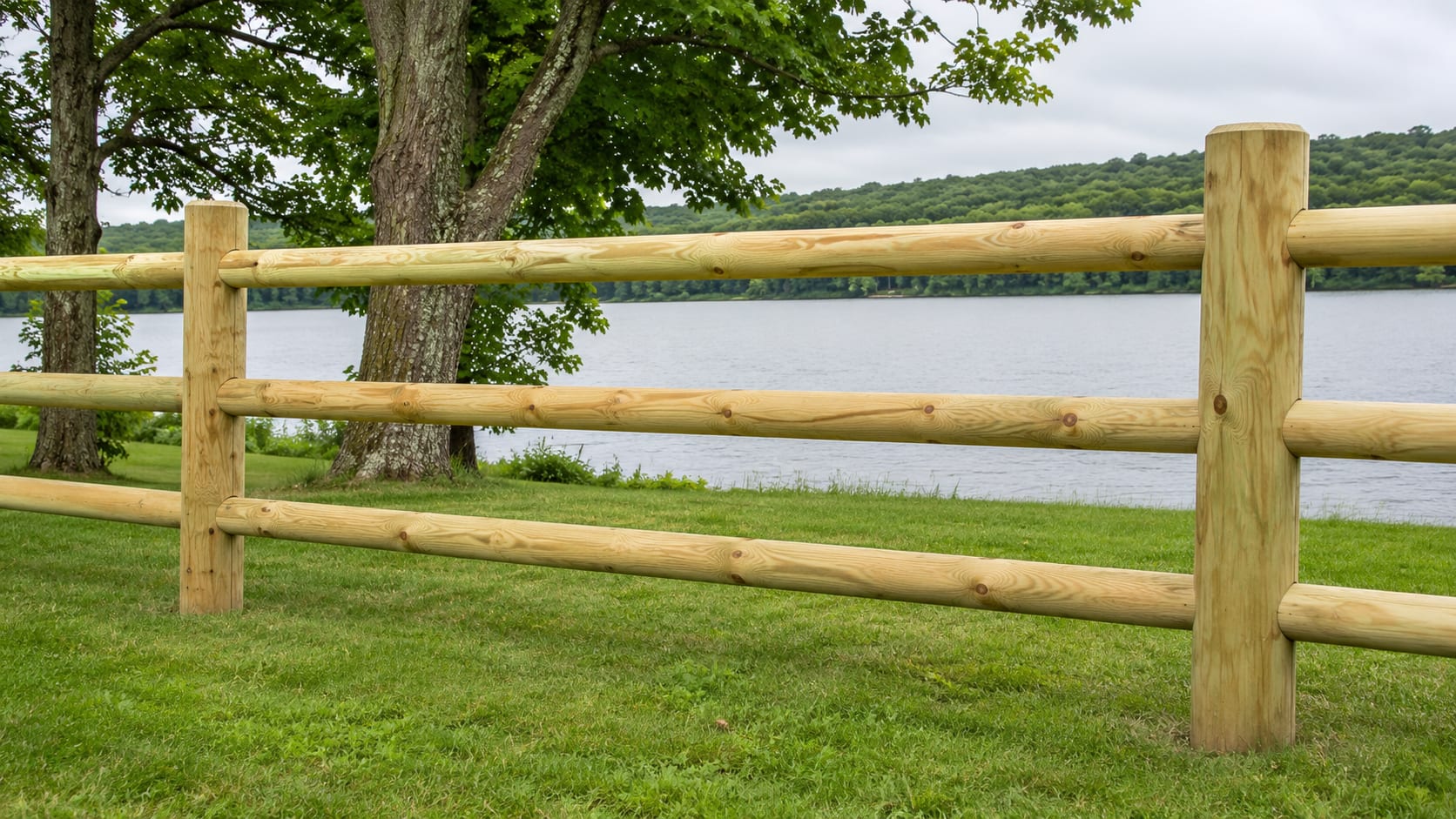
A split-rail fence is usually a good fit for marking a boundary, framing a yard, lining a driveway, or defining a larger property without closing off the view. Choose two rails for a lower visual edge, three rails for a taller boundary, and add wire mesh when you need to contain dogs, poultry, small livestock, or children.
National 2026 estimates range from about $10 to $20 per linear foot for materials and about $25 to $35 per linear foot for an installed cedar fence. A Connecticut price moves with access, ledge, gates, removal, and the wood you choose.
Cedar is naturally resistant to decay and can weather gray without sealer. Pressure-treated pine is a practical lower-cost option, especially where treated ground-contact components are specified. A typical installation places posts about 18 to 24 inches deep and about 8 to 10 feet apart, but the proposed fence line and soil should control the final layout.
Key Takeaways
Two rails
A two-rail fence is commonly about 3 feet to 3 feet 6 inches high and suits visual boundaries, driveways, and yard borders.
Three rails
A three-rail fence is commonly about 4 feet high and creates a taller, more substantial edge for larger properties and perimeter lines.
Wood choice
Northern white cedar, western red cedar, and black locust resist decay naturally, while pressure-treated pine depends on preservative treatment for added service life.
Post setting
Posts are commonly buried about 18 to 24 inches, with compacted soil or gravel used where the design and site conditions allow.
Dog containment
Rails alone are not dependable for dogs, so use properly selected wire mesh or a different fence design.
Local rules
Zoning, building, wetlands, right-of-way, and historic-district requirements are decided by the municipality and property conditions.
What Makes a Fence Traditional Split Rail?
A traditional split-rail fence uses rails split lengthwise from logs. The rail ends are often tapered and fitted into mortised or bored openings in the posts, which gives the finished fence its irregular, rustic appearance. The rails may vary slightly in shape and thickness because they follow the character of the log.
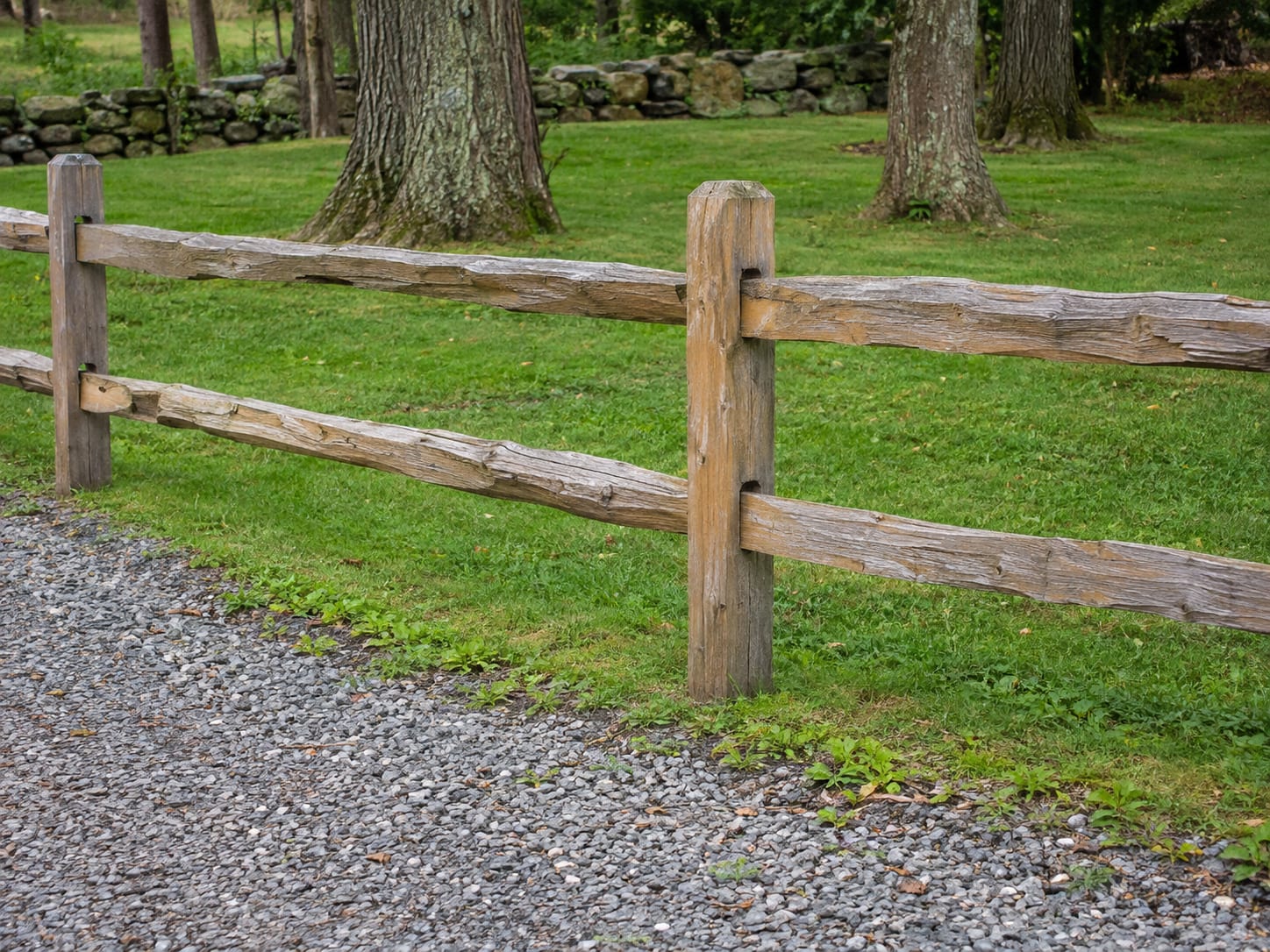
Post-and-rail, also called rail fence, is a broader term. It may use round rails, sawn rails, or manufactured rails that attach to or fit into posts. The components are usually more uniform than traditional split rails. If you want a consistent height and spacing, ask whether the proposed product is a traditional split-rail system or a more uniform post-and-rail system.
The distinction matters when you compare estimates. Rail length, post-hole design, wood species, post spacing, and the way rails fit into the posts affect both material quantity and the finished appearance. A matching replacement rail may also be easier to find when you know the original system.
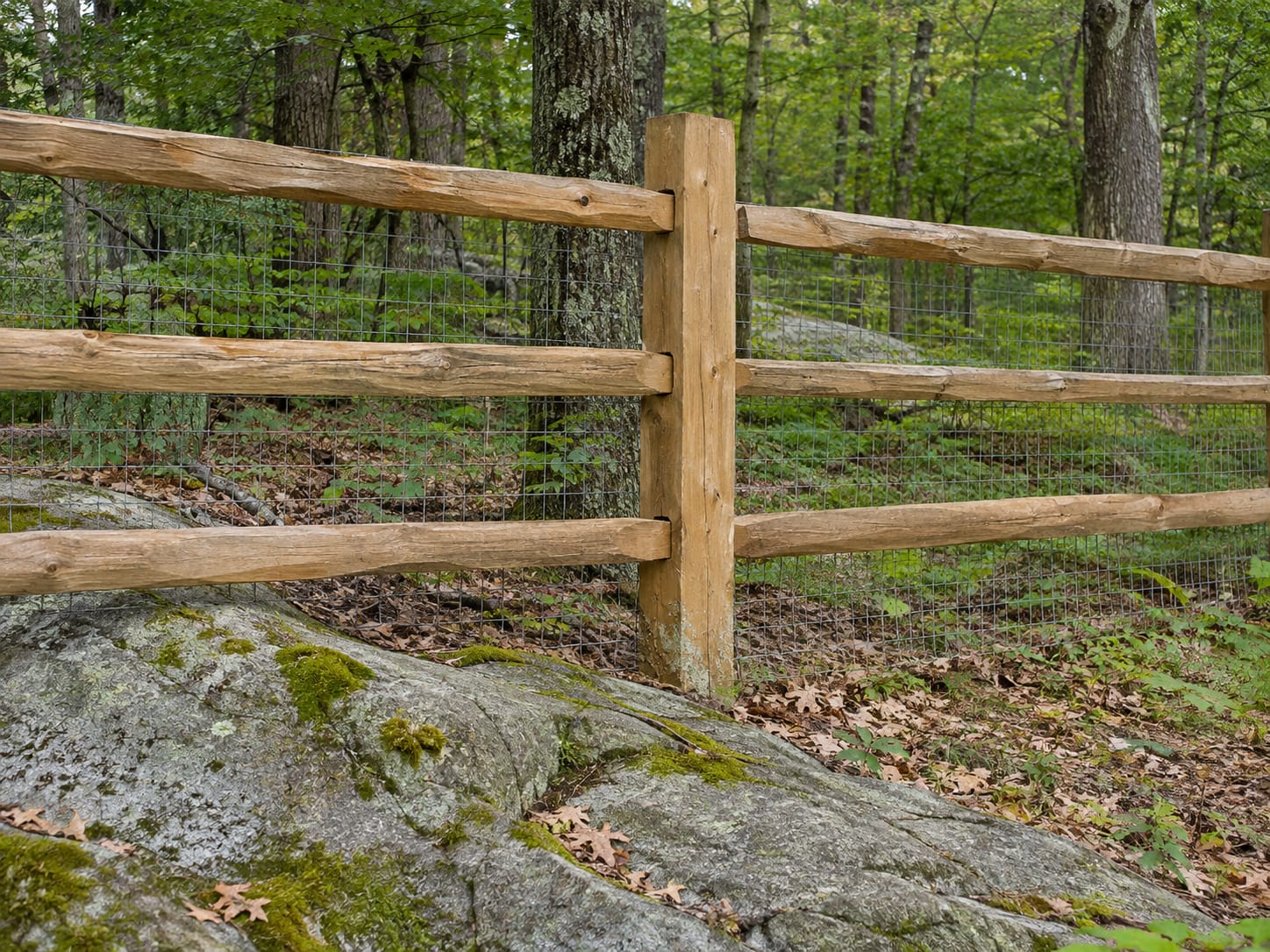
For a closer look at adding mesh behind open rails, see split-rail fence with wire mesh. The mesh changes the fence from a simple visual boundary into a more useful barrier for pets or small animals, but it also affects cost, gates, post strength, and local review.
Choosing Two Rails or Three
The right rail count depends on what the fence needs to do. Start with the purpose, then choose the height and add mesh or another barrier if the rails alone cannot provide the needed containment.
Two rails for a lower visual boundary
A two-rail fence is commonly about 3 feet to 3 feet 6 inches high. It works well along a driveway, around planting areas, across an open front yard, or along a boundary where you want a clear edge without making the fence feel tall.
Two rails can guide vehicles and foot traffic, but they are not a dependable barrier for dogs or small livestock. The open space between the rails allows animals to pass through, and some dogs can jump over a low fence.
Three rails for a taller edge
A three-rail fence is commonly about 4 feet high. It has a more substantial appearance and is often a better choice for a larger property, an estate entrance, a long perimeter line, or some agricultural uses.
Three rails still leave broad openings. If you need to contain horses, poultry, goats, or dogs, the mesh opening, mesh height, bottom clearance, gate latch, and post strength must match the animal. A three-rail fence with mesh may work well for some rural properties, but it is not a pool barrier unless the complete design meets the applicable safety and local requirements.
Hover or tap a row to highlight it.
| Feature | Two-rail fence | Three-rail fence |
|---|---|---|
| Common height | Approximately 3 feet to 3 feet 6 inches | Approximately 4 feet |
| Typical use | Driveway edge, yard border, visual boundary | Larger property, perimeter, estate entrance, some livestock uses |
| View through fence | Open | Open, with a taller visual edge |
| Dog containment | Requires mesh or another barrier | Requires mesh or another barrier |
| Common rail length | About 10 feet or 11 feet | About 10 feet or 11 feet |
The rail count also affects the amount of wood and labor used. When comparing wood fencing options, ask for the species, rail count, rail length, post spacing, gate locations, mesh details, and any site work to be listed separately.
Cedar or Pressure-Treated Pine?
Northern white cedar and western red cedar are naturally very resistant to decay. Black locust is also classified as very resistant to decay by the USDA Forest Products Laboratory. Pressure-treated pine is not naturally highly resistant to decay, but preservative treatment is intended to improve its service life, especially in ground-contact parts.
The USDA classification concerns the average decay resistance of heartwood. Actual fence performance depends on heartwood content, sapwood, moisture, soil contact, drainage, workmanship, and preservative treatment. The wood species alone does not determine how long a fence will remain sound.
The USDA Forest Products Laboratory Wood Handbook describes decay resistance by wood type, while its technical note on wood durability explains why exposure and construction conditions matter.
Cedar can be left unfinished and allowed to weather naturally to gray. It does not need sealer to remain a fence. A compatible exterior stain or water-repellent finish can help maintain the original color and reduce weathering, but the finish creates a maintenance task. Follow the product label for preparation, drying conditions, and reapplication.
A practical published planning estimate for cedar fencing is approximately 15 to 20 years. It is a planning figure for budgeting. Wet soil, shade, poor drainage, snow, ground contact, mechanical damage, and lower heartwood content can shorten the period, while good drainage, sound installation, and suitable wood can help the fence last longer.
For a comparison of cedar and treated pine, see Cedar vs Pressure-Treated Wood Fence: Which Lasts Longer?. The estimate should state the proposed species and explain how the post material will be handled at ground level.
Posts, Spacing, Ledge, and Drainage
Split-rail posts are commonly spaced about 10 feet on center, with some systems using 8-foot to 10-foot spacing. An 11-foot rail may create a section about 10 feet 4 inches to 10 feet 6 inches between post centers because the rail ends overlap inside the post openings.
Corners, ends, gates, terrain changes, and short sections require a layout calculation. Dividing total footage by a nominal spacing can undercount posts if terminals and gates are ignored.
Burial depth and backfill
A common split-rail installation places posts approximately 18 to 24 inches into the ground. One published cedar specification lists an 18-inch burial depth for a three-rail post. The hole is backfilled and compacted around the post.
Tamped gravel can provide drainage and a firm, adjustable backfill. Concrete is not automatically required for every split-rail fence. Some agricultural guidance advises against concrete around certain rail-fence posts because rigid concrete can retain moisture at the post base and make replacement more difficult.
Concrete may be appropriate for some gate posts, end posts, corner posts, high-wind locations, or engineered installations. The proposed method should follow the post manufacturer's instructions and account for soil, wind exposure, gate loads, and drainage.
Connecticut ledge and rocky soil
Connecticut ledge changes the post plan. A shallow hole over rock should not simply be priced as a normal deep post hole. The fence line may need adjustment, a shorter section, drilling into ledge where suitable, a surface-mounted or engineered alternative, or a different fence design.
The contractor should identify rock and drainage conditions before pricing the work. The earlier post, Installing a Fence on Rocky Soil and Ledge in Western Connecticut, covers the planning questions that matter when the intended line crosses ledge or an old stone wall.
Before power excavation, contact Connecticut Call Before You Dig. Connecticut requires advance notice at least two full days before excavation, excluding weekends and holidays, and not more than 30 days before excavation.
A Practical Split-Rail Installation Sequence
- 1
Confirm the line
Use a survey or other boundary reference and mark the intended fence line, gates, utilities, wetlands, stone walls, and ledge.
- 2
Confirm town requirements
Ask the local land-use or zoning office about zoning, building, wetlands, right-of-way, and historic-district requirements.
- 3
Plan excavation
Contact Call Before You Dig and decide how rock, ledge, drainage, and difficult access will be handled.
- 4
Set posts
Excavate the holes, place posts at the planned spacing and depth, and compact the approved backfill.
- 5
Install rails
Fit or attach the rails, checking the run, height, corners, ends, and gate openings.
- 6
Add mesh or gates
Install wire mesh, gate hardware, and any animal or traffic controls included in the written estimate.
Permits and Town Rules in Connecticut
Fence height, setback, and permit status in Connecticut are set town by town. Each municipality's zoning and building rules apply, and wetlands and historic-district rules can apply separately.
Brookfield's zoning regulations approved in 2024 state that fences under 8 feet may be constructed in residential zoning districts without zoning approval. Fences 8 feet or higher require zoning approval and a certificate of zoning compliance.
Stamford's zoning enforcement guidance says a zoning permit is required for a fence or retaining wall and cites a 6-foot limit for fences in front or side yards.
Ridgefield publishes zoning regulations by section and separately publishes Historic District Commission design guidelines. Those guidelines address the historic period, material, height, and design of new fences, with emphasis on low, transparent, historically compatible fencing in historic districts. Connecticut General Statutes Chapter 97a addresses historic districts and certificate of appropriateness review for covered exterior work.
Danbury organizes its zoning regulations by district, including yard requirements and maximum-height requirements. The answer depends on the property's zoning district and the proposed fence location.
A Brookfield rule should not be applied to New Fairfield. A Stamford rule should not be applied to Sherman. Ridgefield, Danbury, Southbury, Newtown, New Milford, and nearby New York municipalities each require their own review.
Use the statewide overview, Do You Need a Permit for Fence Installation in CT?, as a starting point, then confirm the current requirements with the municipality where the property is located. Ask whether you need zoning approval, a building permit, a certificate of zoning compliance, a wetlands review, a survey, a site plan, or historic-district approval.
A low split rail may fit a front-yard or historic-district preference, but its height does not settle the permit question. Front-yard sight lines, corner lots, driveways, and road rights-of-way can change the answer. The earlier post, Can You Put a Fence in Your Front Yard in Connecticut?, explains why yard location matters.
The Connecticut DEEP advises property owners to consult the local land-use office because municipal zoning, subdivision, and inland-wetlands regulations can control where a fence is placed. If a boundary dispute develops, speak with a Connecticut real estate attorney.
For residential work, the Connecticut Department of Consumer Protection treats fence work as home improvement. A written contract should identify the contractor, scope, price, payment schedule, materials, start and completion dates, and responsibilities for permits and site conditions. My Fence Guy can put the species, rail count, post spacing, gates, mesh, and removal into a written estimate.
Split-Rail Fence Cost Per Linear Foot
National published figures in 2026 range from approximately $10 to $20 per linear foot for split-rail materials and approximately $25 to $35 per linear foot for an installed cedar split-rail fence. Angi reports cedar fencing at approximately $11.50 to $18 per linear foot and a national split-rail installation range of $2,250 to $5,500 per project.
These are national figures, not Connecticut bids. Terrain, labor, delivery, gates, removal, wire mesh, rock excavation, grading, access, taxes, and permit requirements can change a local estimate.
Hover or tap a row to highlight it.
| Configuration or material | National cost | Unit and year | Source |
|---|---|---|---|
| Split-rail materials, general | $10 to $20 | Per linear foot, 2026 | HomeGuide |
| Cedar split-rail fence, installed | $25 to $35 | Per linear foot, 2026 | HomeGuide |
| Cedar fencing | $11.50 to $18 | Per linear foot, 2026 | Angi |
| Split-rail installation | $2,250 to $5,500 | Per project, 2026 | Angi |
| National average split-rail installation | About $3,500 | Per project, 2026 | Angi |
A Connecticut estimate should identify the wood species, two-rail or three-rail construction, linear footage, post spacing, gates, wire mesh, removal, delivery, permits, taxes, ledge excavation, drainage, and grading. Ask whether the price is per linear foot, per project, or a combination of both.
Repairs and Maintenance
A single failed rail is usually replaced by removing the damaged rail from the post openings and inserting a matching replacement rail. The new rail should match the existing species, length, dimensions, and hole pattern as closely as possible.
A rotted line post requires temporary support or partial disassembly of the adjacent rails. The failed post is removed, the hole is prepared, a matching post is set, the backfill is compacted, and the rails are reinstalled. End posts, corner posts, and gate posts carry more load and may require bracing or a different setting method.
Inspect neighboring posts when one ground-contact post decays. Similar moisture and drainage conditions can affect nearby components. A damaged rail may be an isolated failure, while decay at several post bases points to a broader site condition.
Leave cedar unfinished if you prefer the natural gray appearance. If you stain or apply a water-repellent finish, plan for cleaning, preparation, drying, and reapplication according to the product label.
Frequently Asked Questions
How much does a split-rail fence cost per foot?
National 2026 estimates range from about $10 to $20 per linear foot for materials and about $25 to $35 per linear foot for an installed cedar split-rail fence. A Connecticut quote can change with gates, mesh, ledge, removal, delivery, grading, access, taxes, and permits.
Should I get a two-rail or three-rail split-rail fence?
Choose two rails for a lower visual boundary around a driveway, yard, or planting area. Choose three rails for a taller appearance around a larger property, estate entrance, perimeter, or some agricultural uses.
How long does a cedar split-rail fence last?
A practical published planning estimate is approximately 15 to 20 years. Soil moisture, drainage, shade, snow, ground contact, workmanship, wood quality, and maintenance can shorten or extend that period.
Do you put split-rail fence posts in concrete?
Not always. Many split-rail systems use compacted soil or gravel, while concrete may suit certain gates, corners, ends, high-wind locations, or engineered installations. The estimate should identify the post-setting method and how drainage will be handled.
How far apart are split-rail fence posts?
Posts are commonly spaced about 10 feet on center, with some systems using 8-foot to 10-foot spacing. Gates, corners, ends, terrain changes, and short sections require the installer to calculate the actual post count.
Is split-rail fence good for dogs?
A split-rail fence by itself is usually not sufficient for containing dogs. Add welded or woven wire mesh with an opening, height, bottom clearance, gate latch, and post strength suited to the individual dog, or choose a full-height dog fence.
Split-Rail Fence Planning Check
1. What is a common height for a two-rail split-rail fence?
2. What is a common post spacing for split-rail fencing?
3. Which wood is naturally very resistant to decay?
4. What should you add when rails alone cannot contain a dog?
5. Who should confirm local fence approval requirements?
Pick an answer to begin.
Final Thoughts
A split-rail fence works best when the rail count, wood species, post spacing, mesh, and setting method match the job. Start with the purpose of the fence, confirm the property line, call before digging, ask the town about the specific parcel, and require the quote to list site work such as rock, ledge, drainage, gates, and removal.
Bring those details to the estimate and each one goes into writing. Call us at (203) 746-1100 for a free estimate, or reach out through our contact page.
Split-Rail Fence Terms
Tap a term to see what it means.
Split rail. A rail split lengthwise from a log, usually fitted into openings in fence posts.
More about fences
Wood Fence Repair: Broken Boards, Rotted Rails and Loose Pickets
Wood fence repair starts with the posts and rails. Replacing broken boards, fixing rotted rails and loose pickets, choosing rated lumber and fasteners, costs.
Read the guide to Wood Fence RepairWood vs Vinyl Fence: Cost, Upkeep and Lifespan in Connecticut
Wood or vinyl fence in Connecticut: installed cost, lifespan in freeze-thaw winters, staining and cleaning, storm repairs and how each looks over the years.
Read the guide to Wood vs Vinyl FenceSplit Rail Fence With Wire Mesh: Uses, Costs and How It Is Built
A split rail fence with wire mesh keeps dogs in and keeps the rustic look. Wire types, attaching mesh, cedar or pine rails, post depth, heights and costs.
Read the guide to Split Rail Fence With Wire Mesh