
Split Rail Fence With Wire Mesh: Uses, Costs and How It Is Built
By Tony Pellicone14 min readPublished
- wood fencing
- pet fencing
- homeowner guide
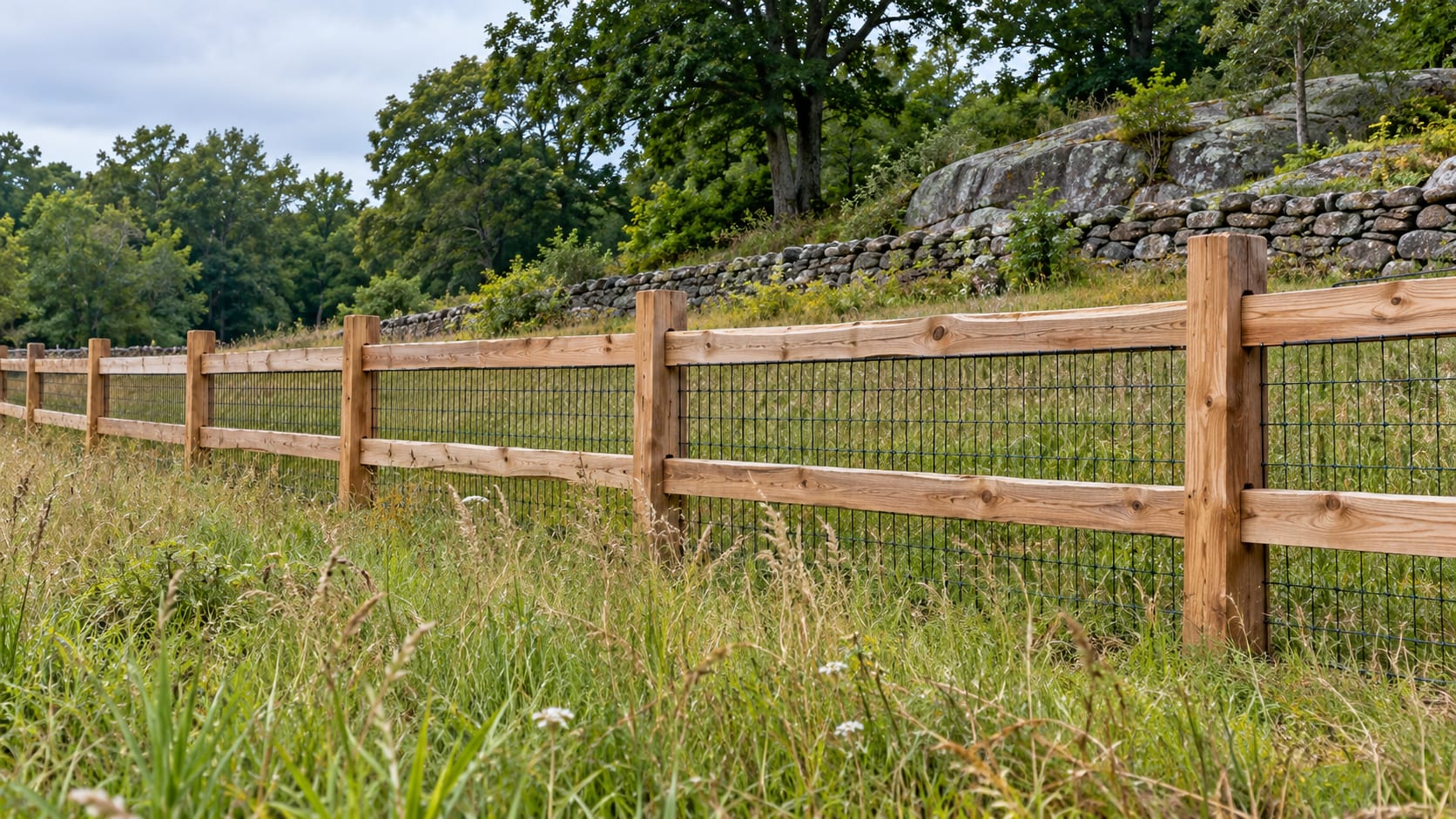
A split rail fence with wire mesh gives you the open, rustic appearance of split rail while adding a real barrier for dogs, gardens, poultry, and smaller livestock. For most residential uses, 14-gauge galvanized welded wire with 2-inch by 4-inch openings is a practical starting point, but puppies, rabbits, poultry, and small dogs usually need smaller openings. Posts are commonly buried 24 to 30 inches, while gate and corner posts may need more depth or concrete.
The right design depends on what you need the fence to do. A two-rail fence may mark a property line, but it is not a dependable dog enclosure by itself. Mesh height, opening size, bottom closure, gate construction, terrain, and local rules all affect the result.
Key Takeaways
Choose the mesh for the animal
Use smaller openings for puppies, small dogs, rabbits, and poultry.
Plan the bottom edge
Burying or flaring the mesh helps stop digging and crawling.
Set posts deeply
Wood posts are commonly buried 24 to 30 inches, with stronger details for gates and corners.
Check local rules
Fence height, placement, corner visibility, wetlands, and permits are handled locally.
Price the full system
Mesh, gates, rocky soil, slopes, and post depth can change the project cost.
Start With the Job the Fence Must Do
The first decision is whether the fence is mainly for property marking, dog containment, animal exclusion, livestock containment, garden protection, or a combination of those purposes. That answer determines the mesh opening, fence height, bottom treatment, rail count, and gate design.
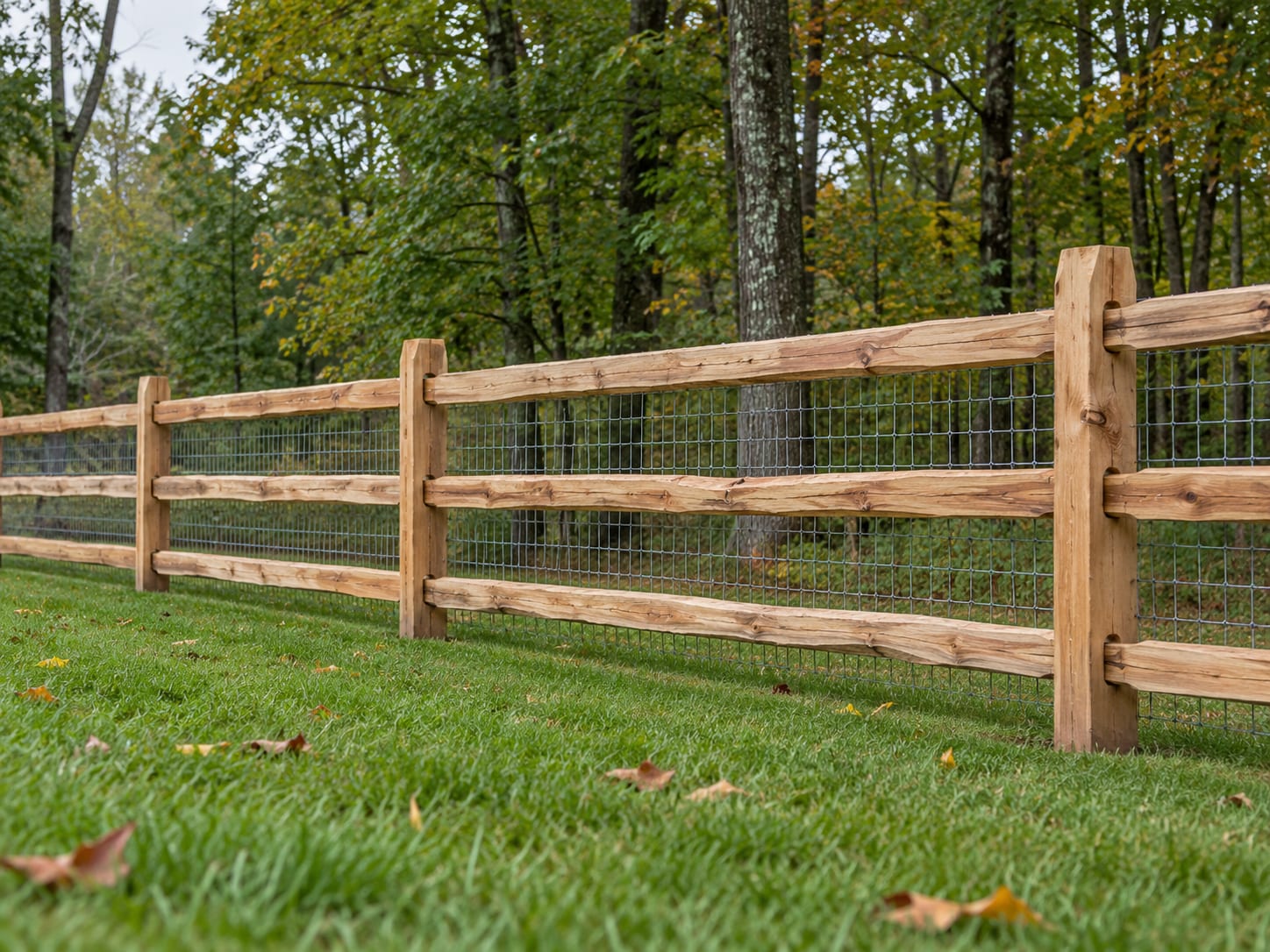
A basic split rail fence leaves wide spaces between the rails. That is useful for appearance and boundary marking, but it will not contain most dogs or small animals. Adding welded wire turns the fence into a more functional barrier while keeping the rails visible from the outside.
For a dog, consider size, jumping ability, digging behavior, and whether the dog pushes against the mesh. A 2-inch by 4-inch opening may work for some larger dogs, but it is not suitable for every dog. Puppies and small dogs can fit through openings that appear small from several feet away.
For deer exclusion, ordinary residential split rail heights are usually not enough. A garden fence intended to keep out deer may need a taller system, subject to local zoning and site rules. For horses or larger livestock, heavy livestock mesh with stronger wire is more suitable than light garden mesh.
A wood fencing system for residential and rural properties can be paired with welded wire, but the written estimate should identify the wood species, rail count, mesh, fasteners, gate details, and bottom closure.
Mesh Choices for Split Rail
Galvanized welded wire is the common general-purpose choice. A typical specification is 14-gauge wire with 2-inch by 4-inch openings. One manufacturer lists this type in 36-inch, 48-inch, 60-inch, and 72-inch heights. Tractor Supply listed a 5-foot by 50-foot roll of 14-gauge galvanized welded wire at $79.99 as of 2026, which works out to about $1.60 per linear foot before installation.
Vinyl-coated welded wire is another 14-gauge option, commonly with the same 2-inch by 4-inch openings. Black and green PVC coatings reduce the bright appearance of galvanized wire and add another layer of corrosion protection. A 50-foot by 48-inch black roll was listed at $79.99 as of 2026, also about $1.60 per linear foot before installation.
Smaller welded openings are better for small animals. Common sizes include 1-inch by 2-inch, 1-inch by 1-inch, and 1/2-inch by 1-inch mesh. The wire gauge describes thickness, not the size of the opening, so check both specifications before ordering.
Plastic-coated poultry or garden mesh can work for light-duty poultry enclosures and domestic animals. One manufacturer lists plastic mesh with openings of approximately 0.87 inches by 1.38 inches. It is lightweight and will not rust, but it is less suitable where a dog can push, chew, or jump against the fence.
For horses and larger livestock, heavy no-climb mesh uses stronger wire. Another manufacturer lists a 2-inch by 4-inch no-climb horse fence with 12.5-gauge line wires and 10-gauge top and bottom wires. The tighter pattern helps reduce hoof entrapment and gives the fence more resistance to animal pressure.
Hover or tap a row to highlight it.
| Mesh choice | Typical use | Practical detail |
|---|---|---|
| 14-gauge galvanized welded wire, 2 by 4 inches | Dogs, gardens, general residential use | Open appearance and common availability |
| 14-gauge vinyl-coated welded wire, 2 by 4 inches | Dogs, gardens, appearance-focused installations | Black or green coating reduces visual contrast |
| 1 by 2 inches or smaller welded wire | Puppies, small dogs, rabbits, poultry | Reduces the chance of animals passing through |
| Plastic-coated poultry mesh | Light-duty poultry and garden enclosures | Lightweight, but less suitable for force or chewing |
| Heavy no-climb livestock mesh | Horses and larger livestock | Stronger top and bottom wires reduce pressure and hoof risk |
The best fence for your dog depends on more than the fence style. The mesh must fit the dog, and the bottom edge must address digging or crawling.
How the Mesh Is Attached
Mesh is normally installed on the inside face of the split rail. From outside the property, the rails remain visible, while the mesh sits against the posts and rails on the animal side.
For wood posts, galvanized fencing staples about 1 1/4 inches long are commonly used. The staples need to hold the mesh firmly without crushing the wire. Mesh should be fastened to the posts first, then to the top and lower rails. That order keeps the wire aligned as the installation moves along the fence.
The mesh should stay below the top rail instead of projecting above it. A projecting edge can change the appearance, create a sharp exposed edge, and give an animal something to catch on.
The bottom edge deserves as much attention as the wire itself. You can bury the mesh in a shallow trench, fold it outward on the ground and pin it, or fit it closely to the lower rail. A public split-rail specification calls for at least 2.5 inches of clearance between the bottom mesh edge and grade. That clearance helps with drainage and mowing, but a buried or ground-flared bottom is more effective against a determined dog or digging animal.
A gate needs its own rigid frame and hardware. Mesh can be stapled across a wood gate frame or attached with clips or fencing wire. Gate posts carry more weight than ordinary line posts, so they usually need a stronger installation. Plan the gate opening before setting the rails, and place the latch where a dog or livestock cannot operate it.
Typical Split Rail With Mesh Installation
- 1
Confirm the layout
Establish the fence line, gate locations, property boundary, and areas affected by slope or ledge.
- 2
Mark utilities
Contact Call Before You Dig at 811 or use cbyd.com before excavation.
- 3
Set the posts
Install line, end, corner, and gate posts at the specified depth with the selected drainage, backfill, or concrete detail.
- 4
Install the rails
Fit the rails through the posts or attach them according to the selected split rail system.
- 5
Add the mesh
Unroll the mesh on the inside face, fasten posts first, then secure the top and lower rails.
- 6
Close the bottom
Bury, flare, pin, or fit the mesh to the lower rail based on the containment purpose.
- 7
Hang and test the gate
Install the rigid gate frame, hardware, latch, and mesh, then check swing clearance and bottom gaps.
Posts, Depth, and Concrete
Wood split rail posts are commonly buried about 24 to 30 inches. Home Depot installation instructions permit dirt installation or a concrete collar and describe compacted dirt above the concrete to help water drain away from the post. One cedar rail supplier specifies at least 24 inches with gravel at the bottom and compacted dirt around the post.
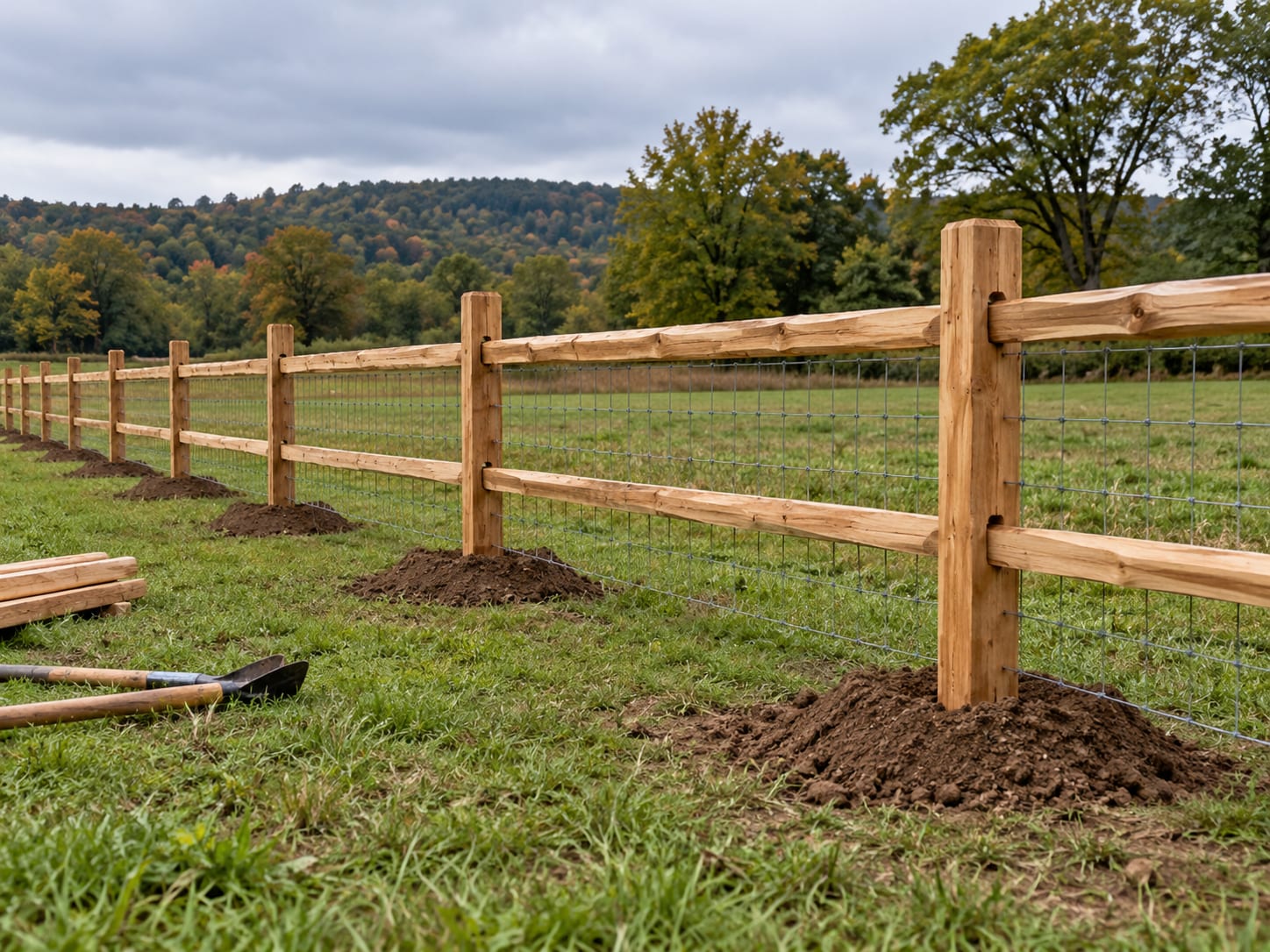
Some systems call for 30 inches, and other systems specify 30 to 48 inches based on frost depth and local conditions. One vinyl system maker recommends concrete for its system. Vinyl systems, gate posts, corner posts, and areas exposed to heavy animal pressure may also require concrete according to the product instructions.
There is no single concrete detail for every split rail fence. A traditional wood system may use tamped soil or gravel, while a vinyl or gate installation may require concrete. The written estimate should state the hole depth, hole diameter, drainage material, backfill, and which posts receive concrete.
Frost heave is the condition that matters most for post depth in western Connecticut, because it can move a shallow post. Ledge or large rock can also limit the planned depth, so the contractor should identify it before finalizing the price.
For property-line work, obtain a survey or other reliable boundary information before placing the fence. An old stone wall may be a useful site reference, but it should not be treated as the legal boundary without appropriate boundary information.
Height, Rails, and Containment
A typical two-rail split rail fence is about 3 feet high at the top rail. A three-rail fence is commonly about 4 to 4.5 feet high. Four-rail and taller agricultural systems are used where more animal control is needed.
Mesh is commonly available in 36-inch, 48-inch, 60-inch, and 72-inch heights. The selected height should match the rail layout, animal, ground slope, and local rules. The final height can change where the mesh reaches grade, follows a slope, or is buried or flared at the bottom.
A two-rail fence without mesh is usually a boundary marker. A two-rail or three-rail fence with correctly selected mesh can contain many dogs, but the dog’s behavior determines whether it is adequate. A tall jumper may need a taller enclosure, while a digger may require buried or flared mesh.
The same principle applies to livestock and wildlife. A fence intended to keep poultry in needs smaller openings than one meant to mark a driveway. A fence intended to keep deer out needs more height than a simple garden boundary. If the property has a wetland review area, stream, or other regulated feature, ask the town wetlands office about the proposed fence line before ordering materials. Connecticut DEEP explains that each municipality has its own inland wetlands agency and local permitting process.
Cost, Lifespan, and Material Choices
National planning figures vary with rail count, height, soil, labor, access, gates, and mesh. They are useful for budgeting, but they are not Connecticut quotes.
HomeGuide lists national installed split rail pricing of about $15 to $35 per linear foot, with pressure-treated pine generally toward the lower end. A separate 2026 national estimate places pressure-treated pine at about $12 to $22 per linear foot installed, with an expected life of about 10 to 15 years.
HomeGuide lists cedar at about $25 to $35 per linear foot installed nationally. Angi lists cedar material and installation at about $11.50 to $18 per linear foot nationally in 2026. A 2026 planning estimate gives cedar an expected life of about 15 to 20 years.
HomeGuide lists vinyl split rail at about $15 to $30 per linear foot installed nationally. Angi lists vinyl at about $18.50 to $25 per linear foot in 2026. A 2026 planning estimate gives vinyl an expected life of about 20 to 30 years, with severe impact, cold-weather cracking, and thin-wall products affecting service life.
HomeGuide lists pine split rail with wire mesh at about $35 to $40 per linear foot installed nationally. Another 2026 national estimate places two-rail split rail at about $15 to $20 per linear foot installed and three-rail at about $20 to $25 per linear foot installed before additional mesh and special site work.
Hover or tap a row to highlight it.
| Material or configuration | National planning figure | Approximate planning life |
|---|---|---|
| Pressure-treated pine | $12 to $22 per linear foot installed in 2026 | 10 to 15 years |
| Cedar | $25 to $35 per linear foot installed nationally, or $11.50 to $18 per linear foot in a 2026 Angi estimate | 15 to 20 years |
| Vinyl | $15 to $30 per linear foot installed nationally, or $18.50 to $25 per linear foot in a 2026 Angi estimate | 20 to 30 years |
| Pine split rail with wire mesh | $35 to $40 per linear foot installed nationally | Depends on wood, mesh, soil, and maintenance |
| Two-rail split rail | $15 to $20 per linear foot installed nationally in a 2026 planning estimate | Depends on material |
| Three-rail split rail | $20 to $25 per linear foot installed nationally in a 2026 planning estimate | Depends on material |
Cedar usually gives you better natural decay resistance and a longer expected life, while pressure-treated pine usually lowers the initial price. The quote should identify whether the posts and rails are cedar, treated pine, or a mix of materials.
Mesh, gates, rocky soil, slopes, and heavier gate posts can materially change the price. A written quote from My Fence Guy should identify the fence length, rail count, material, mesh specification, post depth, bottom treatment, gate hardware, site preparation, permits, cleanup, and whether the price is per linear foot or for the full project.
For more budgeting context, see How Much Does a Fence Cost in Connecticut?. If the work includes a steep grade, stepped versus racked fence construction can affect both the appearance and the mesh closure.
Local Rules for Split Rail Fences in Newington, Danbury and Newtown
Fence requirements are set locally. A rule from one Connecticut town should not be treated as a statewide rule.
Newington's fencing regulations limit residential fencing to 4 feet in front yards and 6 feet in side or rear yards, with corner-lot and sight-visibility rules. Danbury publishes zoning regulations with corner-lot visibility restrictions and separate building-code provisions concerning fences over 6 feet. Danbury also states that its adopted print regulation controls if it differs from the online reference version.
Newtown's zoning regulations apply by property, zoning district and fence location, so ask its land-use office what applies at your address.
Before ordering materials, contact the zoning or land-use office for the address and ask:
- Whether fence height, location, front-yard placement, corner visibility, or setbacks apply.
- Whether zoning approval, a zoning permit, a building permit, or a certificate of approval is required.
- Whether the property lies in a wetland review area, watercourse buffer, flood zone, historic district, or other overlay.
- Which office handles wetlands review.
- Which plan, survey, site sketch, measurements, photographs, and fee must accompany the application.
- Whether special rules apply near a road, driveway, corner, or neighbor.
- Whether the fence must be entirely on the owner's property.
Start with Do You Need a Permit for Fence Installation in CT? and then confirm the address-specific requirements with the town. For a boundary installation, fence property-line rules in Connecticut can help organize the questions for your surveyor, neighbor, and town office.
Putnam, Dutchess, and Westchester counties in New York contain multiple municipalities, so a rule in one municipality does not establish the rule for another. Contact the applicable New York zoning or building office by address before installation.
Frequently Asked Questions
What is the best wire for a split rail fence?
The best general-purpose choice for many residential dog and garden fences is 14-gauge galvanized welded wire with 2-inch by 4-inch openings. Use smaller openings for puppies, small dogs, rabbits, or poultry, and heavier no-climb mesh for horses and larger livestock.
Do split rail posts need concrete?
Split rail posts do not always need concrete. Traditional wood systems may use holes about 24 to 30 inches deep with compacted soil or gravel, while vinyl systems, gate posts, corner posts, and some manufacturer-designed systems may call for concrete.
How long does a split rail fence last?
A split rail fence commonly lasts about 10 to 30 years, depending on material, drainage, soil moisture, installation, weather, animal pressure, and maintenance. Pressure-treated pine is commonly planned for about 10 to 15 years, cedar for about 15 to 20 years, and vinyl for about 20 to 30 years.
Is cedar or pine better for a split rail fence?
Cedar is generally better when you want natural decay resistance and a longer expected life. Pressure-treated pine is generally the lower-cost choice and can work well when the posts have suitable ground-contact treatment and the site drains properly.
How tall should a split rail fence be?
A typical two-rail fence is about 3 feet high, and a typical three-rail fence is about 4 to 4.5 feet high. The proper height depends on the animal, jumping ability, terrain, mesh height, and local zoning rules.
What is the difference between split rail and post-and-rail fence?
Split rail uses rough, irregular rails that fit through holes or mortises in the posts. Post-and-rail fencing usually uses shaped wood or molded vinyl rails attached to the face of posts with brackets, screws, or similar hardware.
Split Rail Fence With Mesh Check
1. Which mesh is a practical general-purpose choice for many residential uses?
2. What opening size is better for puppies and rabbits?
3. Where is mesh normally installed on split rail?
4. What is a common burial range for wood split rail posts?
5. Who sets fence requirements for a specific Connecticut property?
Pick an answer to begin.
Final Thoughts
A split rail fence with wire mesh works best when the mesh, height, bottom edge, posts, and gate are selected for the animal and the site. Decide the purpose first, confirm the local rules, mark utilities, and put every material and installation detail in the written scope.
When you are ready to discuss the fence line, mesh opening, post depth, gate, and site conditions, we can help you plan the work. Call us at (203) 746-1100 for a free estimate, or reach out through our contact page.
Split Rail Fence With Wire Mesh Terms
Tap a term to see what it means.
Split rail fence. A fence made with rough rails that fit through or between posts.
More about fences
Wood vs Vinyl Fence: Cost, Upkeep and Lifespan in Connecticut
Wood or vinyl fence in Connecticut: installed cost, lifespan in freeze-thaw winters, staining and cleaning, storm repairs and how each looks over the years.
Read the guide to Wood vs Vinyl FenceCedar vs Pressure-Treated Wood Fence: Which Lasts Longer?
Cedar or pressure-treated wood fence? Rot resistance, ground-contact posts, lifespan, cost and when new treated wood can be stained, compared side by side.
Read the guide to Cedar vs Pressure-Treated Wood FenceChoosing the Best Fence for Your Dog
Choose a fence for your dog by how it jumps, digs, climbs and chews. Heights by behavior, dig guards, gate latches, materials and invisible fences compared.
Read the guide to Choosing the Best Fence for Your Dog