
Aluminum Fencing in New Fairfield, CT: What to Compare
By Tony Pellicone19 min readPublished
- aluminum fencing
- new fairfield ct
- ornamental fencing
- connecticut
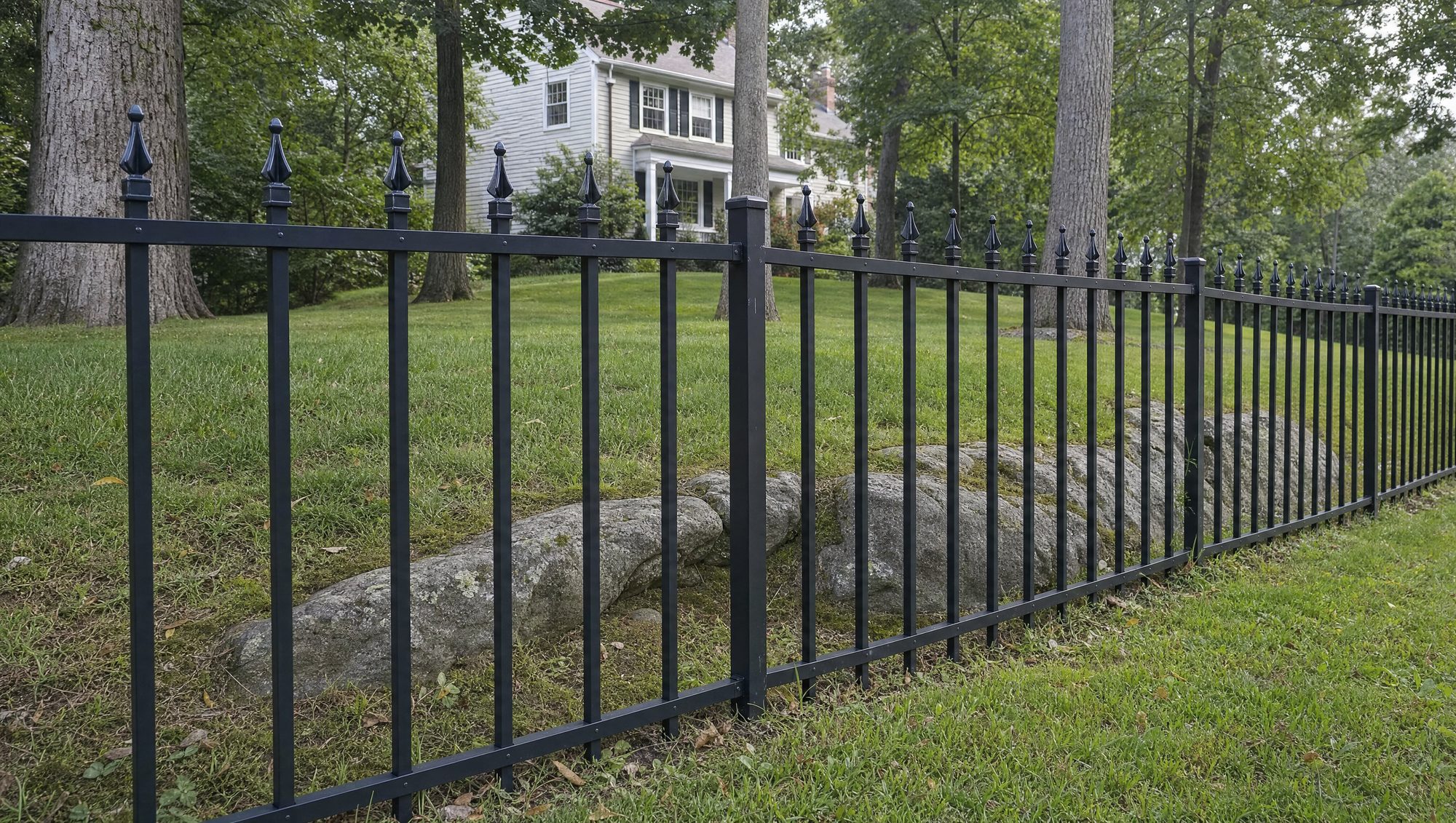
You have already seen the fence you want. Black, open pickets, that iron look, running around a pool or across a front yard somewhere in town, and you decided that is the one. Then the quotes came in, and every one of them says the same three words, black aluminum fence, at prices that are not close to each other. Nothing on the page explains the spread. That is the maddening part of shopping for aluminum fencing in New Fairfield, CT, because two fences can look identical from the road and be completely different products underneath, and the difference usually does not show itself until a gate starts to sag or a panel leans out on a slope. The gap between them is measurable, though, and it lives in details a written estimate can spell out. Here is what actually separates one aluminum fence from another, and what New Fairfield's ground and rules add on top.
Key Takeaways
Aluminum is not wrought iron
It gives you the wrought-iron look, but it is lighter, it does not rust the way iron does, and it behaves differently under impact.
Specifications beat labels
"Residential" and "commercial" mean nothing on their own, so post size, wall thickness, rail count, and gate frame are what you actually compare.
New Fairfield's permit rule depends on the use
Fences up to seven feet are generally exempt from a building permit, but a pool barrier needs one no matter its height.
The ground sets the install
Rocky glacial soil, ledge, slopes, drainage, and freeze-thaw movement decide how posts go in, and rackable or stepped panels handle grade differently.
Gates fail first
Gate width, weight, hinges, latches, and post footings decide whether the fence still lines up after a few winters.
Aluminum Gives You the Iron Look Without the Iron Problem
Ornamental aluminum fencing is built from extruded aluminum posts, rails, and pickets assembled into open panels. It is the common pick where you want to mark a boundary and still see through it, around a pool, a front yard, a garden, or a pet area. The look borrows from traditional iron work, and from twenty feet away most people cannot tell which metal they are looking at. What differs is what happens to that metal over the next few decades.
Aluminum and Wrought Iron Are Not the Same Metal
The wrought iron look fence New Fairfield homeowners ask for is usually a description of a style, not of a material. Aluminum is light, and it forms its own protective oxide layer, so it does not rust the way iron or carbon steel does. Aluminum's role in construction rests on that mix of low weight, durability, and corrosion resistance, and the Aluminum Association points to 6xxx-series alloys as common choices for architectural extrusions.
None of that makes aluminum better than iron at everything. Traditional wrought iron and ornamental steel are heavier, can carry more mass and impact resistance depending on the design, and often support fully custom welded or forged work. They also need an effective coating to hold off corrosion, and they cost more to handle and install. If you want a decorative boundary that keeps looking right with little fuss, aluminum fencing usually wins. If you want maximum mass at a vehicle gate or a one-off forged design, iron still has a real case.
What the Coating Actually Does
The metal resists corrosion on its own. The finish is what keeps it looking new. Most ornamental aluminum carries an architectural or powder-coated finish, and ASTM F2957 sets minimum requirements for architecturally coated tubular-picket ornamental aluminum fence systems, covering materials, structural testing, dimensions, workmanship, and surface-finish testing. A finish warranty is not a promise the coating cannot be hurt. Trimmer strikes, pool chemicals, and the wrong touch-up product all leave marks, so ask how touch-up is handled and whether panels, posts, and gates come from the same color run.
Low maintenance is not no maintenance. Once or twice a year, walk the line and look for loose fasteners, gate sag, latch misalignment, scratched coating, leaning posts, mower damage, and corrosion where dissimilar metals meet at the hardware. Clean it the way the manufacturer says to, since abrasives and incompatible chemicals do more harm than weather ever will.
Two Black Fences Can Be Completely Different Products
Here is the part that explains your price spread. Aluminum fence systems do not share one set of dimensions, alloys, coatings, rail counts, post sizes, or reinforcement. From the road, a light residential panel and a heavier commercial one can read as the same fence. In the ground, and at the gate, they do not act the same at all.
"Residential" and "Commercial" Are Labels, Not Specifications
Those categories are useful only when real numbers sit behind them, and "heavy duty" with no dimensions attached is a marketing phrase. What separates the grades is post dimensions, rail and picket dimensions, wall thickness, panel width, gate frame construction, reinforcement, hardware, coating, structural testing, warranty, and intended application. Two bids can both say black aluminum, three rail, four feet, and still describe different products. So, the question is not which one somebody calls heavier. It is which specifications are written down.
The Numbers That Belong in Your Estimate
An estimate that names the system is what makes two bids comparable in the first place. At a minimum, ask that it identify:
- Manufacturer and product line: The actual system, not just the word "aluminum."
- Height, panel width, and rail count: Two-rail or three-rail, plus the size of the rail itself.
- Picket dimensions and spacing: Both the picket size and the gap between pickets.
- Post dimensions and wall thickness: Where grade differences usually hide.
- Finish and color: The coating type, and the color across panels, posts, and gates.
- Gate frame, hinges, and latches: How the gate is built, not only how wide it is.
- Rackability: How much grade a panel can follow before it has to be stepped.
- Warranty and ASTM F2957 claims: Finish and workmanship terms, in writing.
Put those side by side on two bids and the price difference usually explains itself.
Style Decides More Than Appearance
Black is the default for good reason. It reads as clean contrast next to a house, then more or less disappears against trees, lawn, water, and distance, which is why a black aluminum fence New Fairfield property owners choose tends to look deliberate on colonial, Cape, farmhouse, and contemporary homes alike. Style is not only a taste question, though. Top design, rail count, and picket spacing all interact with safety rules, pets, and where the fence is going.
Flat-Top and Spear-Top Panels
A flat-top panel ends at a clean horizontal top rail with nothing above it, which suits pools, pets, and quieter properties. A spear-top panel runs the pickets past the top rail, often with pointed or decorative finials, giving the traditional ornamental aluminum fence New Fairfield yards tend to wear well. An alternating spear-top raises every other picket for a lighter rhythm. Spear tops deserve a second look based on where they go, since location, safety, and pool-barrier requirements can point you toward a different top.
Arched, Scalloped, and Estate Panels
Arched and scalloped panels rise or fall between posts and usually belong at entrances and feature sections rather than along a whole run. Paired with pedestrian or driveway gates, they become the formal entrance most people have in mind when they ask about estate gates. Driveway gates bring their own planning, since width, weight, automation, posts, foundations, drainage, and vehicle clearance are separate questions from the fence line.
Puppy Pickets for Small Dogs
Standard ornamental spacing is often too wide for a small dog. Puppy-picket panels tighten the spacing across the lower part of the fence to close those openings. Whether you need them depends on your dog and not on the product name.
Where Aluminum Fencing Ends Up on New Fairfield Properties
Aluminum shows up wherever the point is to define space without walling it off. Around here that means pools, dogs, front yards, planting beds, driveway entrances, and commercial boundaries. Each use asks something different from the same panel, and a couple of them carry rules that have nothing to do with taste.
Pool Barriers Are Their Own Project
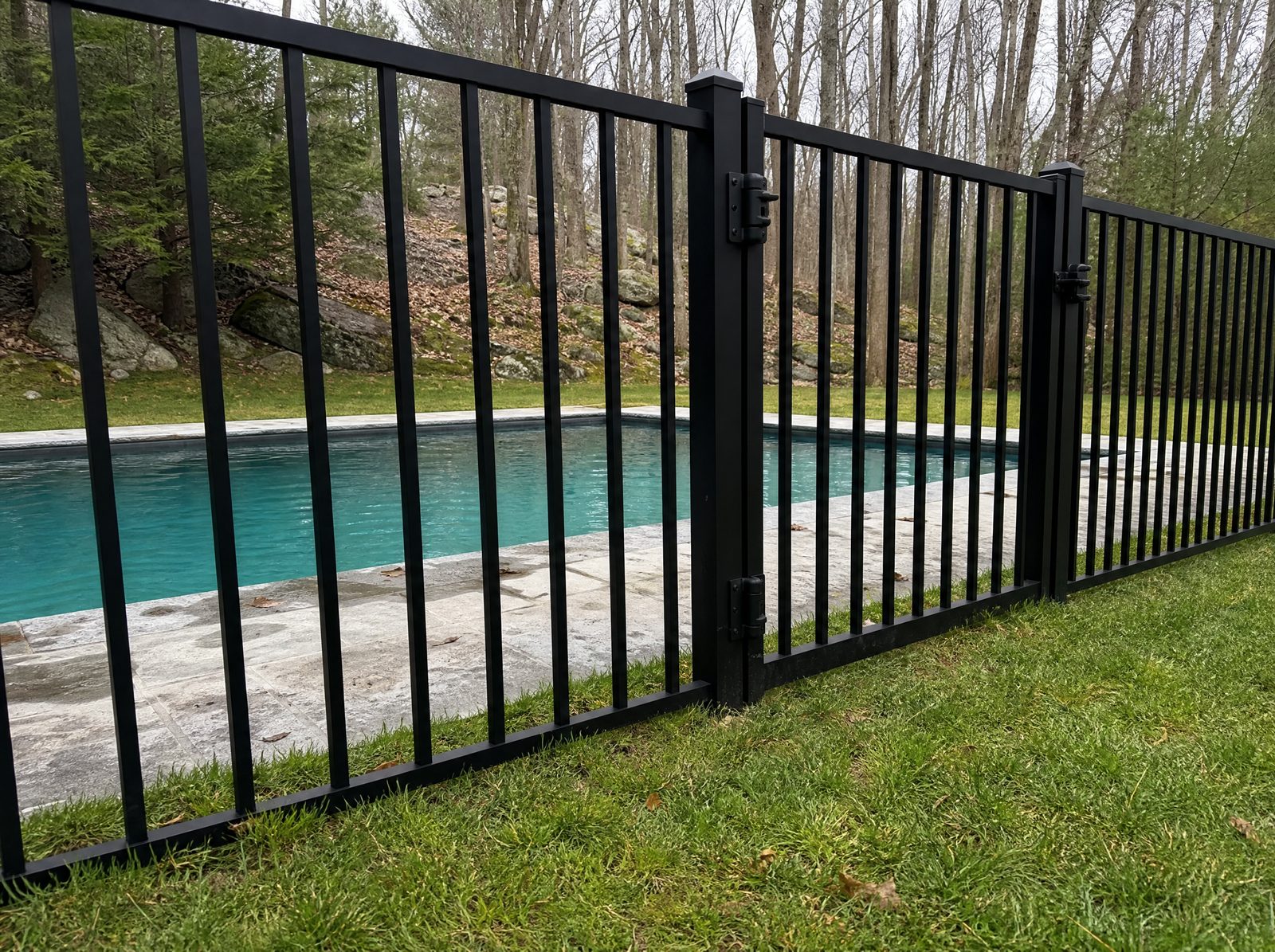
Aluminum is common around pools because you can see the water through it, and that visibility is the easy part. The barrier is a complete system, so height, maximum openings, bottom clearance, non-climbable design, gate direction, self-closing hinges, self-latching hardware, latch placement, and nearby climbable objects all get measured against the applicable code. No panel is pool-compliant just because it is sold as a pool fence. Treat pool fencing as its own project with its own approval, because in New Fairfield it needs a permit regardless of height.
Pet Containment Comes Down to the Gaps
Aluminum works for plenty of dogs, but the product has to match the animal. Height, picket spacing, bottom gaps, gate gaps, latch location, grade transitions, and anything nearby a dog can use as a step all matter. A jumper needs height. A digger needs attention at the bottom. A small dog may need tighter lower spacing. Good pet fencing starts from how your dog actually behaves rather than from a catalog page.
Front Yards, Gardens, and Commercial Lines
Open pickets mark a front boundary without building a wall, which is why they sit comfortably on so many older New Fairfield homes. Around planting beds, the same panel protects the bed and still lets you see it, though mower access and gate placement are worth settling before installation. On offices, multifamily buildings, and controlled-access sites, heavier grades handle the traffic, and commercial fencing is where the specification conversation usually gets most detailed.
The Permit Is Only Half the Question in New Fairfield
New Fairfield keeps this simpler than most people expect, but simple is not the same as no rules. The town states that fences not over seven feet high are generally exempt from a building permit. There is one clear exception and several conditions worth knowing before anything gets ordered, and local rules change, so confirm the current requirements with the town.
The Seven-Foot Exemption and the Pool Exception
A building-permit exemption answers one question, not all of them. A fence used as a swimming pool barrier requires a permit regardless of height, and that is the exception that catches people. Beyond it, placement near roads or intersections, driveway sight lines, property boundaries, easements, wetlands and watercourses, fences attached to regulated structures, and private association or deed restrictions can all still apply. The honest read is that you can often skip the building permit and still owe the town a zoning check. New Fairfield's building permit applications and its zoning department are where you confirm what your lot needs.
A Stone Wall Is Not a Property Line
A fence should never be set from a guess. Mowing lines, hedges, stone walls, and the neighbor's fence are not the legal boundary, and a fence in the wrong place is expensive to move. A survey earns its cost when the markers are missing, the fence will sit close to the line, the lot is irregular, an easement may exist, a neighbor questions the layout, or the property sits near a wetland, lake, or watercourse. Your fence contractor can lay out the run; a licensed surveyor establishes the legal line. Recorded plans often live with the town clerk's land records.
Call 811 Before Any Post Hole
Aluminum posts mean digging, so buried lines come first. Connecticut's Call Before You Dig service is free and required by law, and the request goes in by calling 811 before excavation. Public marking does not cover everything, though. Septic lines, irrigation, well lines, pool equipment, propane, and invisible pet-fence wire are often privately owned and may need a separate private locate. The contract should say plainly who submits the request and who identifies private lines.
New Fairfield Ground Decides How the Posts Go In
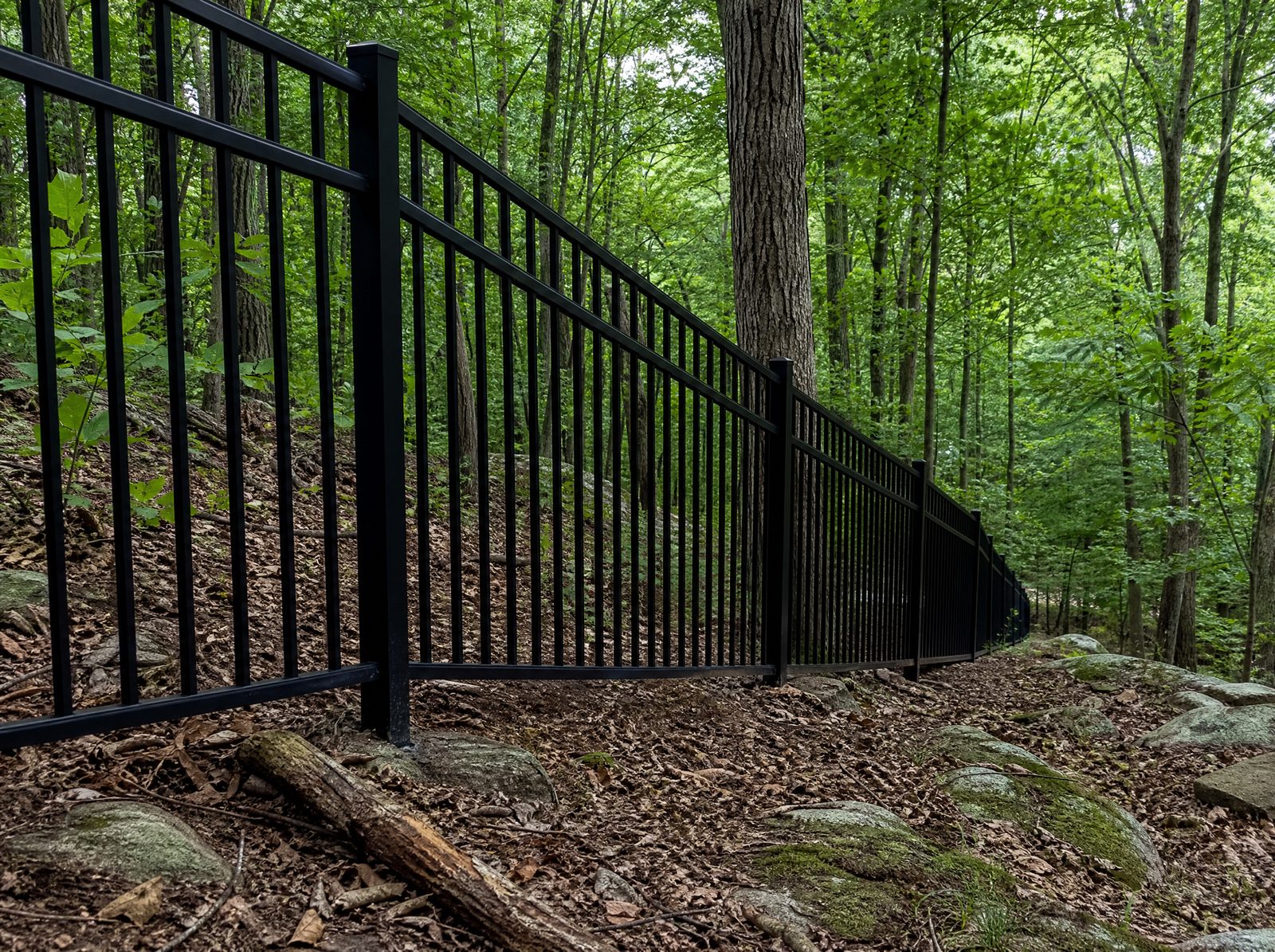
Properties here bring rocky glacial soils, ledge, sloped yards, wooded boundaries, big roots, wet ground, drainage swales, stone walls, narrow machine access, old fences that have to come out, and freeze-thaw movement every winter. Those conditions drive post location, excavation, panel transitions, gate operation, equipment access, labor, and cost. A fence that leans or racks wrong a year after install almost always traces back to what happened below grade.
Rackable Panels Versus Stepped Sections
Rackable aluminum panels follow moderate slopes by letting the pickets stay vertical while the rails angle with the grade. Stepping is used where a panel cannot rack far enough or where a level-panel look is wanted. The choice is not cosmetic. It changes bottom gaps, pet containment, appearance, post height, gate transitions, and which panels are even compatible, so settle it on the walk rather than on install day.
Ledge, Rock, and Change Orders
Ledge may call for drilling, alternative anchoring, adjusted post positions, or different equipment. That is a real site condition and should show up as one, not hide inside a vague number. Ask how hidden rock gets priced before it is found, because the change-order language is what protects both sides once a post hole hits stone. Drainage matters just as much: posts and gates should not block a swale or pool water around footings, since wet low points feed the soil movement that pushes gates out of alignment.
Gate Posts Carry the Real Load
There is no universal post depth for every aluminum fence, and anyone quoting one number for every job is guessing. Depth, hole size, setting method, and reinforcement depend on fence height, panel grade, post size, soil and ledge, drainage, wind exposure, gate load, manufacturer specifications, and local frost conditions. Connecticut's residential code for foundations frames why frost protection matters even though a fence post is not always regulated like a building footing. Gate posts need more support than in-line posts, and wide double gates, driveway gates, and automated gates should never be treated like an ordinary walk gate.
What Moves Aluminum Fence Cost in New Fairfield
There is no honest one-price-fits-all number for aluminum fence cost New Fairfield wide, and a contractor who gives you one over the phone is guessing at your property. Published consumer guides such as Angi's aluminum fence cost breakdown show broad installed ranges, and those work as general market background, never as a quote for your yard.
Footage is the first lever, since a longer run means more posts, panels, and hours. Height, grade, and rail count stack on top, because a three-rail panel uses more material than a two-rail. Gates are their own category, since each one needs dedicated posts, footings, and hardware, and pool-compliant self-closing and self-latching hardware does not price like a standard latch. Then the site takes its cut.
Hover or tap a row to highlight it.
| Cost Driver | Why It Matters |
|---|---|
| Linear footage | A longer run means more posts, more panels, more hardware, and more hours. |
| Height and rail count | Taller panels and three-rail systems use more material than short two-rail runs. |
| Panel grade and specifications | Post size, wall thickness, and reinforcement separate a light residential panel from a heavier commercial one. |
| Gates and pool hardware | Each gate needs dedicated posts, footings, and hardware, and self-closing, self-latching pool hardware costs more than a standard latch. |
| Ledge and rocky soil | Rock can force drilling, alternative anchoring, shifted posts, or different equipment, so it belongs in the change-order language. |
| Slopes and drainage | Racking, stepped sections, and wet low points all add layout work and labor. |
| Access and old-fence removal | Long carries, tight machine access, and pulling out an existing fence are their own line items. |
How an Aluminum Fence Installation Comes Together
A clean aluminum fence installation New Fairfield crews run follows a predictable order, and knowing that order helps you spot a bid that skips steps. It starts with what the fence is for and ends with a walkthrough, with the compliance and utility checks built in where they belong instead of bolted on at the end. The sequence below is how the work should come together on a local lot.
The New Fairfield Aluminum Fence Installation Process
- 1
Step 1: Property Walk and Purpose
We walk the property to settle what the fence is for, the layout, approximate footage, style, and gate locations.
- 2
Step 2: Boundary, Zoning, and Permit Review
Surveys, property lines, setbacks, easements, wetlands, and the pool-barrier permit question all get answered before anything is ordered.
- 3
Step 3: Written Specifications and Estimate
The scope names the manufacturer and product line, height, rail count, picket and post dimensions, finish, gates, rackability, and how ledge gets priced.
- 4
Step 4: Utility Marking and Site Prep
A Call Before You Dig request goes in, private lines like septic, irrigation, and pet-fence wire are identified, and the line is cleared.
- 5
Step 5: Post Setting and Panel Installation
Posts are set for the soil, ledge, drainage, grade, and gate loads, then panels are racked or stepped to follow the ground.
- 6
Step 6: Gates, Adjustments, and Walkthrough
Hinges and latches are set and aligned, bottom gaps and pool hardware are checked, the site is cleaned, and the job is walked with you.
What Separates an Aluminum Fence Contractor Worth Hiring
Connecticut requires home improvement contractors, fence installers included, to register with the Department of Consumer Protection, so registration and insurance are the floor and not a selling point. You can verify a license in a couple of minutes, and the state's guidance on working with a contractor makes a good checklist to hold any bid against. My Fence Guy is family-owned and based right here in New Fairfield, licensed and insured. Past the paperwork, an aluminum fence contractor New Fairfield homeowners can rely on will name the product line, put the specifications in writing, explain how ledge and hidden conditions get priced, and say plainly who files the 811 request and who pulls any permit.
Where Aluminum Fence Projects Usually Go Wrong
Most of the trouble traces back to a short list of decisions:
- Comparing bids across different grades: Same three words, different products, so the cheaper number is not always the cheaper fence.
- Treating the seven-foot exemption as a zoning pass: The building permit and the zoning check are separate questions.
- Assuming a panel is pool-compliant: Compliance comes from the complete installed system, not the marketing name.
- Under-supporting gates: The most common reason a fence stops closing correctly.
- Letting ledge go undocumented: If the estimate does not say how rock is handled, you find out the expensive way.
Frequently Asked Questions About aluminum fencing new fairfield ct
Q: Does aluminum fencing rust?
A: Aluminum does not rust the way iron or carbon steel does. It forms a protective oxide layer and is widely used in construction for that corrosion resistance, though the architectural coating still matters for appearance and long-term finish performance.
Q: Is aluminum fencing the same as wrought iron?
A: No. Ornamental aluminum can imitate the look of wrought iron, but it is lighter and has different corrosion, fabrication, and structural characteristics. The right choice depends on security needs, impact exposure, appearance, customization, and budget.
Q: Do I need a permit for aluminum fencing in New Fairfield?
A: New Fairfield generally exempts fences not over seven feet high from a building permit, but a fence used as a swimming pool barrier requires a permit regardless of height. Zoning, setbacks, easements, and site-specific restrictions may still apply, so confirm the current rules with the town first.
Q: Can aluminum fencing be installed on a slope?
A: Yes. Rackable panels follow moderate slopes while the pickets stay vertical, and stepped sections are used on steeper grades or with less rackable products. The method affects bottom gaps, pet containment, post height, and appearance.
Q: Is aluminum fencing good for dogs?
A: It can be, though height, picket spacing, bottom gaps, gate clearances, digging, and jumping behavior all have to be considered. Puppy-picket panels tighten the lower spacing and may help with smaller dogs.
Q: Can aluminum fencing be used around a pool?
A: Yes, when the complete installed barrier meets the applicable height, opening, bottom clearance, gate, and latch requirements and receives the required approval. A panel marketed as a pool fence is not automatically compliant on its own.
Q: What is ASTM F2957?
A: It is a standard specification setting minimum requirements for architecturally coated tubular-picket ornamental aluminum fence systems, covering materials, structural testing, dimensions, workmanship, and surface-finish testing.
Q: How much does aluminum fencing in New Fairfield, Connecticut cost?
A: Cost depends on footage, height, grade, rail count, picket style, gates, pool hardware, slopes, ledge, removal, access, permits, and customization. A site-specific estimate is far more reliable than a broad online average, which is why a free on-site visit is the honest way to price a property.
Test Your Aluminum Fencing Knowledge
1. Does ornamental aluminum fencing rust the way iron does?
2. What makes two black aluminum fence bids actually comparable?
3. Which aluminum fence always needs a permit in New Fairfield, regardless of height?
4. How do rackable aluminum panels handle a moderate slope?
5. Which part of an aluminum fence usually fails first?
Pick an answer to begin.
Final Thoughts
Aluminum fencing gives you the wrought-iron look with corrosion behavior iron cannot match, and that part of the pitch holds up. The decision in front of you is not aluminum versus iron. It is which aluminum system, at what grade, with which gate support, set into your particular soil and slope, and written down in enough detail that two bids can be compared honestly. Settle the purpose first, confirm the permit and zoning questions, verify the line, mark the utilities, then let the specifications do the arguing.
Get those in order and the fence quietly does its job for decades. It holds the pool barrier, keeps the dog in the yard, marks the boundary, and still swings true at the gate after a dozen New England winters. That is the payoff for asking better questions before anyone digs.
If you are planning aluminum fencing in New Fairfield, CT, we would be glad to walk the property and talk through the system that actually fits it. My Fence Guy is a family-owned contractor based in New Fairfield, CT, and we install aluminum and ornamental fencing alongside wood, vinyl, and chain link, plus pool fencing, pet fencing, estate gates, and railings for residential, commercial, industrial, and agricultural properties. We will put the product line, the specifications, the gate details, and the ledge language in writing, so you can hold our bid up against anyone else's. Call us at (203) 746-1100 for a free estimate, or reach out through our contact page.
Aluminum Fencing Key Terms
Tap a term to see what it means.
Ornamental Aluminum Fence. An open-picket fence built from extruded aluminum posts, rails, and pickets that gives the wrought-iron look without iron's rust behavior.
More about fences
Ornamental Fencing in New Fairfield, CT: Picking a Style
Ornamental fencing in New Fairfield, CT is chosen by eye and judged for decades. Picket profiles, finials, height, and matching your home period.
Read the guide to Ornamental Fencing in New Fairfield, CTRailings in New Fairfield, CT: Guards, Handrails, and Code
A guard and a handrail are not the same part, and the code treats them differently. Railings in New Fairfield, CT: heights, spacing, and the 4 inch rule.
Read the guide to Railings in New Fairfield, CTOrnamental Fencing in Southbury, CT: Style That Fits the House
Spear, flat top, or scroll? Ornamental fencing in Southbury, CT, and how picket profile, finials, and height decide whether a fence flatters the house.
Read the guide to Ornamental Fencing in Southbury, CT