
Who Should Fix a Broken Fence? Handyman, Fence Contractor or Doing It Yourself
By Tony Pellicone13 min readPublished
- fence repair
- homeowner guide
- connecticut

You can usually handle one broken picket, loose board, latch, hinge or surface-mounted bracket yourself when the posts and fence line remain sound.
Hire a handyman for limited carpentry or hardware work. Choose a fence contractor when the repair involves excavation, concrete, structural posts, multiple sections, chain-link tensioning, heavy gates, welding or a fence connected to a pool, livestock enclosure or security boundary.
Start by checking what failed: a board, rail, post, footing, panel, mesh, gate hardware or gatepost. That answer determines the tools, permit questions, Connecticut registration requirements and likely price.
Key Takeaways
DIY repairs
A sound fence may only need a board, picket, latch, hinge, fastener or surface-mounted bracket.
Handyman work
Limited carpentry and hardware repairs fit a handyman when the posts, rails and gate opening remain stable.
Contractor work
Excavation, concrete, structural posts, multiple sections, chain-link tensioning and heavy gates call for a fence contractor.
Connecticut rules
Paid residential fence work over $200 generally falls under the Home Improvement Act and requires a registered contractor.
Digging
Powered excavation for a fence post requires a Call Before You Dig notification at least two full days before work.
Pricing
National 2026 repair figures vary by project, material, access, labor minimums, disposal and structural damage.
Start by identifying the failed part
A fence repair becomes easier to price when you separate surface damage from structural damage. One loose picket attached to solid rails is a small carpentry repair. A gate that will not latch because its post has shifted is a structural repair, even if the latch itself still works.
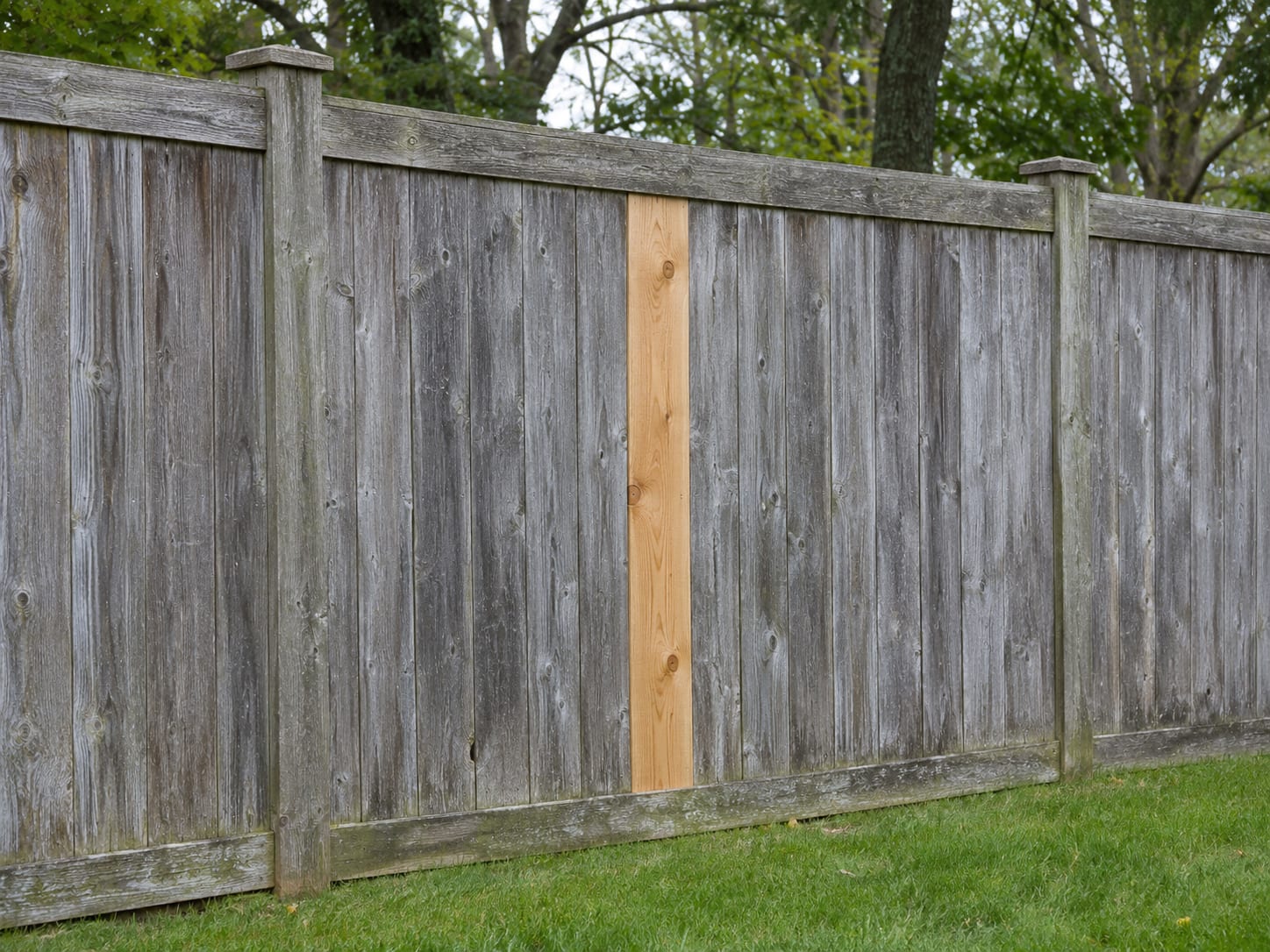
Walk the damaged area and look for movement. Does the post move independently from its concrete footing? Are the rails still attached? Is the panel square? Does the gate opening remain the same width from top to bottom? On chain link, is the fabric torn, or has it pulled loose from a terminal post? These details matter more than the number of feet affected.
A bracket can stabilize an otherwise sound post. It cannot replace a post that is rotten below grade or broken through. A new pair of hinges will not correct a gate opening that has leaned or a gate frame that has sagged.
For a broader decision between repair and replacement, see Fence Repair or Replacement? How to Tell Which Your Fence Needs. If the fence type itself is changing, wood fencing options can help you compare replacement material with the existing section.
Repairs commonly within reach of a homeowner
A capable homeowner may handle replacing one picket or board, re-nailing or re-screwing loose boards, tightening or replacing hinges, bolts and screws, and replacing a latch. Installing a manufacturer-approved post-repair bracket or spur is also within reach, as is replacing a small chain-link tie or other hardware component.
Applying stain or paint comes last, after the structural repair is complete. The work should stay within your tools and lifting ability. A temporary brace may keep a section from falling while you arrange a repair, but it is not a permanent fix for a failing post.
Repairs that call for a crew
A contractor or experienced fence crew is the better choice when the repair involves removing concrete, resetting or replacing a structural post, replacing a complete panel, repairing multiple sections, rehanging a heavy gate, correcting a leaning gate opening, welding ornamental metal or stretching chain-link fabric.
Chain-link fabric has to be pulled tight and attached carefully to terminal posts. A fence puller or equivalent tensioning method is used for that work. Pulling fabric by hand can leave loose spots, bowed lines or stress on the posts.
Post replacement can involve demolition tools, concrete removal, lifting, temporary bracing and excavation. In western Connecticut, a post hole may also hit ledge. That changes the equipment, access plan and price, so tell the contractor about known rock before the estimate.
Hover or tap a row to highlight it.
| Failed component | Likely repair level | Main reason |
|---|---|---|
| One board, picket, latch or fastener | DIY or handyman | Limited hardware or carpentry work |
| Sound post with loose surface connection | DIY or handyman | A bracket or new fastener may be enough |
| Rotten, snapped or loose structural post | Fence contractor | Excavation, concrete and temporary bracing may be needed |
| Torn or loose chain-link fabric | Fence contractor | Fabric must be tensioned and secured correctly |
| Gate that drags because the opening shifted | Fence contractor | The post, frame or footing may need correction |
| Multiple panels or sections | Fence contractor | Matching, removal and line alignment affect the repair |
Connecticut registration and contract rules
Connecticut treats qualifying fence repair on residential property as home improvement. The statutory definition includes the repair or replacement of fences under Connecticut General Statutes Chapter 400, including Sections 20-418 through 20-429.
For residential work priced above $200, the person or business performing the qualifying work generally must hold a Connecticut Home Improvement Contractor registration. The statutory contractor definition has an exception for a person whose total price from all home-improvement contracts with all customers does not exceed $1,000 during any 12-month period. The Department of Consumer Protection also lists work with a contract price below $200 as outside the Home Improvement Act.
That means a homeowner repairing their own fence does not need HIC registration. A handyman doing a residential fence job below $200 generally falls outside the Act for that contract, and a handyman whose total home-improvement contracts stay at or below $1,000 during a 12-month period falls within the statutory exception.
A person or business performing qualifying residential fence work above those thresholds should be registered. Calling someone a handyman does not by itself remove the registration requirement.
For qualifying home-improvement work, Connecticut requires a written, signed and dated contract. The contract should identify the contractor, registration information, contract date, start date, completion date, price and full scope of work. It must include the Notice of the Customer’s Right to Cancel. The homeowner may cancel before midnight on the third business day after signing, and Saturday counts as a business day in Connecticut.
The contract should also cover materials, cleanup, permit responsibility, payment schedule and written changes. Read Do You Need a Permit for Fence Installation in CT? before scheduling work that changes a fence section, location, height or pool barrier.
Check a contractor before signing
Use the Connecticut Department of Consumer Protection eLicense lookup to check a registration. DCP’s instructions are straightforward:
1. Select “Lookup a License.” 2. Search by contractor name, business name, registration number, city or license type. 3. Use one or two search fields for the best results. 4. Check the credential status, expiration date and registration type. 5. Open the detailed record and confirm that the registration is active.
DCP describes eLicense data as maintained by the State of Connecticut and updated instantly. Registration is not a measure of workmanship, so separately ask for references, proof of current general-liability insurance and a written scope.
The Home Improvement Guaranty Fund is administered by DCP. It can help satisfy an unpaid court judgment against a registered home-improvement contractor. Eligible homeowners may recover up to $25,000 for actual damages, court costs and attorney fees awarded in the judgment. Eligibility depends on the property, contract price, contractor registration status, judgment and application timing. Hiring an unregistered contractor can affect eligibility.
Permits and town rules come before the repair
Before repairing a pool barrier, replacing sections, excavating for a post, changing the fence line or installing a gate, contact the building or zoning office for the property. Ask whether the work needs a building permit, zoning permit, wetlands review, historic review, road approval or another municipal approval.
Give the office the property address, fence height, affected length, material, approximate location, photos and any survey or parcel map. Ask whether replacing an existing section is treated differently from installing a new fence. Also ask who must obtain the permit and what documents and fees apply.
Connecticut fence requirements differ by town, zoning district, height, pool use, wetlands and historic status, and by whether the repair changes the existing fence.
New Fairfield’s building-permit page lists fences not over 7 feet high among work exempt from a building permit. It expressly requires a permit for a fence used as a swimming-pool barrier regardless of height. New Fairfield zoning regulations separately state that, unless approved by the Commission, a fence in any district may not exceed 6 feet in total height, with an agricultural-use exception regarding the finished side.
Brookfield’s official FAQ says taller fences require a building permit and may be placed up to the property line. Sherman’s current fee schedule lists fences under miscellaneous structures and equipment subject to a $40 zoning-permit fee, plus applicable state fees. New Milford zoning regulations state that residential-zone fences may not exceed 8 feet and may not obstruct sight lines or affect traffic safety. Ridgefield states that fences may require zoning, building or other approvals.
Those town rules apply to the town that issued them. Ask the office serving your property before ordering replacement materials.
Before a structural fence repair
- 1
Identify the damage
Determine whether the failure involves a board, rail, post, footing, panel, mesh, gate or gatepost.
- 2
Contact the town
Ask about permits, zoning, pool barriers, wetlands, historic areas, setbacks, height and road visibility.
- 3
Plan excavation
Decide who will handle utility notifications, private utility locating, concrete removal and soil restoration.
- 4
Get a written scope
List materials, dimensions, removal, disposal, payment terms, change orders and warranty coverage.
- 5
Complete the repair
Brace the area as needed, reset structural components, align panels and test the gate or barrier.
Call Before You Dig for posts and concrete
Resetting or replacing a fence post requires excavation, so Call Before You Dig applies when powered excavation equipment will be used. That includes digging a new post hole, removing a concrete footing with powered equipment, augering and similar work.
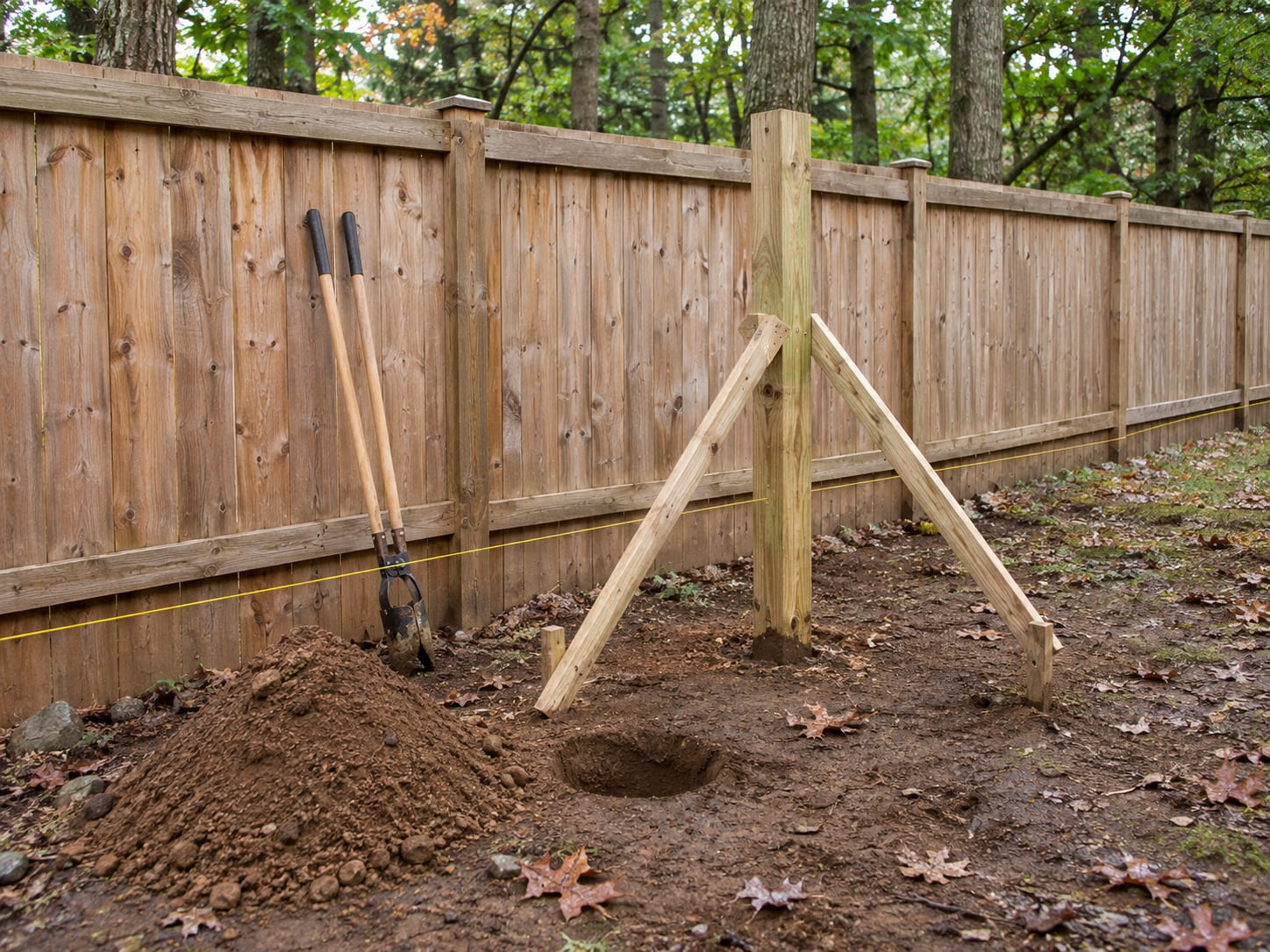
Connecticut requires excavators to notify the central clearinghouse at least two full days before excavation, excluding Saturdays, Sundays and holidays, and not more than 30 days before excavation. Call 811 or 1-800-922-4455, or submit a ticket through Call Before You Dig Connecticut. Connecticut law is in CGS Section 16-345.
If you hire a contractor to excavate, the contractor must call CBYD. If you use powered equipment yourself, you must comply. Hand excavation is treated differently under the notification rule, but PURA and CBYD strongly encourage homeowners to request markouts even when using shovels, post-hole diggers or axes.
A markout may not identify private lines such as irrigation, outdoor lighting, invisible dog fencing or other homeowner-owned utilities. Tell the contractor about those lines and arrange private locating when needed. For more detail, see Call Before You Dig: Marking Utilities Before a Fence Goes In in Connecticut.
A repair limited to replacing a picket, tightening hardware or installing a surface-mounted bracket without excavation does not ordinarily involve the excavation notification trigger.
What a written repair quote should include
A good quote names the damaged components instead of saying only “repair fence.” It should state whether the work is a repair, partial replacement or complete section replacement.
It should name the posts, boards, rails, panels, mesh, gate frames, hinges and latches involved, along with fence dimensions, material, color, style, gauge, wood species and manufacturer when relevant. It should also say whether replacement material will match the existing fence or look different.
The price should break out labor, materials, concrete, hardware, equipment and any service charge, plus removal, loading, hauling and disposal. Cleanup and restoration of soil, lawn, plantings or gravel belong in the quote too, as does responsibility for permits and Call Before You Dig.
Look for a start date, completion date and payment schedule, and a change-order process for hidden rot, buried concrete, ledge, damaged posts or utility conflicts. Warranty terms, exclusions, response time and material warranty transfer should be written down, along with proof of current general-liability insurance and, when residential work qualifies under the Home Improvement Act, the contractor’s HIC registration number.
My Fence Guy can use the site conditions and damaged components to prepare a written scope that separates post work, materials, disposal, equipment and any return visit. That gives you a better comparison between bids than a single per-foot number.
For gates that drag, sag or refuse to latch, see Gate Won't Latch or Close? Fixing Sagging, Dragging and Gapped Gates. For chain-link fabric, rails and posts, see Chain Link Fence Repair: Bent Top Rails, Loose Fabric and Damaged Posts.
What fence repair usually costs
The available figures below are national estimates, not Connecticut prices. Angi’s national 2026 data reports an average fence repair cost of $618 per project, with a typical range of $304 to $948 per project. Its approximate average repair rate is $30 per linear foot, with common repair-company charges of about $125 to $500 for many repair types and average labor of about $50 per hour.
Small jobs are often priced by project instead of by a simple linear-foot formula. Diagnosis, travel, loading, minimum labor time, access, equipment, disposal and a return visit can matter more than the number of feet repaired.
Hover or tap a row to highlight it.
| Repair item | National estimate and unit | Source |
|---|---|---|
| Average fence repair | $618 per project | Angi, 2026 |
| Typical fence repair range | $304 to $948 per project | Angi, 2026 |
| Wood-fence repair average | $510 per project | Angi, 2026 |
| Wood-fence repair range | $320 to $760 per project | Angi, 2026 |
| Wood board replacement | $20 to $60 per board | Angi, 2026 |
| Wood post replacement | $120 to $350 per post | Angi, 2026 |
| Wood panel or section repair | $150 to $400 per panel | Angi, 2026 |
| Wood gate repair | $100 to $400 per gate | Angi, 2026 |
| Chain-link repair average | $545 per project | Angi, 2026 |
| Chain-link repair range | $295 to $803 per project | Angi, 2026 |
| Chain-link mesh repair | $75 to $400 per repair | Angi, 2026 |
| Chain-link post replacement | $100 to $300 per post | Angi, 2026 |
| Chain-link gate repair | $100 to $350 per gate | Angi, 2026 |
Fixr’s national chain-link data, updated in 2025, reports $250 to $750 per project, with a $500 average for a repair involving one reset post, top-rail repair and replacement or stretching of affected fabric. Angi’s national material figures include about $18 per linear foot for chain-link repair, about $20 per linear foot for wood and chain link, about $30 per linear foot for vinyl or PVC and about $24 per linear foot for aluminum. These figures are budgeting references, not Connecticut quotes.
For more cost context, read How Much Does a Fence Cost in Connecticut? What Drives the Price. Ask every contractor whether the estimate includes a trip charge, labor minimum, materials, concrete, disposal, permit costs and return visits.
Frequently Asked Questions
Can a handyman repair a fence?
Yes, a handyman can handle limited carpentry and hardware work when the posts, rails and gate opening remain sound. For residential Connecticut work, check whether the price and the person’s total annual home-improvement contracts trigger HIC registration requirements.
Who should fix a broken fence?
A homeowner can fix a single board, picket, latch, hinge or fastener when the fence remains stable. Use a fence contractor for structural posts, concrete, multiple sections, chain-link tensioning, gate rehanging, welding, excavation, pool barriers, livestock fences or commercial boundaries.
Can you repair a fence yourself?
Yes, limited nonstructural repairs are reasonable when you can work safely and match the existing material. Call CBYD before powered excavation, and contact the town before changing the fence line, height, location or pool barrier.
How much do people charge to repair a fence?
National 2026 figures report about $618 per fence-repair project on average, with a typical range of $304 to $948 per project. The final quote depends on the failed component, access, labor minimum, equipment, disposal, material matching and whether concrete or excavation is involved.
How to price a fence repair job?
Price diagnosis, mobilization, labor, materials, concrete, equipment, removal, disposal, site restoration, permits, utility locating and warranty terms as separate parts of the estimate. Use a project, post, section, gate or component price when that describes the work more clearly than a linear-foot rate.
Fence Repair Decisions
1. Which repair is commonly suitable for a homeowner?
2. When should you contact CBYD?
3. What does a post-repair bracket do?
4. What does Connecticut's Home Improvement Act generally require for qualifying residential fence work above $200?
Pick an answer to begin.
Final Thoughts
Look at the failed component first, then match the repair to the tools and responsibility it requires. A loose board or latch may be a straightforward homeowner repair. A rotten post, shifted gate opening, stretched chain-link section or excavation project belongs with a crew that can handle the structure, utility notification, town questions and written scope.
We want the repair plan to match the actual condition of the fence, whether that means replacing one board or rebuilding a complete section. Call us at (203) 746-1100 for a free estimate, or reach out through our contact page.
Fence Repair Terms
Tap a term to see what it means.
Terminal post. A main chain-link post at an end, corner or gate opening where fabric tension is secured.
More about fences
Fence Repair in Fairfield, CT: Coastal Storms, Salt Air and What the Town Requires
Fence repair in Fairfield, CT: when a repair needs town review, how salt air and coastal storms wear posts and fasteners, and what to settle before work starts.
Read the guide to Fence Repair in Fairfield, CTWood Fence Repair: Broken Boards, Rotted Rails and Loose Pickets
Wood fence repair starts with the posts and rails. Replacing broken boards, fixing rotted rails and loose pickets, choosing rated lumber and fasteners, costs.
Read the guide to Wood Fence RepairStorm or Tree Damage to Your Fence: How Homeowners Insurance Claims Work in Connecticut
A fence usually counts as an other structure under Coverage B. How storm and tree damage claims work in Connecticut and who pays for a neighbor's tree.
Read the guide to Storm or Tree Damage to Your Fence