
Privacy Fence Ideas Between Neighbors That Fit Connecticut Rules
By Tony Pellicone12 min readPublished
- privacy fencing
- neighbors
- homeowner guide
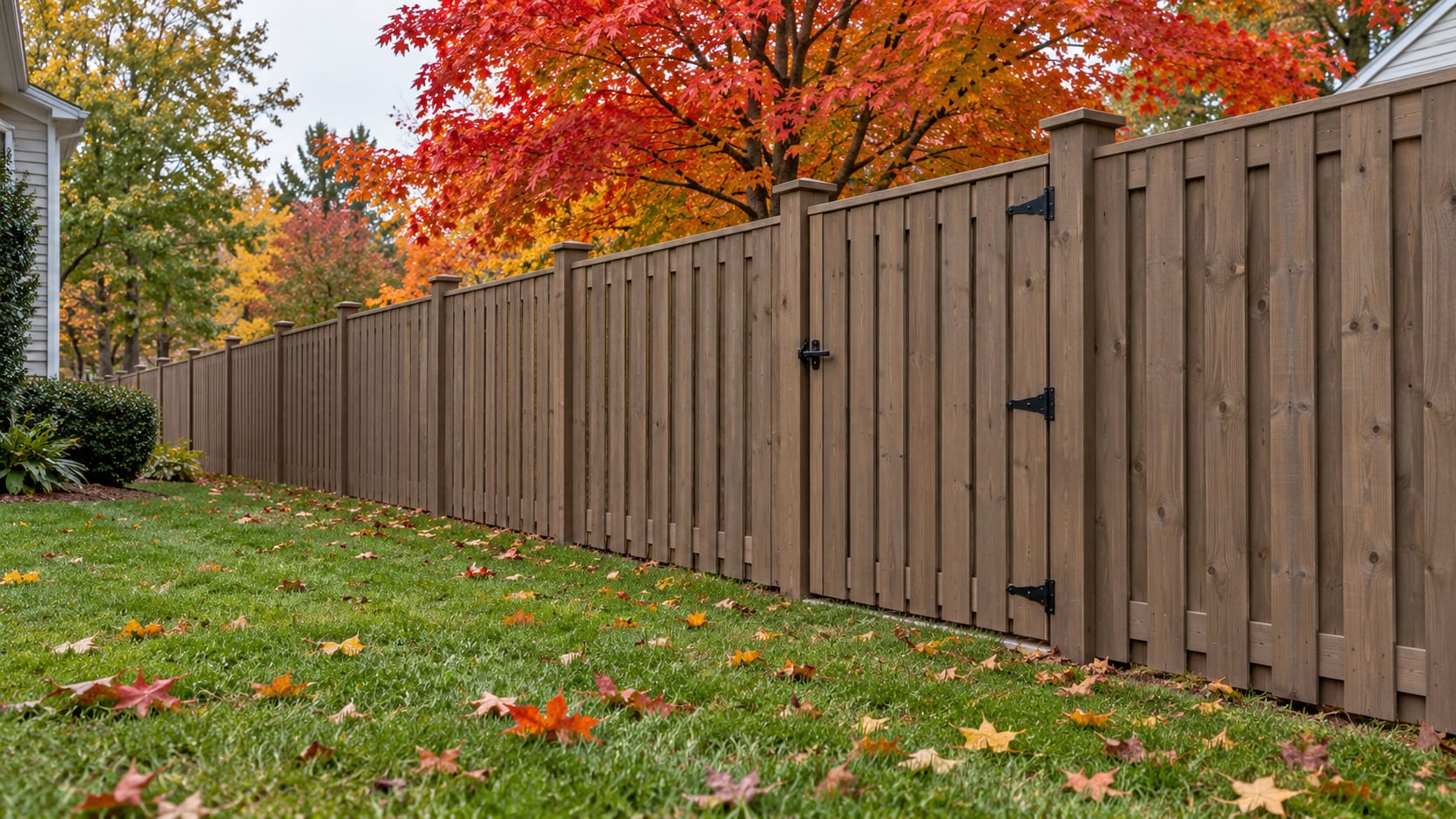
A six-foot solid fence is the usual starting point for backyard privacy, but it is not automatically allowed everywhere in Connecticut. The right height depends on your town, zoning district, yard location, fence design and the actual sightline from a neighbor’s deck, pool or second-story window. In some locations, an eight-foot fence is possible with approval. In others, a screen, planting bed or cedar planter may solve the view without adding height.
Start with the privacy problem, then confirm the local rule before choosing materials or scheduling installation. The town decides the applicable height, setbacks and approvals for the property.
Key Takeaways
Privacy level
Board-on-board and solid vinyl provide full visual screening, while shadowbox and spaced slats provide partial privacy.
Height
Each Connecticut town sets its own privacy-fence height limit.
Local approval
Brookfield and Bethel apply different rules, so your town and zoning district control the answer.
Sightlines
A six-foot fence may not block a view from a raised deck, pool terrace or second-story window.
Alternatives
Screens, planting beds, cedar planters, trellises and lattice tops can target one view.
Neighbor planning
Agree in writing on location, height, finished side, access, costs and maintenance.
Choose the privacy level before choosing the fence
A fence can be six feet high and still leave a clear view if the person looking over it is standing on a deck or raised grade. Walk the property and identify the exact location where privacy is needed. Stand at the neighbor’s likely viewing point, then compare that elevation with the patio, pool, deck or seating area you want screened.
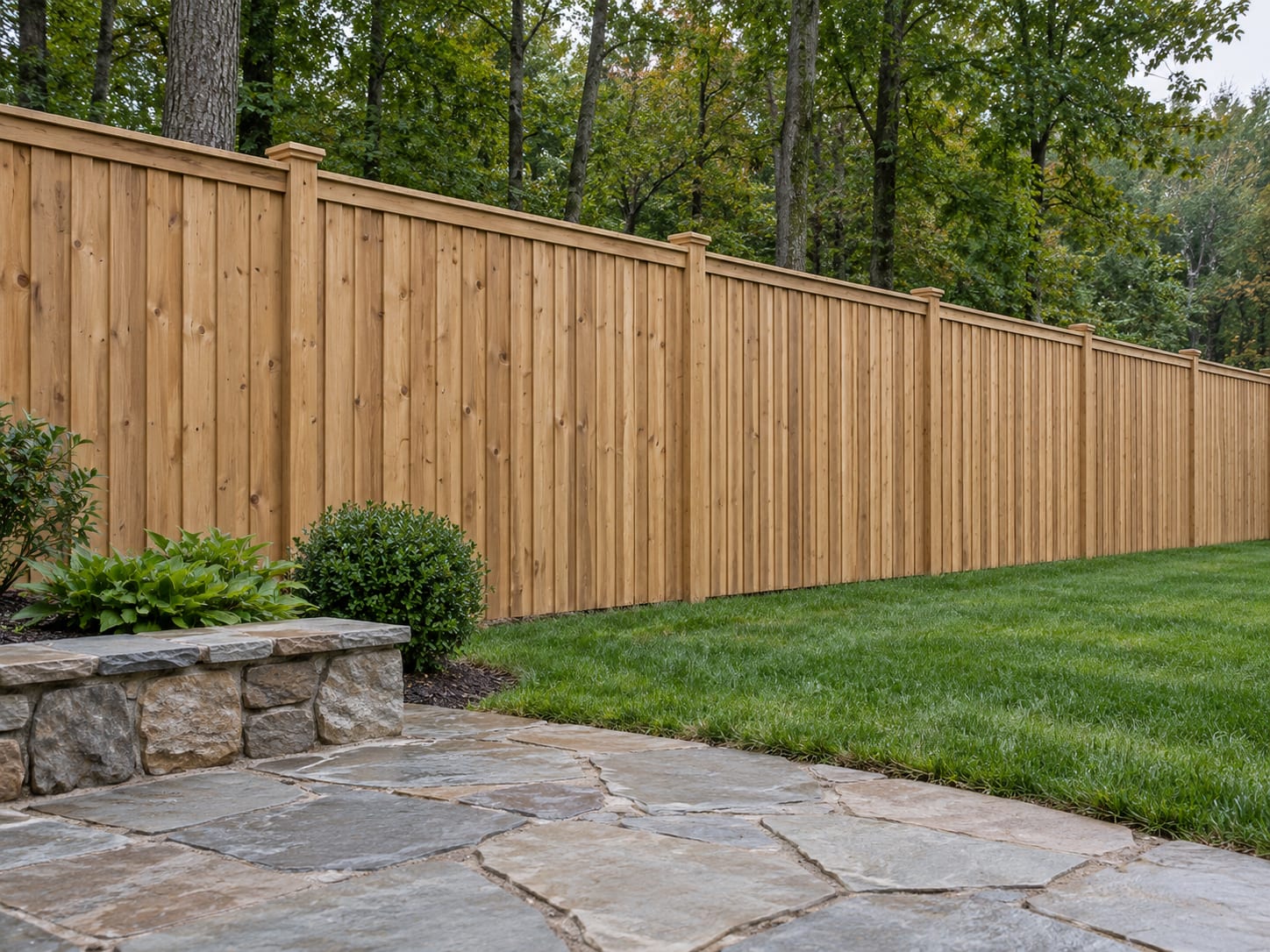
Board-on-board fencing gives the most complete visual screening among common wood styles. The boards overlap, closing the gaps when viewed from the finished side. That overlap uses more material than a single-sided privacy fence, so the installed price can be higher.
Shadowbox fencing uses alternating boards on opposite sides of the rails. It provides substantial but partial privacy, allows more airflow and gives both properties a finished-looking side. Angled views can still reveal limited sightlines.
Solid vinyl panels use tongue-and-groove sections or tightly joined panels for full visual privacy. Vinyl generally needs less routine maintenance than painted or stained wood. Horizontal vinyl slats can also provide full privacy when the slats are solid and closely joined. Spaced horizontal slats provide partial privacy and more airflow.
A lattice top keeps a solid lower section at eye level while allowing some light, air and visibility above it. One manufacturer example uses five feet of solid panel below a one-foot lattice top in a six-foot panel. The result depends on the lattice spacing, viewing angle and the elevation of the person being screened.
Hover or tap a row to highlight it.
| Fence style | Typical privacy level | What changes the result |
|---|---|---|
| Board-on-board wood | Full visual privacy from the finished side | Overlap, height and viewing angle |
| Shadowbox wood | Substantial but partial privacy | Angled views may reveal gaps |
| Solid vinyl | Full visual privacy | Panel height and tight panel joints |
| Solid horizontal slats | Full visual privacy | Slat spacing and panel height |
| Spaced horizontal slats | Partial privacy | Width of openings and viewing angle |
| Lattice top | Full privacy below, partial visibility above | Lattice spacing and total height |
For product details, compare the construction options on the wood fencing product page and the vinyl fencing product page.
Connecticut height rules depend on the town
Privacy-fence height limits come from each town's zoning regulations. Local zoning regulations control height, location, setbacks, approvals and sometimes opacity. The 2022 Connecticut State Building Code exempts fences other than swimming-pool barriers from a building permit when they are not over seven feet high. That is a building permit exemption, not permission to build a seven-foot fence anywhere. Local zoning approval and other reviews may still apply. See the Connecticut fence permit overview before ordering materials.
Brookfield’s zoning regulations allow fences under six feet in residential districts without zoning approval. Fences six feet or higher require zoning approval and a post-construction Certificate of Zoning Compliance. Visibility-inhibiting fences, including lattice, slats, panels and boards, may not exceed eight feet. Other fence types may reach twelve feet under the stated local rules. Read the Brookfield fence permit information and confirm the rule for your zoning district.
Bethel’s zoning regulations limit fences to four feet in a front setback and six feet in a side or rear setback. A fence outside a required setback may reach eight feet. A residential property adjoining commercial or industrial property may also have a fence up to eight feet high under the stated local rule. The Bethel fence permit information is a useful starting point, but the Building Department or zoning office should confirm your address-specific requirements.
These examples show why a six-foot backyard fence is common but not a statewide rule. An eight-foot design may be possible in one location and require a different placement, approval or design in another.
Privacy options when a taller fence is not the best fit
You do not always need to enclose the entire boundary. If the view comes from one deck or seating area, a privacy screen near that area may use less material and create less impact on the neighboring property. Ask the town whether the screen is regulated as a fence, accessory structure, patio feature or another type of improvement.
A planting bed can soften the view while adding year-round or seasonal coverage. Evergreen plants provide coverage through winter. Deciduous shrubs and trees can add seasonal screening and habitat. UConn Extension identifies Green Giant arborvitae as an evergreen screening plant that can grow approximately 40 to 60 feet tall and 15 to 20 feet wide in suitable conditions. That mature size requires careful placement, especially near a property line, septic area, driveway or overhead utility.
Deer pressure can change the plant choice. Inkberry is identified by University of New Hampshire Cooperative Extension as a native evergreen shrub useful for screens and adaptable to well-drained or wet soils. Ask a local nursery about mature size, light, drainage and deer browsing before planting a row.
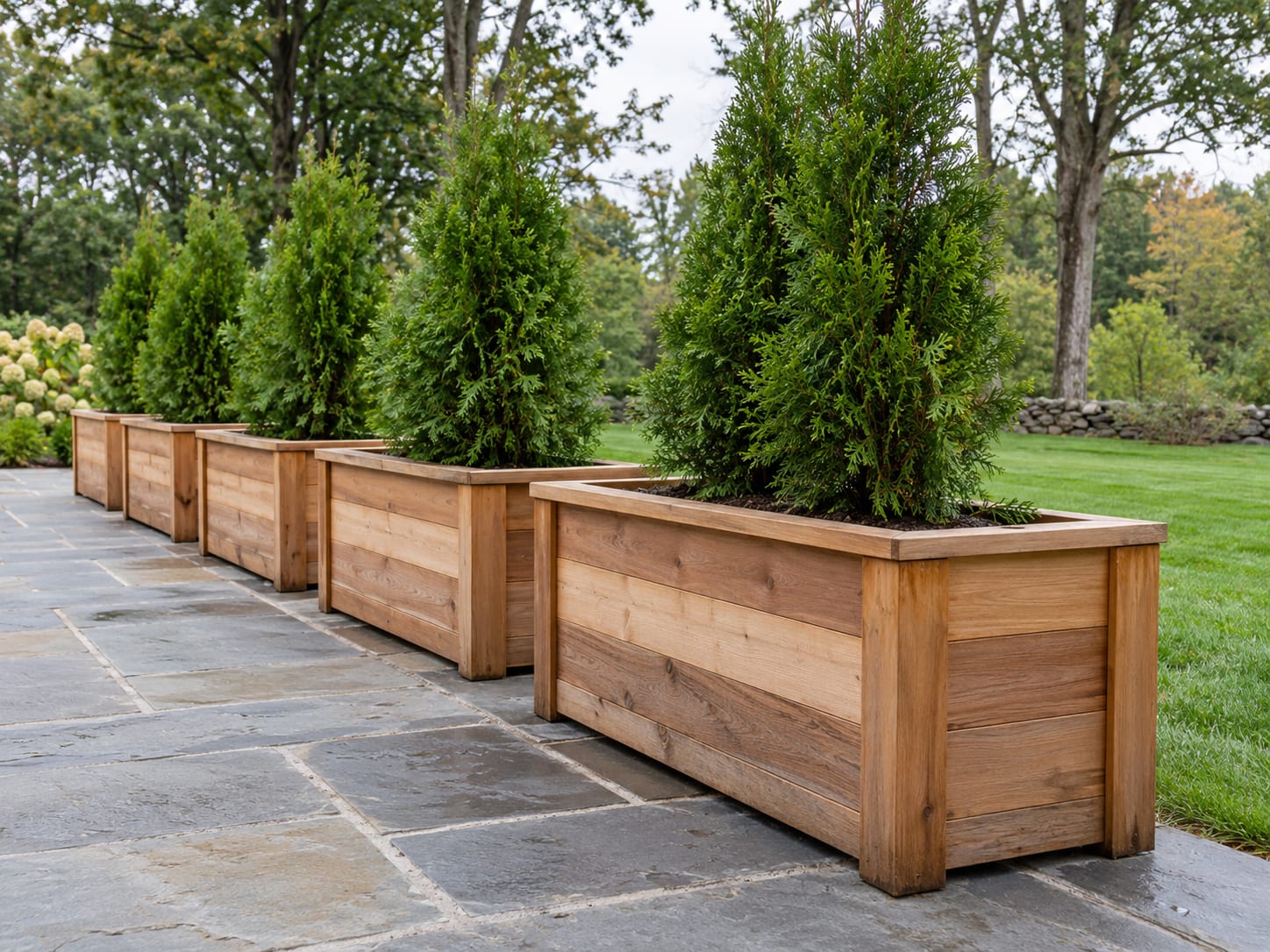
Cedar planters or container plants can target the exact sightline from a patio or deck. They may be useful when you need privacy beside a seating area but do not want a taller fence around the entire yard. A lattice topper, pergola, trellis or arbor with suitable plantings may also help, provided the town allows the structure and its combined height. The cedar planters product page shows one option for keeping planting close to the viewing area.
A shorter fence combined with shrubs or small trees can screen the lower portion of a neighbor’s yard without creating a tall opaque wall. If the property contains or borders a wetland or watercourse, contact the municipal inland wetlands agency before disturbing soil. Connecticut DEEP states that municipalities regulate activities affecting inland wetlands and watercourses under local regulations. The next step may be the wetlands and watercourses fence information.
Work through the design with your neighbor
Start with the privacy problem instead of presenting a finished design:
> “We would like more privacy from the view between our properties, especially from the deck and backyard. Would you be willing to look at a few fence options with us before we schedule anything? We want to agree on the location, height, finished side, material, gate access and maintenance.”
Discuss whether the fence will sit entirely on one property or near the shared boundary. Review the proposed height, style, materials, colors and finished-side orientation. Talk about whether the fence could block a view, change sunlight or affect drainage. Decide who will pay for construction, repairs, staining, replacement and vegetation trimming.
Gate access deserves its own discussion. One neighbor may need continuing access to a driveway, side yard, pool equipment, shed or utility area. Agree on gate locations and whether either person will retain access for maintenance.
Use a current survey or other qualified boundary documentation before placing a fence near the property line. A neighbor agreement records what you both intend; a survey establishes the legal boundary.
Connecticut statutes address division fences and certain disputes involving maliciously erected structures. Connecticut General Statutes §47-43 and related fence statutes address division-fence matters. Sections 52-480 and 52-570 address certain private nuisance and structure disputes. If a specific disagreement develops, speak with a Connecticut real estate attorney rather than treating a general fence rule as legal advice.
Confirm the town requirements before installation
Call the municipal office before you finalize the design. Ask which office handles the project, zoning, building, planning or inland wetlands. Then ask these questions:
- What is the maximum fence height in the applicable front, side or rear yard?
- How is height measured on a slope, berm, retaining wall or raised grade?
- Does the town regulate opaque fences differently from open fences?
- Is zoning approval, a zoning permit, a Certificate of Zoning Compliance or a building permit required?
- Is a site plan, survey or sketch required?
- Are there special rules for corner lots, sight triangles, roads, lakes, streams, wetlands, historic districts or conservation areas?
- Does a lattice topper count toward the total fence height?
- Are gates, posts, trellises, screens or patio structures regulated separately?
- What are the current forms, fees, review times and inspection requirements?
Bring the property address, parcel identification, a survey or property plan if available, and a sketch showing property lines, the proposed fence, gates, house, deck, pool, driveway and nearby structures. Include photos that show the view needing privacy. If the site has rocky soil, ledge or an old stone wall, show that in advance because it can affect layout, post locations and installation cost.
Before digging, submit a Connecticut Call Before You Dig ticket through 811 or CBYD. Connecticut requires at least two full working days’ notice, excluding weekends and holidays, for applicable excavation work. Ask whether privately owned utility lines may require a private utility locator in addition to the CBYD ticket. The Call Before You Dig information for Connecticut fence projects explains the planning step.
Privacy fence planning sequence
- 1
Identify the sightline
Mark the deck, pool, patio or window that needs screening and measure the proposed fence location.
- 2
Check the town rule
Confirm height, setbacks, opacity, approvals and how the town measures height on the property.
- 3
Discuss the plan
Review location, finished side, gates, access, drainage, sunlight and payment with the neighbor.
- 4
Document the boundary
Use a current survey or qualified boundary information before placing the fence near the line.
- 5
Mark utilities
Submit the required CBYD ticket and ask about private utility lines.
- 6
Get the written quote
Confirm linear footage, height, materials, gates, removal, access, approvals and restoration.
- 7
Install and inspect
Build to the approved plan, complete cleanup and arrange any required municipal inspection or certificate.
For a written quote, My Fence Guy can show the linear footage, height, material, style, gate locations, removal, access conditions, post-hole conditions, approvals, restoration and payment schedule. A residential fence contractor must provide a written home-improvement contract, and the Connecticut Department of Consumer Protection advises homeowners to verify registration and insurance. The guide to building a fence on the property line in Connecticut can help you organize the property-line questions before requesting estimates.
Height and Permit Rules for a Shared Privacy Fence
A Connecticut rule should not be carried across the state line. The municipality where the fence will be built controls its own zoning, height, setback and permit requirements.
If your property is near the Connecticut and New York border, call the municipality where the posts will be installed. Ask for the current rule for the exact address, yard, zoning district and fence design.
The Town of Cortlandt in Westchester County allows residential fences up to six feet in front or side yards and up to eight feet in rear yards, subject to its zoning provisions. The Town of Putnam Valley requires a building permit for fences within five feet of a property line or roadway and limits fences in required side or rear yards to six feet.
What drives the installed cost
The total price depends on linear footage, fence height, material, style, gates, removal, access, terrain and post-hole conditions. Rocky soil and ledge can require different excavation work than ordinary soil. A slope, retaining wall, wet area or old stone wall can change the layout and the labor.
Angi reported a national 2026 range of approximately $10 to $50 per linear foot for installed privacy fencing. It gave a national example of about $4,700 per project for a 150-linear-foot six-foot fence and about $6,300 per project for an eight-foot fence. Angi also reported national installed ranges of approximately $15 to $40 per linear foot for vinyl fencing and $10 to $45 per linear foot for wood fencing. These are national figures, not Connecticut quotes.
Request at least three written local estimates. Each one should state the linear footage, height, material, style, number and size of gates, removal and disposal, rock excavation, permit or zoning fees, restoration, taxes and payment schedule. A lower price may not solve the sightline if the fence is too short or placed in the wrong location.
Frequently Asked Questions
How can I block a neighbor’s view of my backyard?
Use a solid six-foot wood or vinyl fence when local rules allow it, but first check the actual viewing height. A raised deck or second-story window may still see over six feet, so a privacy screen, planting bed, cedar planter or permitted lattice top may work better at the specific viewing point.
Is a 6-foot or 8-foot privacy fence better?
A six-foot fence is usually the first option to evaluate because it can screen many ground-level views and fits common residential limits. An eight-foot fence may improve screening from elevated areas, but it may require zoning approval, cost more per linear foot and create more wind exposure and visual impact.
What is the highest fence you can have between neighbors in Connecticut?
The maximum height for a privacy fence between neighbors comes from your town's zoning. The town, zoning district, yard location, setback and fence design control the answer. Brookfield allows visibility-inhibiting fences up to eight feet with required approvals, while Bethel permits up to eight feet in specified locations.
What is the cheapest way to get privacy from neighbors?
Screen only the patio, deck or seating area if the problem is limited to one sightline. Container plants, cedar planters, a permitted screen, a narrow planting bed or a shorter fence combined with shrubs may cost less than enclosing the entire property, while national installed fence pricing varies by material and linear footage.
Privacy Fence Planning Check
1. Which fence style provides full visual privacy from the finished side through overlapping boards?
2. What controls the residential privacy-fence height in Connecticut?
3. Which option can target privacy beside a patio without fencing the whole property?
4. What should you do before digging fence post holes?
5. What can happen with a view from a raised deck?
Pick an answer to begin.
Final Thoughts
The best privacy fence is the one that matches the actual sightline, the level of screening you want and the rule for your property. Compare board-on-board, shadowbox, solid vinyl, horizontal slats, lattice tops and planting options with the town’s height and approval requirements. Then put the boundary, finished side, gate access, maintenance and cost responsibilities in writing with your neighbor.
My Fence Guy can help turn that plan into a written scope that accounts for layout, gates, materials, access and site conditions. Call us at (203) 746-1100 for a free estimate, or reach out through our contact page.
Privacy Fence Terms
Tap a term to see what it means.
Board-on-board. Overlapping boards that close gaps and provide full visual privacy from the finished side.
More about fences
Chain Link Fence Privacy Options: Slats, Fabric and Coated Mesh
Add privacy to a chain link fence with slats, hedge slats, screen fabric or coated mesh. Privacy levels, wind load, costs and how long each option lasts.
Read the guide to Chain Link Fence Privacy OptionsHow Deep Should Fence Posts Be in Connecticut? Frost Line and Footings
How deep to set fence posts in Connecticut: frost depth, manufacturer depth rules by fence height, concrete or gravel, and how frost heave lifts posts.
Read the guide to How Deep Should Fence Posts Be in Connecticut? Frost Line and FootingsInstalling a Fence on Rocky Soil and Ledge in Western Connecticut
Rocky soil and ledge are common in western Connecticut, and fences still go in. Core drilling, pinned posts, surface mounts, and how ledge affects cost.
Read the guide to Installing a Fence on Rocky Soil and Ledge in Western Connecticut